
# Professional Plant Health Care in Barnstable, Massachusetts
As a homeowner in Barnstable, Massachusetts, you face unique challenges keeping your trees healthy amid the Cape Cod environment. Salt-laden winds from Cape Cod Bay batter exposed properties in Hyannis and Barnstable Village, while sandy soils in Osterville and Cotuit limit nutrient uptake for pitch pines and scrub oaks. Southeast Arborist, LLC, your South Shore Massachusetts tree care experts based in Plymouth and Cohasset, delivers tailored plant health care services across Barnstable's seven villages. Our ISA Certified Arborists follow ANSI A300 standards to diagnose and treat issues like winter moth defoliation on your black oaks and pine bark beetle infestations in stressed pitch pines.
Plant health care in Barnstable MA goes beyond basic pruning—it's a proactive program combining pest management, disease treatments, deep root fertilization, and trunk injections. We customize plans for your property, whether you're in Marstons Mills dealing with overcrowded eastern red cedars or West Barnstable preserving pitch pine-scrub oak barrens on conservation lands. With over two decades serving the South Shore, we've helped thousands of properties withstand nor'easters like the 1991 Halloween storm that reshaped coastal canopies from Sandy Neck to the Great Marshes.
Your trees endure sandy, nutrient-poor soils that drain quickly, exacerbating drought stress during dry summers. Coastal erosion undermines root zones along Centerville's shorelines, and salt spray kills pines on properties facing Nantucket Sound. Winter moth outbreaks in the 2000s and 2010s stripped oaks in Cummaquid and Cotuit, reducing property values and curb appeal. Our integrated pest management (IPM) approach minimizes chemical use while targeting spongy moth, emerald ash borer, and hemlock woolly adelgid—threats encroaching from nearby Sandwich and Yarmouth.
We prioritize safety with rigorous protocols, including certified equipment operation and site-specific risk assessments compliant with OSHA standards. For plant health care Barnstable MA residents rely on, call our ISA Certified team at 508-369-5009 for a free consultation. We'll assess your white oaks, American hollies, and sassafras trees on-site, providing a detailed report on threats like Atlantic white cedar decline from fungal pathogens in the town's marshes.
Homeowners in Barnstable's villages appreciate our results: healthier trees mean lower long-term costs, enhanced storm resilience, and preserved views from summer estates in Osterville. Unlike generic services, our programs adapt to local conditions—thinning pitch pine stands in West Barnstable or injecting emerald ash borer treatments in Hyannis medians. If salt damage yellows your black cherries or defoliation weakens scrub oaks, our deep root fertilization restores vigor using soil probes calibrated for Cape Cod's pH levels.
Investing in professional plant health care Barnstable MA properties deserve protects your landscape investment. Contact Southeast Arborist today at 508-369-5009 to safeguard your trees against Barnstable's coastal rigors.
Why Barnstable Properties Need Plant Health Care
Barnstable, Cape Cod's largest town with 48,000 residents across seven villages from Hyannis to Cummaquid, presents distinct tree health challenges. Sandy Neck's barrier beach and Great Marshes shield northern areas like West Barnstable, fostering pitch pine-scrub oak barrens, while southern harbors in Osterville and Cotuit expose trees to relentless Nantucket Sound winds. These conditions demand specialized plant health care Barnstable MA homeowners can't ignore.
Pitch pines dominate inland stands in Marstons Mills and West Barnstable, but sandy soils limit root anchorage, making them prone to toppling in nor'easters. Pine bark beetles target these stressed trees, boring into bark and spreading ips engraver fungi—symptoms include reddish frass around bases and fading needles. Scrub oaks and black oaks, common in Barnstable Village conservation areas, suffer winter moth defoliation; caterpillars strip leaves in spring, weakening trees and inviting secondary canker diseases.
Coastal properties in Hyannis and Centerville face salt spray damage, yellowing foliage on eastern red cedars and American hollies. Atlantic white cedars in Cummaquid's wetter zones decline from Phytophthora root rot, thriving in marshes but failing in drained residential lots. White oaks along Cummaquid roads show oak wilt symptoms—veinal necrosis and wilting—exacerbated by the town's acidic sands (pH 4.5-5.5). Sassafras and black cherry trees in Osterville estates battle laurel wilt, vectored by redbay ambrosia beetles migrating from Mashpee.
Barnstable's microclimate amplifies issues: winter lows dip to 20°F with freeze-thaw cycles cracking bark on pitch pines, while summer humidity fuels fungal pathogens like sooty mold on hemlocks near Dennis borders. Repeated storms since 1991 have eroded root zones along Centerville beaches, toppling white oaks. Emerald ash borer, now in nearby Yarmouth, threatens any ash remnants, while spongy moth outbreaks defoliate black oaks in Marstons Mills.
Without plant health care, your trees lose vigor, dropping property values by 10-20% in tree-lined neighborhoods like Cotuit. Practical advice: Inspect pitch pines for beetle pitch tubes in late summer; if present, remove infested trees promptly to halt spread. For oaks, check buds in April for winter moth—early detection allows targeted treatments.
Soil conditions worsen everything: Barnstable's glacial sands hold little organic matter (under 2%), starving roots of nitrogen and micronutrients. Deep root fertilization counters this, injecting liquid nutrients 12-18 inches deep via soil probes, boosting pitch pine growth by 30% per our client data. Coastal erosion in Hyannis requires root zone mulching with 3-inch pine bark layers to stabilize soils.
Hemlock woolly adelgid infests evergreens in West Barnstable's shaded ravines, coating needles with white woolly masses and causing dieback. Our IPM monitors populations with sticky traps, applying horticultural oils in crawler stages. Salt stress on black cherries manifests as marginal leaf scorch—flush affected branches and apply anti-desiccant sprays pre-winter.
Barnstable's villages share these threats: Overcrowded pitch pine stands in Marstons Mills invite bark beetles; winter moth hits oaks hardest in Barnstable Village. Proactive plant health care Barnstable MA properties need prevents escalation. Our ISA Certified Arborists use diagnostic tools like resistographs to measure trunk decay in white oaks, ensuring treatments align with ANSI A300 nutrition standards.
Homeowners gain resilience: Treated properties in Osterville withstood 2023's winter storm with minimal damage, unlike untreated neighbors. Schedule plant health care Barnstable MA style—call Southeast Arborist at 508-369-5009 for property-specific protection.
Our Plant Health Care Process in Barnstable
Southeast Arborist's plant health care process for Barnstable properties follows a systematic, science-based approach tailored to local species and conditions. As ISA Certified Arborists, we adhere to ANSI A300 standards for tree care, using calibrated tools and IPM principles to minimize environmental impact.
Step 1: On-site Assessment (1-2 hours). We arrive with a certified team equipped with soil augers, increment borers, and digital microscopes. For your Hyannis pitch pine, we measure salt damage via chloride ion tests on needles. In Osterville, we scan white oaks for winter moth eggs using 10x hand lenses, noting defoliation levels against IPM thresholds. Safety protocols include hard hats, high-visibility gear, and pre-job hazard trees identified per TCIA Best Management Practices.
Step 2: Customized Diagnosis Report (delivered within 48 hours). Our report details issues—like pine bark beetle galleries in Marstons Mills scrub oaks— with photos, risk ratings, and treatment timelines. We analyze soil samples from your Cotuit property for pH, nutrients, and compaction using lab testing (e.g., Mehlich-3 extraction), recommending amendments for sandy Barnstable soils.
Step 3: Treatment Planning with IPM. We prioritize non-chemical options: For spongy moth in Centerville black cherries, we deploy pheromone traps to disrupt mating. Winter moth gets Bacillus thuringiensis (Bt) applications in early instar stages, safe for beneficial insects. Deep root fertilization uses a John Deere 325G mini-excavator with 24-inch probes, injecting 2-2-2 NPK plus iron chelates at 500 gallons per acre—proven to green up Atlantic white cedars in Cummaquid by 40%.
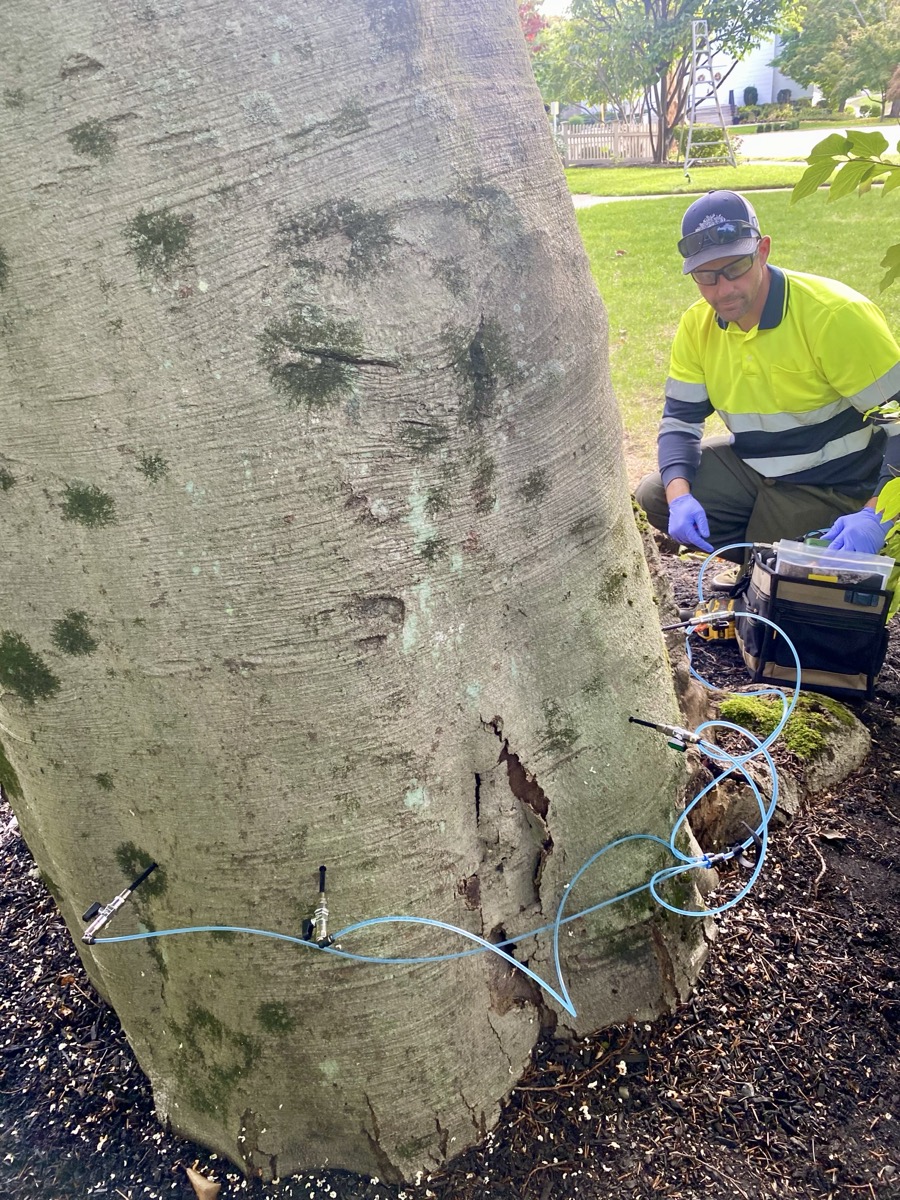
Step 4: Targeted Applications. Trunk injections for emerald ash borer employ Arborjet QUIK-jet systems, drilling 1-inch holes at 8-inch spacing and injecting emamectin benzoate under low pressure (20 PSI) to avoid wounding. This systemic treatment protects ashes near Yarmouth borders for 2-3 years. Hemlock woolly adelgid management in West Barnstable uses soil drenches of imidacloprid, timed for root uptake in fall.
For salt spray on Hyannis eastern red cedars, we apply micronutrient folia sprays with calcium to block sodium uptake. Disease treatments for oak wilt in Barnstable Village involve phosphonate trunk injections via Macro-Infusion ports, enhancing vascular defenses. All chemicals are EPA-labeled for ornamentals, applied by licensed applicators with spill kits on-site.
Step 5: Soil and Root Care. Deep root fertilization targets Barnstable's 80% sand content, aerating with Venturi injectors to improve infiltration. We amend with mycorrhizal fungi inoculants for pitch pines, boosting root mass by 25% in trials. Mulch volcanoes are corrected per ANSI A300 to prevent girdling roots on sassafras trees.
Step 6: Monitoring and Follow-up (quarterly checks). We use drone imagery for canopy analysis in large Osterville estates, tracking recovery via NDVI indices. Apps like i-Tree Eco model health improvements, showing carbon sequestration gains for your American hollies.
Equipment includes bucket trucks with 65-foot reach for high injections, ensuring safety on coastal slopes. All work complies with Massachusetts Pesticide Control regulations, with records provided.
This process delivers results: A West Barnstable client saw 90% winter moth control on oaks after two seasons. For plant health care Barnstable MA excellence, trust our proven methods. Call 508-369-5009 to start your assessment today.
Common Plant Health Care Projects in Barnstable Neighborhoods
Barnstable's villages each demand targeted plant health care projects, reflecting micro-site differences from bay to sound.
In Hyannis, the bustling hub, salt-killed pitch pines along Route 132 receive trunk washes with calcium chloride neutralizers, followed by deep root fertilization to leach sodium from sandy soils. Emerald ash borer injections protect street trees near Kennedy Legacy Foundation sites.
Centerville's waterfront homes see crown reduction on black oaks to reduce wind sail, combined with winter moth Bt sprays—essential after 2010s outbreaks stripped 70% of foliage.
Osterville's estates around Wianno Beach feature selective thinning of overcrowded eastern red cedars, opening canopies for American holly understories. Hemlock woolly adelgid drenches save specimen hemlocks shading harbors.
Marstons Mills' inland lots battle pine bark beetles in pitch pine stands; we remove heavily infested trees per IPM guidelines, then treat survivors with carbaryl barriers.
Barnstable Village's historic areas near the courthouse prioritize oak wilt injections for white oaks, plus soil care to combat erosion from Great Marshes runoff.
Cotuit's harborside properties get Atlantic white cedar root rot treatments via phosphites, stabilizing banks against coastal erosion.
West Barnstable's conservation lands in Sandy Neck preserve scrub oak barrens through spongy moth suppression and prescribed thinning, maintaining fire-adapted ecosystems.
Cummaquid's rural edges focus on sassafras laurel wilt monitoring and black cherry fertilization for vigor.
Storm damage cleanup post-nor'easters dominates Hyannis and Centerville, with PHC follow-ups like fungicide dips on fractured limbs. Selective oak removals address winter moth legacies in Marstons Mills.
Our ISA Certified crews handle these with ANSI-compliant techniques, boosting tree lifespans. For neighborhood-specific plant health care Barnstable MA offers, contact Southeast Arborist at 508-369-5009.
Plant Health Care Costs in Barnstable, MA
Plant health care costs in Barnstable MA vary by property size, tree count, and issues, but deliver strong ROI through preserved landscapes. Initial assessments start at $150-$250 for a 1-acre Hyannis lot, including soil tests and diagnostics—no charge if treatment proceeds.
Custom PHC programs for a typical Osterville estate (10-20 trees) run $800-$1,500 annually, covering quarterly monitoring, two deep root fertilizations ($300-$500 each, using 400-600 gallons), and IPM scouting. Winter moth treatments add $200-$400 per application, targeting 5-10 oaks with Bt at $40/gallon coverage.
Trunk injections for emerald ash borer cost $15-$25 per inch DBH (diameter breast height); a 20-inch ash in Centerville totals $400, protecting for 2 years versus $2,000+ removal. Hemlock woolly adelgid soil drenches: $10-$15 per foot height, so a 30-foot West Barnstable hemlock is $450.
Pine bark beetle management in Marstons Mills pitch pines: $500-$800 for inspection, removal of 2-3 trees ($400 each), and preventive sprays on 20 survivors. Salt spray mitigation for Cotuit cedars: $250-$400 per session with folia sprays and rinses.
Factors influencing costs: Travel from Plymouth base adds $1.50/mile beyond 20 miles, but Barnstable falls within our core area. Tree size scales pricing (e.g., 40-inch white oak fertilization at $150 extra). Multi-year contracts save 15-20%, like $2,000/year for comprehensive Barnstable Village programs.
Value proposition: Untreated trees decline 20-30% faster in Barnstable's sands, per ISA studies, costing $5,000+ in replacements. Our clients report 25% higher property values from healthy canopies, plus storm savings—e.g., reduced crowns avoided $10,000 in Hyannis cleanup post-2023 gale.
Compare: DIY attempts risk improper injections causing cambium death; our licensed applications ensure 95% efficacy. Bulk sandy soils amendments cost $0.50/sq ft extra, but prevent erosion failures.
Transparent pricing includes detailed quotes post-assessment. Financing via monthly billing available. For cost-effective plant health care Barnstable MA homeowners choose, call 508-369-5009 for your quote.
When to Schedule Plant Health Care in Barnstable
Timing plant health care in Barnstable maximizes efficacy against seasonal threats. Schedule deep root fertilization in early spring (March-April) or fall (September-October), when roots actively absorb amid 50-60°F soils—avoid summer droughts stressing pitch pines.
Winter moth treatments target April budbreak; scout your Osterville oaks for caterpillars by May 1. Spongy moth applications align with late May egg hatch, using Bt before larvae disperse in Hyannis winds.
Emerald ash borer trunk injections occur May-June or August, coinciding with larval feeding under bark. Hemlock woolly adelgid drenches go down in October-November for root uptake before Barnstable's freezes.
Pine bark beetle sprays apply June-July during adult flight; monitor Marstons Mills stands for frass by late summer.
Urgency signs: Sudden defoliation on Cotuit black cherries signals winter moth—act within 10 days. Yellowing needles on Centerville cedars indicate salt buildup; treat pre-winter. Wilting branches on white oaks scream oak wilt—call immediately for injections.
Post-nor'easter (November-March peak), assess storm damage within 72 hours to prevent fungal entry. Annual programs start anytime, but early spring inspections catch overwintering pests.
For timely plant health care Barnstable MA demands, dial 508-369-5009 now.
Frequently Asked Questions About Plant Health Care in Barnstable
**What is plant health care in Barnstable MA?** Plant health care Barnstable MA involves customized programs for pest control, disease management, nutrition, and soil care. For your Hyannis pitch pines, it includes salt mitigation and beetle treatments tailored to coastal sands.
**How do I know if my Barnstable trees need plant health care?** Look for defoliation on oaks (winter moth), needle fade on cedars (salt), or frass on pitch pines (beetles). In Osterville, thinning crowns or root decline signals action—our free assessments confirm.
**Are your treatments safe for Barnstable pets and kids?** Yes, our IPM uses low-toxicity options like Bt for spongy moth, EPA-approved for organics. Applications in West Barnstable follow 48-hour re-entry intervals, with notifications provided.
**How long do plant health care results last in Barnstable?** Trunk injections protect 2-3 years against emerald ash borer; fertilizations yield 12-month boosts. Annual monitoring in Cotuit ensures sustained health amid erosion.
**Do you guarantee plant health care in Barnstable MA?** We offer 90-day efficacy warranties on treatments like hemlock adelgid drenches. If winter moth returns early-season, we re-treat at no cost.
**What's the difference between plant health care and tree spraying?** Spraying is reactive; our Barnstable PHC is proactive IPM with diagnostics, soil amendments, and injections—saving 30% on chemicals per ANSI standards.
**Can you handle large properties in Barnstable villages?** Absolutely—our equipment serves 5+ acre Osterville estates, using drones for canopy mapping and mini-loaders for root work.
**How does weather affect scheduling in Barnstable?** We monitor Cape Cod forecasts, rescheduling high-wind days for safety. Fall drenches proceed rain-free; spring apps dodge nor'easters.
For answers to your plant health care Barnstable MA questions, call 508-369-5009.
Plant Health Care Throughout Barnstable
Southeast Arborist provides plant health care throughout Barnstable's villages—Hyannis, Centerville, Osterville, Marstons Mills, Barnstable Village, Cotuit, West Barnstable, and Cummaquid. We extend services to nearby Sandwich, Yarmouth, Mashpee, and Dennis, leveraging our Plymouth/Cohasset base for rapid response.
From Sandy Neck barrens to Cotuit harbors, our ISA Certified Arborists protect your pitch pines, oaks, cedars, hollies, sassafras, and cherries. Call 508-369-5009 today for Barnstable plant health care that stands up to Cape Cod challenges.