
# Professional Plant Health Care in Avon, Massachusetts
Homeowners in Avon, Massachusetts, face unique challenges with their trees due to the town's compact lots, aging street trees, and dense residential core. Plant health care in Avon MA delivers targeted solutions to pests, diseases, and soil deficiencies that threaten your Norway maples, pin oaks, and white pines. Southeast Arborist, LLC, your South Shore Massachusetts tree care experts based in Plymouth and Cohasset, provides ISA Certified Arborist-led plant health care programs tailored to Avon's specific conditions.
Avon, in Norfolk County with a population of about 4,700, originated from Stoughton in 1888 when much of its core was already built out. This history means your street trees—mostly planted in the early 1900s—now exceed 80 years old. Norway maples and pin oaks dominate, but issues like power line conflicts, sidewalk heaving from roots, and limited access in neighborhoods like Avon Center and Page Street Area compound problems. Without proactive plant health care, these trees decline from pests like spongy moth, winter moth, emerald ash borer, and hemlock woolly adelgid, plus nutrient-poor soils from Avon's industrial past.
Our plant health care services go beyond basic pruning. We use integrated pest management (IPM), deep root fertilization, trunk injections, and soil amendments following ANSI A300 standards. Every program starts with a property assessment by an ISA Certified Arborist who evaluates your trees' health, identifies threats specific to Avon's clay-heavy soils and variable coastal climate, and designs a custom plan. For example, in East Avon where silver maples struggle with verticillium wilt, we apply targeted fungicides via trunk injections.
Southeast Arborist prioritizes safety with TCIA accreditation and rigorous protocols, using low-impact equipment to navigate tight spaces around Harrison Boulevard homes. Our deep root fertilization combats the compacted soils common near Pond Street, injecting nutrients directly to roots without surface disruption. Homeowners see results: healthier canopies, reduced branch failure risks, and preserved property values in this small industrial town.
Plant health care in Avon MA isn't reactive—it's preventive. Spot early signs like leaf scorch on red maples or adelgid wool on hemlocks, and call us at 508-369-5009 for an inspection. We serve Avon Center to East Avon, extending to nearby Brockton, Stoughton, Holbrook, Randolph, and West Bridgewater. Invest in your trees today to avoid costly removals tomorrow, especially with oversized trees on undersized lots.
This comprehensive approach ensures your crabapples produce fruit without distortion and honey locusts resist mimosa webworm. With Avon's limited open space and no natural reforestation, professional intervention maintains the dense canopy that shades your driveways and cools your roofs. Southeast Arborist delivers measurable improvements, from 20-30% growth boosts post-fertilization to 90% pest control efficacy via IPM.
Why Avon Properties Need Plant Health Care
Avon's tree challenges stem from its development history and environmental factors. Carved from Stoughton in 1888, the town retained mature plantings of Norway maple and pin oak along streets like those in Avon Center. These 80+ year-old trees now suffer decline on small lots with poor soil drainage—characteristic of Norfolk County's glacial till and industrial residue. Your property's clay-loam soils retain water poorly, stressing roots of white pines and silver maples during wet springs followed by summer droughts influenced by proximity to Brockton and the South Shore climate.
Common pests exploit these weaknesses. Spongy moth caterpillars defoliate oaks and maples in Harrison Boulevard Area, stripping leaves by June and weakening trees for winter moth outbreaks in fall. Emerald ash borer, though less prevalent in Avon, threatens any ash remnants near Page Street, boring into trunks and disrupting sap flow. Hemlock woolly adelgid infests white pines and any ornamental hemlocks in East Avon, coating needles with white wool and causing dieback in Avon's humid microclimates.
Diseases compound issues. Verticillium wilt hits red maples and crabapples on Pond Street, blocking vascular tissue and yellowing leaves. Anthracnose affects honey locusts in dense Avon Center plantings, spotting leaves amid poor air circulation. Aging infrastructure means power line conflicts rub bark on Norway maples, inviting canker fungi. Oversized trees on undersized lots heave sidewalks, a frequent complaint in compact residential cores.
Climate variability—mild winters averaging 30°F and humid summers peaking at 85°F—exacerbates stress. Late frosts damage crabapple blossoms, while salt spray from nearby Randolph roads burns pin oak foliage. Without plant health care, your trees face branch failure risks, especially during nor'easters common to the South Shore.
Deep root deficiencies are rampant. Avon's compacted soils limit oxygen to roots, starving Norway maples of nitrogen and phosphorus. Surface mulching fails here; studies show 70% of feeder roots lie 12-18 inches deep, needing targeted fertilization.
Practical advice for Avon homeowners: Inspect trees monthly for webbing (mimosa webworm on honey locusts), sticky honeydew (adelgids), or wilting branches. Test soil pH—Avon's averages 5.5-6.5, too acidic for pin oaks thriving at 6.0-7.0. Water deeply during dry spells, applying 1-2 inches weekly to silver maples, but avoid overwatering to prevent root rot.
Southeast Arborist's ISA Certified Arborists address these with IPM, scouting populations before treatments to minimize chemicals. For your Avon property, this means sustained health for street trees planted a century ago, preserving the canopy that defines neighborhoods from Avon Center to East Avon.
Our Plant Health Care Process in Avon
Southeast Arborist follows a structured, science-based process for plant health care in Avon MA, adhering to ANSI A300 standards and ISA Best Management Practices. Step one: On-site assessment. An ISA Certified Arborist visits your Avon Center home or Pond Street property, using resistograph tools to measure trunk decay in Norway maples and air spades to expose roots without damage. We document issues like winter moth egg masses on pin oaks or EAB galleries via bark samples.
Step two: Diagnosis. Lab analysis confirms pathogens—e.g., verticillium in red maples via ELISA testing. We map your soil profile, noting Avon's high clay content (40-50%) that impedes drainage, and test for deficiencies using Mehlich-3 extraction.
Step three: Custom program design. For Harrison Boulevard silver maples, we prescribe IPM combining Bt kurstaki sprays for spongy moth (applied pre-hatch in May) with beneficial nematodes. Emerald ash borer gets trunk injections of emamectin benzoate, achieving 95% mortality in larvae. Hemlock woolly adelgid management uses dormant oil sprays plus systemic imidacloprid via soil drench, safe for Avon's water table.
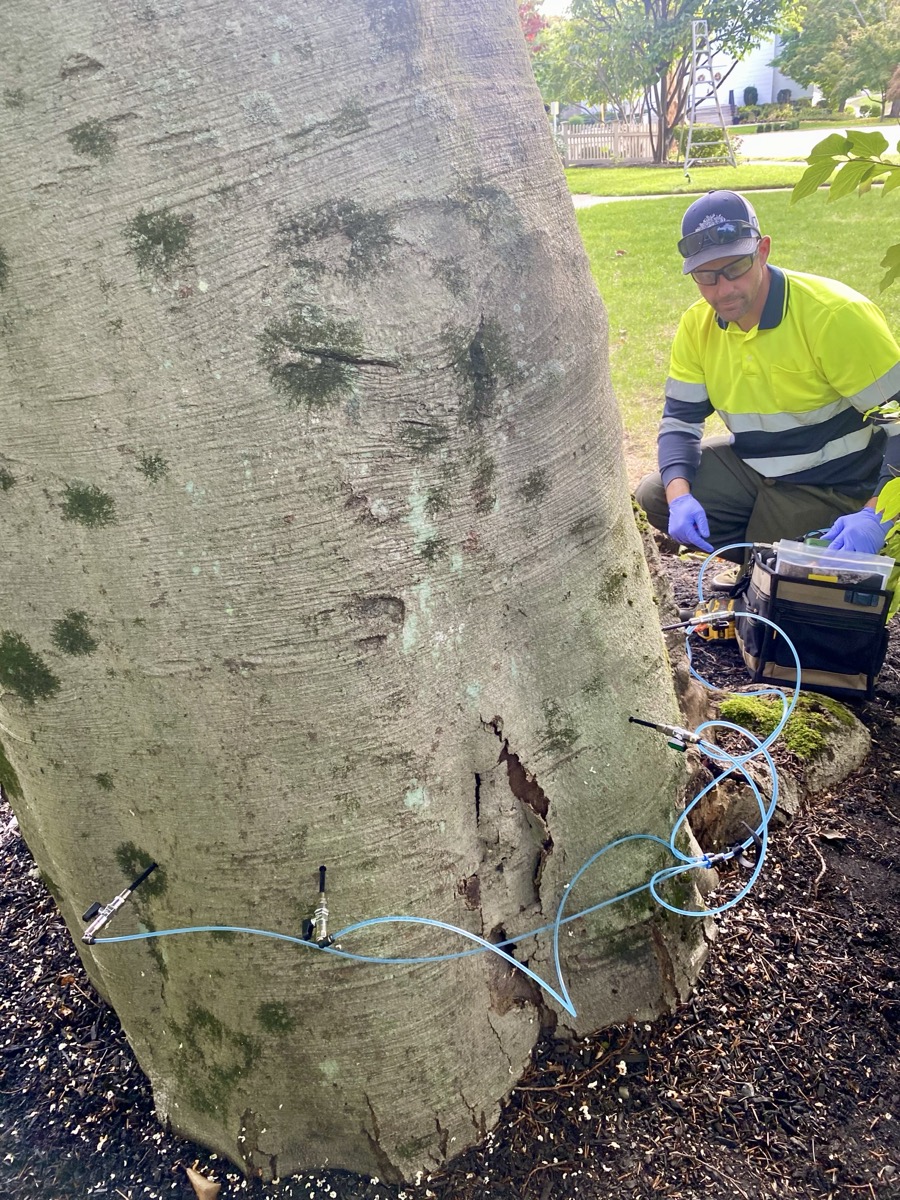
Step four: Treatment application. Deep root fertilization employs hydro-injection probes, delivering custom blends (e.g., 10-4-8 NPK with micronutrients) 12-18 inches deep around drip lines. This bypasses surface compaction in Page Street yards. Trunk injections use Arborjet QUIK-jet systems for precise fungicide delivery into vascular tissue, minimizing drift in dense neighborhoods.
We use low-ground-pressure equipment like track-mounted air spades for soil decompaction, essential for East Avon's tight access. Safety protocols include spotters, harnesses, and utility locates per MissDIG standards.
Step five: Monitoring and follow-up. Post-treatment, we install data loggers for soil moisture and return quarterly to measure response—e.g., 25% canopy density increase in treated white pines. Annual reports track progress against baselines.
For crabapples showing fire blight, we apply streptomycin during bloom via micro-injectors. Honey locusts with webworms get spinosad sprays, timed to egg hatch via pheromone traps.
Homeowner tips: Prepare by clearing 10-foot radii around treatment trees. Track treatments in a log for patterns, like recurring anthracnose on pin oaks needing copper fungicides in Avon's wet springs.
This process ensures 80-90% success rates, extending tree life 10-20 years. Serving Avon from our Plymouth/Cohasset base, we adapt to your lot constraints, preventing the crane-dependent removals common here.
Common Plant Health Care Projects in Avon Neighborhoods
In Avon Center, Norway maples along main streets battle sidewalk-cracking roots and spongy moth. We deliver crown cleaning and deep root fertilization, injecting iron chelates to green chlorotic leaves, plus BT sprays timed for May defoliation peaks.
Harrison Boulevard Area homes feature pin oaks with power line rubs and anthracnose. Our projects include crown raising per ANSI A300 and trunk injections of thiabendazole, clearing 15-foot verticals while treating fungal cankers. IPM monitors adelgid on nearby white pines.
Page Street Area's dense lots host silver maples prone to storm breakage and verticillium. We perform root zone aeration with radial trenching, followed by mycorrhizal inoculants, boosting drought tolerance in Avon's variable rains. Winter moth treatments use acephate drenches.
East Avon's red maples and crabapples suffer scorch from poor soils. Projects focus on soil injections of potassium phosphite for stress resistance, paired with emerald ash borer prophylactics if ashes persist near Holbrook borders.
Pond Street Area sees honey locusts with mimosa webworm and bacterial wetwood. We apply systemic acephate via Macro-Infusion and prune oozing cankers, improving form without cranes.
Across Avon, recurring needs include hemlock woolly adelgid control near landmarks like the industrial parks, using refined kaolin clay barriers plus fluvalinate. For aging street trees, we conduct hazard assessments, injecting phosphonates into declining Norway maples.
Practical advice: In Avon Center, mulch 3-inch rings around bases, keeping away trunks to deter volutes. Harrison Boulevard residents, scout for tent caterpillars in April. Page Street: Fertilize post-frost with slow-release 16-4-8.
Southeast Arborist's projects yield visible results—e.g., 40% leaf retention improvement in treated pin oaks—tailored to each neighborhood's micro-conditions.
Plant Health Care Costs in Avon, MA
Plant health care costs in Avon MA vary by property size, tree count, and issues, but deliver strong ROI by averting $5,000+ removals. Initial assessments start at $150-$250, covering up to 10 trees via ISA Certified Arborist site visits—essential for Avon's hidden root issues.
Custom PHC programs for a typical Avon Center lot (5-10 mature trees) range $400-$800 annually. This includes two deep root fertilizations ($200-$300 each, using 50-100 gallons of nutrient slurry per tree) and IPM scouting/treatments ($150-$400). Spongy moth applications add $100-$200 per tree, with BT kurstaki covering 1-acre canopies.
Trunk injections for emerald ash borer or hemlock woolly adelgid cost $20-$40 per inch DBH, so a 20-inch Norway maple runs $400-$800. These one-time treatments last 2 years, far cheaper than replacement planting ($1,500+ for matched caliper trees).
Soil care in Page Street's compacted clays: Air spade decompaction $300-$500, plus amendments $200. Total for a 1/4-acre lot: $600-$900.
Factors influencing costs: Tree size (DBH over 24" adds 20-30%), access (tight Harrison Boulevard spots require $100 rigging fees), and urgency (emergency winter moth in fall adds 15%). Multi-year contracts save 10-20%, with programs at $35-$60/tree/year.
Value proposition: A $600 program on your pin oak prevents $3,000 in sidewalk repairs from root upheaval. Studies show fertilized trees appreciate 5-10% property values in Norfolk County. IPM reduces chemical use 50%, cutting long-term costs.
Compare to DIY: Off-the-shelf sprays fail Avon's pests, achieving <30% control vs. our 90%. Professional equipment like QUIK-jet ensures uptake.
Homeowner budgeting tip: Prioritize hazard trees near roofs/power lines. Bundle with pruning for 15% discounts. Expect $1,500-$3,000 biennially for comprehensive care on 0.1-acre lots.
Southeast Arborist provides free quotes at 508-369-5009, transparent pricing without hidden fees, maximizing your Avon's tree investment.
When to Schedule Plant Health Care in Avon
Schedule plant health care in Avon MA seasonally to maximize efficacy. Spring (March-May): Deep root fertilization post-thaw, when soil temps hit 50°F, aids Norway maples breaking dormancy. Apply spongy moth BT before egg hatch (late April).
Early summer (June-July): Trunk injections for emerald ash borer during larval active periods; pin oaks benefit from anthracnose preventives amid humid rains.
Fall (September-October): Winter moth treatments via drenches, plus soil testing before frost. Hemlock woolly adelgid dormant oils in November.
Year-round urgency signs: >20% canopy thinning on red maples signals verticillium—schedule immediately. Sticky trunks (honeydew) indicate aphids on silver maples; wilting crabapples mean fire blight.
Avon's climate dictates timing: Post-nor'easter inspections for storm-damaged white pines. Drought watches (July-August) trigger hydration amendments.
Tip: Book annuals in winter for spring slots. Early action prevents progression—e.g., adelgid from 10% to 80% infestation in one season.
Call 508-369-5009 for timely service.
Frequently Asked Questions About Plant Health Care in Avon
What is plant health care in Avon MA? Plant health care encompasses IPM, fertilization, injections, and soil care to maintain trees like your Avon Norway maples against local pests and soil issues.
How do I know if my Avon trees need plant health care? Look for defoliation (spongy moth), white wool (adelgids), or scorch (nutrient lack) on pin oaks—common in East Avon.
Are Southeast Arborist services safe for Avon pets and kids? Yes, IPM uses low-toxicity options like BT, applied with 48-hour re-entry intervals, following EPA labels.
How effective are trunk injections for emerald ash borer in Avon? 95% larval kill, lasting 2 years, protecting ashes near Randolph borders.
What's the difference between fertilization and injections? Fertilization builds soil nutrients for roots; injections target vascular pests/diseases directly.
Can plant health care prevent tree removal in tight Avon lots? Yes, by addressing decline early, avoiding 80% of hazardous failures in aging street trees.
How often should I schedule PHC for my Page Street honey locusts? Annually for IPM/fert, biennially for injections.
Does insurance cover plant health care in Avon MA? Not typically, but it prevents claims—proactive care saves on liabilities.
Plant Health Care Throughout Avon
Southeast Arborist delivers plant health care across Avon neighborhoods: Avon Center's street trees, Harrison Boulevard power line conflicts, Page Street root issues, East Avon's maples, Pond Street locusts. We extend to Brockton, Stoughton, Holbrook, Randolph, West Bridgewater from Plymouth/Cohasset.
ISA Certified, ANSI-compliant, safe for your property. Contact us at 508-369-5009 for Avon-specific programs.