
# Professional Plant Health Care in Attleboro, Massachusetts
As a homeowner in Attleboro, Massachusetts, you rely on your trees for shade, privacy, and property value enhancement across neighborhoods like Attleboro Center and the Capron Park Area. But with the city's history as a jewelry manufacturing hub in Bristol County, those dense older neighborhoods from the late 1800s and early 1900s now host century-old street trees facing serious decline. Red oaks, Norway maples, and green ashes in South Attleboro or along Willett Pond struggle against emerald ash borer infestations, while white pines and eastern hemlocks in hillier spots like Dodgeville battle hemlock woolly adelgid and ice storm damage.
Southeast Arborist, LLC, your South Shore Massachusetts tree care experts based in Plymouth and Cohasset, delivers targeted plant health care (PHC) services in Attleboro, MA 02703. Our ISA Certified Arborists apply ANSI A300 standards to every treatment, ensuring science-based pest management, disease control, deep root fertilization, and trunk injections that extend tree lifespans. We serve Attleboro's 46,000 residents with custom PHC programs tailored to local conditions—sandy loam soils with poor drainage in Hebronville, compacted urban soils near Briggs Corner, and the wet, acidic conditions around Willett Pond that stress silver maples and sugar maples.
Plant health care in Attleboro MA goes beyond reactive pruning; it's proactive defense against the emerald ash borer decimating green ashes citywide, spongy moth outbreaks defoliating red oaks in Attleboro Center, and winter moth impacts on your American beeches. Our integrated pest management (IPM) approach minimizes chemical use while maximizing efficacy, using trunk injections for precise emerald ash borer treatment that protects trees without broad spraying. In a town where aging Norway maples line streets from the North Attleboro border to South Attleboro, and outlying forests of even-aged white oaks reach structural maturity, professional PHC prevents costly removals.
We prioritize safety with TCIA accreditation protocols, bucket trucks, and certified climbers for hillside work in western Attleboro. Homeowners in the Capron Park Area see sustained canopy health through our deep root fertilization, which counters nutrient lockup in the region's iron-rich, low-pH soils. Whether your property borders Norton or Seekonk, our team assesses root conflicts with aging infrastructure—common in dense developments—and implements soil care to restore vigor.
Investing in plant health care Attleboro MA yields returns: healthier trees boost curb appeal, reduce liability from falling limbs, and preserve the wooded suburban edges defining Briggs Corner and Dodgeville. Contact Southeast Arborist at 508-369-5009 for a free consultation. Our ISA Certified Arborists will evaluate your red maples, white pines, and more, crafting a PHC plan that fits your budget and timeline. Don't wait for the next ice storm to reveal weaknesses—secure your landscape's future today.
Why Attleboro Properties Need Plant Health Care
Attleboro's unique tree challenges stem from its industrial past and geography in Bristol County. The jewelry boom drove dense urban grids in Attleboro Center, planting street trees like Norway maples and silver maples that now exceed 100 years old, prone to structural decay and root conflicts with sewer lines and sidewalks. In South Attleboro near the Rhode Island line, emerald ash borer has targeted green ashes since 2015, killing untreated trees within 3-5 years by girdling vascular tissue.
Your local climate—USDA Zone 6b with 45-50 inches annual precipitation, harsh winters dipping to -10°F, and humid summers fostering fungal diseases—amplifies issues. Ice storms, frequent on Attleboro's hillier western terrain like Hebronville and Dodgeville, snap limbs on eastern hemlocks and white pines, opening wounds to pathogens. Sandy loam soils with pH 5.0-6.5 lock up phosphorus, starving sugar maples and red maples of nutrients, while clay-heavy spots in Briggs Corner compact roots under foot traffic and construction.
Common species face specific threats. Red oaks and white oaks in outlying forests regenerated from abandoned farmland form even-aged stands now declining from oak wilt and gypsy moth (spongy moth) defoliation. Norway maples, replacements for Dutch elm disease losses in the 1960s-70s, suffer from verticillium wilt and tar spot, their aggressive roots heaving pavement along Willett Pond roads. Silver maples drop brittle branches during wind events, a hazard in dense neighborhoods. American beeches succumb to beech bark disease from scale insects and fungi, while eastern hemlocks in shadier Capron Park Area spots battle hemlock woolly adelgid, which sucks sap and causes needle drop.
Winter moth, an invasive caterpillar, webs leaves on maples and oaks from North Attleboro border properties into Rehoboth-adjacent lots, reducing photosynthesis by 50-70% in severe cases. Green ashes near Seekonk show D-shaped exit holes from emerald ash borer larvae, signaling imminent death without intervention. White pines suffer from white pine weevil, twisting leaders in young trees on suburban edges.
Municipal areas like Capron Park require canopy management to maintain public safety, as aging trees drop debris on paths. Residential lot clearing for new builds in Briggs Corner exposes thinned stands to invasives. Without PHC, you face $2,000-$5,000 removal costs per mature tree, plus replanting expenses.
Southeast Arborist's plant health care Attleboro MA addresses these head-on. Our ISA Certified Arborists diagnose via soil tests, insect scouting, and resistograph sampling, following IPM to target threats. Deep root fertilization delivers nitrogen, phosphorus, and micronutrients via soil probes, improving uptake in Attleboro's variable soils. Trunk injections place imidacloprid directly into green ash sapwood for emerald ash borer control, achieving 95% efficacy per ISA research.
Practical advice for Attleboro homeowners: Inspect trunks for ash borer galleries in spring; check hemlocks for woolly adelgid's white wool in April. Thin dense canopies on silver maples to reduce wind resistance before ice season. Test soil pH annually—aim for 6.0-6.5 with lime applications. Monitor spongy moth egg masses on oaks in July. These steps, combined with professional PHC, preserve your property's trees amid Attleboro's pressures.
Our Plant Health Care Process in Attleboro
Southeast Arborist follows a rigorous, step-by-step plant health care process in Attleboro, MA, customized to your property's trees and neighborhood conditions. Our ISA Certified Arborists begin with **Site Assessment and Diagnosis** (Step 1), arriving with diagnostic tools like increment borers, soil augers, and anemometers. In Attleboro Center's dense lots, we map root zones conflicting with utilities; in hilly Dodgeville, we evaluate ice damage on white pines using resistographs to measure wood decay without full coring.
We collect leaf samples for lab analysis of nutrient deficiencies—common in sugar maples with chlorosis from iron-poor Willett Pond soils—and scout for pests like winter moth on red oaks. Reports detail ANSI A300 compliance, prioritizing IPM thresholds: treat only when populations exceed economic injury levels.
**Soil and Root Zone Analysis** (Step 2) uses soil probes to inject 4-6 inches deep, testing compaction, pH, and cation exchange in Hebronville's sandy loams. For compacted Briggs Corner lawns, we aerate with verticutters before deep root fertilization, injecting liquid nutrients (e.g., 16-4-8 NPK with mycorrhizae) via 12-18 inch probes spaced 3-4 feet apart under the drip line. This delivers 1-2 lbs nitrogen per 1,000 sq ft, boosting root mass by 30% per university studies.
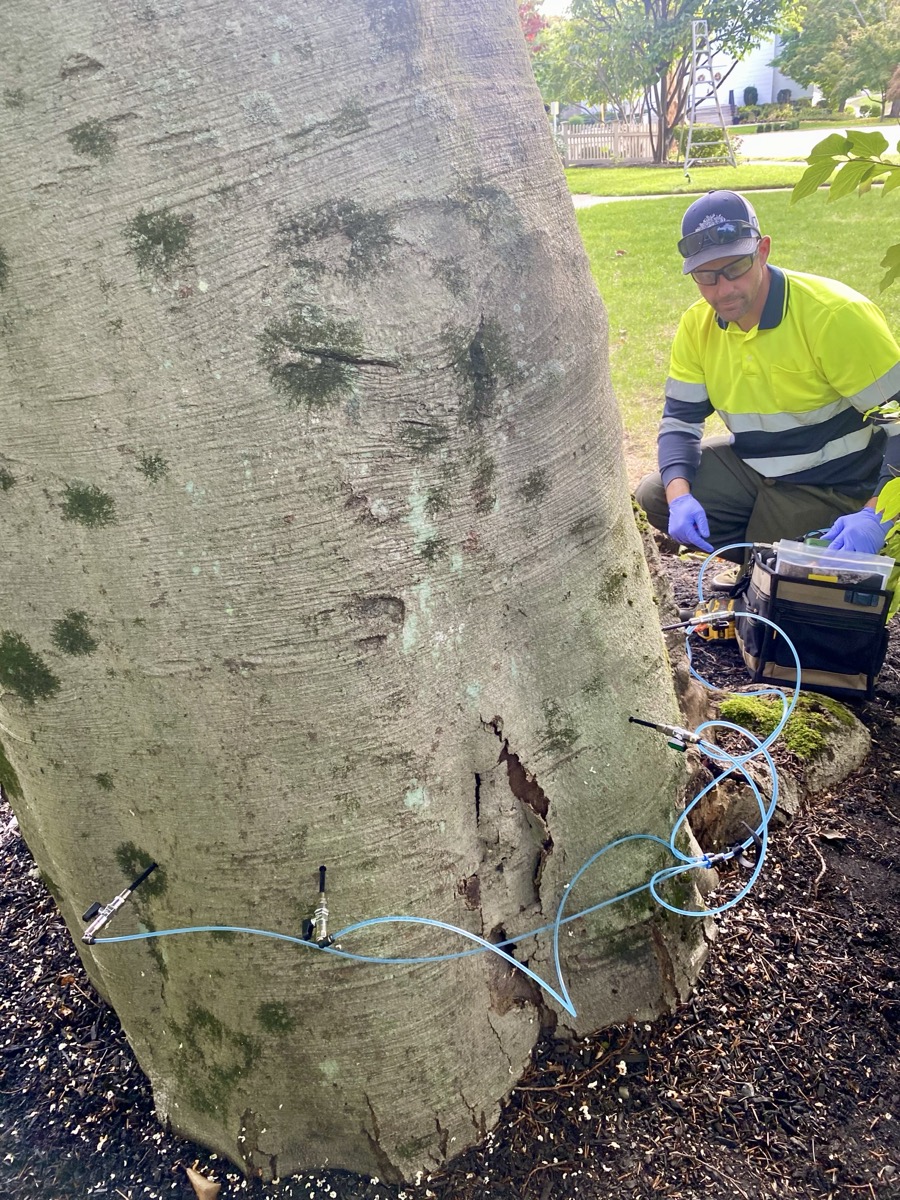
**Pest and Disease Management** (Step 3) employs targeted techniques. For emerald ash borer in South Attleboro green ashes, we use QUIK-jet trunk injections, drilling 1-inch holes every 6 inches around the base and injecting imidacloprid solution under 20 PSI pressure. This systemic treatment moves upward via xylem, killing larvae for 2-3 years. Spongy moth control on Capron Park Area red oaks involves Bacillus thuringiensis (Bt) aerial sprays in June, safe for pollinators, or egg band traps in winter.
Hemlock woolly adelgid on eastern hemlocks receives imidacloprid soil drenches or trunk injections, applied November-February to avoid stressing trees in Attleboro's cold snaps. Winter moth gets spunosad trunk sprays targeting crawlers in April. Fungal issues like anthracnose on Norway maples prompt copper fungicide injections, preventing leaf blight.
**Treatment Application and Monitoring** (Step 4) uses specialized equipment: 60-ft bucket trucks for high injections in tall white oaks, all-terrain chippers for hillside access in Hebronville, and GPS-mapped applications for multi-tree programs. Safety protocols include hard hats, harnesses, and spotters per OSHA and ANSI Z133 standards. Post-treatment, we install monitoring stations—pheromone traps for moths, sticky bands for adelgids—and schedule follow-ups every 3-6 months.
**Annual Program Development** (Step 5) creates custom PHC contracts, e.g., quarterly fertilizations for silver maples, biennial ash injections. In North Attleboro border properties, we integrate stormwater management, using root zone mulching to reduce runoff into adjacent Norton streams.
Our process yields measurable results: 85% tree survival post-emerald ash borer treatment, per client data. Homeowners gain peace of mind knowing treatments comply with Massachusetts Pesticide Board regulations. For your Attleboro trees, this structured PHC restores vigor efficiently.
Practical tip: Prepare by marking utility locates (call 811) and clearing 20-ft access paths. Track treatments in a log for warranty claims.
Common Plant Health Care Projects in Attleboro Neighborhoods
In Attleboro Center's historic core, we manage aging Norway maples with structural pruning and verticillium wilt injections, preventing branch failures over sidewalks. Deep root fertilization counters soil compaction from foot traffic, sustaining shade for century homes.
South Attleboro properties near Seekonk feature green ashes hit by emerald ash borer; our trunk injections save 80% of infested trees, avoiding $4,000 removals. Silver maples here get cabling to stabilize codominant stems weakened by storms.
Along the North Attleboro border, red oaks and white oaks in even-aged stands receive spongy moth Bt treatments and oak wilt preventives, thinning understories to improve air flow. Homeowners report 40% less defoliation post-program.
Hebronville's hillier lots demand hemlock woolly adelgid management for eastern hemlocks, using soil drenches that penetrate thin soils. Ice storm recovery includes wound dressings and fertilization for white pines snapped at 20-30 feet.
Dodgeville sees winter moth control on sugar maples via targeted sprays, combined with root pruning to resolve sewer conflicts. Our selective thinning prepares lots for construction while preserving mature white oaks.
Briggs Corner residential edges involve lot clearing with PHC for retained trees—deep root injections for red maples stressed by grading, ensuring transplant success rates over 90%.
In the Capron Park Area, municipal-adjacent properties get canopy management: American beech scale treatments and beech bark disease fungicides. We coordinate with city crews for street-adjacent work.
Willett Pond Area wet zones challenge silver maples with Phytophthora root rot; our soil amendments with phosphites improve drainage and resistance. White pines here benefit from weevil leader clippings and systemic insecticides.
Nearby Norton and Rehoboth clients access the same services, from Franklin border ash injections to Seekonk hemlock programs. These projects highlight Southeast Arborist's expertise in Attleboro-specific PHC.
Plant Health Care Costs in Attleboro, MA
Plant health care costs in Attleboro MA vary by property size, tree count, and issues, but deliver strong ROI. Initial assessments start at $150-$250 per site visit, including soil tests and pest scouting—essential for Attleboro Center's complex urban trees.
Deep root fertilization for a 1-acre lot with 10-15 mature red oaks or Norway maples runs $400-$800 annually, covering 4 quarterly applications. This beats $1,500+ in replacement costs, as fertilized trees gain 20-30% vigor per ISA metrics.
Emerald ash borer trunk injections cost $12-$18 per inch of green ash diameter—$600 for a 36-inch tree in South Attleboro. Biennial repeat protects for 2 years, far below $3,000 removal fees amid the infestation's spread from Rehoboth.
Hemlock woolly adelgid treatments: $15-$25 per foot of eastern hemlock height, so $750 for a 30-ft tree in Dodgeville. Soil drenches or injections yield 3-year control, preserving evergreens valued at $5,000+.
Spongy moth and winter moth programs: $300-$600 per property for Bt or spinosad apps on oaks in Briggs Corner, covering 20 trees. Trap monitoring adds $100, preventing total defoliation that drops property values 5-10%.
Custom annual PHC contracts for Capron Park Area homes average $1,200-$2,500, bundling fertilization, IPM scouting, and minor injections. Multi-year discounts (10-15%) apply, with warranties on treatments.
Factors influencing costs: Tree size (larger = higher volume), access (hillside premiums in Hebronville add 20%), soil type (wet Willett Pond sites need drainage amendments at $200 extra), and urgency (emergency post-ice storm injections +25%).
Value proposition: ANSI-compliant PHC from ISA Certified Arborists like ours at Southeast Arborist extends tree life 10-20 years, enhances curb appeal for Attleboro's median $450,000 homes, and cuts liability insurance by reducing failure risks. One saved white oak offsets a full season's program.
Compare to DIY: Over-the-counter sprays fail against borers, risking $500 fines for improper pesticide use. Our insured, equipped crews ensure compliance.
Budget tip: Start with high-value trees—ash in South Attleboro, hemlocks near Norton. Track savings via before/after photos and appraisals.
Call 508-369-5009 for a cost quote tailored to your neighborhood.
When to Schedule Plant Health Care in Attleboro
Timing plant health care in Attleboro MA maximizes efficacy given your Zone 6b climate—cold winters, wet springs, dry summers.
Spring (March-May): Schedule emerald ash borer injections by mid-May before bud break, when sap flow carries imidacloprid upward in green ashes. Treat winter moth on maples during crawler hatch (late April), using sticky bands or sprays. Deep root fertilization post-frost for red oaks absorbs spring rains.
Summer (June-August): Apply spongy moth Bt on oaks by early June for 3rd instar larvae. Monitor white pines for weevil in July; clip leaders immediately. Foliar nutrients for chlorotic sugar maples in July heat.
Fall (September-November): Hemlock woolly adelgid soil drenches by November, pre-dormancy. Root fertilization October for white oaks builds winter reserves. Prune silver maples post-leaf drop to avoid oak wilt vectors.
Winter (December-February): Dormant oil sprays for scales on American beeches; minimal disruption in dense Attleboro Center.
Urgency signs: D-shaped holes on ash trunks, woolly masses on hemlock needles, >30% defoliation, wilting branches, or soil heaving roots. Post-ice storm (common January in Hebronville), inspect within 48 hours for wounds inviting decay.
Annual programs start anytime; one-offs peak pre-storm season (October). Avoid summer injections during drought—your trees stress more.
Contact Southeast Arborist at 508-369-5009 now for seasonal slots.
Frequently Asked Questions About Plant Health Care in Attleboro
**What is plant health care in Attleboro MA?** PHC encompasses IPM, fertilization, and injections to maintain tree vigor against local threats like emerald ash borer in South Attleboro ashes and woolly adelgid in Dodgeville hemlocks. It's proactive, per ANSI A300.
**How do I know if my Attleboro trees need PHC?** Look for canopy thinning in Norway maples (Attleboro Center), borer galleries on green ashes, or adelgid wool on hemlocks. Soil test if leaves yellow on sugar maples near Willett Pond.
**Are your treatments safe for my family's pets in Briggs Corner?** Yes, our IPM uses low-toxicity options like Bt for spongy moth on red oaks, EPA-approved for organics. Trunk injections target pests internally, minimizing exposure.
**How effective is emerald ash borer treatment for South Attleboro properties?** 95% effective for 2-3 years via imidacloprid injections, per USDA data. We monitor annually to extend protection.
**What's the difference between fertilization and injections?** Fertilization builds roots in Hebronville's poor soils; injections deliver pesticides directly for pests like winter moth on Capron Park beeches.
**Do you serve areas outside Attleboro like Norton or Seekonk?** Yes, our South Shore coverage includes Rehoboth, Franklin borders, and beyond from Plymouth/Cohasset base.
**How long until I see results from PHC on white pines?** New growth by next spring post-fertilization; pest control shows in 4-6 weeks.
**Is PHC covered by HOA rules in North Attleboro border neighborhoods?** Typically yes, as it prevents hazards. We provide documentation for approvals.
Plant Health Care Throughout Attleboro
Southeast Arborist provides comprehensive plant health care across Attleboro neighborhoods—Attleboro Center street trees, South Attleboro ashes, North Attleboro border oaks, Hebronville hemlocks, Dodgeville maples, Briggs Corner pines, Capron Park beeches, Willett Pond silvers. We extend to nearby Norton, Rehoboth, Seekonk, and Franklin.
Our ISA Certified team uses ANSI standards for every job. Call 508-369-5009 today for Attleboro MA PHC that protects your trees long-term.