
# Professional Oak Tree Specialist in Rehoboth, Massachusetts
As a homeowner in Rehoboth, Massachusetts, your property likely features mature red oaks and white oaks framing stone-wall-lined fields or lining the Palmer River valley. These oaks dominate the landscape in this rural Bristol County town of 12,000 residents, where forests cover extensive areas around neighborhoods like Rehoboth Village, Anawan, and Hornbine. Southeast Arborist, LLC, your local oak tree specialist in Rehoboth MA, specializes in caring for these trees amid challenges like spongy moth damage, ice storm vulnerabilities, and the emerging emerald ash borer threat—though oaks face their own diseases such as oak wilt.
Our ISA Certified Arborists, based in Plymouth and Cohasset, serve the South Shore Massachusetts region, including Rehoboth's 02769 zip code. We follow ANSI A300 standards for tree care, ensuring every pruning cut, health assessment, and structural evaluation meets professional benchmarks. With phone ready at 508-369-5009, we address your oaks' needs precisely: preventing oak wilt through strict pruning timing (never February through July), diagnosing diseases like anthracnose or powdery mildew common in Rehoboth's humid inland climate, and performing immediate wound sealing on all cuts to block pathogens.
Rehoboth's history as a 1643 settlement means its woods represent some of Bristol County's oldest continuously forested land. Red oaks (Quercus rubra) thrive on upland sites with sandy loam soils derived from glacial till, while white oaks (Quercus alba) anchor richer bottomlands near the Palmer River. Both species intermingle with sugar maples, American beeches, white pines, shagbark hickories, black birches, eastern hemlocks, red maples, and tulip trees, creating dense canopies vulnerable to ice buildup during winter storms. Your oaks may show spongy moth defoliation, leaving branches weak and hazardous over rural roads.
As your oak tree specialist Rehoboth MA provider, we conduct thorough health assessments, identifying issues like root rot from compacted farm soils or codominant stems prone to splitting in wind. Practical advice for you: inspect your oaks now for vertical cracks or fungal brackets at the base, signs of internal decay. Avoid DIY pruning, as improper cuts invite oak wilt vectors. Our team uses climbing gear, bucket trucks, and low-impact rigging to preserve your large-lot woodlands without soil disturbance.
In Rehoboth's agricultural-forest interface, oaks near fence lines or barns require defensible space management to reduce fire risk and maintain pasture access. We thin overcrowded stands, removing declining trees to favor vigorous red and white oaks. For Palmer River Area properties, we handle riparian pruning compliant with Massachusetts wetland regulations. Safety protocols include traffic control on narrow roads like those in North Rehoboth and spotter systems for overhead power lines common along Route 118.
Choosing Southeast Arborist means partnering with experts who understand Rehoboth's microclimate—milder than coastal areas but prone to late frosts affecting spring bud break. We track local weather data from nearby Attleboro to time services optimally. Homeowners in South Rehoboth report fewer storm losses after our structural pruning, which reduces wind sail and balances crowns. Call 508-369-5009 today for a free oak assessment tailored to your property's soil pH (often 5.5-6.5 in Rehoboth's acidic loams) and exposure.
This comprehensive approach positions us as the go-to oak tree specialist in Rehoboth MA, delivering long-term value through science-based care. Your oaks deserve specialists who prevent problems before they escalate, safeguarding your home, farm, or woodland investment.
Why Rehoboth Properties Need Oak Tree Specialist
Rehoboth's rural character, with its stone walls marking old pasture boundaries now reclaimed by forest, amplifies the need for an oak tree specialist. Your red oaks and white oaks, key components of these woods, face unique pressures from the town's inland position in Bristol County. Winters bring ice storms that load dense canopies, snapping limbs over winding roads in neighborhoods like Anawan and Hornbine. Spongy moth outbreaks, peaking in 2023 across South Shore MA, have left widespread hazard trees—oaks defoliated repeatedly show dieback, creating risks for your large-lot property.
Local soils, a mix of glacial outwash sands and till-derived loams, support red oaks on drier uplands and white oaks in moister Palmer River valley bottoms. These species coexist with sugar maples prone to verticillium wilt, American beeches battling beech bark disease, and white pines stressed by white pine weevil. Shagbark hickories drop heavy nuts that damage roofs in Rehoboth Village, while black birches and eastern hemlocks succumb to woolly adelgid near farm edges. Red maples flood in wet springs, and tulip trees lean from shallow roots in compacted fields.
Oak wilt, caused by Bretziella fagacearum, threatens Rehoboth's mature stands. The fungus spreads via root grafts or sap-feeding beetles active in summer, turning leaves bronze from the top down. Your oaks need specialist intervention: we prevent it by avoiding pruning from February through July, when beetles vector the pathogen. Ice events, like the 2022 storm that downed trees along Route 44 toward Seekonk, exploit codominant leaders in red oaks, leading to splits. Emerald ash borer, now in nearby Taunton, indirectly stresses oaks competing for resources in thinning woodlands.
Agricultural-forest interfaces around Swansea and Somerset borders demand fence line clearing—oaks encroaching on pastures block livestock and mowers. In North Rehoboth's open fields, overhanging limbs hazard school buses on rural routes. Palmer River Area homes face riparian erosion, where white oak roots stabilize banks but dying trees undermine them. Our ISA Certified Arborists diagnose these via resistograph probing and air spade root exams, revealing decay hidden in Rehoboth's slowly decomposing leaf litter.
Climate data from Attleboro shows Rehoboth's 45-inch annual rainfall and 40-inch snowfall create humid conditions favoring oak anthracnose, which blackens leaves in wet springs. Powdery mildew coats twigs, weakening structure. Homeowners can check for these: yellowing leaves with shot-hole patterns signal bacterial leaf scorch, common in drought-stressed red oaks on sandy soils. Thin bark on young oaks splits in freezes, inviting hypoxylon canker.
Without specialist care, your oaks contribute to road safety issues—falling debris on narrow paths in South Rehoboth endangers cyclists and farmers. Large-lot management requires thinning: remove 20-30% of suppressed oaks to boost diameter growth in retainers, per ANSI A300 guidelines. This favors mast production for local wildlife, sustaining Rehoboth's deer and turkey populations.
Practical steps for you: map your oaks' locations relative to structures, noting drip lines over wells or septic systems. Test soil with a kit from UMass Extension—aim for pH 6.0-6.5 with mulch to retain moisture. Monitor spongy moth egg masses on trunks this fall; BTK sprays protect without harming bees. Southeast Arborist integrates these into custom plans, ensuring your oaks thrive amid Rehoboth's farming legacy.
Our Oak Tree Specialist Process in Rehoboth
Southeast Arborist's oak tree specialist process in Rehoboth MA starts with a site visit to your property, whether in Rehoboth Village or the Palmer River Area. Our ISA Certified Arborists arrive with drones for canopy mapping and soil probes for root zone analysis, tailored to local glacial soils. We assess red oaks for bifurcated trunks common on windy Hornbine ridges and white oaks for buttress flare decay near farm foundations.
Step 1: Health Assessment (1-2 hours). Using ANSI A300 Part 1 standards, we visually score your oaks on a 0-10 vigor scale, checking for wilting (oak wilt early sign), cankers, and woodpecker damage indicating insects. Resistographs drill increment cores painlessly, measuring decay density—over 30% loss flags removal. Air spades expose roots non-destructively, revealing girdling or compaction from mower traffic in Anawan lawns.
Step 2: Disease Diagnosis. Lab samples go to our Plymouth lab for PCR testing on oak wilt or Phytophthora root rot, prevalent after Rehoboth's wet falls. We differentiate red oak strain (kills in 6 weeks) from white oak (chronic). Treatments include phosphonate injections for sudden oak death threats or macro-infusion for vascular pathogens, dosed per tree DBH.
Step 3: Risk Evaluation. TRAQ assessments quantify failure targets—your home roof, road, or barn. We model wind loads using local data (gusts to 60 mph in ice storms) and cable failing roots in loose Palmer River silts.
Step 4: Pruning Plan. Critical timing: August-January only, avoiding beetle season. We perform structural pruning: subordinate codominant stems, thin to 25% live crown removal max. Every cut gets immediate wound sealant—latex-based to repel insects, unlike outdated paints. Techniques vary: handsaw for interiors, bow saws for elevated limbs, chippers for cleanup.
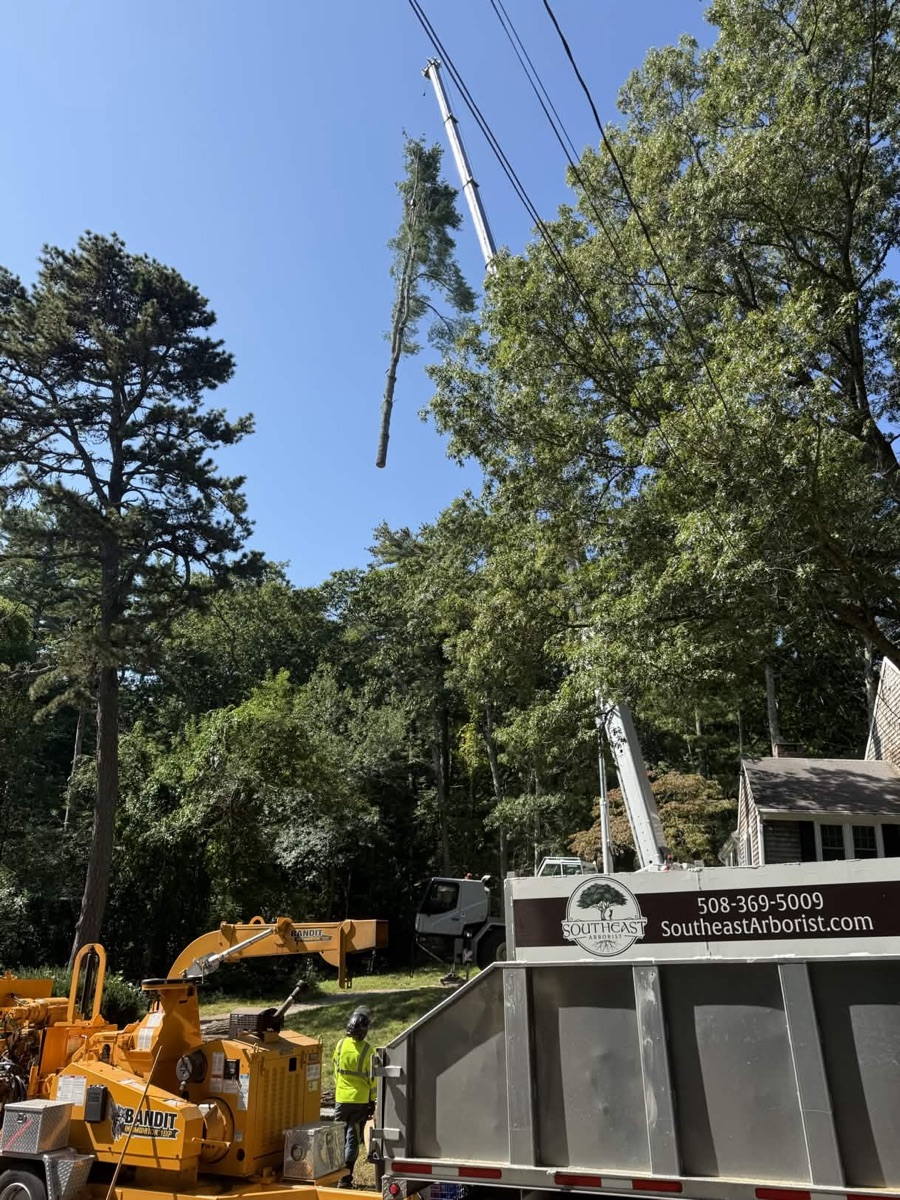
Equipment includes 85-foot bucket trucks for South Rehoboth power line access, CTLA-trained climbers with Petzl gear for white pine-oak mixes, and low-ground-pressure tracked loaders to avoid rutting Rehoboth's farm fields. Rigging uses 7/8-inch bull ropes with friction savers, lowering 5-ton red oak sections safely over stone walls.
Step 5: Implementation with Safety Protocols. Per OSHA and ANSI Z133, we deploy two-way radios, high-vis vests, and chain-off zones. Traffic control on Route 118 uses cones and flaggers. Post-work, we apply mycorrhizal inoculants to pruning sites, boosting root health in nutrient-poor sands.
Step 6: Follow-Up Monitoring. We provide a digital report with photos, maps, and 6-month check-in. For woodland management, we mark retainers with paint—favor straight white oaks for mast, cull spongy moth victims.
This process transformed a 100-year-old red oak stand in North Rehoboth, reducing hazard rating from high to low after thinning 15 declining trees. Homeowners gain 20-30 years of life extension. Practical tip: water young oaks 1-2 inches weekly during July droughts, mulching 3 inches deep but not against trunks.
Our South Shore MA base ensures rapid response—same-day for emergencies like ice-downed limbs post-storm. As your oak tree specialist Rehoboth MA team, we document everything for insurance claims, maximizing value.
Common Oak Tree Specialist Projects in Rehoboth Neighborhoods
In Rehoboth Village, oak tree specialist projects focus on hazard removals near historic homes along Bay State Road. Red oaks overhang stone walls, dropping debris into gardens; we dismantle section-by-section to protect 18th-century foundations, then grind stumps 4 feet deep for replanting white oaks.
Anawan properties see structural pruning for white oaks near pastures. Farmers request crown thinning to 30% openness, improving light for hayfields while maintaining windbreaks against Seekonk winds. We clear fence lines, limb-lifting to 12 feet for tractors.
Hornbine's rural roads demand roadside hazard pruning. Overhanging red oaks along Hornbine Road risk vehicles; our bucket truck work creates 15-foot clearance, coordinating with town DPW. We integrate sugar maple and shagbark hickory care, removing girdled stems.
North Rehoboth large-lot woodlands need thinning projects. Overcrowded stands with black birch and eastern hemlock suppress oaks; selective removal of 25% basal area favors red oaks, creating defensible space around solar arrays common here.
South Rehoboth farms require agricultural interface management. White oaks along field edges get pollarding for livestock shade, with immediate sealing to prevent hypoxylon. We manage tulip tree invasives that outcompete natives.
Palmer River Area riparian projects stabilize banks. Towering oaks with beeches hold flood-prone soils; we prune deadwood and cable leaders per MassDEP buffers, enhancing habitat for Palmer River fish.
Nearby Attleboro edges see oak wilt preventives—trenching root grafts between properties. Swansea lots get emerald ash borer-adjacent oak boosts via fertilization. Taunton border farms need fence clearing amid red maples.
These projects use GPS mapping for compliance, with wood chips for paths. Your neighborhood's oaks benefit directly—call 508-369-5009 for a site-specific plan.
Oak Tree Specialist Costs in Rehoboth, MA
Oak tree specialist costs in Rehoboth MA range from $500-$2,000 for assessments and pruning, scaling with tree size, access, and complexity. A 24-inch DBH red oak structural prune in Rehoboth Village might cost $800-$1,200, including travel from our Cohasset base. Factors: height over 60 feet adds $300 for crane rental; Palmer River wetland permits bump $200.
Removal costs $1,000-$5,000 per mature white oak. Sectional dismantling in Anawan yards: $1,500 for a 40-foot tree near a barn. Stump grinding: $150-$400, deeper in Hornbine clays. Health injections for oak wilt prevention: $10-$15 per inch DBH, so $360 for a 24-incher.
Woodland thinning projects dominate Rehoboth's large lots—$2,000-$10,000 per acre in North Rehoboth, marking 20-30 trees for removal. Fence line clearing: $500-$1,500 per 100 feet, factoring stone wall protection. Roadside work in South Rehoboth: $75-$125 per tree, with town coordination.
Value proposition: Our ISA certification ensures ANSI-compliant work, preventing $10,000+ storm damages. A $1,200 prune extends oak life 25 years, yielding $50,000+ property value via curb appeal. Insurance discounts average 5-10% post-report.
Comparisons: DIY risks $5,000 liability; unqualified crews cause decay. We offer bundled woodland management: $3,500/acre saves 20% vs. piecemeal. Free quotes factor Rehoboth specifics—sandy soils need less equipment.
Financing via our partners covers 0% for 12 months. ROI: Healthier oaks boost farm yields by 15% via shade regulation. Contact 508-369-5009 for precise estimate.
When to Schedule Oak Tree Specialist in Rehoboth
Schedule your oak tree specialist in Rehoboth MA from late summer through winter—August to January—for pruning, dodging oak wilt beetles active February-July. Fall (September-October) suits assessments before leaf drop reveals structure.
Urgency signs: 20%+ canopy dieback from spongy moth, leaning trunks post-ice, or mushrooms at base. Vertical seams or water sprouts signal failure risk—act within weeks to avoid $20,000 removal.
Spring (post-frost, April-May) for injections; avoid cuts. Ice storm aftermath (January-March) prioritizes hazards on Hornbine roads.
Annual checks for Palmer River properties prevent flood erosion. Call 508-369-5009 now if leaves bronze or bark sloughs—early intervention halves costs.
Frequently Asked Questions About Oak Tree Specialist in Rehoboth
What is an oak tree specialist in Rehoboth MA? An oak tree specialist like Southeast Arborist provides species-specific care for red and white oaks, including disease prevention, pruning, and risk assessment tailored to Rehoboth's forests.
How do I know if my Rehoboth oak has oak wilt? Look for wilting leaves from treetop down, vascular streaking under bark. Our ISA Arborists confirm via lab tests—prevent by no summer pruning.
When is the best time for oak pruning in Rehoboth? August-January only. Rehoboth's humid summers vector beetles; we seal cuts immediately.
What causes spongy moth damage to oaks in Hornbine? Caterpillars defoliate, stressing trees. We recommend BTK sprays and removals for hazards.
How much does oak tree removal cost in Palmer River Area? $1,500-$4,000 for 30-50 foot trees, including riparian compliance and stump grinding.
Can you help with woodland thinning in North Rehoboth? Yes, we thin overcrowded stands per ANSI standards, retaining healthy red oaks for mast.
Are your arborists certified for Rehoboth properties? All ISA Certified, following ANSI A300 and Z133 safety for large-lot and roadside work.
What about oak care near Attleboro farms? We clear fence lines, prune for defensible space, integrating with ash borer threats.
Oak Tree Specialist Throughout Rehoboth
Southeast Arborist delivers oak tree specialist services across Rehoboth neighborhoods: Village hazard prunes, Anawan farm clearances, Hornbine roadside safety, North thinning, South fence work, Palmer River riparian care. We extend to nearby Attleboro, Seekonk, Swansea, Taunton, Somerset.
From Plymouth/Cohasset, we reach 02769 fast. Call 508-369-5009 for assessments—your oaks protected by ISA experts.