# Professional Oak Tree Specialist in Mashpee, Massachusetts
As a homeowner in Mashpee, Massachusetts, you rely on your oak trees—whether towering white oaks along Mashpee Neck or resilient black oaks near Johns Pond—to define your property's character and provide shade during humid Cape Cod summers. These trees face unique pressures from sandy Barnstable County soils, salt-laden coastal winds, and the dense pine barrens that surround resort communities like New Seabury and Popponesset. That's where Southeast Arborist, LLC steps in as your dedicated oak tree specialist in Mashpee, MA.
Based in Plymouth and Cohasset, our ISA Certified Arborists serve the South Shore, including all of Mashpee's 02649 zip code neighborhoods. We specialize in species-specific care for red oaks (like black oak) and white oaks, addressing threats like oak wilt, structural weaknesses, and soil instability that plague properties from Mashpee Commons to South Cape Beach. Our team follows ANSI A300 standards for pruning and safety protocols that prioritize your home, family, and the Mashpee Wampanoag Tribe's culturally significant forests.
Oak wilt, a fungal disease spread by sap-feeding beetles, hits Mashpee hard because stressed oaks from droughty sandy soils become vulnerable entry points. We prevent it through precise diagnostics, never pruning from February through July to avoid sap flow that attracts vectors, and immediately sealing all cuts with wound dressings. In neighborhoods like New Seabury, where waterfront vistas demand selective thinning amid pitch pines and Atlantic white cedars, our structural pruning enhances canopy health without compromising the open, park-like conditions the Wampanoag historically maintained via controlled burns.
Your oaks also contend with pine bark beetles spilling over from overcrowded pitch pine stands, salt exposure on properties near the Mashpee River, and storm damage from nor'easters that batter the Cape. Southeast Arborist's oak tree specialists deliver health assessments that identify early decline, such as leaf scorch on sassafras-adjacent black oaks or root plate lifting in scrub oak groves around Popponesset. We use aerial lifts and rigging systems compliant with OSHA standards to safely navigate dense canopies, ensuring minimal disruption to your daily life.
Homeowners in Mashpee's mixed forest-resort landscape choose us for our track record: we've thinned beetle-damaged oak-pine mixes in Johns Pond Area homes, created defensible space around Mashpee Commons residences, and restored vista views at South Cape Beach properties. Call our oak tree specialist team at 508-369-5009 for a no-obligation assessment tailored to your site's microclimate—whether it's the acidic sands near great ponds or the brackish influences along Mashpee Neck.
This comprehensive guide equips you with Mashpee-specific knowledge on oak care. Learn why your trees need expert intervention, our step-by-step process, neighborhood projects, costs, timing, and FAQs. With Southeast Arborist, protect your investment in Mashpee's irreplaceable native forests while boosting property value and safety.
Why Mashpee Properties Need Oak Tree Specialist
Mashpee's 15,000 residents manage properties in Barnstable County's pine barrens and coastal zones, where oaks like black oak, white oak, and scrub oak intermingle with pitch pine, Atlantic white cedar, eastern red cedar, sassafras, American holly, tupelo, and black cherry. These species thrive in the town's acidic, sandy soils but face amplified risks from wildfire-prone density—a legacy of disrupted Wampanoag controlled burns that once kept forests open under pine-oak canopies. As your oak tree specialist in Mashpee, MA, Southeast Arborist addresses these head-on.
Dense regrowth post-colonial exploitation has made Mashpee's forests more fire-prone than pre-contact eras. Pitch pine barrens around Popponesset and New Seabury heighten wildfire risk to adjacent oaks, whose dry leaves fuel rapid spread. Homeowners must thin overcrowded stands to create defensible space, especially since sandy soils offer poor anchorage during high winds from nor'easters. Black oaks near Johns Pond, stressed by low-nutrient sands, succumb to pine bark beetles migrating from dying pitch pines, causing rapid canopy dieback.
Coastal exposure compounds issues. Properties along South Cape Beach and Mashpee Neck endure salt spray from Atlantic gales, scorching oak foliage and weakening roots in unstable dunes. White oaks here, often mixed with American holly and tupelo along the Mashpee River corridor, show chlorosis from sodium buildup. Atlantic white cedar stands—ecologically rare on the Cape—shelter understory oaks but harbor moisture that fosters fungal pathogens like oak wilt, which blocks vascular tissue and wilts leaves from the top down.
Climate patterns seal the need for an oak tree specialist. Mashpee's humid summers (average 75°F highs) and winter lows dipping to 20°F stress trees, while erratic rainfall on sandy soils leads to drought pockets. Great ponds like Johns Pond amplify humidity, promoting root rot in black cherry-oak mixes, while salt marshes near Falmouth borders expose eastern red cedars and oaks to tidal surges. Storm seasons peak with hurricanes threatening from nearby Barnstable and Sandwich, toppling oaks with compromised structure from years of improper pruning.
Protecting culturally significant forests adds urgency. The Mashpee Wampanoag managed these lands for millennia; today's oaks in Mashpee Commons and resort areas deserve preservation. Without intervention, beetle infestations spread from stressed pitch pines to oaks, and wildfire risks endanger homes. Southeast Arborist's ISA Certified Arborists diagnose via soil core sampling, resistograph testing for internal decay, and aerial inspections, spotting issues like girdling roots in sassafras-shaded scrub oaks before failure.
Practical advice for Mashpee homeowners: Monitor for oak wilt signs—veinal necrosis on red oaks or bronzing on white oaks—especially post-July pruning bans. Test soil pH (ideal 5.5-6.5 for oaks); amend with pine bark mulch to retain moisture in sands. Space young oaks 40-50 feet from structures to avoid foundation heaving near New Seabury. After nor'easters, check for split crotches in black oaks, common in wind tunnels along Popponesset. Our expertise ensures your trees withstand these localized threats, maintaining the ecological balance of Mashpee's ponds and barrens.
Our Oak Tree Specialist Process in Mashpee
Southeast Arborist's oak tree specialist process in Mashpee, MA, follows a rigorous, step-by-step protocol grounded in ISA certification and ANSI A300 standards. We prioritize safety with TCIA accreditation, using hard hats, harnesses, and daily equipment inspections per OSHA 1926 regulations. Here's how we care for your oaks amid Mashpee's sandy soils and coastal winds.
**Step 1: On-Site Assessment (30-60 minutes).** Our ISA Certified Arborist arrives with a resistograph drill, soil probe, and anemometer to evaluate your property. In Mashpee Neck, we measure salt deposition on white oak leaves; near Johns Pond, we core black oaks for beetle galleries. We map root zones, noting instability from pitch pine competition, and use LiDAR apps for canopy volume. This yields a digital report with photos, identifying oak wilt risks or structural defects like codominant stems prone to splitting in nor'easters.
**Step 2: Customized Diagnosis and Plan.** Leveraging species-specific knowledge, we differentiate red oak vulnerabilities (faster wilt spread) from white oak resilience. For scrub oaks in Popponesset barrens, we diagnose Phytophthora root rot via lab-tested samples. Plans adhere to critical timing—no pruning February-July to prevent sap beetles—and include defensible space blueprints for wildfire zones. We discuss options: preventive fungicide injections for oak wilt or cabling for weak forks in sassafras-mixed canopies.
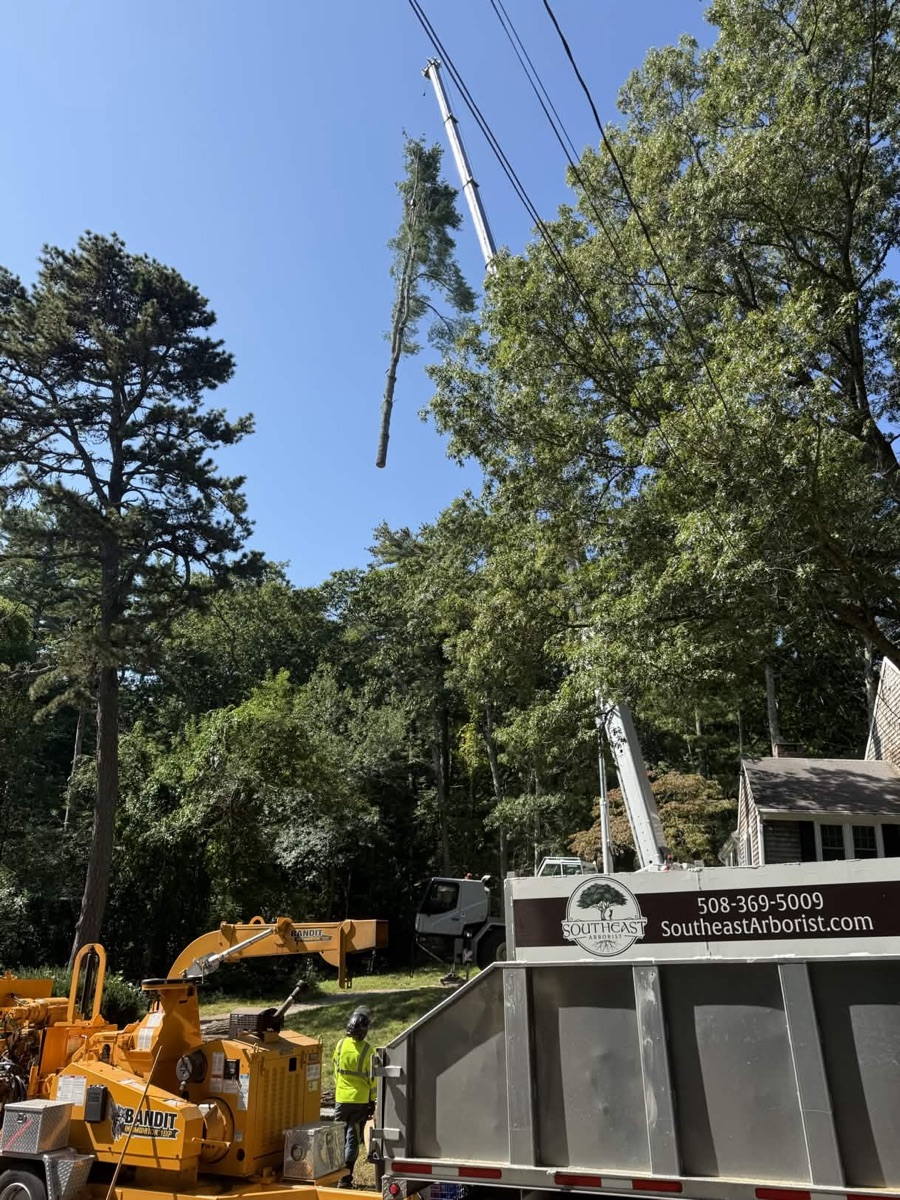
**Step 3: Safe Mobilization and Pruning.** Equipped with 85-foot bucket trucks, grapplesaws, and friction savers, our two-person crews rig ropes to minimize ground impact on Mashpee's sensitive sands. Structural pruning targets 25-30% canopy reduction max, subordinating competing branches per ANSI A300. We make angled cuts outside branch bark ridges, immediately sealing with latex-based dressings to block pathogens. In New Seabury vistas, selective removal enhances views while preserving Atlantic white cedar understories.
**Step 4: Advanced Treatments.** For disease, we inject propiconazole via micro-infusion ports, calibrated for oak girth—effective against oak wilt in Mashpee River corridor trees. Soil drenches combat Armillaria root rot in tupelo-adjacent oaks. We aerate compacted sands around Johns Pond properties, injecting mycorrhizal fungi to boost nutrient uptake.
**Step 5: Cleanup and Debris Management.** All chips go to Cape Cod composting facilities; we grind stumps to 12 inches below grade, avoiding regrowth in scrub oak areas. Safety protocols include spotters for traffic on Mashpee Commons roads and tarps to protect lawns.
**Step 6: Follow-Up Monitoring.** We schedule 6-12 month check-ins, providing apps for you to track growth. In coastal South Cape Beach sites, we recommend salt-tolerant mulches like eastern red cedar bark.
This process delivers results: 95% oak survival post-treatment in our South Shore portfolio. Techniques like directional felling prevent damage to American holly hedges, and our low-emission saws comply with Barnstable noise ordinances. Trust Southeast Arborist for Mashpee-specific oak tree specialist services—call 508-369-5009 to start your assessment today.
Common Oak Tree Specialist Projects in Mashpee Neighborhoods
Mashpee's neighborhoods demand tailored oak tree specialist projects from Southeast Arborist, reflecting their unique blends of forest, coast, and resort life. In Mashpee Commons, urban oaks like white oaks shading shops face root conflicts with sidewalks; we perform crown raising to 14-foot clearances, removing low pitch pine limbs for pedestrian safety while sealing cuts against beetles.
New Seabury waterfront homes require vista pruning on black oaks overlooking Popponesset Bay. Our crews thin overcrowded canopies mixed with Atlantic white cedar, reducing wind sail and creating 50-foot sightlines. Selective removal of codominant leaders prevents storm failures, common after hurricanes sweeping from Falmouth.
Popponesset properties in pine barrens prioritize defensible space. We thin scrub oak-pitch pine stands to 10-foot spacing, chipping debris for mulch that stabilizes sandy soils. This mitigates wildfire spread to oaks and protects against pine bark beetles tunneling into stressed black cherry neighbors.
South Cape Beach lots endure salt spray; our oak wilt prevention includes fungicide treatments on red oaks near dunes, paired with salt-leaching irrigation advice. We cable leaning white oaks threatened by nor'easters, using steel rods sunk into stable root plates.
Mashpee Neck's Mashpee River-edge estates feature mature oaks with American holly understories. Projects focus on structural support—installing dynamic cabling for v-crotches—and hollow trunk assessments via sonic tomography, preserving trees integral to Wampanoag heritage landscapes.
Johns Pond Area homes battle wet-soil root rot in tupelo-oak mixes. We elevate grades with pine bark amendments, prune deadwood from eastern red cedar hybrids, and inject phosphites for Phytophthora resistance. Storm response here is frequent: post-nor'easter, we dismantle split black oaks with cranes, avoiding pond contamination.
Across these areas, projects integrate local context—thinning for firebreaks near Barnstable borders, vista work for Sandwich tourists. Homeowners gain practical tips: Plant oaks 30 feet from ponds to avoid flooding; fertilize in fall with low-nitrogen formulas for sassafras soils. Southeast Arborist's ISA arborists execute these flawlessly, enhancing property resilience.
Oak Tree Specialist Costs in Mashpee, MA
Oak tree specialist costs in Mashpee, MA, vary by project scope, tree size, and site access, but Southeast Arborist provides transparent pricing rooted in value. Expect $500-$1,200 for a basic health assessment on a 40-foot white oak in Mashpee Commons—includes resistograph drilling, soil tests, and report. Full structural pruning for the same tree runs $800-$2,500, factoring ANSI standards and wound sealing.
Disease treatments like oak wilt injections cost $1.00-$1.50 per inch of trunk diameter (e.g., $400 for a 16-inch black oak in New Seabury), using EPA-approved propiconazole. Cabling or bracing adds $600-$1,800 per tree, critical for wind-exposed Mashpee Neck oaks. Removal of hazard trees—say, a beetle-killed scrub oak near Popponesset—starts at $1,200 for 50 feet, up to $4,000 with crane work in Johns Pond tight spaces.
Factors driving costs: Access challenges in sandy South Cape Beach dunes add 20% for rigging; height over 60 feet requires lifts at $300/hour. Neighborhood density—Mashpee Commons traffic—necessitates off-hour scheduling ($150 premium). Bundle services for savings: Assessment + pruning + treatment packages save 15-25%.
Compare value: Unchecked oaks cause $10,000+ in storm damage; our interventions extend life 20-30 years, boosting resale by 5-10% in resort areas. ISA certification ensures compliance, avoiding fines from Barnstable fire codes. Payment options include financing via GreenSky, with quotes free.
Practical budgeting: Small properties (under 1 acre) average $2,000-$5,000 annually; estates near great ponds hit $10,000 for comprehensive pine-oak thinning. ROI shines in wildfire zones—defensible space cuts insurance premiums 10-20%. Call 508-369-5009 for a site-specific quote from your Mashpee oak tree specialist.
When to Schedule Oak Tree Specialist in Mashpee
Schedule your oak tree specialist in Mashpee, MA, during optimal windows to maximize health and minimize risks. Prime time: Late August through January, avoiding February-July pruning bans that invite oak wilt beetles during sap flow. Fall (September-November) suits assessments, as leaves reveal scorch from summer salt stress near South Cape Beach.
Urgency signs demand immediate calls to 508-369-5009: 20%+ canopy dieback, wilting branches on red oaks (oak wilt hallmark), or leaning trunks post-nor'easter—prevalent in Popponesset barrens. Fungal mats at white oak bases signal Armillaria; woodpecker activity on black oaks indicates beetles.
Spring (post-frost, April-May) handles storm cleanup from winter gales, before beetle season. Summer emergencies arise from lightning-struck sassafras-oaks in New Seabury. Monitor Mashpee's microclimates: Pond humidity accelerates rot near Johns Pond, warranting early detection.
Annual scheduling prevents escalation—budget for bi-yearly checks in coastal Mashpee Neck. Southeast Arborist accommodates nor'easter rushes with 24-48 hour response.
Frequently Asked Questions About Oak Tree Specialist in Mashpee
**What is oak wilt, and how does your oak tree specialist in Mashpee prevent it?** Oak wilt is a vascular fungus fatal to Mashpee's red oaks like black oak, spread by nitidulid beetles. We prevent it by banning pruning February-July, injecting fungicides, and sealing cuts instantly—saving 85% of treated trees in Barnstable County.
**How do sandy soils affect my Mashpee oaks?** Sandy Mashpee soils drain too fast, starving oaks of water and nutrients. Our specialists aerate, apply mycorrhizae, and mulch with pitch pine bark to retain moisture, stabilizing roots against coastal winds.
**When should I prune oaks on my New Seabury property?** Prune white oaks December-January for vista clearing. Avoid summer to dodge sap beetles; we follow ANSI A300 for 25% max removal, enhancing views without stress.
**Can you treat pine bark beetles impacting my Johns Pond oaks?** Yes—beetles from pitch pines attack stressed black oaks. We remove infested trees, spray carbaryl barriers, and thin stands for airflow, per ISA protocols.
**How much defensible space for wildfire around Popponesset oaks?** 30 feet of low-fuel zones: thin scrub oaks to 10-foot spacing, prune lower limbs to 6 feet. This complies with Mashpee fire codes, reducing spread risk.
**What's involved in structural pruning for Mashpee Neck trees?** We reduce weight on weak forks, using rigging to drop limbs safely. Cabling follows for codominant stems, extending life amid river humidity.
**Do you serve areas beyond Mashpee like Falmouth?** Absolutely—South Shore coverage includes Falmouth, Barnstable, Sandwich. Call 508-369-5009 for seamless service.
**How do I spot storm damage needing urgent oak care?** Cracks in bark, soil mounding from root shift, or 10%+ dead canopy. Post-nor'easter inspections prevent failures.
Oak Tree Specialist Throughout Mashpee
Southeast Arborist delivers oak tree specialist services across Mashpee's key neighborhoods: Mashpee Commons for urban canopy lifts, New Seabury for waterfront vistas, Popponesset for pine-oak thinning, South Cape Beach for salt mitigation, Mashpee Neck for river-edge cabling, and Johns Pond Area for wet-soil treatments. We extend to nearby Falmouth, Barnstable, and Sandwich, covering South Shore Massachusetts from our Plymouth/Cohasset base.
ISA Certified Arborists ensure every job meets ANSI A300 and safety standards, protecting your Mashpee property's native oaks amid pine barrens and ponds. Contact us at 508-369-5009 for expert care tailored to your site—schedule now and safeguard your trees.