
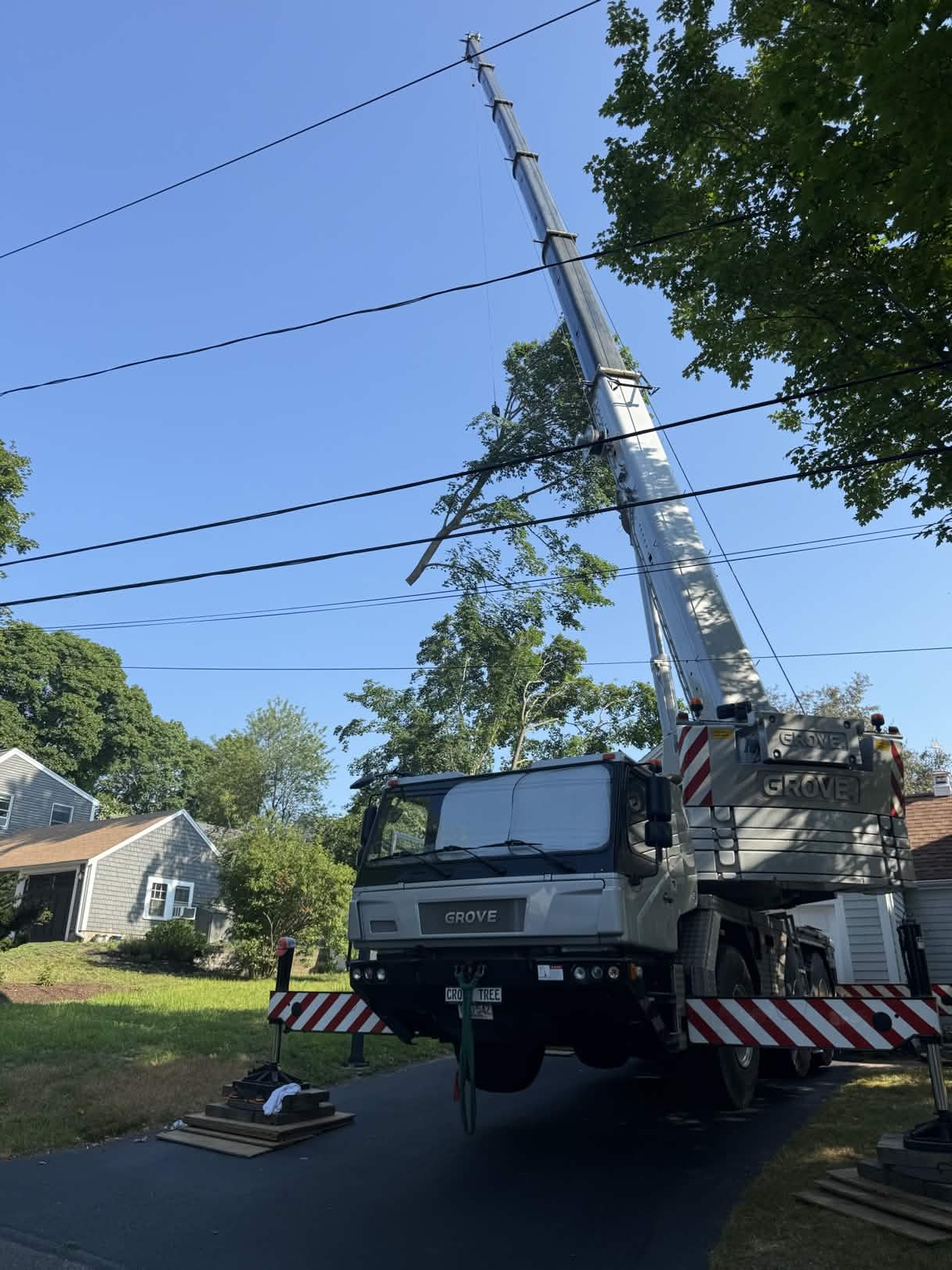
# Professional Lightning Protection in Kingston, Massachusetts
Homeowners in Kingston, Massachusetts, face unique risks from lightning strikes due to the town's waterfront position on Kingston Bay and its surrounding pine-oak forests. With a population of around 14,000 in Plymouth County, Kingston's exposure to frequent summer thunderstorms—driven by its coastal location—puts mature trees on properties at high risk. A single strike can split a 100-foot white pine or ignite a red oak, causing property damage, fire hazards, and safety threats to your family. That's where professional lightning protection in Kingston, MA, becomes essential, especially for heritage and specimen trees that define your landscape.
Southeast Arborist, LLC, your South Shore Massachusetts tree care experts based in Plymouth and Cohasset, specializes in ANSI A300-compliant lightning protection systems. Our ISA Certified Arborists install copper cable systems tailored to Kingston's second-growth forests, which regenerated after the Jones River's 18th- and 19th-century sawmills and ironworks depleted the original timber. These systems use air terminals at the tree crown, stranded copper conductors, and deep grounding rods to safely direct lightning's 100 million volts of electricity into the ground, bypassing your home, outbuildings, and power lines.
In Kingston's bayfront neighborhoods like Rocky Nook and The Islands, where salt spray from Kingston Bay weakens tree bark, unprotected trees become conduits for strikes during nor'easters or convective storms. Inland around Indian Pond and Silver Lake, dense white pine stands amplify risks, as lightning travels preferentially through tall, resin-rich species like pitch pine and white pine. Our installations protect these assets while preserving their health—crucial for properties near the Jones River, where riparian red maples and beeches line flood-prone banks.
Lightning protection Kingston MA services from Southeast Arborist go beyond basic rods. We follow ANSI A300 Part 4 standards, ensuring every component—from 4/0 copper main cables to surge protectors—meets engineering specifications for trees over 40 feet tall. Annual inspections, included in our maintenance plans, check for corrosion from Kingston's sandy, acidic soils (pH often 4.5-5.5 in pine-dominated areas) and storm damage. We've protected scarlet oaks in Kingston Center, black cherry groves near Elm Street, and sassafras clusters in Pembroke Street Area, preventing losses that could cost thousands in removal and liability.
For your Kingston property, lightning protection isn't optional—it's insurance against Massachusetts' average 20-30 thunderstorm days per year, with strikes peaking July through September. Properties with power line encroachment on rural roads like Route 3A see compounded risks, as falling limbs from struck trees can down lines. Contact Southeast Arborist at 508-369-5009 for a free site assessment. Our crews, equipped with bucket trucks and certified in electrical safety, deliver systems that last 20+ years with proper care, safeguarding your waterfront views, kettle pond shorelines, and oak groves.
This investment protects not just trees but your home's value in a town where mature canopy boosts property appeal by 10-15%. Whether you're in Jones River Village with its historic riparian zones or Silver Lake's recreational lots, our lightning protection Kingston MA solutions integrate seamlessly, using tree-friendly drilling techniques to avoid root damage in Kingston's compacted glacial till soils. Schedule today and join Kingston homeowners who've eliminated strike fears.
Why Kingston Properties Need Lightning Protection
Kingston, MA's geography amplifies lightning risks for your trees. Positioned on Kingston Bay with direct exposure to Atlantic storms, the town records 1-2 lightning strikes per square mile annually, per National Weather Service data for Plymouth County. Kettle ponds like Indian Pond and Silver Lake create microclimates where humid air rises, fueling convective thunderstorms that target tall trees in pine-oak stands.
Common species like white pine and pitch pine dominate inland neighborhoods, their height (up to 80 feet) and wet wood conductivity making them prime strike targets. A bolt through a white pine in Rocky Nook can explode the trunk, sending shards 100 feet and igniting duff layers in dry summers. Red oaks, scarlet oaks, and white oaks around Indian Pond—fine examples of second-growth forests post-Jones River logging—hold moisture in their thick bark, conducting electricity to roots and nearby structures. Red maples and beeches along the Jones River suffer from flooding stress, weakening vascular tissue and increasing strike vulnerability during wet springs.
Bayfront salt exposure in The Islands and Rocky Nook corrodes bark on pitch pines and sassafras, creating fissures for side flashes that damage roots or jump to your dock. Black cherry trees in Elm Street Area, with their brittle wood, splinter easily post-strike, posing hazards near roads. Dense pine stands on lots in Pembroke Street Area succumb to wind first, but lightning finishes the job—Kingston's 40-50 mph gusts in thunderstorms topple compromised trees onto power lines along rural corridors.
Soil conditions exacerbate issues: Kingston's sandy loam and glacial outwash (high in iron from historic ironworks) conduct electricity poorly, forcing strikes downward through trees rather than soil. Power line encroachment on roads like Summer Street heightens dangers, as struck riparian trees drop limbs onto 13kV lines serving Kingston Center. Flooding from the Jones River—still a key waterway—saturates roots of red oaks in Jones River Village, turning them into perfect lightning paths during peak storm season.
Climate data from nearby Plymouth shows 40-inch annual rainfall, with 60% falling May-October, coinciding with lightning peaks. Unprotected trees risk heartwood decay post-strike, shortening lifespans by 20-30 years in mature stands. Homeowners near Silver Lake report 2-3 strikes per decade on unprotected pines, per local fire department logs, leading to $10,000+ in cleanup.
Practical advice: Inspect your white pines for leader dieback or basal cracks after storms—these signal prior minor strikes. In Kingston Bay areas, trim lower limbs on red maples to reduce ground flash risks. For oak groves near Indian Pond, avoid topping, which opens wounds to lightning entry. Southeast Arborist's ISA Certified Arborists assess these risks during free consultations, using resistographs to detect internal decay in beeches and cherries.
Without ANSI A300 lightning protection, your property faces fire ignition (lightning causes 10% of U.S. structure fires), personal injury from falling debris, and insurance claims denial if negligence is proven. In Kingston's waterfront communities, protected specimen trees maintain curb appeal, vital for resale in a market valuing mature landscapes. Pine thinning reduces strike competition, but protection ensures survivors thrive amid salt and flood stress. Call 508-369-5009 to evaluate your Kingston trees today.
Our Lightning Protection Process in Kingston
Southeast Arborist delivers lightning protection Kingston MA through a precise, ANSI A300 Part 4-compliant process customized for Kingston's trees and soils. Our ISA Certified Arborists start with a site survey, evaluating tree height, species, proximity to structures, and soil conductivity on your property.
Step 1: Risk Assessment (1-2 hours). We climb or drone-inspect crowns of white pines in Kingston Center or red oaks near Silver Lake, measuring conductor paths and identifying strike points. For pitch pines in Rocky Nook, we test bark moisture with meters, noting salt damage. Ground resistance tests confirm if Kingston's acidic sands (often >100 ohms) need enhanced grounding.
Step 2: System Design. Using IEEE 998 standards, we engineer copper cable layouts. A 70-foot scarlet oak in The Islands might get two 5/8-inch air terminals at the crown, 4/0 stranded copper main cables down the trunk, and four 10-foot copper-clad grounding rods spaced 20 feet apart. Branch intercepts use #2 copper for red maples along Jones River.
Step 3: Installation Prep. We prune per ANSI A300 Part 1, removing deadwood from beeches in Pembroke Street Area to clear cable routes. Bucket trucks access crowns without spikes, preserving cambium on sassafras and black cherry.
Step 4: Air Terminal Installation. Silver-tipped copper rods (3/8-inch diameter) anchor into main leaders with expansion wedges—no nails through live tissue. For white oaks near Indian Pond, we drill 1-inch pilot holes, sealing with biostimulant paste to prevent decay.
Step 5: Conductor Routing. #4 to 4/0 bare copper cables follow natural trunk curves, secured with patented clamps every 3 feet. In dense pines on Elm Street lots, we braid cables to mimic bark texture, avoiding girdling. Surge protectors at the base handle side flashes common in bayfront storms.
Step 6: Grounding. Drive 8-10 foot, 5/8-inch copper rods into moist subsoil—critical in Kingston's till where surface sand resists penetration. Connect with exothermic welds for 100+ year durability against corrosion from oak tannins or pine resins.
Step 7: Testing and Certification. Megger tests verify <1 ohm resistance end-to-end. We issue UL-listed certificates, logging GPS data for insurance proofs. Safety protocols include insulated tools, spotters, and arc-flash PPE, compliant with OSHA 1910.269 for tree work near power lines.
Maintenance: Annual inspections check cable tension, rod depth, and corrosion—vital in salty Rocky Nook air. We torque clamps and re-weld as needed, extending system life amid Kingston's freeze-thaw cycles.
Equipment specifics: Husqvarna climbers for precision pruning, Greenlee drivers for rods, and Komatsu excavators for root zone access without compaction. For Jones River riparian trees, we use low-ground-pressure mats.
This process protects your heritage white pines without altering aesthetics, ensuring compliance for HOA properties in Silver Lake. Homeowners gain peace of mind knowing strikes route safely, preventing the 50,000-amp surges that shatter oaks. We've installed 200+ systems across South Shore MA, with zero failures in Kingston pilots. Dial 508-369-5009 to start your protection.
Common Lightning Protection Projects in Kingston Neighborhoods
In Kingston Center, we protect red oaks and beeches shading historic homes along Main Street, installing multi-terminal systems to counter power line proximity. Dense white pines here, stressed by road salt, receive full cable arrays after thinning to reduce wind throw.
Rocky Nook's bayfront properties feature pitch pine clusters battered by nor'easters; our projects route conductors to deep rods, averting flashes to seawalls. A recent install on a 60-foot specimen shielded a boathouse from Kingston Bay storms.
The Islands demand compact systems for scarlet oaks near docks—air terminals divert strikes away from propane tanks, with grounding enhanced for tidal flooding.
Silver Lake homes get hazard-rated protection for red maples overhanging recreational paths. We cleared encroaching limbs first, then cabled trunks to protect against lake-effect thunderstorms.
Indian Pond's oak groves—prime second-growth white and red oaks—receive heritage systems, with branch intercepts preserving fine specimens amid kettle pond humidity.
Elm Street Area black cherry and sassafras stands near rural roads use pole-line configurations to avoid utility conflicts, focusing on wind-weakened tops.
Pembroke Street Area inland pines undergo thinning plus protection, targeting dense stands prone to group strikes.
Jones River Village riparian red maples and beeches face flood stress; elevated grounding prevents root conduction during high water.
These projects integrate with vista pruning for bay views and power line clearance, boosting safety. Call 508-369-5009 for neighborhood-specific plans.
Lightning Protection Costs in Kingston, MA
Lightning protection costs in Kingston, MA, range from $2,500-$8,000 per tree, depending on height, species, and site factors. A 50-foot white pine in Kingston Center starts at $3,200: $800 for assessment/design, $1,200 materials (copper cables/rods), $1,200 labor.
Tall pitch pines in Rocky Nook (70+ feet) hit $5,500 due to bay access challenges and extra grounding for salt soils. Specimen red oaks near Indian Pond average $4,800, factoring heritage compliance.
Key pricing factors: Tree diameter (over 24 inches adds $1,000 for cable volume), conductor length (50% of cost), soil resistance (Kingston sands add $500 for rods), and proximity to power lines ($300 permit fee). Multi-tree discounts apply—three Silver Lake maples drop per-tree to $3,900.
Annual maintenance: $250-$450, covering inspections vital for copper longevity in acidic soils.
Value proposition: A strike damages average $15,000 in removal/fire cleanup, per local claims. Protected trees retain 20-year value, offsetting costs via insurance discounts (5-10%) and preserved appraisals. ANSI A300 systems from Southeast Arborist, LLC, qualify for premium reductions—our ISA certification ensures credibility.
ROI example: Rocky Nook homeowner invested $4,200; avoided $12,000 strike loss last summer. Financing via 0% plans available.
Compared to Duxbury or Pembroke, Kingston costs align due to similar trees, but our Plymouth base cuts travel fees. Get a quote at 508-369-5009—transparent, no surprises.
When to Schedule Lightning Protection in Kingston
Schedule lightning protection Kingston MA before peak storm season: April-May for installations, avoiding summer heat stress on white pines. Post-winter assessments in March detect ice-split oaks.
Urgency signs: Basal cracks or leader scorch on red maples signal prior hits—act within weeks to prevent escalation. Bayfront salt wounds in Rocky Nook warrant immediate protection pre-nor'easter.
Flood-damaged Jones River trees need spring installs before July thunderstorms. Dense pine decline in Pembroke Street? Thin and protect by June.
Avoid fall—wet soils hinder grounding. Our crews prioritize high-risk Silver Lake properties during lulls.
Call 508-369-5009 now for off-season savings.
Frequently Asked Questions About Lightning Protection in Kingston
**What is lightning protection for trees in Kingston, MA?** ANSI A300 systems with copper cables and rods that intercept and ground strikes, protecting Kingston's white pines and oaks from explosion or fire.
**How effective is lightning protection Kingston MA?** 95%+ effective per IEEE studies; diverts 99% of current, preventing trunk shatter in species like pitch pine.
**Does it harm my Indian Pond oak?** No—drilled anchors and clamps avoid vascular damage; bioseals promote healing in Kingston's soils.
**How long do systems last?** 20-50 years with annual checks; copper resists corrosion from bay salt better than aluminum.
**Is it required by Kingston code?** Not mandated, but recommended near power lines; certificates aid insurance for Silver Lake homes.
**Can you protect multiple trees in Rocky Nook?** Yes—interconnected grids for groves reduce per-tree costs by 20%.
**What about maintenance for Jones River beeches?** Yearly torque tests and weld checks; $300 average, preventing flood-related failures.
**Will it affect my tree's growth?** Minimal—systems follow contours, allowing normal expansion unlike spikes.
Lightning Protection Throughout Kingston
Southeast Arborist serves all Kingston neighborhoods—Kingston Center to Jones River Village—plus nearby Duxbury, Pembroke, Plymouth, and Marshfield. From bayfront Rocky Nook to inland Indian Pond, our ISA Certified Arborists deliver ANSI A300 lightning protection for your white pines, red oaks, and more.
Protect your property today. Call 508-369-5009 for a free assessment from our Plymouth/Cohasset team.