
# Professional Tree Cabling in Fall River, Massachusetts
If you own a home in Fall River, Massachusetts, your property likely features mature trees shaped by the city's unique hillside terrain and exposure to Mount Hope Bay. From the grand red oaks in The Highlands to the silver maples lining streets in the South End, these trees provide shade, privacy, and historical character. However, Fall River's hilltop winds, aging urban canopy, and events like the 1938 hurricane have left many with structural weaknesses. Tree cabling in Fall River MA offers a proven solution to support these valuable assets without removal.
Southeast Arborist, LLC, your South Shore Massachusetts tree care experts based in Plymouth and Cohasset, specializes in ANSI A300-compliant tree cabling and bracing. Our ISA Certified Arborists install high-strength cabling systems to reinforce weak branch attachments, codominant stems, and split trunks. This service preserves heritage trees in neighborhoods like Maplewood and Flint Village, where century-old Norway maples dominate. Unlike removal, cabling maintains your tree's ecosystem benefits—cooling your home in Bristol County's humid summers, stabilizing steep slopes in Steep Brook, and complying with Watuppa Ponds watershed regulations.
Fall River's 94,000 residents face specific risks: emerald ash borer threatens green ash trees across Globe Village, while white pines in the North End sway in bay-driven gales. Our cabling prevents failures that could damage roofs in dense developments or block emergency access on hilly streets. We use dynamic cabling techniques that allow natural movement, reducing bark abrasion on species like American beech and London plane common near the ponds.
Homeowners often discover the need during routine inspections. A leaning red maple in your Watuppa Ponds Area yard or a cracked white oak crotch in The Highlands signals urgency. Our annual inspection program catches these issues early, scheduling cabling before storms hit. Costs typically run lower than removal—saving you thousands while keeping your landscape intact.
Tree cabling Fall River MA isn't just support; it's risk management tailored to local conditions. Steep terrain limits crane access in areas like Steep Brook, so our low-impact methods use rope access and bucket trucks. We've supported trees post-storm in Somerset and Swansea, extending service to nearby Dartmouth, New Bedford, and Taunton.
Recognizing weaknesses requires expertise. Look for included bark at branch unions, as seen in many honey locusts along Fall River's older streets. Our team assesses soil conditions—often compacted clay on hillsides—that contribute to root instability. With 508-369-5009, contact Southeast Arborist for a free evaluation. Preserve your Fall River trees with professionals who understand Bristol County's challenges. This investment protects your property value in a city where mature trees define neighborhood appeal.
Why Fall River Properties Need Tree Cabling
Fall River's topography and history create ideal conditions for tree cabling needs. Perched above Mount Hope Bay in Bristol County, the city's hilltop neighborhoods endure relentless winds funneling up slopes from the water. The 1938 hurricane devastated the canopy here, toppling silver maples and red oaks still prominent today. Your trees in The Highlands or Maplewood face similar threats, with gusts exceeding 50 mph during nor'easters stressing weak attachments.
Common species amplify vulnerabilities. Norway maples, planted over a century ago in the city's textile-era residential zones, develop codominant leaders prone to splitting. In the South End and Flint Village, these trees line narrow streets, their failures risking power lines and vehicles. Silver maples, fast-growing but brittle, crack under wind loads in Globe Village, where urban density heightens damage potential. Red maples and white oaks in Steep Brook exhibit V-shaped crotches weakened by poor soil drainage on steep inclines.
Emerald ash borer has decimated green ash trees since 2015 in the North End, leaving survivors with dieback and structural compromise. White pines, scattered along Watuppa Ponds Area edges, suffer top-heavy crowns from salt-laden bay winds, while American beech roots shallowly in compacted urban soils. London planes and honey locusts near mills show included bark unions, common in aging street trees.
Local climate exacerbates issues. Fall River averages 45 inches of annual precipitation, with wet springs saturating clay-loam soils that limit root spread. Winter ice loads on branches in The Highlands mimic hurricane forces, and summer droughts stress red oaks, causing branch drop. Watuppa watershed regulations since the 1870s restrict removal, mandating preservation techniques like cabling for mature forest stands.
Steep terrain compounds risks. In Steep Brook and Globe Village, slopes over 20% prevent heavy equipment, leaving trees unsupported. Hilltop exposure above the bay creates wind tunnels, as seen in post-storm data from Somerset and Swansea. Urban infrastructure—overhead utilities in the South End—forces cabling over removal to avoid costly disruptions.
Tree cabling addresses these precisely. ANSI A300 standards guide our installations, supporting weak points without girdling trunks. For your red oak in Maplewood, cables reduce sway by 40-60%, per ISA research, preventing limb failure. In Watuppa Ponds Area, we brace beeches to comply with environmental rules, preserving watershed health.
Without cabling, failures cost thousands. A fallen Norway maple in Flint Village could total a parked car; in the North End, it blocks steep access roads. Our ISA Certified Arborists inspect for signs like cracks, lean, or deadwood—critical in Fall River's aging canopy. Proactive cabling outperforms removal, retaining mature trees that boost property values by 7-15% in Bristol County studies.
Nearby towns share traits: Dartmouth's wooded parcels and Taunton's riverine maples demand similar support. Call Southeast Arborist at 508-369-5009 to assess your Fall River property. Protect against bay winds, borer threats, and hillside hazards with targeted tree cabling Fall River MA.
Our Tree Cabling Process in Fall River
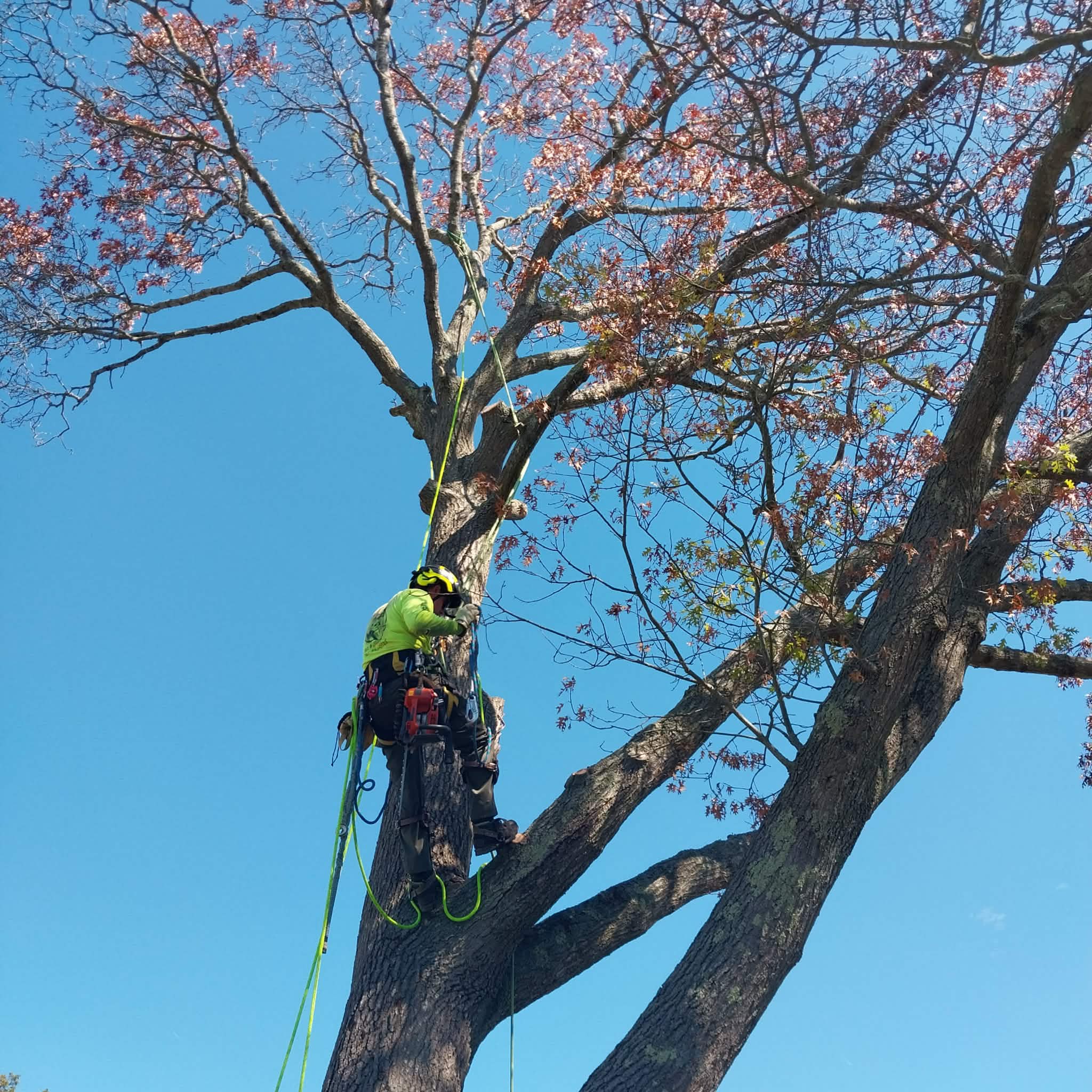
Southeast Arborist follows a meticulous, ANSI A300-compliant process for tree cabling in Fall River MA, adapted to local steep terrain and species. Our ISA Certified Arborists begin with a site assessment on your property. In The Highlands, we climb red oaks using rope access to evaluate codominant stems. Tools include resistographs for decay detection in white oaks and sonic tomographs for internal voids in Norway maples—essential given Fall River's aging trees.
Step one: Visual and instrumental inspection. We check for weak attachments per ISA Best Management Practices. In silver maple crotches common in the South End, we measure bark inclusion angles. Drones survey hilltop canopies in Steep Brook, spotting issues inaccessible by bucket truck. Soil probes assess root plate stability on clay-heavy slopes near Mount Hope Bay.
Step two: Risk analysis. Using the Matthew's Tree Risk Assessment method, we quantify failure probability. A leaning green ash in Flint Village, hit by emerald ash borer, might score high due to 30-degree trunk lean from bay winds. We calculate cable loads based on branch weight—up to 5 tons for mature London planes in Globe Village.
Step three: Customized design. For dynamic cabling, we select 1/2-inch to 3/4-inch EHS galvanized steel cables or synthetic polyester ropes, slackened 10-15% to allow movement. In American beech near Watuppa Ponds, we install spider bracing with turnbuckles for multi-point support. Static cabling suits rigid honey locusts in the North End, tensioned to 20% of breaking strength.
Step four: Precise installation. Rope access arborists ascend without spikes, protecting bark on red maples. We drill minimal 1-inch holes at 120-degree intervals, threading cables through. In steep Maplewood yards, portable winches tension from ground level. UV-resistant coatings prevent corrosion in Fall River's humid climate.
Safety protocols dominate. All work complies with OSHA and ANSI Z133 standards. Traffic control in busy South End streets uses certified flaggers. In Watuppa areas, we adhere to watershed no-disturbance buffers, hand-carrying gear up slopes.
Step five: Load testing and labeling. Post-installation, we verify tension with dynamometers, tagging cables with inspection dates. Red oaks in The Highlands receive annual program enrollment, scheduling checks before nor'easter season.
Maintenance follows. We train you to monitor for cable wear or tree growth over cables—common in fast-growing white pines. Pruning reduces wind sail on Mapleswood silver maples, extending cable life 15-20 years.
Equipment suits Fall River: compact bucket trucks navigate Flint Village alleys; all-terrain gear tackles Steep Brook inclines. Unlike generic crews, our ISA certification ensures science-backed results—cabling halves failure risk per studies.
For your property, this process preserves heritage without disruption. A Globe Village homeowner saved a 80-foot Norway maple, avoiding $8,000 removal. Schedule via 508-369-5009. Southeast Arborist's tree cabling process delivers lasting stability amid Fall River's winds and terrain.
Common Tree Cabling Projects in Fall River Neighborhoods
Fall River neighborhoods showcase distinct cabling needs tied to their trees and layouts. In The Highlands, oldest residential section, we cable century-old red oaks and Norway maples with split leaders from 1938 hurricane scars. Hilltop winds demand multi-cable arrays on codominant trunks, preserving shade over Victorian homes.
Maplewood's street trees—silver and red maples—frequently require support. Fast growth creates V-crotches; we install dynamic systems to prevent sidewalk cracks and roof strikes. A recent project braced two 60-foot silver maples, tensioned against bay gusts.
South End urban density means cabling over removal. White oaks near mills show decay; our bracing reinforces roots on compacted soils, avoiding utility conflicts. Emerald ash borer victims here get targeted cabling post-injection.
Flint Village's mixed canopy features white pines and American beech. Pines' heavy tops lean bayward; we use spider braces. Beeches on steep lots receive guy wires anchored into slopes, stabilizing against erosion.
Globe Village industrial edges host London planes and honey locusts. Brittle branches over streets get looped cabling, reducing pedestrian risk. Post-storm, we cabled a fractured plane, restoring traffic flow.
Steep Brook's terrain challenges access. Red maples on 25% slopes need rope-access cabling; no cranes fit. We supported a cluster during nor'easter recovery, using portaledges for height work.
North End near the bay sees white pines and green ash cabling. Borer-weakened ash get stem wraps; pines counter wind throw with high-tension lines.
Watuppa Ponds Area demands regulatory compliance. Mature oaks and beeches in the watershed receive low-impact bracing, preserving forest buffers. Selective cabling aids lot clearing for new builds, saving heritage specimens.
Common across neighborhoods: storm-response cabling post-gales, like after 2023 winds mirroring 1938. We serve adjacent Somerset, Swansea, Dartmouth, New Bedford, Taunton similarly.
Your neighborhood project starts with inspection. Call 508-369-5009 for Southeast Arborist to handle Fall River-specific cabling.
Tree Cabling Costs in Fall River, MA
Tree cabling costs in Fall River MA vary by project specifics, offering value over removal. Basic single-cable installation for a 40-foot red oak in The Highlands starts at $450-$750, including assessment and one-year warranty. Complex jobs—like multi-point bracing on a 70-foot Norway maple in Maplewood—range $1,200-$2,500.
Key factors: Tree size and species. Larger diameters (over 24 inches) in South End white oaks add $300-$600 for extra hardware. Brittle silver maples in Flint Village need premium synthetics, upping costs 20%.
Access challenges inflate prices. Steep Brook slopes require rope crews, adding $200-$400. Watuppa Ponds regulations mandate buffers, extending time.
Number of cables matters. Dynamic setups for codominant stems in Globe Village use 2-4 cables at $150 each. Annual inspections cost $150-$250, preventing $5,000+ failures.
Compared to removal—$1,500-$4,000 for a mature tree plus stump grinding—cabling saves 50-70%. No replanting ($500+) or permits needed. In Bristol County, preserved trees raise appraisals 10%, per realtor data.
Our transparent pricing: Free quotes factor local wind loads, soil, and species. ISA certification ensures no overages. Payment plans available for North End multi-tree projects.
Value shines long-term. A Steep Brook red maple cabling lasted 18 years, averting storm damage. Nearby Swansea clients report similar ROI.
Get your Fall River quote at 508-369-5009. Southeast Arborist delivers cost-effective tree cabling MA.
When to Schedule Tree Cabling in Fall River
Schedule tree cabling in Fall River MA during late spring (May-June) or early fall (September-October). Mild weather aids climbing on red oaks in The Highlands; avoid summer humidity stressing crews or winter ice on silver maples in the South End.
Urgency signs demand immediate action: Cracks or splits in Norway maple crotches, lean exceeding 15 degrees in Steep Brook white pines, or deadwood over 25% canopy in Flint Village green ash. Bay wind sway post-gust or included bark oozing signal cabling now.
Pre-nor'easter timing protects Watuppa Ponds beeches. Emerald borer dieback in the North End accelerates needs—inspect annually.
Our program flags urgency. Call 508-369-5009 anytime; we prioritize hillside risks.
Frequently Asked Questions About Tree Cabling in Fall River
What is tree cabling, and how does it work for Fall River trees? Tree cabling installs flexible steel or synthetic lines through drilled holes to support weak branch unions. In Fall River, it stabilizes Norway maples against Mount Hope Bay winds, allowing natural sway unlike rigid rods.
How long does tree cabling last on my property? Properly installed ANSI A300 cabling endures 15-25 years. Annual inspections by our ISA arborists adjust for growth on red oaks in The Highlands or corrosion in humid Steep Brook.
Is cabling better than tree removal in Maplewood? Yes, for healthy canopies. Cabling preserves shade, costs less than removal, and complies with Watuppa regulations, retaining your silver maple's value.
Will cabling damage my South End oak? No. Minimal 1-inch holes heal quickly; our techniques avoid spikes on bark. Dynamic slack prevents girdling.
How much does emerald ash borer affect cabling needs in Flint Village? Severely—borer weakens green ash stems 30-50%. We cable survivors post-treatment, reducing split risk.
Can you cable trees on steep Globe Village terrain? Absolutely, using rope access. No cranes needed for London planes.
What's involved in your annual inspection program? Visual checks, load tests, and growth adjustments for North End white pines. $150-$250 yearly.
Do you serve nearby towns like Swansea? Yes, from Somerset to Taunton, with Fall River expertise.
Contact 508-369-5009 for answers.
Tree Cabling Throughout Fall River
Southeast Arborist provides tree cabling across Fall River neighborhoods: The Highlands' heritage oaks, Maplewood maples, South End streets, Flint Village pines, Globe Village planes, Steep Brook slopes, North End ash, Watuppa Ponds forests. We extend to Somerset, Swansea, Dartmouth, New Bedford, Taunton.
Our Plymouth/Cohasset base ensures prompt South Shore response. ISA Certified, ANSI-compliant.
Protect your trees—call 508-369-5009 today for tree cabling Fall River MA.