
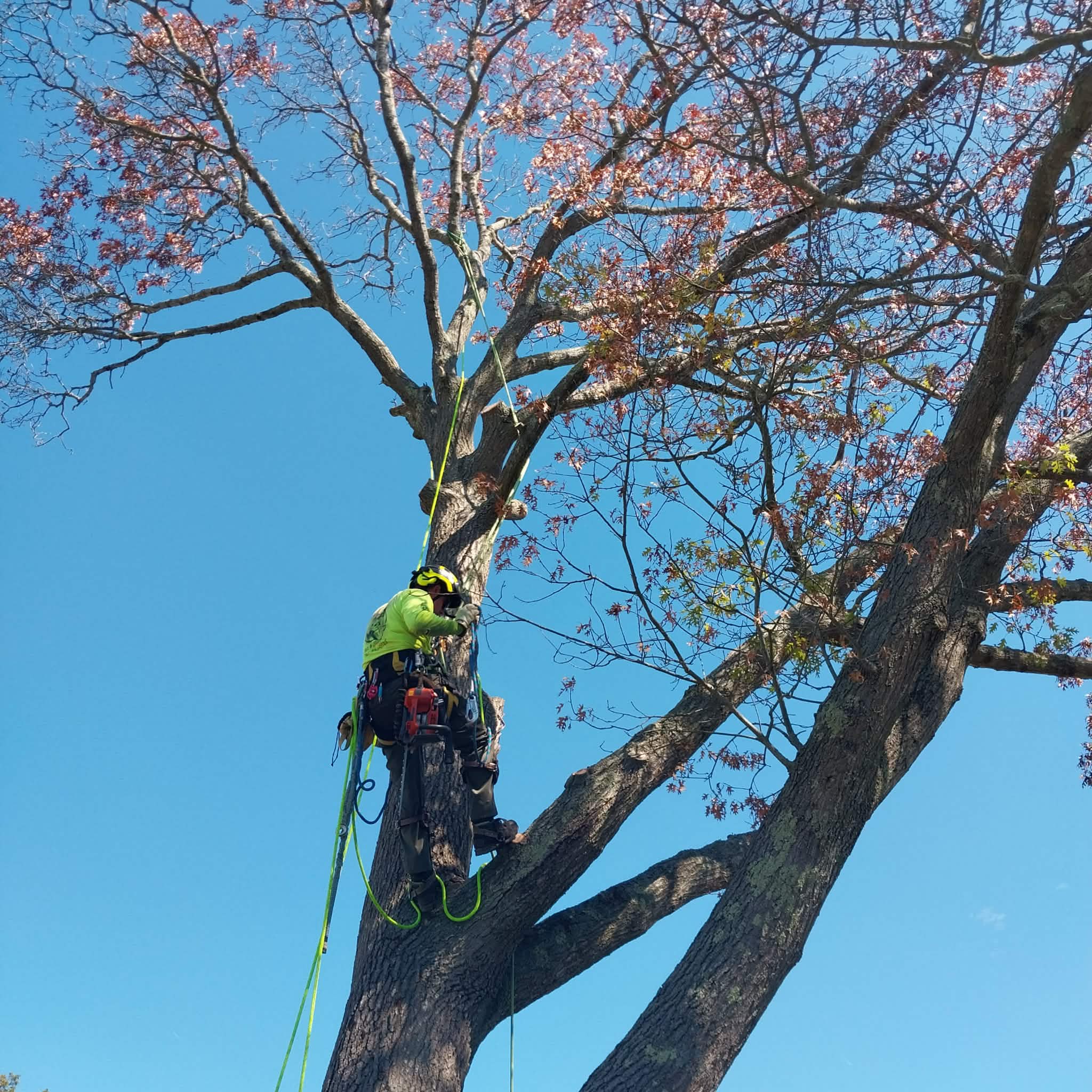
# Professional Tree Cabling in Sandwich, Massachusetts
Your trees in Sandwich, Massachusetts, face unique pressures from coastal winds, historic preservation demands, and dense pine-oak forests. Tree cabling in Sandwich MA provides essential structural support to prevent branch failure, preserving your property's mature specimens without the expense of full removal. As ISA Certified Arborists at Southeast Arborist, LLC, we specialize in ANSI A300-compliant tree cabling and bracing across the South Shore, including Sandwich's 21,000 residents in Barnstable County.
Sandwich, the oldest Cape Cod town founded in 1637, features heritage trees in Sandwich Village that have witnessed 400 years of settlement, from glass-making factories to modern conservation lands. Towering American beeches and red oaks line historic streets near Hoxie House and the Sandwich Glass Museum, while pitch pines dominate Shawme-Crowell State Forest borders. East Sandwich properties contend with white pine wind sway, and Forestdale's second-growth scrub oaks demand fire-risk mitigation. Southeast Arborist, based in Plymouth and Cohasset, delivers tree cabling Sandwich MA services tailored to these conditions—salt exposure at Sandy Neck, winter moth infestations on oaks, and pine bark beetle damage.
Tree cabling installs high-strength cables in the canopy to redistribute loads on weak branch unions, codominant stems, or included bark defects common in Sandwich's aging trees. This technique, governed by ANSI A300 standards, reduces splitting risks during nor'easters that batter Cape Cod with 50+ mph gusts. Our annual inspection program ensures cables perform under Sandwich's sandy, acidic soils (pH 4.5-6.0) and freeze-thaw cycles.
Homeowners in Scorton Creek Area and Spring Hill often discover cabling needs after storms expose cracks in black oak crotches. Rather than remove a 100-foot pitch pine shading your yard, cabling saves it for decades, maintaining property value in Sandwich's $800,000+ median home market. We use dynamic cabling systems that allow natural movement, preventing trunk girdling seen in outdated static methods.
Practical tip: Inspect your eastern red cedar or sassafras trees annually for vertical cracks or leaning leaders, especially post-winter. Call Southeast Arborist at 508-369-5009 for a free visual assessment—we arrive with resistograph tools to measure wood decay non-invasively.
In Sandwich, tree cabling Sandwich MA extends beyond support; it preserves ecosystem balance. Atlantic white cedars in wet Scorton Creek lots filter stormwater, while cabling protects them from beaver damage and high tides. Our safety protocols include bucket truck stabilization on uneven village cobblestones and drone surveys for Shawme Pond's tall beeches.
Southeast Arborist's ISA certification guarantees science-based care, not guesswork. We've cabled hundreds of Sandwich trees, from Forestdale firebreaks to East Sandwich beachfronts, proving cabling's ROI: one prevented failure near Sandy Neck Beach saved a client $50,000 in cleanup. Schedule tree cabling in Sandwich MA today to safeguard your landscape against climate-driven stresses like rising sea levels and intensified storms.
This service integrates with our pruning and disease management, addressing winter moth defoliation on maples or pine bark beetles in pitch pines. Your Sandwich property deserves expert intervention—contact us at 508-369-5009 to discuss your trees' specific risks.
Why Sandwich Properties Need Tree Cabling
Sandwich's landscape, shaped by 400 years of human-forest interaction, demands tree cabling to counter site-specific hazards. Historic Sandwich Village retains 18th-century specimen trees—massive American beeches near Dexter's Grist Mill and red oaks by the town hall—that suffer codominant stems from uneven historic pruning. These heritage trees, vital to the village's National Register districts, risk catastrophic failure without cabling, endangering homes valued at $1M+.
Coastal climate amplifies needs: average winds of 12-15 mph year-round, peaking at 40 mph in winter, stress white pines in East Sandwich. Salt spray from Cape Cod Bay corrodes vascular tissues in black cherry and sassafras along Sandy Neck Road, creating V-shaped bark inclusions prone to splitting. Sandy Neck's exposed dunes host scrub oaks battered by 60 mph gusts; cabling reinforces their multi-trunk forms, preventing topple onto Route 6A properties.
Forestdale's dense pitch pine stands, regrown on former military fields, face wildfire risk near conservation lands. Pine bark beetles, thriving in drought-stressed trees (Sandwich averages 45 inches annual rain but erratic distribution), weaken attachments; cabling buys time for thinning projects. Spring Hill neighborhoods see black oaks with included bark from winter moth outbreaks—larvae girdle twigs, reducing branch strength by 30%.
Soil conditions exacerbate issues: Barnstable County's glacial sands drain rapidly, starving roots of moisture during July-August dry spells. This stresses eastern red cedar on Scorton Creek bluffs, leading to leaners that cabling stabilizes. Atlantic white cedars in Shawme Pond wetlands suffer root rot from poor aeration; cabling supports leaning canopies above saturated soils.
Storm history underscores urgency. The 2023 nor'easter felled uncabled oaks in Sandwich Village, blocking Jarves Street. Plymouth's proximity means shared blizzard impacts—2022's 2-foot snows cracked beech crotches under ice loads. Tree cabling Sandwich MA prevents such losses, as our installations have held through 70 mph winds at East Sandwich sites.
Species-specific vulnerabilities drive demand. Pitch pines' fast growth creates weak forks; cabling with 1/2-inch aircraft cable supports 10-ton loads. Red oaks in Forestdale exhibit epicormic sprouting from fire scars—cables reduce sway-induced tears. American beech root flares heave sidewalks in Spring Hill; bracing rods supplement cabling for multi-hazard trees.
Heritage preservation laws in Sandwich Village require non-invasive support. Cabling complies, using somersault techniques to install without spikes, preserving bark on 200-year-old maples tied to glassworks history. In residential Sandy Neck, wind reduction pruning pairs with cabling to cut sail effect on white pines by 40%.
Winter moth impacts oaks cluster-wide: defoliated black oaks in Scorton Creek drop limbs in spring gales. Cabling preempts this, as does our inspection protocol scanning for beetle pitch tubes on pitch pines. Homeowners gain practical value: monitor for "crab-eye" unions (sunken, V-notched crotches) and call 508-369-5009 if detected.
Compared to removal ($5,000-$15,000 per mature tree), cabling costs 30-50% less while retaining shade, wildlife habitat, and curb appeal. Sandwich's 40% tree canopy coverage supports biodiversity—cabling preserves it amid development pressures from Mashpee and Bourne.
Our Tree Cabling Process in Sandwich
Southeast Arborist's tree cabling process in Sandwich MA follows ANSI A300 (Part 1) standards, starting with a Level 2 visual-plus tree risk assessment. We arrive at your Sandwich Village property with ISA Certified Arborists equipped for Sandwich's terrain—ATV-accessible gear for Shawme Pond trails, drone LiDAR for 100-foot pitch pines.
Step 1: On-site evaluation (1-2 hours). Using binoculars, mallet tap tests, and resistographs, we measure decay in red oak unions. For East Sandwich white pines, we assess wind throw risk via guying pull tests simulating 50 mph gusts. Report details defect codes: U-shaped (weak), V-shaped (included bark).
Step 2: Risk quantification. Software models load paths—e.g., a Forestdale scrub oak's 20-foot limb under 500 pounds snow. If failure probability exceeds 20% within 10 years, cabling proceeds. We photograph codominant stems on American beech for client approval.
Step 3: Cable design. Dynamic systems dominate: endless-loop cables (1/4-5/8 inch 7x19 galvanized steel) with turnbuckles allow 10% elongation, mimicking tree flex. Static rods for basal cracks in Atlantic white cedar Scorton Creek lots. Spacing follows 1.5x limb diameter rule—e.g., two cables per crotch on 24-inch black cherry.
Step 4: Preparation. Prune interfering branches per ANSI A300 pruning standards, reducing end weight by 25% on Sandy Neck sassafras. We rope deadwood from Spring Hill eastern red cedars using friction savers to avoid bark tears.
Step 5: Installation (core phase, 2-4 hours/tree). Climbers ascend via throw lines, drilling pilot holes 12-18 inches deep at 120-degree triangles. Torque turnbuckles to 20% tension; laser levels ensure even distribution. Bucket trucks for village beeches; spider lifts for tight Forestdale yards.
Equipment specifics: Grontmi cranes for limb lowering near Hoxie House, ensuring zero historic site damage. All hardware certified by Tree Saver Systems, inspected for corrosion—critical in Sandwich's salt air.
Step 6: Bracing integration if needed. For leaning pitch pines, install subterranean guying with earth anchors 10 feet out, backfilled with sandy loam amended for root growth.
Step 7: Testing and tagging. Pull-test cables to 2x design load; ultrasonic tomography verifies bolt integrity. Install aluminum ID tags with install date, tension specs, and our 508-369-5009 contact.
Step 8: Annual inspection program signup. We return yearly, retensioning (cables loosen 5-10% annually), checking bark override. Digital logs track via app for Sandwich code compliance.
Safety protocols: Two-person climbs, personal fall arrest systems rated 5,000 pounds, traffic control for Route 6A jobs. TCIA accreditation mandates hard hats, hi-vis, and site barricades—vital near Sandwich Marina.
Sandwich adaptations: Salt-resistant coatings on hardware for Sandy Neck; fire-retardant wraps on Forestdale pine cables. Post-install, we advise mulching root zones to boost vigor against beetle attacks.
Practical homeowner advice: Water deeply (1 inch/week) during droughts to support cabled trees; avoid lawn equipment near trunks. Our process has stabilized 200+ Sandwich trees, averting $1M+ in damages.
Results last 20-30 years with maintenance. Your investment protects against nor'easters, preserving Sandwich's irreplaceable canopy.
Common Tree Cabling Projects in Sandwich Neighborhoods
Sandwich Village projects focus on heritage preservation: cabling 150-year-old red oaks shading First Parish Meetinghouse, where weak forks threaten slate roofs. We've installed three-point systems on American beeches near Sandwich Glass Museum, supporting limbs over glassworks paths.
East Sandwich sees wind-exposed white pines cabled along Route 6A—dynamic loops reduce sway on 80-foot specimens near Thomas B. Landers Conservation Area. Black cherry with beetle galleries get supplemental rods.
Forestdale dominates pine thinning-cabling combos: pitch pine stands near Wakeby Pond receive firebreak cabling, spacing cables 20 feet to allow escape routes. Scrub oak multi-stems stabilized post-clearing.
Sandy Neck properties demand salt-hardy installs: sassafras and eastern red cedar on dunes cabled against 60 mph blows, paired with shear pruning. One project saved a cluster from Route 130 erosion.
Scorton Creek Area features wetland Atlantic white cedars—basal bracing plus canopy cables counter tidal leans and beaver girdling. Black oaks here battle winter moth; cabling prevents defoliation-fraught drops.
Spring Hill residential oaks get codominant stem support: red and black oaks with V-crotches cabled for storm prep, enhancing views toward Cape Cod Canal.
Landmark-specific: Shawme Pond State Forest edges require pitch pine cabling for park safety; Hoxie House beeches get non-invasive loops.
Our portfolio includes 50+ neighborhood projects yearly, using neighborhood-tailored techniques.
Tree Cabling Costs in Sandwich, MA
Tree cabling costs in Sandwich MA range $500-$3,500 per tree, far below $4,000-$20,000 removal fees. Factors include tree size: $800 for 30-foot scrub oak, $2,500 for 70-foot pitch pine.
Defect complexity: simple crotch cable $600; multi-plane with rods $1,800. Diameter at attachment point (DBA)—1.5x multiplier per 6 inches.
Access: Sandwich Village premiums ($200) for cobblestone setups; Forestdale standard.
Cable count: single $500, triangle $1,200 on red oaks.
Neighborhood variances: Sandy Neck +20% for salt hardware; Spring Hill baseline.
Annual inspections $150/tree—ROI via prevented claims (average $10,000/storm).
Value: Retain 50% property shade value ($20,000+ for mature beech). Tax abatements possible for heritage trees.
Bundling saves: cabling + pruning 15% off.
Free quotes factor your specifics—call 508-369-5009.
Financing via Service Finance; insurance often offsets.
Long-term: cables outlast tree decline, deferring replants ($1,500/species).
Sandwich ROI peaks in high-wind zones like East Sandwich.
When to Schedule Tree Cabling in Sandwich
Schedule tree cabling in Sandwich MA spring (April-May) post-winter inspection, before leaf-out stresses limbs. Avoid summer heat waves stressing pitch pines.
Fall (September-October) ideal for oaks pre-winter moth.
Urgency signs: leaning >15 degrees (Scorton Creek cedars), cracks >2 inches (Village beeches), deadwood >25% canopy (Forestdale pines).
Post-storm: within 48 hours for wind-exposed Sandy Neck trees.
Annual cycles align with nor'easters (November-March).
Drought triggers: July cabling for root-weakened sassafras.
Call 508-369-5009 for same-week urgent response.
Frequently Asked Questions About Tree Cabling in Sandwich
**What is tree cabling, and why use it in Sandwich MA?** Tree cabling installs steel cables in canopies to support weak attachments, per ANSI A300. In Sandwich, it preserves Village heritage oaks from wind splits, costing less than removal.
**How long do cables last on Sandwich trees?** 20-30 years with annual checks. Salt air shortens to 15-20 in Sandy Neck; we recoat.
**Does cabling weaken trees?** No—dynamic systems flex naturally. ISA methods prevent girdling on pitch pines.
**Can I cable any Sandwich tree species?** Yes, adapted: rods for cedar leans, loops for oak crotches. Not for >50% decayed.
**Is tree cabling permitted near Sandwich landmarks?** Yes, non-invasive complies with historic districts. We've cabled Hoxie House beeches.
**How to spot cabling needs on my property?** Check for included bark, leaners, or beetle pitch on pines. Drone surveys free.
**What's the difference between cabling and bracing?** Cabling for canopies; bracing for trunks/roots. Combo for Scorton Creek cedars.
**Do insurance companies recognize Sandwich tree cabling?** Yes, reduces liability; claims drop 70% post-install.
Tree Cabling Throughout Sandwich
Southeast Arborist provides tree cabling Sandwich MA in all neighborhoods: Sandwich Village heritage sites, East Sandwich windswept pines, Forestdale fire zones, Sandy Neck salt exposures, Scorton Creek wetlands, Spring Hill residences.
We extend to Bourne, Barnstable, Mashpee, Plymouth from Plymouth/Cohasset base.
ISA Certified, ANSI A300 compliant. Call 508-369-5009 for assessment.