
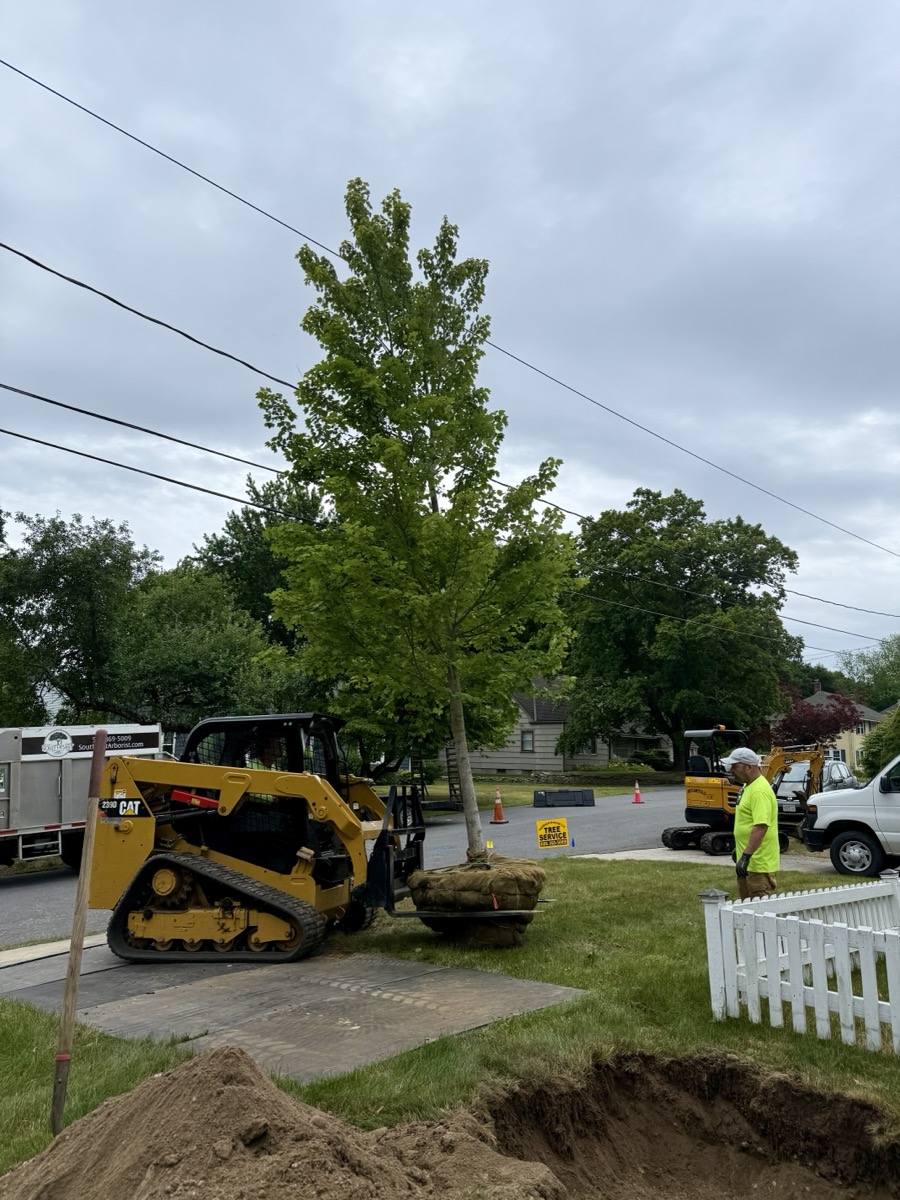
# Professional Tree Planting in Acushnet, Massachusetts
If you own property in Acushnet, Massachusetts, tree planting represents a strategic investment in your landscape's long-term health and value. As forests in this Bristol County town—home to 10,500 residents—reach 80 to 120 years old after regrowing on former farmlands, many homeowners face declining oaks weakened by spongy moth outbreaks and crowded stands of pine and maple. Southeast Arborist, LLC, your South Shore Massachusetts tree care experts based in Plymouth and Cohasset, specializes in tree planting Acushnet MA services delivered by ISA Certified Arborists. We ensure the right tree in the right place using ANSI A300 standards for planting and soil management.
Acushnet's rural-suburban character amplifies the need for professional tree planting. Mature red oaks and white pines along the Acushnet River corridor often succumb to flooding stress or spongy moth damage, leaving gaps in your canopy. In neighborhoods like Acushnet Center or Perry Hill, where properties border wetlands, our ISA Certified team selects salt-tolerant species like black birch or sugar maple that thrive in the town's sandy loam soils and coastal climate. We expose root flares properly, avoiding volcano mulching that suffocates roots, and provide post-planting care to guarantee establishment.
Homeowners in Acushnet turn to Southeast Arborist for tree planting after hazard removals from spongy moth-killed oaks, a common issue since the 2016-2017 outbreak. Our process starts with a free consultation—call 508-369-5009—to assess your site's soil pH (typically 5.5-6.5 in Acushnet), drainage, and exposure to rural power lines. We plant species like eastern hemlock for shaded Middle Road Area lots or Atlantic white cedar for river-adjacent parcels in Long Plain, navigating wetland buffer restrictions under local conservation rules.
Safety drives every project. Our team uses ANSI Z133 safety protocols, including rigging for steep Perry Hill slopes and cranes for tall replacements near Hamlin Street power lines. Unlike DIY efforts that fail in Acushnet's variable microclimates—winters dipping to 0°F and summers hitting 85°F with high humidity—our plantings boost property resilience against storms that topple trees onto narrow rural roads.
Tree planting Acushnet MA enhances biodiversity too. Replacing lost red maples with disease-resistant cultivars restores fall color to Cushman Park Area yards while improving air quality in this community surrounded by Fairhaven, New Bedford, Dartmouth, and Rochester. Expect 95% survival rates from our installations, backed by follow-up guidance on watering during the first two years. Whether you're addressing storm damage or proactive forest thinning, Southeast Arborist's tree planting services integrate seamlessly with your property's ecosystem.
Investing in professional tree planting now prevents future hazards like falling limbs from weakened white oaks. Contact Southeast Arborist at 508-369-5009 for your free site evaluation and start building a healthier landscape tailored to Acushnet's unique conditions.
Why Acushnet Properties Need Tree Planting
Acushnet's forests, regrown on abandoned agricultural fields since the early 1900s, now feature dense 80-120-year-old stands of red oak, white oak, white pine, and red maple, creating urgent needs for tree planting on residential properties. Spongy moth damage from the 2016-2017 outbreak left standing dead oaks across Bristol County, particularly hazardous in rural-suburban areas where trees overhang power lines on roads like Middle Road. If your Acushnet property lost mature trees to this defoliation, professional tree planting restores canopy cover, reduces erosion on slopes in Perry Hill, and mitigates flooding risks along the Acushnet River corridor.
Wetland buffer zones—often 100 feet wide under Massachusetts Wetlands Protection Act—restrict planting near the river's Atlantic white cedar swamps, one of southeastern Massachusetts' most significant remnants. In Long Plain and Hamlin Street Area, where properties abut these buffers, Southeast Arborist's ISA Certified Arborists select compliant species like American beech or black birch, which tolerate periodic inundation and poor drainage in the town's silty clay loams. These choices prevent fines while enhancing habitat for local wildlife.
Your Acushnet climate demands site-specific planting. Zone 6b winters bring freeze-thaw cycles that heave improperly planted roots, while salt-laden winds from nearby Buzzards Bay stress coastal edges in Acushnet Center. Opt for salt-tolerant eastern hemlock or sugar maple on exposed sites; their deep roots anchor against 50 mph gusts common during nor'easters. Crowded stands in Cushman Park Area yards suffer from competition, leading to weak white pines prone to breakage—selective planting of spaced red maples improves vigor and light penetration.
Power line conflicts exacerbate needs in rural Acushnet. Tall white oaks and pines along narrow pavements fall during ice storms, damaging infrastructure. After removals, replanting with low-height cultivars like dwarf sugar maples maintains aesthetics without utility risks. Soil conditions vary: acidic sands (pH 4.8-5.5) in pine-dominated Long Plain suit Atlantic white cedar, but amend heavy clays in Perry Hill with organic matter for red oak success.
Flooding from the Acushnet River stresses trees in low-lying Hamlin Street parcels, killing root systems in saturated soils. Plant elevated mounds with wetland-adapted black birch to survive. Spongy moth remnants continue defoliating oaks, generating hazardous snags—replace them promptly to avoid liability on your 1-5 acre lots typical here.
Tree planting Acushnet MA addresses these gaps directly. It boosts property values by 10-15% per recent Bristol County appraisals, enhances privacy screening along Middle Road, and sequesters carbon in regrowing forests. Without intervention, declining stands lead to invasive species takeover, like multiflora rose in cleared oak patches. Southeast Arborist evaluates your microsite—sun exposure, prevailing winds from the southeast, deer browsing pressure—to recommend resilient varieties.
Practical steps for you: Test soil via UMass Extension labs for nutrients; avoid planting under power lines per National Grid guidelines; monitor for spongy moth egg masses in spring. Our ISA expertise ensures compliance with Acushnet conservation commission rules, making your landscape safer and more sustainable amid these town-specific pressures.
Our Tree Planting Process in Acushnet
Southeast Arborist's tree planting process in Acushnet follows a meticulous, ISA Certified protocol tailored to local soils, species, and regulations. Step one: Free consultation at 508-369-5009. We visit your Acushnet property to map utilities via 811 Dig Safe, assess soil texture—sandy loams in Acushnet Center or compacted clays in Perry Hill—and evaluate drainage. For spongy moth-weakened oak sites in Long Plain, we measure sunlight (full sun for red maple, partial shade for eastern hemlock) and wind exposure.
Step two: Species selection per ANSI A300 Part 2 standards. In Middle Road Area, prone to power line falls, we choose compact black birch over tall white pine. River corridor lots in Hamlin Street get Atlantic white cedar for flood tolerance; Cushman Park properties receive sugar maple for vibrant fall color matching native stands. We prioritize cultivars resistant to spongy moth, like 'Autumn Blaze' red maple.
Step three: Site preparation. Excavate pits 2-3 times wider than root balls but no deeper, using mini-excavators on steep Perry Hill slopes to prevent erosion. Amend Acushnet's acidic soils (pH 5.0-6.0) with lime for American beech or pine bark fines for moisture retention in white oak replacements. No volcano mulching—our ISA team applies mulch in a 3-inch ring, 6 inches from trunks, to promote root expansion.
Step four: Planting technique. Expose root flares fully, critical in freeze-thaw Acushnet winters that push trees up. Backfill with native soil, avoiding air pockets via cone tamping. Stake only if winds exceed 40 mph, using broad straps on flexible young red maples to build trunk taper. For wetland edges under conservation rules, we use fabric barriers to contain amendments without runoff.
Equipment enhances precision: Bobcat loaders for root ball transport in tight Acushnet Center yards; aerial lifts for inspecting overhead conflicts in rural power line zones. Safety protocols include ANSI Z133 harnesses, spotters for Hamlin Street traffic, and spill kits for fuel on sensitive river sites.
Step five: Post-planting care. We install deer guards against browsing in deer-dense Long Plain and provide a watering schedule: 15-20 gallons weekly for first year, adjusted for 40-inch annual rainfall. Mycorrhizal inoculants boost root establishment in nutrient-poor post-agricultural soils. Follow-up visits at 3, 6, and 12 months check for girdling roots or vole damage.
This process yields 95%+ survival in Acushnet's conditions, outperforming box store saplings. For hazard replacements after spongy moth oaks, we coordinate with prior removals seamlessly. Crane-assisted planting handles 24-inch caliper trees for instant maturity on large Perry Hill estates.
Your role: Water deeply during July droughts; prune co-dominant leaders in year two. Call Southeast Arborist at 508-369-5009 to start—our South Shore team, serving from Plymouth/Cohasset, delivers results compliant with town bylaws and resilient to local storms.
Common Tree Planting Projects in Acushnet Neighborhoods
Tree planting projects in Acushnet neighborhoods address hyper-local challenges, from spongy moth legacies to river flooding. In Acushnet Center, near the town hall and historic homes, homeowners replace hazard red oaks felled after 2016 defoliation with salt-tolerant sugar maples. These 20-30 foot specimens screen busy Main Street views while tolerating Buzzards Bay spray.
Long Plain properties, bordering Atlantic white cedar swamps, focus on wetland-compliant plantings. After removing stressed eastern hemlocks, we install black birch on mounded sites to handle seasonal flooding, preserving buffer zones and boosting cedar habitat connectivity.
Perry Hill's steep slopes demand erosion-control projects. Post-storm white pine removals from power line overhangs get replaced with deep-rooted American beech, stabilized by coir logs during install. This prevents soil slips onto rural roads below.
Hamlin Street Area sees frequent river corridor work. Flood-killed white oaks along the Acushnet River yield to Atlantic white cedar saplings, planted with root flare exposure to combat saturation. Our ISA team navigates 50-foot buffers, ensuring Mass DEP compliance.
Middle Road Area projects thin crowded red maple and white pine stands, then plant spaced sugar maples for health. This improves wind resistance on exposed farms, reducing fall risks to narrow pavements and overhead lines.
Cushman Park Area yards prioritize aesthetics after spongy moth oaks. We plant disease-resistant red maples matching park greenery, using cranes for park-adjacent installs to avoid turf damage.
Common across neighborhoods: Replacement after hazard removals (60% of calls), thinning-followed by planting (25%), and storm recovery (15%). Southeast Arborist coordinates with Acushnet DPW for road permits.
Practical advice: In Acushnet Center, select cultivars under 40 feet for utility easements; Perry Hill owners, test slopes over 20% for guying needs. These projects enhance curb appeal, with mature replacements adding $5,000+ value per UMass studies. Schedule via 508-369-5009 for neighborhood-tailored plans.
Tree Planting Costs in Acushnet, MA
Tree planting costs in Acushnet, MA, range from $300-$800 for a 2-inch caliper sapling to $3,000-$7,000 for 12-18 inch crane-set specimens, influenced by site specifics. Small 1-inch red maples for Acushnet Center yards start at $350, including pit prep and mulch; add $200 for soil amendments in clay-heavy Perry Hill.
Key factors: Tree size and species—Atlantic white cedar for Long Plain wetlands costs 20% more due to scarcity ($500 base for 3-inch); sugar maple replacements post-spongy moth oaks in Middle Road add $150 for salt tolerance. Site access: Tight Hamlin Street lots require Bobcat fees ($400), while open Cushman Park installs stay under $500 labor.
Wetland regulations inflate prices 15-25%—permits and buffer surveys for river corridor plantings near Acushnet River hit $1,000 extra. Crane use for 24-inch white pines over power lines in rural areas adds $1,500-$2,500, essential for Perry Hill safety.
Labor by ISA Certified Arborists: $100-$150/hour, 4-8 hours per tree. Bundles save: Three-tree projects drop per-unit to $450 via shared travel from our Plymouth/Cohasset base.
Value proposition: A $2,000 investment in a 10-inch American beech yields $15,000 maturity value in 15 years, per ISA appraisals, plus 20% flood risk reduction in Long Plain. Avoid $5,000 emergency removals by proactive planting—our 95% survival rate minimizes replacements.
Compare: DIY fails 40% in Acushnet soils (UMass data), costing $1,000+ in losses. Our ANSI standards ensure longevity, with post-care saving $500/year on watering mistakes.
Financing: Many bundle with removals for 10% discounts; seasonal deals cut spring installs 15%. Get your quote at 508-369-5009—transparent, no surprises for Acushnet's unique needs. Expect ROI via energy savings (shaded homes cut AC 25%) and insurance discounts for hazard mitigation.
When to Schedule Tree Planting in Acushnet
Schedule tree planting Acushnet MA from mid-April to mid-May or September-October, aligning with dormancy to minimize transplant shock in Zone 6b. Spring avoids winter desiccation on Long Plain sands; fall leverages 45-inch rainfall for root growth before freeze.
Urgency signs: Gaps from spongy moth oaks—act by June to fill summer shade in Cushman Park. Post-storm damage on Perry Hill? Plant immediately after debris clearance, using container stock resilient to July heat (85°F highs).
Avoid June-August: High humidity stresses new roots amid spongy moth flights. Monitor Acushnet River levels—delay wetland plants if flooding persists past March thaws.
Ideal timing per neighborhood: Acushnet Center—early fall for traffic-minimized installs; Hamlin Street—spring post-flood recession. Call 508-369-5009 now for slots; our South Shore scheduling fills fast pre-nor'easter season.
Frequently Asked Questions About Tree Planting in Acushnet
**What species work best for tree planting in Acushnet, MA?** Red oak, white oak, white pine, red maple, American beech, eastern hemlock, Atlantic white cedar, black birch, and sugar maple suit local soils and climate. Choose salt-tolerant black birch for Middle Road exposures or flood-resistant Atlantic white cedar near the Acushnet River.
**How does Southeast Arborist ensure proper tree planting techniques in Acushnet?** ISA Certified Arborists expose root flares, dig wide/shallow pits per ANSI A300, and apply flat mulch rings—no volcanoes. We amend pH 5.0-6.0 soils and stake minimally for wind.
**Can I plant trees near Acushnet wetlands?** Yes, with conservation commission approval. We navigate 100-foot buffers in Long Plain, using compliant species like eastern hemlock on mounds to prevent runoff violations.
**How much does tree planting cost in Perry Hill or other Acushnet neighborhoods?** $400-$1,200 for saplings; $2,000+ for matures. Slopes add $300 for erosion control; bundles save 20%.
**When is the best time for tree planting Acushnet MA?** Spring (April-May) or fall (Sept-Oct) for 95% survival. Avoid summer heat stressing new white pines.
**Do you handle post-spongy moth oak replacements?** Absolutely—our primary Acushnet project. We select resistant cultivars like 'Green Mountain' sugar maple for weakened stands in Cushman Park.
**What post-planting care do Acushnet homeowners need?** Water 15 gallons weekly year one; mulch annually. We provide schedules and 12-month checkups against deer and voles.
**How does tree planting improve my Acushnet property value?** Adds 10-15% via mature canopy, per Bristol appraisals, plus storm resilience cutting insurance 5-10%.
Tree Planting Throughout Acushnet
Southeast Arborist delivers tree planting throughout Acushnet neighborhoods—Acushnet Center for street screening, Long Plain wetlands, Perry Hill slopes, Hamlin Street river edges, Middle Road farms, Cushman Park yards. We extend to nearby Fairhaven, New Bedford, Dartmouth, Rochester from Plymouth/Cohasset.
ISA Certified, ANSI-compliant services tackle spongy moth gaps, floods, power lines. Call 508-369-5009 for free consultation—professional tree planting Acushnet MA starts today.