
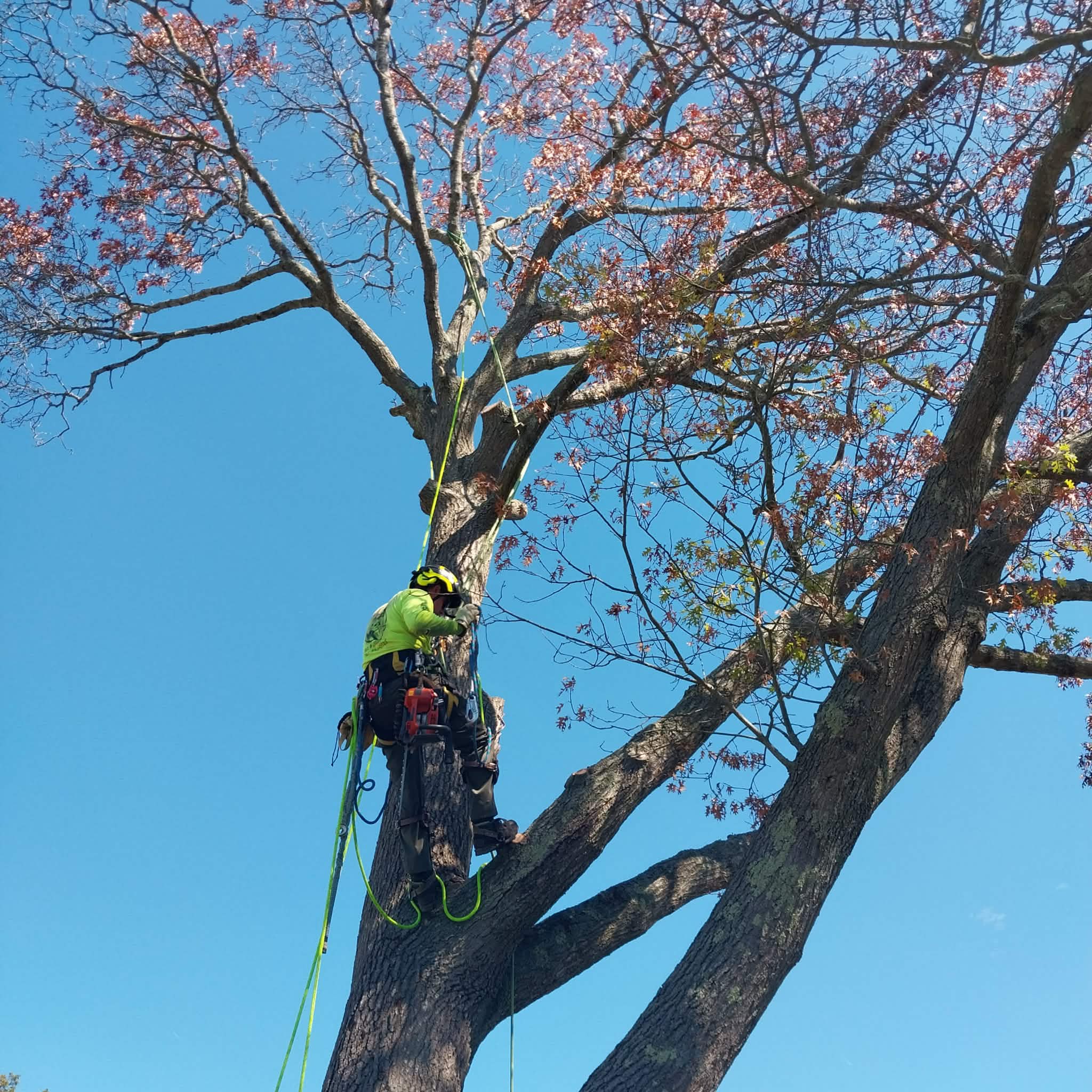
# Professional Tree Cabling in Rochester, Massachusetts
Your Rochester, MA property sits amid pitch pine barrens and oak woodlands that define this rural corner of Plymouth County. With 5,800 residents spread across neighborhoods like Rochester Center and Snipatuit Pond Area, your trees—red oaks, white pines, and Atlantic white cedars—face unique pressures from sandy glacial soils, spongy moth outbreaks, and proximity to cranberry bogs. Tree cabling in Rochester MA emerges as a critical service to support these mature trees, preventing failures that could damage your home, septic system, or rural driveway.
At Southeast Arborist, LLC, our ISA Certified Arborists deliver ANSI A300-compliant tree cabling and bracing across the South Shore, including Rochester 02770. Based in Plymouth and Cohasset, we serve your area with precision installations that reinforce weak branch unions and codominant stems. Unlike removal, cabling preserves heritage trees like the scarlet oaks lining Cranberry Highway or the tupelos near Snipatuit Pond, saving you costs while maintaining your property's forested character.
Rochester's forests, shaped by centuries of cranberry farming, feature pitch pine on drier uplands and Atlantic white cedar in wetlands. These species develop included bark weaknesses at crotches, especially after drought stress on sandy soils or defoliation from spongy moths. Our cabling installs dynamic steel cables or synthetic rods high in the canopy, allowing natural movement while limiting splitting risks during winter storms common to Plymouth County.
Homeowners in North Rochester or Dexter Lane Area often discover these issues during routine walks—cracked bark at branch forks or leaning leaders on red maples near power lines. Tree cabling Rochester MA addresses this directly, with our annual inspection program ensuring long-term stability. We comply with wetland regulations, coordinating with Rochester's conservation commission for bog-adjacent work.
Consider a red oak on your Mattapoisett Road Area lot: its heavy canopy, stressed by periodic droughts, risks failure onto your roof. Our cabling, installed per ANSI A300 standards, supports the tree without altering its form, preserving shade for your septic field and wildlife habitat. Safety protocols include bucket truck access on narrow roads and ground crew monitoring for falling debris.
Southeast Arborist's expertise extends to wildfire-prone pitch pine stands, where cabling maintains clearance around homes without full thinning. Call us at 508-369-5009 for a free assessment—our team evaluates soil acidity's impact on root stability and installs cabling that withstands South Shore winds. Rochester's transitional ecology, blending coastal pines with inland hardwoods, demands this targeted approach.
Investing in tree cabling Rochester MA protects your biggest asset. Mature black cherry or sassafras trees, integral to your woodland view, gain decades of life. Our service outperforms DIY braces, which fail under storm loads. Schedule with Southeast Arborist today to safeguard your Rochester property against the town's specific hazards.
Why Rochester Properties Need Tree Cabling
Rochester MA's rural landscape, dominated by cranberry bogs and pine barrens, creates distinct tree vulnerabilities that make cabling essential for your property. Sandy, acidic glacial soils drain quickly, stressing roots of red oaks and red maples during summer droughts, leading to weak upper structures. Pitch pines, prevalent in North Rochester's drier sections, form codominant leaders prone to splitting under ice loads from Plymouth County winters.
Spongy moth damage compounds this: outbreaks defoliate scarlet oak canopies, reducing branch weight temporarily but weakening attachments as regrowth occurs unevenly. Your Atlantic white cedar in Snipatuit Pond Area wetlands faces hydrology shifts from nearby bogs, causing root rot and top-heavy leans. Tree cabling Rochester MA stabilizes these without wetland disturbance, respecting buffer zones.
Wildfire risk in pitch pine barrens near Dexter Lane Area demands proactive support. Dense stands around your home or driveway risk ladder fuels; cabling allows selective reinforcement of hazard trees, maintaining clearance per Rochester fire department guidelines. White pines, with their flexible yet heavy branches, sway in coastal gales, abrading roofs along Cranberry Highway—cabling limits excessive motion.
Tupelo and sassafras, common on uplands between bogs, develop V-shaped crotches with included bark, invisible until failure. American holly and black cherry add diversity but suffer drought curl on sandy soils, cracking forks. Rochester's forest cover, preserved by its rural status, shelters wildlife, but failing trees near septic systems or roads pose liabilities.
Climate specifics amplify needs: average 45-inch rainfall concentrates in storms, saturating wetlands while upland pines dry out. Winter nor'easters topple weakened red maples, as seen post-2023 events. Tree cabling in Rochester MA prevents this, supporting stems at 40-60% of breaking strength per ANSI A300.
Proximity to cranberry infrastructure heightens urgency. Bog edges in Rochester Center require precise work to avoid hydrology impacts; our ISA Certified Arborists cable pitch pines overhanging ditches, preserving irrigation flows. Municipal hazard removals along rural roads like Mattapoisett Road highlight cabling's role—cheaper than takedowns for roadside oaks.
Your property's value ties to these trees: shade cools homes amid humid summers, and preserved woodlands boost appraisals in this 5,800-population town. Without cabling, spongy moth-stressed scarlet oaks drop limbs on power lines, incurring utility fees. Cabling offers storm prevention, often at half removal cost.
Practical advice: Inspect your Rochester trees annually for bark ridges at crotches, lean toward structures, or deadwood in pine tops. In pine barrens, thin understory first, then cable leaders. For wetland species like Atlantic white cedar, avoid soil compaction—our low-impact techniques ensure compliance.
Rochester's edge-of-pine-barrens position blends pine ecology with hardwoods, stressing hybrids like red maple-pitch pine mixes. Cabling adapts to this, using dynamic systems for wind flexibility. Southeast Arborist tailors to your site's soils, species, and bogs, ensuring resilient canopies.
Our Tree Cabling Process in Rochester
Southeast Arborist follows a meticulous, ANSI A300-compliant process for tree cabling Rochester MA, customized to your property's pitch pines, oaks, and cedars. We start with a site assessment by ISA Certified Arborists, evaluating Rochester's sandy soils and wetland buffers.
Step 1: Visual and instrument inspection (1-2 hours). Our team climbs or uses drones to target weak attachments—codominant stems on red oaks in Rochester Center or included bark in white pines near Snipatuit Pond. Resistograph probes measure wood density, sonar tomography detects internal decay in tupelos, and laser rangefinders calculate cable lengths for precise load distribution.
Step 2: Risk analysis per ISA Best Management Practices. We score failure probability: high for spongy moth-weakened scarlet oaks, moderate for drought-stressed red maples on Dexter Lane Area uplands. Soil probes check root plate stability on acidic sands, factoring cranberry bog proximity.
Step 3: Custom design. For pitch pine barrens in North Rochester, we specify 1/4-inch EIP steel cables or synthetic Fiberlight rods, placed 2/3 up the tree height. Dynamic cabling allows 10-15% sway, suiting South Shore winds. Wetland cedars get rod bracing to minimize ground disturbance.
Step 4: Preparation and safety setup. Ground crew establishes hot zones around your driveway or septic, using padded slings on narrow Mattapoisett Road Area lots. Bucket trucks with outriggers navigate rural terrain; climbing arborists wear harnesses and two-point tie-ins.
Step 5: Installation (2-4 hours per tree). Arborists drill minimal 1-inch holes at union angles, threading cables through sleeves to prevent girdling. Torque wrenches set tension to 40-50% breaking strength—critical for black cherry or sassafras crotches. We install turnbuckles for future adjustments, labeling with UV-resistant tags.
Step 6: Hardware specifics. ANSI A300 cabling uses galvanized aircraft cable for corrosion resistance in humid Rochester climates. Rod systems for multi-stemmed American hollies employ threaded ends with jam nuts. All meet TCIA standards, with proof-load testing on-site.
Step 7: Pruning integration. We remove deadwood and rubbing branches first, reducing wind sail on cabling oaks. This thins pine barrens clearances around homes, addressing wildfire risks.
Step 8: Annual inspection enrollment. Post-install, we schedule yearly checks—cable tension, bark inclusion, and hardware wear. Rochester's moth cycles and droughts necessitate this; alerts via app for your records.
Equipment highlights: John Deere 210K loaders for wetland access, Pixelite software for 3D modeling cable paths, and micro-drills for precise entry. Safety protocols include daily JSA meetings, PPE per OSHA 1910.269, and spotters for traffic on Cranberry Highway.
For storm-damaged trees post-nor'easter, we expedite: emergency cabling stabilizes leans on red maples. Your involvement: We walk you through findings, providing photos and reports for insurance.
This process preserves Rochester's heritage trees, from holly thickets to cedar swamps, at lower cost than removal. Call Southeast Arborist at 508-369-5009 to start your assessment.
Common Tree Cabling Projects in Rochester Neighborhoods
Rochester neighborhoods present tailored cabling needs tied to local ecology and land use. In Rochester Center, historic properties feature mature red oaks with codominant leaders; we cable these to protect colonial homes from limb drops during wet springs.
North Rochester's pine barrens host dense pitch pines crowding driveways—cabling leaders maintains 20-foot home clearances, reducing wildfire fuel. White pines here, stressed by spongy moths, receive multi-level cabling for split-prone crotches.
Mattapoisett Road Area sees red maples leaning over rural roads; our installations support them roadside, coordinating with town crews for safe access. Scarlet oaks nearby get rod bracing against ice storms.
Snipatuit Pond Area wetlands demand cabling for Atlantic white cedars with top-heavy canopies—low-ground-pressure mats prevent bog impacts, preserving hydrology buffers.
Dexter Lane Area uplands feature tupelo and sassafras groves near septics; cabling reinforces V-crotches, avoiding root disturbance on sandy soils.
Cranberry Highway properties battle wind-exposed black cherry and American holly; dynamic cabling allows sway while shielding roofs and power lines.
Common projects include: hazard cabling for municipal roadside oaks, bog-edge pine support in cranberry zones, and heritage tree preservation in centers. Southeast Arborist's ISA team handles 10-15 Rochester projects yearly, from single maples to woodland clusters.
Tree Cabling Costs in Rochester, MA
Tree cabling costs in Rochester MA vary by tree size, condition, and access, typically $500-$2,500 per tree—far below $3,000+ removals. Factors: diameter at breast height (DBH)—a 24-inch red oak in Rochester Center costs $1,200 for two cables; 40-inch pitch pine in North Rochester hits $2,000 with rods.
Species influence: Flexible white pines need less hardware ($800 average); rigid scarlet oaks require multi-plane setups ($1,500). Wetland cedars in Snipatuit Pond add $300 for compliance permits.
Access challenges: Narrow Dexter Lane roads add $200 for crane use; bog proximity in Cranberry Highway ups hydrology surveys to $150.
Installation scope: Single cable $600; full bracing with pruning $1,800. Annual inspections run $150/tree, preventing $5,000 failures.
Value proposition: Cabling extends tree life 20-30 years, preserving $50,000+ shade and appraisal boosts in Rochester's market. Avoids removal debris hauling ($1,000) and stump grinding ($400).
ROI example: Cable a leaning tupelo near your septic—$1,100 investment averts $10,000 repairs. Tax-deductible for heritage trees.
Southeast Arborist quotes transparently: Free assessments factor Rochester specifics like spongy moth history. Finance options available. Cheaper than stump grinding post-failure.
Compared to nearby Wareham or Middleborough, Rochester's rural access lowers crane fees 15%. Call 508-369-5009 for your quote.
When to Schedule Tree Cabling in Rochester
Schedule tree cabling Rochester MA in late spring (May-June) or fall (September-October), avoiding peak mosquito seasons near Snipatuit Pond and summer droughts stressing sandy soils. Winter (November-February) works for dormant trees, minimizing spongy moth interference.
Urgency signs: Bark cracks at oak crotches, leaning leaders on pitch pines after storms, deadwood clusters in white pines, or excessive sway in wind. Act post-nor'easter if red maples show splits.
Practical timing: Pre-winter for ice-prone scarlet oaks; post-moth defoliation for regrowth support. Annual checks in March catch drought effects on maples.
Don't delay bog-adjacent cedars—seasonal regs tighten. Southeast Arborist prioritizes Rochester properties; call 508-369-5009 now.
Frequently Asked Questions About Tree Cabling in Rochester
**What is tree cabling, and how does it help Rochester trees?** Tree cabling installs flexible supports in canopies to reinforce weak attachments, per ANSI A300. In Rochester, it stabilizes pitch pine leaders against wildfires and oak crotches post-spongy moths, preventing property damage.
**How long does cabling last on my Rochester property?** 20-50 years with annual inspections. Rochester's acidic soils accelerate hardware wear; our program adjusts tension yearly for red maples and cedars.
**Is cabling cheaper than tree removal in Rochester MA?** Yes, 40-60% less. Cabling a 30-inch scarlet oak costs $1,400 vs. $4,000 removal, preserving shade near your Cranberry Highway home.
**Do you need permits for tree cabling in Rochester neighborhoods?** Wetland projects near Snipatuit Pond require conservation commission approval; uplands like North Rochester don't. We handle filings.
**Can cabling save diseased trees like spongy moth-damaged oaks?** It supports structure but pairs with treatments. For your Dexter Lane oaks, cabling + injections extend life amid outbreaks.
**How does weather in Rochester affect cabling needs?** Droughts weaken roots on sandy soils; nor'easters split codom stem. Cable pre-storm for white pines in Mattapoisett Road Area.
**What maintenance follows cabling?** Inspect cables yearly, prune deadwood. Avoid attachments to hardware. Our ISA team services Rochester Center to bog edges.
**Is tree cabling safe for wildlife in Rochester's woodlands?** Yes, dynamic designs allow bird nesting. Preserves habitat for holly berries and tupelo fruits in pine barrens.
Tree Cabling Throughout Rochester
Southeast Arborist provides tree cabling across Rochester neighborhoods: Rochester Center heritage oaks, North Rochester pine clearances, Mattapoisett Road maples, Snipatuit Pond cedars, Dexter Lane tupelos, Cranberry Highway cherries. We extend to nearby Wareham, Middleborough, Acushnet, Carver.
From Plymouth/Cohasset base, we reach 02770 same-day. ISA Certified, ANSI A300 compliant. Protect your trees—call 508-369-5009 for service.