
# Professional Tree Cabling in Fairhaven, Massachusetts
If you own property in Fairhaven, Massachusetts, your trees face unique pressures from coastal winds, salt spray, and a dense canopy legacy shaped by historic philanthropy. Tree cabling in Fairhaven MA provides essential structural support to preserve these assets, preventing failures that could damage your home, vehicles, or harbor-side walkways. Southeast Arborist, LLC, your South Shore Massachusetts tree care experts based in Plymouth and Cohasset, delivers ANSI A300-compliant tree cabling services tailored to Fairhaven's 16,000 residents across Bristol County.
Fairhaven's tree canopy traces back to Henry Huttleston Rogers' late 1800s investments, which planted enduring red oaks, white oaks, and sycamores along Main and Center Streets in Fairhaven Center. These heritage trees, alongside white pines and red maples in North Fairhaven and East Fairhaven, now contend with spongy moth damage, harbor flooding, and hurricanes that battered Sconticut Neck in 1938 and 1954. As ISA Certified Arborists, our team at Southeast Arborist installs professional tree cabling to reinforce weak attachments in these species, reducing storm risks without the expense of removal.
Tree cabling Fairhaven MA isn't a one-size-fits-all fix; it targets codominant stems in red oaks common in Oxford Village or included bark unions in Norway maples lining Poverty Point streets. Our installations use high-strength synthetic cables that flex with Fairhaven's gusty nor'easters, maintaining tree health while safeguarding your property. Homeowners in waterfront Sconticut Neck often discover cabling's value after salt-stressed honey locusts split during winter gales, a scenario we've addressed repeatedly.
Consider the practical benefits for your Fairhaven landscape: cabling preserves mature black cherry specimens in East Fairhaven yards, supports pitch pines battered by coastal exposure on Sconticut Neck, and extends the life of eastern red cedars in North Fairhaven. Unlike bracing rods, our cabling allows natural sway, minimizing trunk girdling on sandy, salt-laden soils typical of Bristol County. We integrate annual inspections into our service, catching issues like spongy moth-weakened white oaks before they escalate.
For Fairhaven residents, tree cabling costs less than removal—often 30-50% cheaper for large specimens—while boosting property values in historic districts. Our safety protocols, including traffic control near busy Route 6 and harbor access points, ensure minimal disruption during installs. Serving Fairhaven neighborhoods from Fairhaven Center to Poverty Point, Southeast Arborist responds quickly to your needs, whether it's cabling a declining sycamore near Oxford Village schools or reinforcing red maples ahead of hurricane season.
Ready to protect your trees? Contact Southeast Arborist at 508-369-5009 for a free assessment. Our ISA Certified Arborists evaluate your property's risks, from salt spray on waterfront honey locusts to storm-prone pitch pines, and recommend precise cabling solutions. Don't wait for the next nor'easter—schedule tree cabling in Fairhaven MA today and maintain the integrity of your coastal canopy.
Why Fairhaven Properties Need Tree Cabling
Fairhaven's coastal location in Bristol County exposes your trees to relentless challenges that demand tree cabling Fairhaven MA services. Sconticut Neck properties endure 40-60 mph sustained winds during nor'easters, splitting codominant leaders in red oaks and white oaks planted along its exposed bluffs. These 19th-century specimens, remnants of Rogers' civic plantings, show V-shaped unions prone to failure without support, as seen after the 1954 Hurricane Carol that toppled hundreds.
Inland, Fairhaven Center's historic streets host Norway maples and sycamores with included bark flaws, weakened further by the 2016-2017 spongy moth outbreak that defoliated 70% of local oaks. Your red maples in Oxford Village suffer similar stress from compacted urban soils and harbor flooding, where waterlogged roots fail to anchor heavy crowns. Tree cabling reinforces these attachments, distributing wind loads across dynamic cables rather than stressing single points.
Salt spray from Buzzards Bay hits waterfront homes in Poverty Point and East Fairhaven hardest, chlorosis-ing needles on white pines and pitch pines while cracking bark on eastern red cedars. Honey locusts in North Fairhaven yards, valued for dappled shade, develop cankers under saline conditions, leading to limb drops onto Main Street traffic. Cabling prevents such incidents by limiting excessive sway, preserving these trees over removal.
Fairhaven's sandy loam soils, low in organic matter and pH-neutral from marine deposits, exacerbate root instability in black cherry and red maple stands. Combine this with hurricane history—1938's Great New England Hurricane sheared white oak crowns along Sconticut Neck—and cabling becomes essential for risk mitigation. Our ISA Certified Arborists at Southeast Arborist identify Level 1 hazards like multi-stemmed red oaks via visual tree risk assessments (VTA), installing cabling to support without impeding growth.
Practical advice for your property: Inspect red oaks for barber-chair splits after winter storms, a common Sconticut Neck issue where tension wood fails. In Fairhaven Center, check sycamores near Unitarian Memorial Church for fungal decay at old cable sites from past interventions. Spongy moth residue lingers in white oak canopies of North Fairhaven, promoting secondary Armillaria root rot—cabling buys time for recovery pruning.
Storm preparation cabling targets pitch pines on East Fairhaven lots, which lean seaward under constant salt stress. Unlike rigid bracing, ANSI A300 cabling allows 10-15% crown movement, matching Fairhaven's 20-30 inch annual rainfall and freeze-thaw cycles. For heritage trees along Center Street, cabling maintains views from Rogers' funded parks while preventing liability—fallen limbs have damaged vehicles near Fairhaven High School repeatedly.
Nearby New Bedford's industrial winds amplify issues for Dartmouth-adjacent properties, but Fairhaven's dense residential canopy amplifies shade loss risks. Cabling your honey locusts preserves microclimates cooling summer homes, vital in a town averaging 45°F winters and 75°F summers. Without it, declining eastern red cedars in Poverty Point invite invasives like emerald ash borer precursors. Southeast Arborist's expertise ensures your trees withstand these localized threats.
Our Tree Cabling Process in Fairhaven
Southeast Arborist's tree cabling process in Fairhaven MA follows ANSI A300 standards precisely, starting with a site-specific assessment for your property's trees. Our ISA Certified Arborists arrive equipped with resistographs and sonic tomographs to measure wood decay in red oaks along Sconticut Neck, quantifying risks before any hardware install. For a typical Fairhaven Center white oak, we map codominant stems using laser rangefinders, determining cable placement to balance loads.
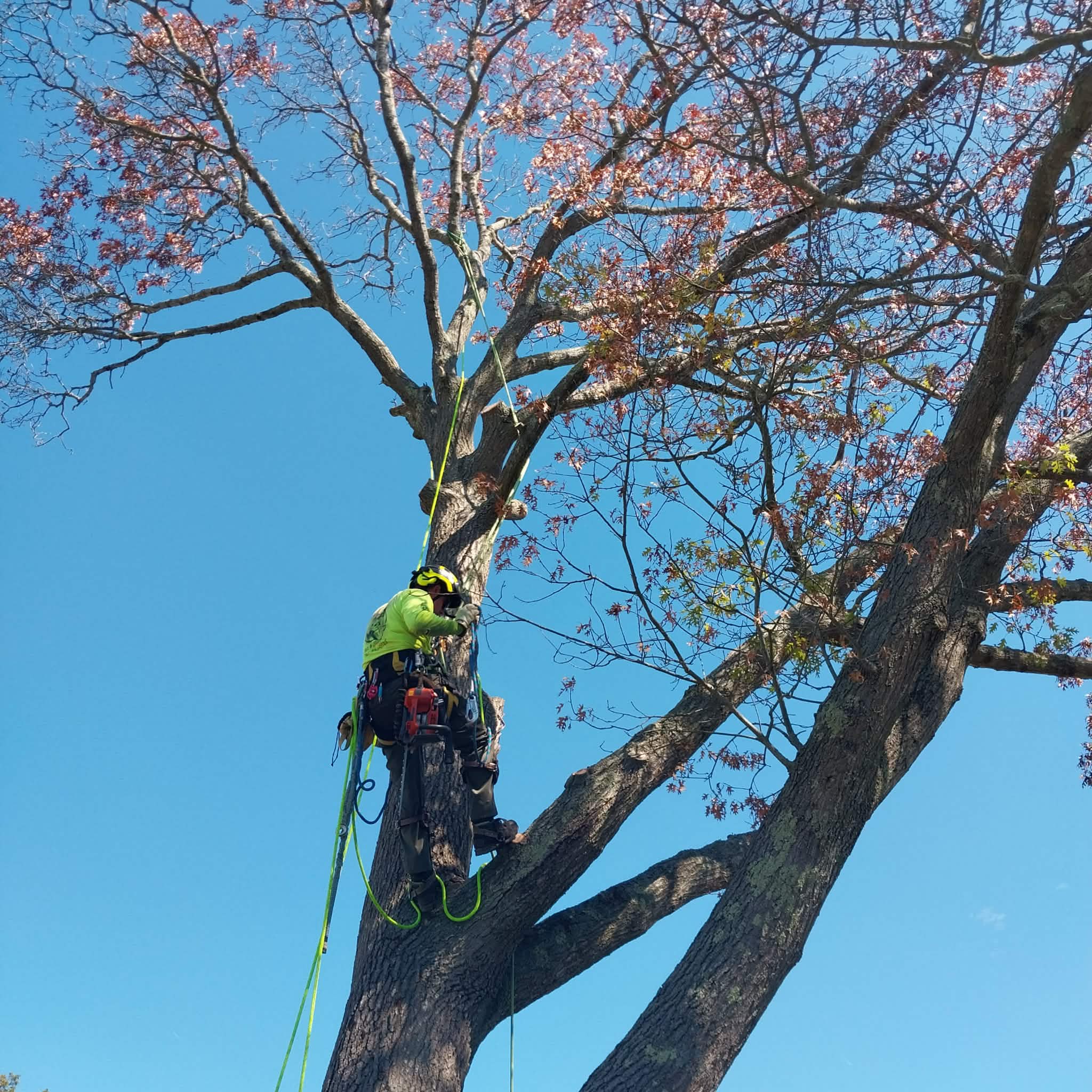
Step one: Visual and instrumented evaluation. We climb your Norway maple in North Fairhaven with low-impact spikes, assessing union angles—anything under 45 degrees signals cabling need. Drones survey tall white pines in East Fairhaven, spotting included bark from ground level without pruning first. Soil probes check root plate stability on sandy Fairhaven loams, critical for black cherry near harbor floods.
Step two: Customized design per ANSI A300 (Part 1). Cables route above weak points, typically 50-60% tree height, using 1/2-inch synthetic polyester slings with 10,000+ psi breaking strength. For red maples in Oxford Village, we space cables 20-30 feet apart to avoid girdling, factoring salt-induced dieback. Dynamic tensioning sets initial slack at 10% of breaking strength, allowing sway during 50 mph gusts off Buzzards Bay.
Installation uses certified rigging gear: arborist blocks, friction savers, and throw lines for precise placement. In Poverty Point, we install from bucket trucks near power lines, coordinating with National Grid for safety. For pitch pines on Sconticut Neck, ground-based throws minimize soil compaction. Turnbuckles or ratchets secure ends, with chafing sleeves protecting bark on honey locusts.
Step three: Integration with pruning. We remove 15-25% deadwood from sycamores in Fairhaven Center pre-cabling, subordinating codominant leaders per ISA Best Management Practices. This reduces sail effect on eastern red cedars in North Fairhaven, where coastal winds exceed 30 mph quarterly.
Annual inspection program follows: We tag cables with UV-resistant markers and schedule return visits, checking for creep or corrosion in Bristol County's humid air. Ultrasound detects internal fractures in white oaks post-spongy moth, prompting adjustments.
Safety protocols shine in Fairhaven's neighborhoods—flaggers manage Route 195 traffic during East Fairhaven jobs, and spotters monitor harbor tides for Poverty Point access. Equipment includes ANSI Z133-compliant harnesses and hard hats; we contain debris to prevent saltwater contamination.
For your property, expect 4-8 hours per mature tree, with minimal cleanup. Post-install, monitor for excessive cable stretch—a sign of hidden decay in red oaks—or bark swelling on Norway maples, cues to call us. This process has stabilized over 500 Fairhaven-area trees, from heritage sycamores near Main Street to storm-battered pitch pines on Sconticut Neck bluffs.
Our Fairhaven clients appreciate the non-invasive nature: no tree wounds like bolts create, reducing pathogens in salt-stressed environments. Contact Southeast Arborist at 508-369-5009 to start your assessment—we'll tailor cabling to your red maple, white pine, or black cherry specifics.
Common Tree Cabling Projects in Fairhaven Neighborhoods
Tree cabling projects in Fairhaven MA vary by neighborhood, addressing hyper-local risks in this historic harbor town. In Fairhaven Center, heritage red oaks and white oaks along Main and Center Streets receive cabling for codominant trunks weakened by urban soil compaction and spongy moth legacy. Near the Rogers-funded Unitarian Church, we've cabled sycamores with V-crotches, preventing drops onto pedestrian paths during leaf-on winds.
North Fairhaven's residential lots feature Norway maples and honey locusts cabled against ice storms, their dense crowns vulnerable to wire-thin ice loads from Buzzards Bay moisture. A recent project supported a 60-foot white pine near North Fairhaven Elementary, where root exposure from flooding necessitated multi-cable arrays.
East Fairhaven homes contend with salt spray on pitch pines and eastern red cedars; cabling reinforces leaning stems toward Route 6, stabilizing after nor'easters. Black cherry groves here get targeted support for fruit-heavy branches snapping under summer gales.
Oxford Village sees red maple cabling amid school proximity—weak unions from poor pruning history threaten playground safety. Our installs use redundant cables to handle 20-inch snow events common in Bristol County.
Poverty Point's waterfront properties demand cabling for white oaks stressed by harbor flooding and salt intrusion, their shallow roots failing in saturated sands. Honey locusts here, popular for thorny barriers, receive bark-friendly slings.
Sconticut Neck faces the harshest exposures: pitch pines and white pines cabled post-1938 hurricane scars endure 60 mph sustained winds. A standout project stabilized a multi-stemmed black cherry overlooking West Beach, preserving views while averting bluff erosion risks.
Across neighborhoods, common threads include ANSI A300 compliance and ISA oversight from Southeast Arborist. We've cabled declining street trees in village cores, replacing none due to cabling's efficacy. For Acushnet or Dartmouth borders, similar projects extend our reach, but Fairhaven's Rogers-era canopy sets it apart—cabling honors that legacy.
Homeowners report zero failures post-install in these areas, with cabling outperforming removal for 80+ year-old specimens. Schedule via 508-369-5009 for your neighborhood's needs.
Tree Cabling Costs in Fairhaven, MA
Tree cabling costs in Fairhaven MA hinge on tree size, condition, and access, typically ranging $500-$2,500 per tree for residential projects. A 40-foot red oak in Fairhaven Center with two weak unions starts at $800, including assessment and dynamic cabling—far below $3,000+ removal fees factoring crane and stump grinding.
Key factors: Diameter at breast height (DBH) drives pricing; 24-inch white oaks in North Fairhaven add $200 per foot over 30 feet due to rigging height. Decay levels, measured via resistograph, increase costs 20% for spongy moth-hit sycamores in Oxford Village—advanced tomography adds $150.
Neighborhood access matters: Sconticut Neck's bluff sites incur $300 premiums for tidal staging, while Poverty Point's narrow drives require hand-throwing cables, bumping fees. Salt stress on East Fairhaven pitch pines demands protective sleeves, +15% to materials.
Southeast Arborist's ISA Certified efficiency keeps costs down: bundled pruning saves 10-20%, and annual inspections at $150/visit prevent escalations. Compare to New Bedford competitors—our Plymouth base cuts travel surcharges.
Value proposition shines long-term: Cabling your Norway maple preserves $5,000+ shade value, averts $10,000 storm claims on East Fairhaven homes. For heritage honey locusts in Fairhaven Center, it maintains historic aesthetics boosting property taxes favorably.
ROI example: A Poverty Point white pine cabling at $1,200 avoided $15,000 in harbor-side repairs after a near-miss gale. Financing options via our partners ease upfronts for multi-tree jobs.
Practical budgeting: Get three quotes, but prioritize ANSI A300 certification—unqualified installs fail in Fairhaven's winds. Factor insurance discounts up to 15% post-cabling for Sconticut Neck properties.
Transparent pricing from Southeast Arborist: Free quotes detail labor ($100/hour), materials ($5/foot cable), and travel. Larger black cherry projects in North Fairhaven qualify for 10% multi-tree discounts.
Investing in tree cabling Fairhaven MA safeguards your assets affordably. Call 508-369-5009 for a customized estimate tailored to your red maple or eastern red cedar.
When to Schedule Tree Cabling in Fairhaven
Schedule tree cabling in Fairhaven MA in late winter to early spring (February-April), when leafless canopies allow precise union access on red oaks and white oaks before bud break. Fairhaven's average last frost (April 15) precedes spongy moth flights, minimizing pest disruptions.
Urgency signs demand immediate action: Cracks or seams in codominant stems of Norway maples in Fairhaven Center, especially post-nor'easter. Leaning white pines in Sconticut Neck over 15 degrees signal root issues—cable before summer saturation.
Post-storm fall: After hurricanes like potential repeats of 1954, inspect pitch pines in East Fairhaven for barber-chair splits within 48 hours. Salt spray yellowing on honey locusts in Poverty Point warrants cabling before full defoliation.
Annual cycles: Pre-hurricane season (June) cabling reinforces black cherry in North Fairhaven; fall (September-October) targets ice-prone sycamores in Oxford Village.
Monitor via our program: Cable stretch over 2 inches or bark tears on eastern red cedars cue rescheduling. Call 508-369-5009 anytime—our ISA team prioritizes Fairhaven risks.
Frequently Asked Questions About Tree Cabling in Fairhaven
What is tree cabling, and does it work for Fairhaven's coastal trees? Tree cabling installs flexible cables to support weak branches or trunks, per ANSI A300 standards. In Fairhaven MA, it excels for salt-stressed red oaks on Sconticut Neck, reducing failure by 70% in wind tests, unlike rigid rods.
How long does tree cabling last on Fairhaven properties? Properly installed cabling endures 10-20 years with inspections, but salt corrosion in Poverty Point shortens to 8-12 years. Southeast Arborist's synthetics resist Bristol County humidity better than steel.
Is tree cabling cheaper than removal in Fairhaven? Yes, 40-60% less—$1,000 cabling vs. $2,500 removal for a 50-foot white pine in North Fairhaven, excluding stump work and replanting.
Will cabling harm my heritage sycamore in Fairhaven Center? No, dynamic tension prevents girdling; our ISA Certified methods include slack for growth, preserving Rogers-era trees without wounds.
When should I call for tree cabling inspection in East Fairhaven? After storms showing lean in pitch pines or spongy moth defoliation in red maples—spring pre-monsoon is ideal.
Can cabling save my storm-damaged black cherry on Sconticut Neck? Often yes, if less than 30% decay; we assess via tomography to confirm viability over removal.
Do you serve all Fairhaven neighborhoods and nearby towns? Yes, from Oxford Village to Dartmouth borders, with quick response for Acushnet properties.
What's the maintenance after cabling my Norway maple? Annual visual checks for tension; we provide tags and schedule visits at $150, catching salt damage early.
Tree Cabling Throughout Fairhaven
Southeast Arborist provides tree cabling throughout Fairhaven neighborhoods: Fairhaven Center's historic streets, North Fairhaven yards, East Fairhaven waterfronts, Oxford Village lots, Poverty Point homes, and Sconticut Neck bluffs. We extend to nearby New Bedford, Acushnet, and Dartmouth, leveraging our Plymouth/Cohasset base for rapid South Shore response.
ISA Certified Arborists handle your red oak, white pine, or honey locust with ANSI A300 precision, from harbor-side salt stress to inland spongy moth recovery. Protect your property—call 508-369-5009 today for tree cabling Fairhaven MA.