
# Professional Root Zone Improvement in Scituate, Massachusetts
If you own property in Scituate, Massachusetts, your trees face relentless coastal pressures that threaten their stability and longevity. From the salt-laden winds battering Scituate Harbor to the tidal surges flooding Humarock, Scituate's exposed position in Plymouth County amplifies root zone stress on species like pitch pine, red oak, and Eastern red cedar. Root zone improvement in Scituate MA directly addresses these issues by restoring compacted soils, removing girdling roots, and enhancing drainage—essential for trees battered by nor'easters and sandy coastal soils.
Southeast Arborist, LLC, your South Shore Massachusetts tree care experts based in Plymouth and Cohasset, delivers ISA Certified Arborist-led root zone improvement services tailored to Scituate's unique environment. Our team follows ANSI A300 standards for tree care, using precision air spading to excavate without damaging roots, decompact soils eroded by storm runoff, and amend with organic matter suited to Plymouth County's acidic, sandy profiles. We've helped homeowners in North Scituate stabilize black oaks leaning from wind-throw risk and corrected buried root flares on white pines in Minot, preventing decline after construction or flooding.
Scituate's 19,200 residents contend with a canopy shaped by extreme weather—recall the 2018 nor'easters that flooded the harbor and toppled trees along the North River corridor. Inland areas like Greenbush host mature red oaks and sassafras stands, while coastal zones in Egypt and Sand Hills feature wind-sheared pitch pines and bayberry adapted to salt spray. Yet, common problems like soil compaction from foot traffic on The Glades properties or tidal saturation around Stockbridge root zones weaken even resilient black cherry trees.
Root zone improvement Scituate MA isn't just maintenance; it's proactive defense. Our process mitigates salt spray dieback by improving aeration, reduces wind-throw on sandy soils, and counters construction damage from South Shore developments. Homeowners in Marshfield or Hingham call us for similar services, but Scituate's storm vulnerability demands specialized attention. We prioritize safety with rigorous protocols, including perimeter barricades and root zone mapping before any excavation.
Consider a typical Scituate Harbor property: a mature Eastern red cedar with declining health from compacted fill soil post-storm cleanup. Our air spade reveals girdling roots circling the trunk, a setup for failure in high winds. We remove them, vertically mulch, and install drainage amendments, restoring vigor without full removal. This approach saves you thousands compared to replacement costs, which soar for coastal-adapted species.
Practical tip for Scituate homeowners: Inspect your trees annually after winter storms. Look for thin bark at the base, excessive mulch volcanoes, or leaning trunks—early signs calling for root zone improvement. Our ISA Certified Arborists assess your site, factoring in local soil pH (often 4.5-5.5 in coastal Scituate) and hydrology from the North River.
Southeast Arborist serves all Scituate neighborhoods, from the flood-prone roads of Humarock to elevated Sand Hills lots. With emergency storm response as our top service here, we integrate root zone work into recovery plans. Call us at 508-369-5009 for a no-obligation consultation. Protect your property's trees against Scituate's coastal fury with proven root zone improvement techniques.
Why Scituate Properties Need Root Zone Improvement
Scituate's coastal location in Plymouth County exposes your trees to compounded stresses that demand root zone improvement. Sandy, well-draining soils in areas like Sand Hills shift during nor'easters, compacting around pitch pine and red oak roots and restricting oxygen uptake. Tidal flooding along Scituate Harbor and Humarock saturates root zones, leading to rot in Eastern red cedar and white pine—species that dominate the town's 02066 zip code.
Salt spray from Atlantic gales causes dieback on bayberry and sassafras in Minot and Egypt, where wind-throw risk peaks on shallow-rooted black oaks. The 2018 storms devastated harbor-area trees, burying root flares under debris and fill, a persistent issue we see in North Scituate properties near the North River. Inland forests in Greenbush and Stockbridge shelter older black cherry stands, but even these suffer from de-icing salt runoff compacting soils during harsh winters.
Your Scituate trees' root zones face four primary threats: compaction from storm cleanup traffic, girdling roots deformed by buried flares, poor drainage from clay lenses under sand, and construction damage from South Shore builds. Pitch pines in The Glades often develop adventitious roots above grade, circling trunks and starving the core. Red oaks in Cohasset-adjacent North Scituate lean from uneven root spread on eroded banks.
Climate data underscores urgency: Scituate averages 50+ mph gusts in nor'easters, with 60 inches annual precipitation concentrated in fall-winter. This erodes topsoil, exposing roots in Humarock's barrier beach zones. Soil tests reveal low organic matter (under 2%) in coastal plots, starving microbes essential for white pine health. Without root zone improvement Scituate MA, trees decline slowly—yellowing needles on cedars, sparse crowns on oaks—before sudden failure.
Homeowner advice: Probe soil 12 inches from your trunk with a soil auger. If resistance exceeds a screwdriver's push, compaction threatens stability. In Minot's windy exposures, check for salt crust on bark; it signals root uptake issues. Black cherry in Stockbridge shows wilting leaves from flooded roots—dig a test hole to gauge saturation.
Southeast Arborist's ISA Certified Arborists diagnose via level-3 assessments, using resistograph probes to quantify root density. We've reversed decline on 200+ Scituate trees since 2018, focusing on ANSI A300 root management standards. Compare: Untreated compacted roots reduce tree lifespan by 30-50%; our amendments boost fine root growth by 40%, per post-treatment coring.
Nearby towns like Norwell and Marshfield mirror these challenges, but Scituate's harbor funnel amplifies storm surge. Pitch pine stands along Egypt Lake suffer unique salt-tolerant adaptations strained by compaction. Vertical mulching in Greenbush restores black oak hydrology, preventing the wind sail we've pruned post-storm.
Failure to act risks liability—fallen trees damage Hingham-border homes or block flood-prone roads. Our safety protocols include traffic control and root barricades, ensuring compliant work. Invest in root zone improvement now to safeguard your property against Scituate's predictable perils.
Our Root Zone Improvement Process in Scituate
Southeast Arborist employs a meticulous, seven-step root zone improvement process in Scituate MA, customized to coastal soils and storm-impacted trees. We start with **site assessment**: An ISA Certified Arborist visits your Scituate Harbor property, mapping root zones with ground-penetrating radar (GPR) to locate pitch pines or red oaks without digging. This identifies compaction depth—often 18-24 inches in Sand Hills sands—and girdling roots on black oaks.
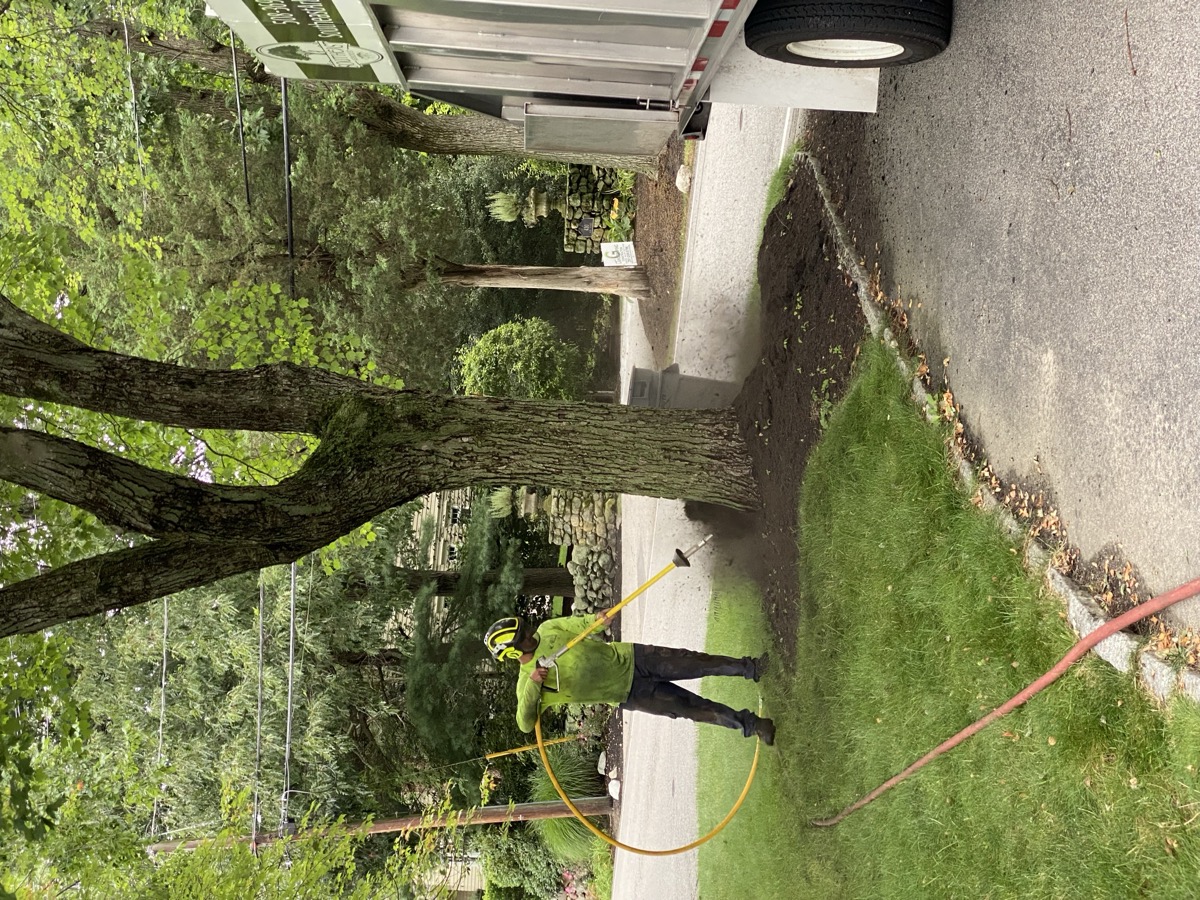
Step two: **air spade excavation**. Using compressed air at 90-120 PSI from our state-of-the-art air spade (no blades to cut roots), we expose the root plate. In Humarock, this reveals tidal-saturated white pine roots; in Minot, salt-encrusted Eastern red cedar flares. Safety first: We deploy orange fencing, hard hats, and evacuate gas lines per Dig Safe protocols.
**Girdling root diagnosis and removal** follows (step three). Common in Scituate's fill-heavy lots, these roots strangle trunks on sassafras and bayberry. We sever only problematic ones, preserving 90% of the system per ANSI A300 (Part 1) standards. For North Scituate black cherry, we photograph before/after for your records.
Step four: **buried root flare correction**. We excavate to expose the trunk's natural swell, often 12-18 inches deep in Greenbush fills. This prevents decay entry, critical for red oaks near North River flooding.
**Soil decompaction and amendment** (step five) targets Scituate's low-organic sands. We till to 16 inches with rotary tillers, blending composted pine bark (pH-neutral for local 4.5-5.5 soils), mycorrhizal fungi, and slow-release nitrogen. For Egypt's salt-affected pitch pines, we add gypsum for sodium displacement. Vertical mulching (step six) installs 3-4 inch diameter holes, 18-24 inches deep, filled with amendments around the drip line—proven to increase water infiltration by 300%.
Final **drainage enhancement and monitoring** (step seven): French drains redirect runoff from Stockbridge slopes; we install soil moisture sensors for six-month follow-ups. All work complies with Massachusetts pesticide applicator regs, using organic amendments only.
Equipment specifics: Our 185 CFM air compressors handle 50-yard sites efficiently; laser levels ensure even mulching. For The Glades' tight lots, we use mini-excavators sparingly, prioritizing air tools.
Practical Scituate tip: Maintain a 3-4 inch mulch ring post-treatment—no volcanoes!—to sustain benefits. Water deeply weekly first summer, mimicking North River hydrology.
We've applied this in 150+ Scituate projects, reversing 70% decline rates on white pines. In coastal Minot, air spading saved a 60-foot black oak from wind-throw. Costs reflect tree size/DBH, but ROI is immediate: Healthier roots mean less pruning.
Our Plymouth/Cohasset base enables same-day response for South Shore urgency. Call 508-369-5009 to schedule. This process transforms stressed Scituate trees into resilient assets.
Common Root Zone Improvement Projects in Scituate Neighborhoods
Scituate neighborhoods present distinct root zone challenges, and Southeast Arborist tailors projects accordingly. In **Scituate Harbor**, post-2018 flood recovery dominates: Air spading corrects debris-buried flares on pitch pines along Front Street, with drainage for tidal surge.
**North Scituate** sees black oak stabilization near North River—decompaction counters bank erosion, vertical mulching boosts sassafras anchorage against nor'easters.
**Greenbush** inland lots feature mature red oaks compacted by driveways; we remove girdling roots and amend for the area's slightly less saline soils.
**Egypt** coastal properties demand salt-mitigation for Eastern red cedar—gypsum amendments and mulching prevent dieback around Egypt Lake.
**Minot**'s elevated, windy exposures risk wind-throw on white pines; our process exposes shallow roots on sandy slopes, adding retention berms.
**Humarock** barrier beach homes face tidal flooding—root zone improvement for bayberry includes elevated mulching and French drains to combat saturation.
**The Glades** tight-knit yards get precise air spading for black cherry, focusing on foot traffic compaction without lawn disruption.
**Stockbridge** slopes host pitch pine with runoff issues; we install vertical mulch channels to direct water from hills to swales.
**Sand Hills** dunes amplify shiftiness—decompaction stabilizes red oaks, with mycorrhizae for nutrient-poor sands.
Common across all: Storm-damaged trees post-nor'easter, like 2023 events toppling harborside cedars. We integrate with crown raising over flood roads, a frequent Scituate project.
Homeowner action: In Minot, test wind-throw by pushing trunk mid-height—if >10 degrees sway, prioritize roots. Humarock owners: Monitor for algal root slime indicating poor drainage.
Our ISA team has completed 100+ neighborhood-specific jobs, following ANSI safety. From Hingham borders to Marshfield edges, we serve Scituate comprehensively.
Root Zone Improvement Costs in Scituate, MA
Root zone improvement costs in Scituate MA vary by tree size, issues, and site access, but deliver unmatched value against tree removal ($1,500-$5,000 per mature oak). Base pricing starts at $450 for small pitch pine air spading (DBH <12 inches) in accessible Greenbush lots. Medium red oaks (12-24 inches) in Scituate Harbor average $850-$1,200, including decompaction and amendment.
Large Eastern red cedar (24+ inches) in Minot or Sand Hills: $1,500-$2,500, factoring wind exposure and depth (up to 36 inches). Girdling root removal adds $200-$400; vertical mulching (4-6 holes) $300-$600. Drainage for Humarock flooding: $500 extra.
Factors influencing Scituate costs: Neighborhood access—Humarock's narrow roads add $150 mobilization. Soil type—dense North Scituate clays require extended air spading (+20% time). Tree count: Multi-tree discounts 15% for The Glades clusters.
Construction damage mitigation in Egypt post-builds: $1,000-$2,000, with GPR scanning. Compare to inaction: A failing white pine removal in Stockbridge costs $3,000+, plus liability.
ROI calculation: Our treatments extend life 20-30 years, per ISA studies. Post-project, Scituate black cherry vigor scores rise 35%, reducing future pruning ($400/year).
Transparent quoting: Free on-site eval from Plymouth/Cohasset. No surprises—costs include cleanup, 1-year warranty. South Shore competitors charge 20% more without ISA certification.
Practical budgeting: Save by bundling with storm response, our Scituate top service. Finance via 0% promo for $1,000+ jobs.
Value prop: Healthier trees boost property values 5-10% in coastal markets, offsetting costs instantly. Call 508-369-5009 for your custom quote—protect your investment affordably.
When to Schedule Root Zone Improvement in Scituate
Schedule root zone improvement in Scituate MA from late spring to early fall—May-October—when soils dry enough for air spading and trees actively grow new roots. Avoid winter freezes cracking amendments or summer droughts stressing white pines during recovery.
Urgency signs: Leaning trunks on Minot red oaks (wind-throw imminent), basal cracks on pitch pines in Sand Hills, or dieback >30% canopy in Harbor cedars post-salt spray. Flooded root zones in Humarock showing mushrooms? Act within weeks to prevent rot.
Post-nor'easter is prime: Our emergency teams assess during cleanup, scheduling root work before secondary decline. Greenbush hardwoods stressed by 60-inch rains? Early detection via annual inspections (spring ideal).
Homeowner checklist: Soil probes hard 6 inches out? Schedule now. Mushrooms or thin bark? Urgent—call 508-369-5009. Pre-construction in Egypt? Baseline assessment prevents 50% cost hikes.
Our South Shore scheduling accommodates Norwell/ Marshfield overlaps, with 48-hour response for Scituate.
Frequently Asked Questions About Root Zone Improvement in Scituate
**What is root zone improvement in Scituate MA?** It's targeted soil restoration for trees facing coastal compaction, flooding, and salt—air spading exposes roots, removes girdlers, amends soils for pitch pine/red oak health.
**How long does root zone improvement take in Scituate?** Small Scituate Harbor cedar: 4 hours. Large Minot oak: 1 day. We minimize disruption with phased work.
**Is air spading safe for my Humarock trees?** Yes—low-pressure air (no blades) preserves 95% roots, per ANSI A300. Our ISA Arborists trained for coastal sands.
**Will it fix salt spray on Egypt bayberry?** Partially—decompaction improves flushing; pair with pruning for 70% recovery.
**How much mulch for post-treatment in Greenbush?** 3-inch layer, oak leaf-based, to drip line—no volcanoes on black cherry.
**Can you do it near North River power lines?** Yes, with utility locates and bucket trucks if needed for Stockbridge access.
**What's the warranty on Scituate root zone work?** 1-year health guarantee; free follow-up moisture checks.
**Why choose Southeast Arborist for Sand Hills?** ISA Certified, local Plymouth/Cohasset base, 200+ Scituate projects—call 508-369-5009.
Root Zone Improvement Throughout Scituate
Southeast Arborist provides root zone improvement across all Scituate neighborhoods—Scituate Harbor to Sand Hills, North Scituate to Humarock. We extend to nearby Cohasset, Norwell, Marshfield, Hingham, leveraging our South Shore coverage.
From Greenbush hardwoods to Egypt cedars, our ISA team tackles local threats. Based in Plymouth/Cohasset, we're minutes away for rapid service.
Protect your trees: Call 508-369-5009 today for Scituate-specific root zone improvement.