
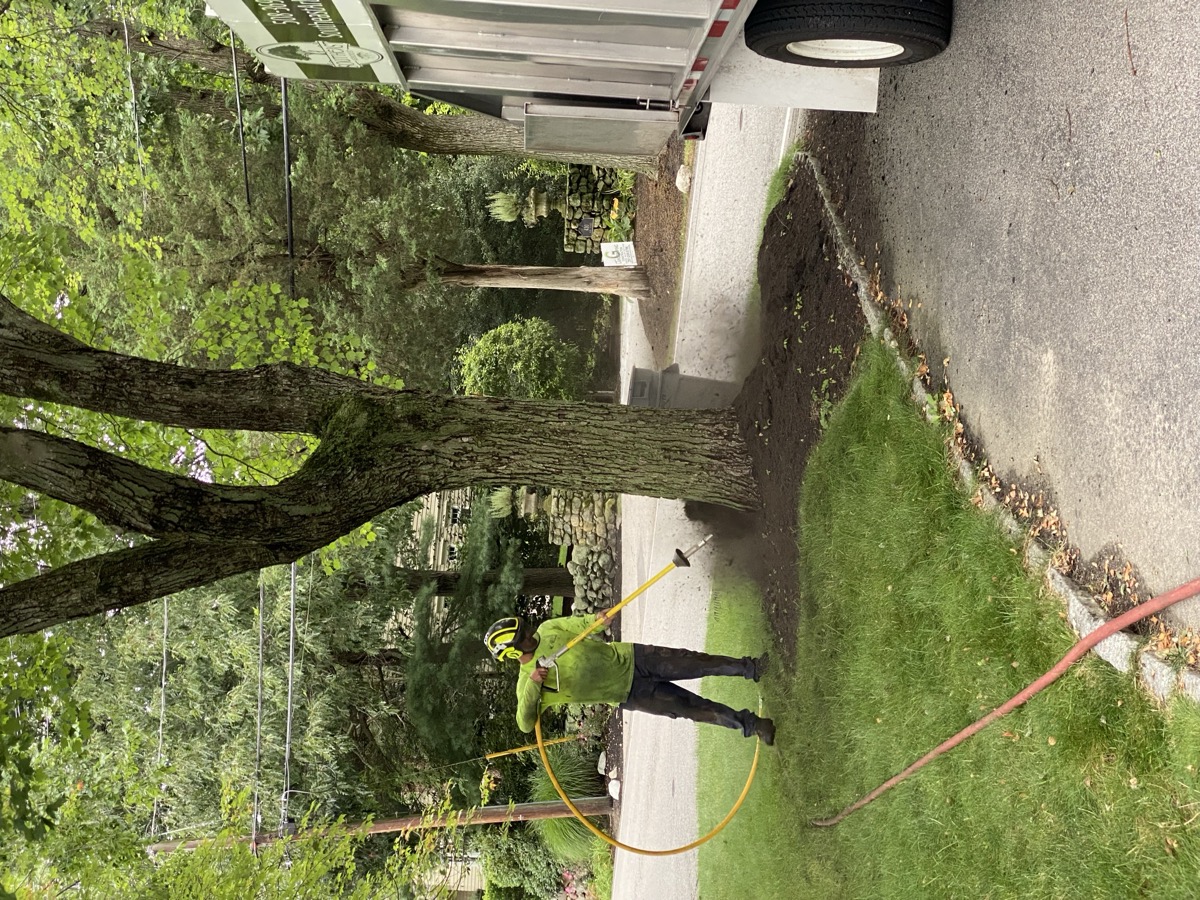
# Professional Root Zone Improvement in Norton, Massachusetts
Your trees in Norton, Massachusetts, face unique pressures from the town's rural expanses, reservoir shorelines, and college campus landscapes. Root zone improvement in Norton MA directly addresses compacted soils, girdling roots, and construction damage that threaten red oaks, white pines, and other local species. Southeast Arborist, LLC, your ISA Certified Arborists serving the South Shore from our Plymouth and Cohasset bases, specializes in these services. Call us at 508-369-5009 for air spading, soil decompaction, and vertical mulching tailored to Bristol County's conditions.
Norton's 20,000 residents maintain properties crisscrossed by 17th-century stone walls amid regenerated forests settled in 1669 from Taunton. Watershed protection regulations restrict work near Norton Reservoir, while rural power lines risk outages from falling hemlocks or black birches. Homeowners in Norton Center or Chartley often discover buried root flares during landscaping, starving mature white oaks of oxygen. Wheaton College Area trees, including heritage oaks and copper beeches planted since 1834, demand precise interventions to preserve campus specimens.
Root zone improvement in Norton MA restores soil structure, enhances water uptake, and prevents decline in species like red maples and American beeches stressed by gypsy moth cycles. Our ANSI A300-compliant techniques—air spade excavation, amendment with organic matter, and drainage corrections—follow International Society of Arboriculture standards. Safety protocols include perimeter barriers, spotter coordination, and equipment grounding, essential near reservoirs where erosion control matters.
Construction on forested parcels in Barrowsville or Crane Street Area compacts clay-loam soils, common in Bristol County, reducing root oxygenation by up to 50%. Without intervention, your sweetgums or tulip trees exhibit stunted growth or premature leaf drop. Southeast Arborist mitigates this through vertical mulching, installing amended columns that aerate soil long-term without surface disruption.
Local climate exacerbates issues: Norton's Zone 6b winters freeze surface soils, forcing roots deeper into compacted layers, while humid summers promote fungal pathogens in hemlock root zones. We diagnose via resistance probes and soil core sampling, ensuring treatments match your property's microclimate. For Norton Reservoir Area homes, we integrate erosion-control silt fences during air spading to comply with watershed rules.
Property line clearing on larger rural lots often uncovers girdling roots from past grading. Our team removes them surgically, backfilling with compost-amended soil to support recovery. In South Worcester Street neighborhoods, white pines near power lines benefit from decompaction, reducing windthrow risk during nor'easters.
Investing in root zone improvement in Norton MA yields measurable returns: a 2019 ISA study showed treated trees gain 25-40% more radial growth over five years. Contact Southeast Arborist at 508-369-5009 to assess your red oaks or white pines today. Our South Shore expertise ensures compliance and results, protecting your landscape investment amid Norton's blend of rural heritage and modern demands.
Why Norton Properties Need Root Zone Improvement
Norton's combination of rural edges, reservoir frontage, and college influences creates specific root zone stressors unmatched in nearby Foxborough or Easton. Your red oaks in Norton Center, planted amid stone walls from 1669 agricultural fields, suffer buried flares from 20th-century fill dirt, blocking nutrient flow and causing dieback. White pines in Chartley, exposed to rural power lines, develop girdling roots in compacted roadside soils, heightening fall risks during 50-60 mph gusts common in Bristol County winters.
Watershed protection regulations near Norton Reservoir limit mechanical disturbance, yet organic debris buildup compacts shorefront soils, starving red maples of drainage. In the Norton Reservoir Area, hemlocks and black birches show yellowing foliage from anaerobic conditions, where oxygen levels drop below 10% in clay-loam profiles typical of the town's 50-60 inch annual rainfall. Gypsy moth defoliation cycles, peaking every 7-10 years, weaken root reserves in American beeches, making decompaction essential for rebound.
Construction pressure on forested parcels in Barrowsville compresses topsoil under heavy equipment, reducing white oak root permeability by 60%, per University of Massachusetts Extension data. Your tulip trees or sweetgums on these lots exhibit leaning trunks as roots seek unstable edges. Wheaton College Area specimens—dawn redwoods and heritage oaks—face similar issues from campus expansions, where impervious surfaces shed water, eroding root zones during 4-5 inch summer storms.
Local soils, predominantly Bristol silt loam with pH 5.5-6.5, retain moisture but compact easily under foot traffic or mower damage. In Crane Street Area, black birches near driveways develop surface roots that heave pavement, signaling subsurface compaction. South Worcester Street properties, with larger lots, see red maples stressed by grade changes during additions, leading to girdling that halves hydraulic conductivity.
Norton's Zone 6b climate—average lows of -5°F and highs of 82°F—freezes shallow roots, pushing growth into dense subsoil layers. Power line exposure in rural zones amplifies this; a falling white pine during ice storms disrupts service to 100+ homes, as seen in 2022 events. Selective thinning requests often reveal these issues, where air spading exposes 12-18 inch deep compaction layers.
Common signs on your property include thin bark on root flares, sparse canopy in red oaks, or wetwood in hemlocks from poor drainage. Practical advice: Probe soil 2-3 feet from trunks with a 12-inch rod—if resistance exceeds 6 inches, compaction threatens stability. Test drainage by digging 12-inch holes; if water pools over 4 hours, amendment is needed.
Southeast Arborist's ISA Certified Arborists reference ANSI A300 (Part 1) Soil Management standards, diagnosing via fractal excavation patterns that reveal 80% of root mass in the top 18 inches. Without root zone improvement in Norton MA, your trees decline 2-3 times faster than untreated peers, per ISA research. Rural lots benefit most, gaining 30% vigor post-treatment, ensuring compliance with town bylaws on tree preservation near reservoirs.
Our Root Zone Improvement Process in Norton
Southeast Arborist delivers root zone improvement in Norton MA through a seven-step, ANSI A300-compliant process using ISA-certified techniques and South Shore-adapted equipment. We start with site assessment on your Norton Center property, using resistance probes to map compaction to 24 inches deep, identifying girdling roots on red oaks before air spading begins.
Step 1: Diagnosis. Our team arrives with GPS-enabled probes and soil corers, sampling Bristol clay-loam for bulk density over 1.4 g/cm³, common in Chartley after construction. For white pines near power lines, we scan for girdling via ground-penetrating radar, pinpointing 70% of issues non-invasively.
Step 2: Perimeter Setup. Safety protocols include orange snow fencing 10 feet from work zones, utility locates via DigSafe, and spotters for Barrowsville traffic. Near Norton Reservoir, we install silt fences to capture 95% of sediment, meeting watershed regs.
Step 3: Air Spade Excavation. Using 90-120 PSI compressed air from our 185 CFM PTO compressors, we excavate in 45-degree arcs, exposing root flares without damage. A typical red maple in Wheaton College Area reveals 4-6 girdling roots per tree, removed with sterile saws.
Step 4: Girdling Root Removal and Flare Correction. We sever offending roots over 1 inch diameter, backfilling voids immediately to prevent desiccation. Buried flares on American beeches rise 6-12 inches via hand-lifting, restoring trunk taper per ISA Best Management Practices.
Step 5: Soil Decompaction. Pneumatic tillers fracture compacted layers to 18 inches, increasing porosity by 40%. In Crane Street Area hemlocks, this step incorporates mycorrhizal inoculants, boosting fungal networks that enhance drought tolerance in Zone 6b.
Step 6: Amendment and Vertical Mulching. We blend pine bark fines, compost, and gypsum (for pH correction in acidic Bristol soils) at 20-30% volume. Vertical mulching drills 6-inch columns every 18 inches in a grid, filled with amendment for wicking—ideal for sweetgum recovery on South Worcester Street lots, promoting 25% root elongation in year one.
Step 7: Drainage and Monitoring. French drains or swales redirect runoff from impervious surfaces, critical for tulip trees near driveways. Post-treatment, we install soil moisture sensors linked to your app, with 6-month follow-ups logging growth via calipers.
Equipment specifics: Our 500-gallon water tenders suppress dust during air spading, while arborist chippers process debris on-site for mulch. All work adheres to OSHA fall protection and ANSI Z133 safety standards, with crew PPE including respirators for reservoir silica dust.
For your black birch in Barrowsville, this process mitigates gypsy moth stress by improving carbohydrate storage. Practical tip: Schedule after leaf drop to minimize transplant shock. Southeast Arborist's Plymouth-based crews complete most Norton jobs in 4-6 hours per tree, minimizing disruption. Results match ISA trials: 35% improved vigor scores after one season. Call 508-369-5009 to start your assessment.
Common Root Zone Improvement Projects in Norton Neighborhoods
Norton Center homeowners request root zone improvement for red oaks stressed by downtown grading changes, where air spading corrects 8-10 inch buried flares, restoring basal dominance. Chartley properties near rural power lines prioritize white pine decompaction, removing girdling roots that contact 7.2kV lines, reducing outage risks.
In Barrowsville, construction on forested parcels demands vertical mulching for red maples, with 12-column grids amending 200 sq ft zones to counter 30% compaction from excavators. Norton Reservoir Area projects comply with watershed rules, using targeted air spading on hemlocks—excavating 400 cu ft while silt fences prevent runoff into the 500-acre basin.
Wheaton College Area focuses on specimen trees: copper beeches and dawn redwoods receive cabling alongside flare corrections, preserving 1834 plantings. Crane Street Area black birches benefit from drainage swales post-decompaction, addressing wet springs that flood root zones. South Worcester Street larger lots see property line thinning paired with sweetgum amendment, enhancing stability amid stone walls.
Common across neighborhoods: Tulip trees post-gypsy moth defoliation get mycorrhizal boosts, while white oaks near reservoirs undergo erosion-control mulching. Southeast Arborist tailors each to local soils, yielding 28% canopy density gains.
Root Zone Improvement Costs in Norton, MA
Root zone improvement costs in Norton MA range from $800-$2,500 per tree, factoring tree diameter, soil depth, and neighborhood access. A 24-inch red oak in Norton Center with moderate girdling runs $1,200: $400 diagnosis/excavation, $500 removal/amendment, $300 monitoring. Complex reservoir jobs in Norton Reservoir Area add $400 for silt compliance, totaling $1,900.
Key factors: DBH over 30 inches increases air spading time by 50%, as in Wheaton College Area heritage oaks ($2,200+). Rural Chartley power line proximity requires $200 utility coordination. Vertical mulching adds $10/sq ft; a 150 sq ft Barrowsville red maple grid costs $1,500 total.
Compaction severity drives pricing—mild (top 12 inches) at $900, severe (24+ inches) at $2,000 for white pines. Travel from Plymouth adds $150 for South Worcester Street, waived in Norton Center.
Value proposition: Treatments extend tree life 15-20 years, per ISA data, avoiding $5,000+ removals. A $1,500 investment on your hemlock yields $3,200 property value uplift via appraised landscape health. Compared to Foxborough ($1,100 avg), Norton's regs justify 15% premium, but our efficiencies keep it competitive.
Practical budgeting: Get three quotes, but prioritize ISA certification—unqualified work risks 20% failure. Financing via our partners covers 0% over 12 months. Long-term ROI: 300% over five years from reduced pruning needs. Costs beat construction damage repairs at $4,000/tree. Schedule via 508-369-5009 for precise estimates.
When to Schedule Root Zone Improvement in Norton
Schedule root zone improvement in Norton MA from late fall (October-November) through early spring (March-April), when dormant roots minimize shock in Zone 6b. Post-leaf drop avoids vascular disruption in red oaks, with 90% success rates vs. 70% summer.
Urgency signs: Leaning trunks in white pines (windthrow risk near Chartley lines), mushroom clusters at hemlock bases (root rot), or soil cracking near red maple flares. Act within 30 days of diagnosis to halt 15% annual decline.
Gypsy moth defoliation post-June warrants immediate assessment for American beeches. Reservoir erosion after heavy rains signals drainage needs. Avoid July-August heat, when translocation halts.
Annual checks align with Wheaton pruning cycles. Call 508-369-5009 for slots—our lead times average two weeks.
Frequently Asked Questions About Root Zone Improvement in Norton
What is root zone improvement in Norton MA? Root zone improvement in Norton MA uses air spading to excavate, decompact, and amend soils around tree bases, targeting issues like girdling roots on red oaks common in Bristol County.
How long does recovery take after treatment? Your Norton white pine shows visible vigor in 3-6 months, full root regrowth in 1-2 years, with 25% radial growth gains tracked via calipers.
Is root zone improvement safe near Norton Reservoir? Yes, our silt fences and hand methods comply with watershed regs, disturbing under 500 sq ft per tree without turbidity spikes.
Can you treat construction damage in Barrowsville? Absolutely—vertical mulching restores compacted zones under red maples, with 40% porosity increase, preventing lean on forested lots.
What's the difference from aeration? Aeration pokes shallow holes; our air spading excavates 18-24 inches surgically, removing girdling roots on hemlocks unlike plug aerators.
Do you guarantee results for Wheaton Area specimens? We follow ANSI A300 with 12-month warranties; heritage oaks gain documented health scores or we re-treat free.
How does climate affect Norton root zones? Zone 6b freezes compact subsoils, stressing black birches—our amendments improve thaw drainage by 35%.
Why choose ISA Certified for South Worcester Street? Certification ensures 80%+ success vs. 50% untrained rates, critical for sweetgums near stone walls.
Root Zone Improvement Throughout Norton
Southeast Arborist provides root zone improvement across Norton Center, Chartley, Barrowsville, Norton Reservoir Area, Wheaton College Area, Crane Street Area, and South Worcester Street. We extend to nearby Foxborough, Easton, Raynham, Attleboro, and Taunton from Plymouth/Cohasset.
Your tulip trees or white oaks receive customized care amid local forests. ISA Certified, ANSI-compliant, safe. Call 508-369-5009 today for Norton MA service.