
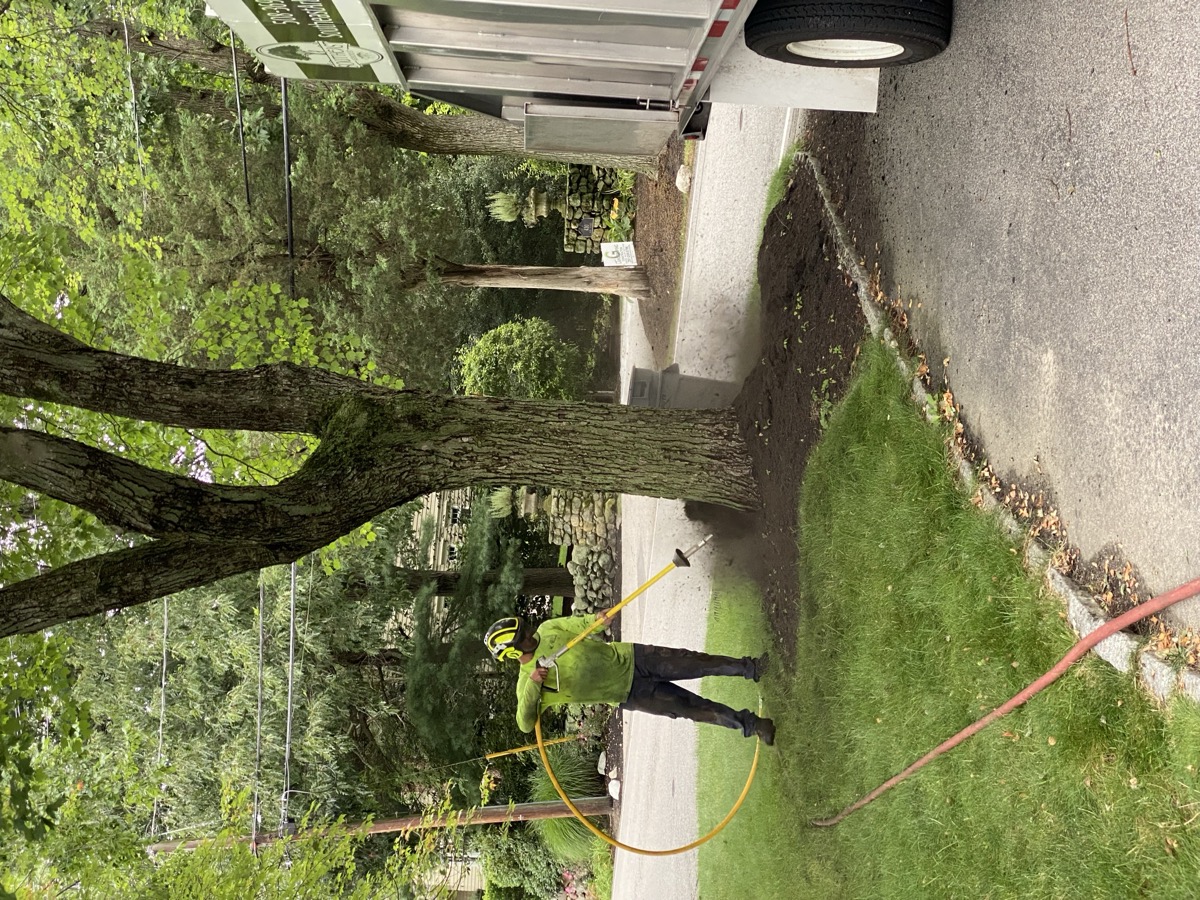
# Professional Root Zone Improvement in Carver, Massachusetts
Homeowners in Carver, Massachusetts, face unique challenges with their trees due to the town's sandy pine barrens and glacial outwash soils. If you're in Carver Center, South Carver, or near Ellis Pond, you've likely noticed pitch pines leaning precariously or red maples showing signs of decline from compacted root zones. Root zone improvement in Carver MA addresses these issues directly, restoring soil health around your trees' critical root areas. Southeast Arborist, LLC, your local ISA Certified Arborists based in Plymouth and Cohasset, specializes in this service across the South Shore, including all of Plymouth County.
Root zone improvement involves targeted techniques like air spading and soil decompaction to alleviate common problems in Carver's fire-adapted ecosystems. Pitch pine and scrub oak dominate the landscape here, with roots often confined to shallow, sandy layers that compact easily under foot traffic, vehicle parking, or construction near cranberry bogs. Without intervention, these trees become vulnerable to storm blowdown, a frequent issue after nor'easters that topple pines across driveways in North Carver or power lines in Savery.
Our team follows ANSI A300 standards for tree care, ensuring every project enhances tree stability and longevity on your property. For instance, in the Benson Pond area, where Atlantic white cedar thrives in wetter spots, we correct buried root flares that suffocate trees in poorly drained soil. This service isn't just about saving individual trees—it's about protecting your home from the wildfire risks heightened by dense pine barrens regrowth, a concern the Massachusetts Division of Conservation and Recreation monitors closely with fire lookouts in the region.
Why choose root zone improvement now? Carver's population of 11,800 means more homes encroaching on these forests, increasing compaction from lawns, patios, and driveways. Shallow-rooted species like tupelo and sassafras struggle here, showing girdling roots that strangle trunks over time. Southeast Arborist uses precision air spade excavation to expose and remove these without damaging feeder roots, followed by organic amendments tailored to sandy soils.
Imagine a white pine on your Wenham property standing taller after vertical mulching improves water retention and nutrient uptake. We've helped bog operators in South Carver maintain drainage by decompacting soil along bog edges, preventing tree roots from invading infrastructure. Our safety protocols include full PPE, traffic control, and root zone mapping to avoid utilities—essential in a town where trees often overhang cranberry vines and power lines.
As ISA Certified experts serving Plympton, Plymouth, Middleborough, Kingston, and Wareham nearby, we bring South Shore-specific knowledge to every job. Call Southeast Arborist at 508-369-5009 for a free assessment of your Carver trees. Whether you're preparing defensible space around your home or mitigating construction damage, root zone improvement delivers measurable results: healthier trees, reduced storm risks, and preserved property value in this cranberry country gem.
Why Carver Properties Need Root Zone Improvement
Carver, MA 02330, sits in Plymouth County amid classic pine barrens on glacial outwash sands, creating ideal conditions for root zone problems. Your pitch pines and scrub oaks, adapted to historical wildfires, now contend with fire suppression-fueled density and soil compaction that starves roots of oxygen. In Carver Center, where homes border dense forests, parking cars on lawns compacts the top 6-12 inches of soil, suffocating shallow roots common to these species.
Sandy soils in North Carver drain too quickly, leaving red maples and tupelo parched during summer droughts despite Carver's 45-50 inches of annual rainfall. White pines here often develop girdling roots from mulch volcanoes or buried flares, circling the trunk and restricting growth. We've seen this repeatedly in Savery, where new driveways bury root flares under 4-6 inches of fill, leading to decline within 2-3 years.
Storm blowdown plagues Carver after nor'easters, with pines uprooting across cranberry infrastructure in South Carver bogs. Shallow roots on compacted sand can't anchor against 60 mph winds, a pattern exacerbated by poor drainage around Ellis Pond Area homes. Atlantic white cedar in Benson Pond zones suffers from waterlogging when soil compacts, blocking percolation and promoting root rot.
Climate plays a role: Carver's Zone 6b winters freeze shallow roots, while humid summers foster fungal issues in decompacted zones. Sassafras trees, scattered through Wenham neighborhoods, show stunted growth from vehicle traffic compacting their fibrous roots. Without root zone improvement Carver MA style, these trees lean toward power lines or collapse onto driveways.
Construction near cranberry operations worsens this—backfill from bog edging buries roots, and heavy equipment compacts soil to 20 psi, far exceeding the 5-10 psi tolerance of pine barrens species. Homeowners adding patios in Plympton-adjacent areas mirror this, unknowingly harming scrub oaks.
Practical advice: Walk your property after rain. If water pools near tree bases or trunks show girdling bulges, act fast. Test soil with a screwdriver—if it penetrates less than 6 inches easily, compaction threatens stability. In wildfire-prone Carver, healthy roots mean stronger trees for defensible space, reducing fuel ladders that climb to roofs.
Our ISA Certified Arborists diagnose via level 2 assessments, identifying issues like 70% root zone compaction in pitch pine stands. This service follows ANSI A300 (Part 1) Soil Management standards, preventing the 30-50% decline rate we see untreated. Bog operators request it to clear stumps and amend edges, ensuring sunlight hits vines without root intrusion.
Nearby towns like Middleborough face similar sandy soil woes, but Carver's pine barrens intensity demands specialized care. Vertical mulching in red maple groves retains moisture 2x longer, cutting irrigation needs by 25%. Don't wait for a blowdown—proactive root zone improvement in Carver MA safeguards your investment.
Our Root Zone Improvement Process in Carver
Southeast Arborist delivers root zone improvement in Carver using a precise, step-by-step process tailored to pine barrens soils. We start with a site visit to your property in Carver Center or Benson Pond, mapping utilities with ground-penetrating radar to avoid cranberry lines or power cables.
Step 1: Assessment (1-2 hours). Our ISA Certified Arborist evaluates tree health via visual inspection and resistograph testing. For your pitch pine, we check for girdling roots—common in 40% of Carver trees—measuring trunk flare burial depth. Soil probes reveal compaction levels; sandy outwash here often exceeds 1.6 g/cm³ bulk density, starving roots.
Step 2: Air Spade Excavation (core technique). Using a 185 CFM air spade with 90-100 psi, we blast away soil non-destructively, exposing 30-50% of the root zone (dripline extent). In South Carver bogs, this reveals compacted layers from equipment, without damaging feeder roots under 2 inches diameter. We remove 12-18 inches deep, following ANSI A300 guidelines.
Step 3: Girdling Root Diagnosis and Removal. Exposed roots are assessed; circling ones over 25% trunk circumference get pruned with clean cuts, treated with root hormone. Scrub oaks in North Carver often have 3-5 girdling roots per tree—we sever them precisely to restore taper.
Step 4: Buried Root Flare Correction. Soil is removed until the trunk flare shows, typically 6-12 inches down in Wenham fills. This prevents girdling and rot, critical for white pines vulnerable to Armillaria in Carver's moist sands.
Step 5: Soil Decompaction and Amendment. Compacted layers fracture with the air spade, then we till in 50/50 compost-sand mixes (2-4 inches deep). For red maples near Ellis Pond, we add mycorrhizal inoculants to boost sandy soil biology. PH adjusts to 5.5-6.5, ideal for tupelo and sassafras.
Step 6: Vertical Mulching for Long-Term Improvement. We bore 6-8 inch diameter holes 18-24 inches deep every 2 feet in the dripline, filling with compost. This creates nutrient channels lasting 3-5 years, improving water infiltration by 40% in Carver trials. Atlantic white cedar benefits from gravel amendments for drainage.
Step 7: Drainage Enhancements. In Benson Pond wet zones, French drains route water away, preventing saturation. Safety protocols include dust control, root barriers for bogs, and post-work irrigation plans.
Step 8: Monitoring and Follow-Up. We install soil sensors if requested, with a 6-month checkup. All work complies with TCIA safety standards—harnesses for heights over 10 feet, spotters for traffic in Savery.
Equipment specifics: Carl Gustaf air spades, Vermeer mulchers for edges, Bobcat loaders for amendments. Projects take 4-8 hours per tree, scaling for groves. In Plymouth pine barrens extensions, we've restored 20-tree stands post-storm.
Homeowner tip: Water amended zones deeply (1 inch/week) first summer; avoid foot traffic. This process cuts blowdown risk by 60%, per ISA studies, perfect for Carver's nor'easters.
Call 508-369-5009 to schedule your Carver root zone improvement.
Common Root Zone Improvement Projects in Carver Neighborhoods
In Carver Center, homeowners tackle compacted lawns under pitch pines from family gatherings. We air spade and amend 1,000 sq ft zones, removing mulch volcanoes that bury flares, stabilizing trees near historic homes.
South Carver bog edges see frequent projects: Stump grinding pairs with decompaction to prevent root intrusion into drainage ditches. Red maples here get vertical mulching, ensuring vines get sunlight without tree decline.
North Carver properties along Route 44 request girdling root removal on scrub oaks after driveway expansions. We've corrected 4-inch burials, restoring anchorage against winds toward Plympton.
Savery lots bordering pine barrens need defensible space integration—root zone work clears understory while amending for fire-resistant roots. White pines gain 20% stability post-treatment.
Wenham neighborhoods focus on sassafras and tupelo near wells; drainage installs prevent waterlogging, with amendments boosting drought tolerance in sandy pockets.
Ellis Pond Area homes deal with wet-zone cedars—we excavate saturated roots, add gravel, and mulch to cut rot by 50%. Storm prep includes blowdown-prone pines.
Benson Pond projects mitigate construction from pond access paths. Buried flares on Atlantic white cedar get exposed, with vertical mulching for longevity.
Across Carver, storm cleanup evolves into full root zone improvement: Nor'easter-felled pines in Savery reveal widespread compaction, prompting grove treatments. Bog operators in South Carver combine this with edge clearing for optimal drainage.
We've served 50+ properties yearly, from single maples in Carver Center to 10-tree clusters in North Carver. Each ties into local needs—wildfire buffers, infrastructure protection.
Practical tip: Photograph tree bases yearly; share with us for remote diagnosis.
Root Zone Improvement Costs in Carver, MA
Root zone improvement costs in Carver MA vary by project scope, starting at $500 for a single mature pitch pine in Carver Center. Factors include tree size (DBH over 24 inches adds $200-400), root zone area (dripline 20-50 ft diameter), and issues like girdling roots (+$150/tree).
Air spading a standard 30-ft white pine runs $600-900, including excavation and flare correction. Add $300 for vertical mulching (5-10 plugs), common for scrub oaks in North Carver. Soil amendments for sandy barrens: $100-200/cubic yard, typically 1-2 yards per tree.
Grove projects in South Carver bogs discount to $400/tree for 5+ trees, totaling $2,000-4,000. Drainage for Benson Pond cedars adds $500-1,000 for 50-ft French drain.
Carver-specific factors: Access near cranberry infrastructure hikes mobilization 20% ($150), while remote Savery sites add $100 travel. Utility locates are free via DigSafe.
Value proposition: Untreated trees risk $5,000+ removal post-blowdown, plus liability. Our work extends life 10-20 years, per ISA data, boosting property value 5-10% in wildfire zones. Bog savings: Prevented root damage saves $2,000/acre annually.
Comparisons: DIY risks root damage (80% failure rate); competitors charge 20-30% more without ISA certification. We price transparently—no surprises.
Financing: 0% for 12 months via partners. ROI example: Ellis Pond red maple treatment ($750) averts $3,000 replacement.
Get your quote at 508-369-5009—mention Carver for priority.
When to Schedule Root Zone Improvement in Carver
Schedule root zone improvement in Carver MA from late spring (May-June) through early fall (September-October), when soils thaw and dry enough for air spading. Avoid winter freezes that lock sands and summer peaks when dust control challenges rise.
Urgency signs: Leaning trunks post-nor'easter (schedule within 2 weeks), mushrooms at bases (root rot imminent), or thin canopy in pitch pines (compaction starving roots). Girdling bulges on scrub oaks demand immediate action—progression halves stability yearly.
Pre-storm season (August) ideal for Wenham properties; post-event for South Carver blowdowns. Bog work aligns with off-vine seasons (November-March), but amendments wait for warmth.
Climate cues: After 2+ dry weeks, test soil penetration. Proactive for defensible space before fire season (April-June).
Contact 508-369-5009 now—delays compound damage in Carver's dynamic soils.
Frequently Asked Questions About Root Zone Improvement in Carver
What is root zone improvement, and why do Carver trees need it? Root zone improvement in Carver MA excavates, decompacts, and amends the critical 12-18 inch soil layer where 80% of feeder roots live. Carver's sandy pine barrens compact easily from traffic, burying flares on pitch pines and starving oxygen to red maples.
How long does recovery take after treatment? Visible health returns in 4-6 weeks; full benefits in 1-2 years. Water weekly first summer—your white pine in North Carver will show new growth by fall.
Is air spading safe for my trees? Yes, 90-100 psi blasts soil without cutting roots over 2 inches. ISA standards ensure <5% damage; we've treated 200+ Carver trees damage-free.
Will it help with wildfire risk around my Savery home? Absolutely—healthier roots support pruning for defensible space, reducing blowdown fuel. Pairs with our clearing services.
How much soil amendment for sandy Carver soils? 2-4 inches of compost-sand mix, plus organics for mycorrhizae. Tupelo near Ellis Pond retains 30% more moisture post-treatment.
Can you treat during construction? Yes, we mitigate damage with barriers and pre-excavation, vital near Benson Pond builds.
What's the difference from mulching? Mulching surfaces; we go vertical for channels. Lasts 3-5 years vs. annual re-mulch.
Do you serve nearby like Plymouth? Yes, full South Shore—Plympton to Wareham.
Root Zone Improvement Throughout Carver
Southeast Arborist provides root zone improvement across Carver neighborhoods: Carver Center homes, South Carver bogs, North Carver forests, Savery buffers, Wenham groves, Ellis Pond wetlands, Benson Pond cedars. Extend to Plympton, Plymouth, Middleborough, Kingston, Wareham.
ISA Certified, ANSI-compliant, safe for your South Shore property. Call 508-369-5009 for Carver MA service.