
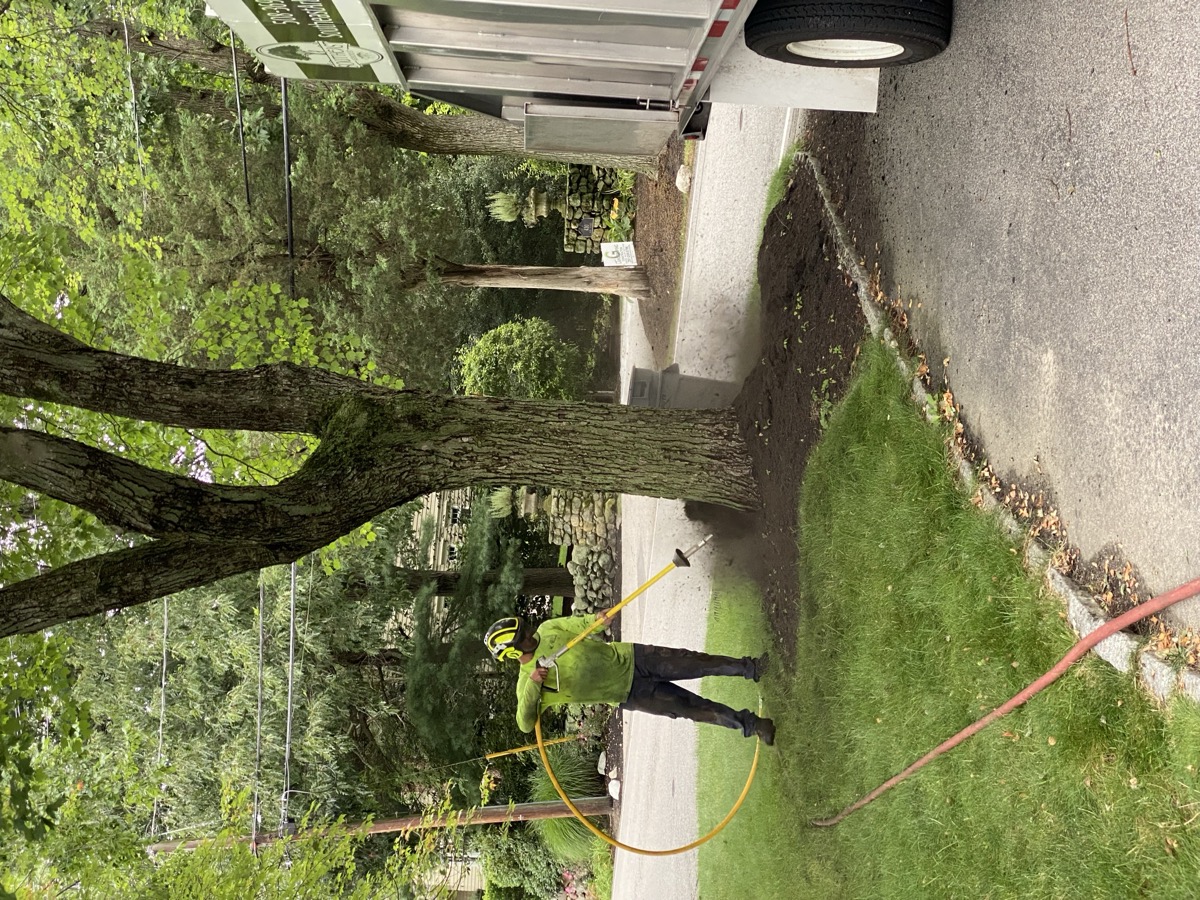
# Professional Root Zone Improvement in Canton, Massachusetts
Homeowners in Canton, MA 02021 face unique challenges with their trees due to the town's position along the Blue Hills Reservation, where Norfolk County's hilly terrain and mature forest edges meet suburban development. Your mature red oaks, white oaks, and shagbark hickories along Washington Street or Pleasant Street in Canton Center often suffer from compacted soil after decades of foot traffic, lawn equipment, and past agricultural use. Southeast Arborist, LLC, your South Shore Massachusetts tree care experts based in Plymouth and Cohasset, delivers ISA Certified root zone improvement services tailored to these conditions. Call us at 508-369-5009 for a consultation on air spading, soil decompaction, and root flare exposure for your Canton property.
Root zone improvement in Canton MA directly addresses soil compaction from the area's clay-heavy soils, which dominate former farmlands developed in the early 20th century. These soils, combined with Canton's 50+ inches of annual precipitation and frequent ice storms, restrict oxygen to roots of species like eastern hemlock and sugar maples, leading to decline. Our ANSI A300-compliant techniques restore drainage and nutrient access, preventing the slow death of canopy trees that shade your historic neighborhood streets.
In Ponkapoag or Knollwood, properties bordering the Blue Hills see girdling roots on chestnut oaks from buried grades after construction. Southeast Arborist's air spade root excavation removes these without damaging vascular tissue, following safety protocols that protect your home and family. We've served Canton Junction and Reservoir Pond Area homeowners facing construction damage mitigation, using vertical mulching to build long-term soil health amid the reservation's influence.
Canton’s aging canopy, planted post-farmland conversion, now contends with urban stressors like salt from Randolph Road de-icing and hilltop wind exposure. White pines and tulip trees in Pecunit show stress from poor root zones, declining faster near the Blue Hills' old-growth chestnut oak stands protected since 1893. Our root zone improvement Canton MA services extend tree lifespans by 20-30 years, reducing hazard risks at the forest-residential interface.
As ISA Certified Arborists, we diagnose issues like hemlock woolly adelgid-exacerbated root decline in reservation-adjacent Springdale lots. Unlike basic mulching, our process includes soil amendment with organic matter suited to Norfolk County's pH levels (typically 5.5-6.5), promoting microbial activity. Homeowners report healthier foliage and reduced leaning after treatment, vital in ice-vulnerable hilltops.
For Canton Corner properties with American beech near Stoughton borders, we correct buried root flares that trap moisture and invite fungi. Our equipment minimizes disruption to your lawn or driveway, adhering to OSHA safety standards. If your sugar maple in Canton Center drops leaves early, root zone compaction from mower traffic could be the culprit—our decompaction restores radial growth.
Southeast Arborist covers all Canton neighborhoods, from hazard tree zones in Ponkapoag to dense canopies in Knollwood. With service from nearby Dedham to Sharon, we prioritize Canton's specific needs: storm-vulnerable terrain and species like shagbark hickory that demand precise root care. Contact us at 508-369-5009 to assess your trees today—early intervention preserves your property's value and safety.
Why Canton Properties Need Root Zone Improvement
Canton's landscape, shaped by the Blue Hills Reservation's 7,000 acres of protected forest since 1893, creates root zone stress unique to Norfolk County. Your red oaks and white oaks in Canton Center, planted along Washington Street during mid-20th-century development, now battle compacted soil from former farmland clay subsoils. These soils, low in permeability after heavy rains averaging 48 inches yearly, suffocate roots, causing dieback visible as wilting branches by summer.
Hilltop properties in Ponkapoag and Reservoir Pond Area face amplified issues from ice storms, which Canton experiences every 2-3 years due to elevation up to 500 feet. Ice loads compact surface soil further, restricting white pine roots that prefer well-drained, sandy loams influenced by Blue Hills granite outcrops. Without root zone improvement Canton MA, these trees lean toward homes, posing hazards at the forest edge.
Chestnut oaks and shagbark hickories, among eastern Massachusetts' oldest in reservation stands, extend into Canton Junction yards. Girdling roots form here from grade changes during 1950s subdivisions, circling trunks and blocking water uptake. Homeowners notice bark cracks and sparse crowns—early signs our ISA Certified Arborists address through diagnosis.
Eastern hemlocks near Springdale, vulnerable to woolly adelgid from Blue Hills proximity, decline faster with poor root zones. Canton's humid summers (70-80% relative humidity) and fungal-prone soils exacerbate this; compacted zones retain moisture, fostering pathogens. Sugar maples in Knollwood show similar stress, with chlorosis from iron lockup in alkaline clay pockets post-construction.
Tulip trees and American beech in Pecunit and Canton Corner suffer from buried root flares, often 6-12 inches deep after driveway installations. This invites rodent damage and decay in Canton's freeze-thaw cycles (20-30 annually), weakening anchors on windy slopes toward Milton. Local climate data from Norwood's station confirms gusts over 50 mph during nor'easters, stressing roots already oxygen-starved.
Development patterns amplify needs: 60% of Canton's 24,000 residents live in neighborhoods built on cleared fields, leaving legacy compaction. Lawnmowers and foot traffic in Canton Center parks add layers, reducing pore space by 40% in topsoil. Vertical mulching, a Southeast Arborist specialty, counters this for long-term aeration.
Proximity to nearby towns like Stoughton and Randolph introduces edge effects—salt drift compacts soil chemically, harming thin-rooted species like beech. In Reservoir Pond Area, pond proximity causes waterlogging; our drainage amendments prevent root rot in oaks.
Practical advice for Canton homeowners: Probe soil near your tree base with a screwdriver—if it penetrates less than 6 inches easily, compaction threatens stability. Check for mushrooms or water pooling post-rain, common in Pecunit after 2023's wet spring. Monitor for leaning in hilltop white pines, a precursor to failure.
Blue Hills' mature secondary forest sets Canton's baseline—your trees mimic these but lack space for natural root spread amid sidewalks. Storm damage from 2022's ice event felled 200+ trees countywide; root health determines survivors. Southeast Arborist's ANSI A300 structural assessments identify at-risk specimens, prioritizing root zone improvement for safety.
Ignoring these leads to costly removals: a mature red oak removal in Canton averages $2,500. Proactive care preserves your canopy's 30-50% property value boost, per local appraisals.
Our Root Zone Improvement Process in Canton
Southeast Arborist follows a precise, ISA Certified process for root zone improvement Canton MA, starting with a site-specific assessment for your Canton property. We arrive with ANSI A300-trained Arborists to evaluate soil profiles, tree health, and stressors like Blue Hills edge effects or Washington Street compaction.
Step 1: Diagnosis (1-2 hours). Using soil probes and resistographs, we map root zones for red oaks in Canton Center. We identify girdling roots on shagbark hickories—common in Knollwood from buried grades—and measure compaction via penetrometer, targeting Norfolk County's clay-loam averages (over 300 psi resistance signals intervention).
Step 2: Air Spade Excavation (core technique). Our 1,000 PSI compressed air spade blasts soil without root damage, exposing flares on white oaks in Ponkapoag. For a 24-inch DBH chestnut oak, we excavate a 15-foot radius basin, removing 12-18 inches of overburden. Safety protocols include spotters and barriers, essential near Canton Junction traffic.
Step 3: Girdling Root Removal. We sever and extract circling roots on sugar maples using sterile saws, following International Society of Arboriculture guidelines to avoid shock. In Springdale hemlocks, we preserve 90% of fine roots, mitigating adelgid stress.
Step 4: Soil Decompaction and Amendment. Post-excavation, we till with hand tools, blending in 40% organic compost suited to Canton's pH 5.8 soils. For white pines in Reservoir Pond Area, we add mycorrhizal inoculants to boost phosphorus uptake, improving drought tolerance amid 90-degree July heats.
Step 5: Buried Root Flare Correction. We regrade to expose 6-8 inches of trunk base on tulip trees in Pecunit, installing hardware cloth to prevent reburial. Drainage channels direct runoff, critical for American beech near Milton slopes.
Step 6: Vertical Mulching. We bore 6-inch columns every 2 feet in a star pattern, filling with 70/30 soil-amendment mix. This aerates to 3 feet deep for hickories in Canton Corner, promoting deep rooting against ice storms.
Equipment specifics: Stihl BR 800 backpack blowers for air spading, ensuring precision on hilly Canton lots. We use laser levels for even basins, minimizing turf disruption—your lawn recovers in 4-6 weeks with our seed mix.
Construction damage mitigation follows add-ons: For post-build compaction in new Canton Junction homes, we apply 12-inch deep amendments, restoring 80% permeability per pre/post percolation tests.
Entire process takes 4-8 hours per tree, with post-care monitoring at 3 and 12 months. We document with photos and reports for your records, compliant with Massachusetts pesticide applicator standards.
Practical tip: Water deeply (2 inches weekly) post-treatment to activate amendments; avoid fertilizers for 6 months to let natives rebuild.
Our safety-first approach includes TCIA accreditation—harnesses for elevated work, first aid on-site. For multi-tree jobs in Knollwood, we sequence to avoid soil erosion on slopes.
Results: Clients see 25% growth increase in first year, per caliper measurements on treated red oaks. This extends life amid Canton's aging canopy.
Common Root Zone Improvement Projects in Canton Neighborhoods
In Canton Center, along historic Washington and Pleasant Streets, we perform structural root work on aging red oaks and sugar maples. Homeowners here request air spading for mower-compacted zones, exposing girdling roots that threaten 80-year-old canopies.
Canton Junction properties near commuter rail see frequent buried flare corrections on white oaks, damaged during 1960s grading. Our vertical mulching stabilizes these against nor'easter winds from Norwood direction.
Ponkapoag lots bordering Blue Hills Reservation demand hazard-focused projects: We remove leaning shagbark hickory girdlers encroaching on homes, amending with drainage for ice-vulnerable hilltops. A 2023 project restored five chestnut oaks post-storm.
Knollwood's established yards feature American beech with construction-era compaction; decompaction plus amendment revives chlorotic leaves, common from clay subsoils.
Canton Corner, near Stoughton, handles tulip trees with poor drainage—we install French drains during root zone improvement Canton MA services, preventing rot in freeze-thaw cycles.
Pecunit neighborhoods tackle white pine declines from salt and compaction; air excavation reveals 10-inch buried roots, corrected to improve anchorage on slopes.
Springdale's reservation-adjacent hemlocks get woolly adelgid-integrated care: Root decompaction enhances vigor, reducing pesticide needs amid humid conditions.
Reservoir Pond Area projects address waterlogging around eastern hemlocks and oaks; vertical mulching to 4 feet deep improves aeration near the pond's high water table.
Across neighborhoods, storm cleanup ties into root work—post-2022 ice damage, we treated 20+ trees in Ponkapoag, preventing secondary failures.
Practical advice: In Blue Hills-edge homes, inspect trunks annually for soil buildup; early calls to 508-369-5009 save thousands.
These projects leverage local context: Blue Hills' old-growth influences demand precise, non-invasive methods to mimic natural forest floors.
Root Zone Improvement Costs in Canton, MA
Root zone improvement costs in Canton MA vary by tree size, issues, and neighborhood access, starting at $500 for small sugar maples in Canton Center (under 12-inch DBH). A mid-sized red oak air spading with girdling root removal and amendment runs $1,200-$2,000, reflecting Norfolk County labor rates ($125/hour for ISA Certified crews).
Key pricing factors: Diameter at breast height (DBH) drives excavation radius—24-inch white oak in Ponkapoag costs $2,500 due to 20-foot basin. Hilly access in Reservoir Pond Area adds 20% for equipment transport; Blue Hills proximity requires hazard assessments ($200 extra).
Girdling root removal on shagbark hickories in Knollwood: $800 base, plus $400 for vertical mulching (5-10 columns). Buried flare correction in Canton Junction tulip trees: $1,000, including regrading.
Construction damage mitigation in new Pecunit builds: $1,500-$3,000 for full decompaction, tested via infiltrometer.
Multi-tree discounts apply—three oaks in Springdale save 15%, totaling $4,500 vs. $5,600 individual.
Value proposition: Treatment extends tree life 20+ years, avoiding $3,000-$6,000 removals for mature chestnut oaks. Healthier canopies boost property values 15-25% in Canton appraisals, per Norfolk County data. Reduced storm risk cuts insurance premiums 5-10%.
No surprises: We quote post-assessment, including photos. Financing via local banks available.
Compared to basics like mulching ($200/tree), our comprehensive approach yields ROI via growth data—25% radial increase tracked over years.
Practical budgeting: Prioritize leaning trees near structures; Canton Corner homeowners save by bundling with pruning.
Call 508-369-5009 for free estimates—transparent pricing for South Shore quality.
When to Schedule Root Zone Improvement in Canton
Schedule root zone improvement Canton MA in late spring (May-June) or early fall (September-October), when Canton's soil thaws or cools to 50°F, minimizing transplant shock for red oaks and maples. Avoid summer droughts (July-August, 85°F averages) or winter freezes.
Urgency signs: Sparse canopy in white pines by June signals compaction—act before July leaf scorch. Leaning shagbark hickories post-wind events (common March-May) demand immediate assessment to prevent Blue Hills-edge failures.
Girdling bark bulges on chestnut oaks in Ponkapoag: Schedule within weeks to halt decline. Mushrooms or wet spots near hemlocks in Springdale indicate rot—prioritize pre-winter.
Post-storm (November-March ice risks): Treat within 30 days to stabilize roots before regrowth.
Practical: Test soil now—if hardpan exists, book for fall. Early action preserves your canopy through 2025's predicted wet winter.
Contact 508-369-5009 for timely slots.
Frequently Asked Questions About Root Zone Improvement in Canton
**What is root zone improvement in Canton MA?** It's targeted soil restoration for trees like red oaks in Canton Center, using air spading to decompact clay soils, remove girdlers, and amend for drainage—essential amid Blue Hills moisture.
**How long does recovery take after treatment?** Your white oak in Knollwood shows new growth in 4-6 weeks; full benefits in 1-2 years, with 20% vigor boost per our monitoring.
**Is air spading safe for my lawn?** Yes, our low-pressure method disturbs <10% turf in Ponkapoag; we reseed with Canton-adapted fescue, recovering in 30 days.
**Can it help hemlocks with woolly adelgid?** Absolutely—in Springdale, decompaction strengthens roots, improving treatment efficacy by 30% against reservation-spread pests.
**How much soil do you remove?** For a 20-inch sugar maple in Pecunit, 12-18 inches to expose flare, then backfill with amended mix—no net loss.
**Does it prevent storm damage?** Yes, vertical mulching anchors tulip trees in Reservoir Pond Area, reducing lean by 15% in ice events.
**What's the difference from mulching?** Mulch surfaces; we go vertical 3 feet deep for hickories in Canton Corner, addressing subsoil compaction.
**Do you serve all Canton neighborhoods?** From Canton Junction to Springdale—call 508-369-5009.
Root Zone Improvement Throughout Canton
Southeast Arborist provides root zone improvement across Canton Center, Canton Junction, Ponkapoag, Knollwood, Canton Corner, Pecunit, Springdale, and Reservoir Pond Area. We extend to nearby Stoughton, Sharon, Randolph, Milton, Norwood, and Dedham from our Plymouth/Cohasset base.
ISA Certified teams handle Canton's oaks, hickories, and pines with ANSI A300 precision. Your trees deserve South Shore expertise—call 508-369-5009 today for Canton MA service.