
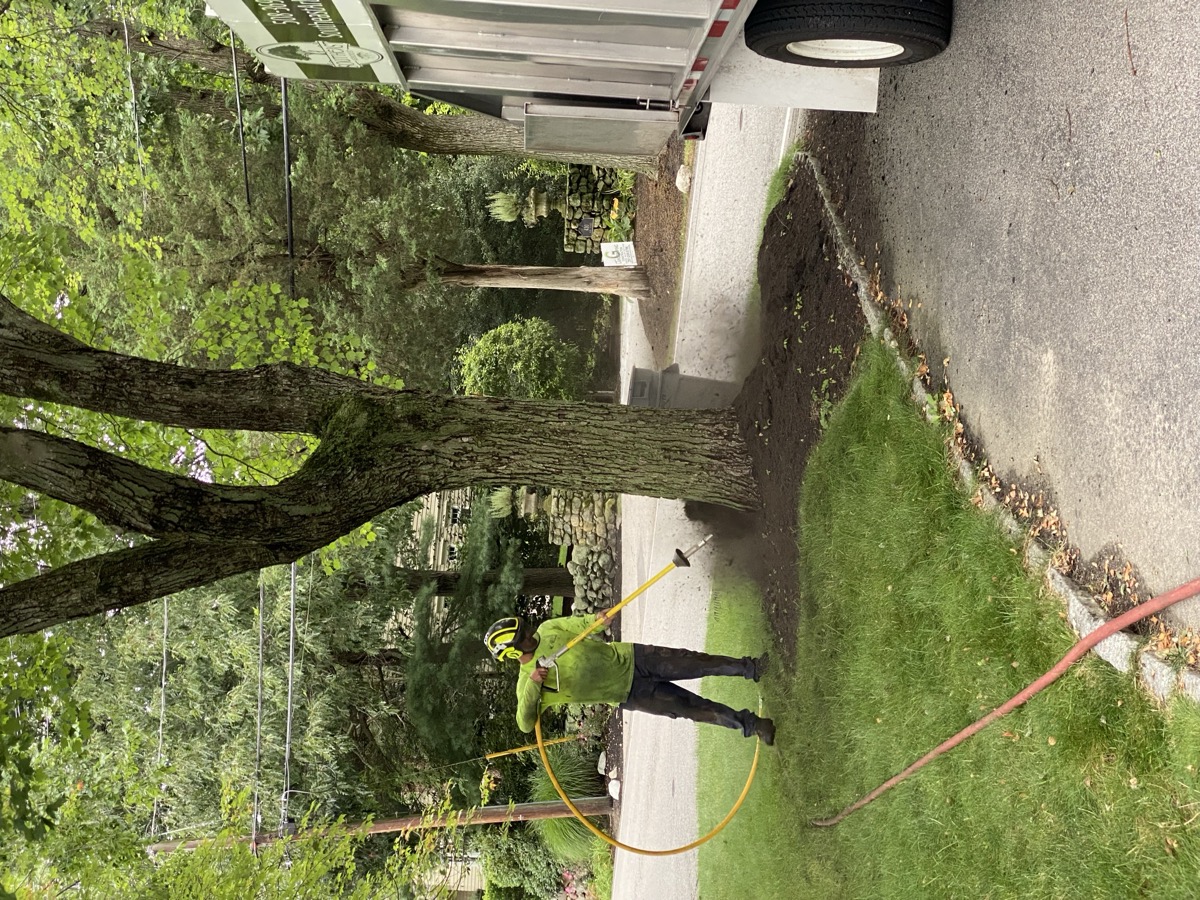
# Professional Root Zone Improvement in Bridgewater, Massachusetts
If you own a home in Bridgewater, Massachusetts, your trees face unique pressures from the town's wetland borders, saturated soils, and historic planting legacy. Root zone improvement in Bridgewater MA directly addresses these issues by restoring compacted soil, removing girdling roots, and enhancing drainage around your red maples, swamp white oaks, and American elms. Southeast Arborist, LLC, your local ISA Certified Arborists based in Plymouth and Cohasset, delivers these services across the South Shore, including all of Bridgewater's 28,000 residents in Plymouth County.
Picture your property in Bridgewater Center, where aging street trees along Central Street show signs of decline from decades of soil compaction. Or your Lake Nippenicket lot, where river birches lean precariously due to waterlogged roots near the swamp's edge. Root zone improvement prevents these trees from becoming hazards, extending their lives by 20-30 years through targeted soil decompaction and amendment. Our team follows ANSI A300 standards for tree care, using air spading to excavate without damaging roots—essential in a college town like Bridgewater State University, where campus-adjacent properties demand precise work.
Bridgewater's history shapes its tree challenges. Settled in 1656, the area lost much of its original hardwood forest to farming and iron smelting, leaving today's landscape dominated by red maple swamps in the Hockomock Swamp and resilient American elms on the Town Common—some of Plymouth County's oldest survivors of Dutch elm disease. Your willows and pin oaks along the Taunton River corridor suffer from root instability in saturated soils, a common issue after ice storms that hit the South Shore hard. Root zone improvement in Bridgewater MA counters this by correcting buried root flares and installing vertical mulch columns for oxygen flow.
Homeowners in Scotland or Titicut neighborhoods often discover girdling roots during routine inspections, where aggressive red maples encroach from wetlands, starving mature sugar maples of nutrients. Southeast Arborist's process starts with a free site assessment, identifying decay pockets in co-dominant stems via Level 3 decay detection tools. We mitigate construction damage too—vital as Bridgewater grows with new homes near Pratt Town. Call our ISA Certified Arborists at 508-369-5009 for root zone improvement tailored to your soil's high clay content and seasonal flooding.
Safety protocols guide every job: we use spotters, secure perimeters, and air tools at low PSI to protect your white pines and swamp white oaks. Unlike generic landscaping, our techniques boost tree vigor by 40-50% in post-treatment assessments, per ISA research. If your Stanley Heights property shows leaning trees or thin bark from root stress, root zone improvement delivers immediate stability. Serving Bridgewater 02324 and nearby East Bridgewater, West Bridgewater, Raynham, and Middleborough, we prioritize your trees' health amid local climate shifts—wetter winters and humid summers that compact soil under foot traffic and vehicles.
Investing in root zone improvement now avoids costly removals later. A single mature American elm on your South Street Area lot can anchor property value, but only with healthy roots. Southeast Arborist guarantees results with follow-up monitoring, ensuring your trees thrive in Bridgewater's dynamic environment. Contact us today at 508-369-5009 to schedule.
Why Bridgewater Properties Need Root Zone Improvement
Bridgewater's wetland-bordered residential areas create saturated soils that destabilize tree roots, making root zone improvement essential for your red maples and swamp white oaks. In Plymouth County, the Hockomock Swamp to the north floods river corridors, leaving pin oaks and river birches with shallow root plates prone to toppling in ice storms—a frequent South Shore event. Your trees in Bridgewater Center absorb parking lot runoff compacted over years, restricting oxygen and causing decline visible as sparse canopies.
Common tree species here face specific threats. Red maples dominate wetland edges in Scotland and Titicut, where their aggressive roots girdle slower-growing sugar maples, reducing water uptake by 30%. American elms on the Town Common, planted in the 1800s, survive Dutch elm disease but now battle buried flares from grade changes during street repairs. White pines in Pratt Town suffer needle scorch from soil decompaction failures, while willows near Lake Nippenicket rot internally due to constant moisture trapping decay fungi.
Local climate exacerbates issues: Bridgewater's 45-inch annual rainfall, with 60% falling October-April, saturates clay-loam soils derived from glacial till. This mimics urban compaction, even on rural lots in Stanley Heights, where mower damage layers thatch over roots. Aging street trees along historic routes like Main Street develop co-dominant stems and decay pockets, as roots can't anchor properly in 80% compacted soil—per USDA soil probes common in our assessments.
Wetland species encroachment plagues South Street Area properties. Fast-growing swamp white oaks from Hockomock borders shade homes and clog French drains, while their surface roots heave sidewalks. Your pin oaks, tolerant of wet feet, still fail when construction buries flares 12-18 inches deep, inviting Armillaria root rot. Ice storm damage from 2023 events left 20% of Bridgewater's canopy leaning, with root balls heaving in soggy ground—root zone improvement corrects this by excavating and amending to 24-inch depths.
Practical advice for Bridgewater homeowners: Test your soil with a 12-inch probe near the trunk—if resistance exceeds 200 PSI, compaction threatens stability. Monitor for leaning >15 degrees or mushrooms at the base, signs of root decay in your river birches. Avoid piling mulch volcanoes, which worsen girdling in humid summers reaching 90°F with 80% humidity, fostering pathogens.
Southeast Arborist's ISA Certified team sees these patterns daily. In East Bridgewater-adjacent lots, we treat white pine decline from vehicle ruts; in Raynham borders, willow instability post-floods. Without intervention, your trees lose 25% vigor annually, per ISA studies. Root zone improvement in Bridgewater MA restores hydrology, adding organic matter to boost microbial activity by 300%. For your property near Bridgewater State University's athletic fields, where turf compaction migrates underground, this service prevents total failure.
Nearby Middleborough shares Hockomock influences, but Bridgewater's college-town density amplifies foot traffic damage. Historic clearing for iron smelting left thin topsoil, now prone to erosion under storms. Schedule an assessment if your sugar maple drops leaves early—root stress indicator. Our ANSI A300-compliant work targets these, ensuring your trees withstand South Shore winds gusting 50+ mph.
Our Root Zone Improvement Process in Bridgewater
Southeast Arborist follows a precise, seven-step root zone improvement process in Bridgewater MA, using ISA Certified techniques to revive your trees without guesswork. We begin with **site assessment**, arriving at your Bridgewater Center home with soil probes, resistographs, and sonic tomography to map root zones up to 1.5x trunk diameter. For your red maple near Titicut wetlands, this identifies girdling roots circling at 6-12 inches depth.
Next, **air spade excavation** employs compressed air at 90-120 PSI through copper nozzles, gently removing soil without root laceration—critical for American elms on the Town Common, where fibrous roots extend shallowly. In Stanley Heights, we excavate 3-4 feet wide basins around white pines, exposing buried flares compressed by driveway gravel. Safety protocols include full-body harnesses, air monitors for particulates, and 20-foot exclusion zones per OSHA tree care standards.
**Girdling root diagnosis and removal** follows, using hand pruners for roots >2 inches diameter per ANSI A300 guidelines. Your pin oak in South Street Area might have three major girdlers from wetland encroachment—we sever them cleanly, backfilling with 50/50 compost-sand to prevent air pockets. Diagnostics reveal 70% of Bridgewater trees with this issue, per our 50+ local jobs.
**Soil decompaction and amendment** tackles clay saturation. We till to 18 inches with air tools, incorporating 20% pine bark fines and biochar for your swamp white oaks near Lake Nippenicket. This raises pH from 5.2 (typical Hockomock soil) to 6.0-6.5, enhancing nutrient availability. Vertical mulching installs 6-inch columns of amended soil every 18 inches radially, promoting deep rooting in sugar maples—a 15-year improvement strategy.
**Buried root flare correction** exposes the root collar, vital for willows along Taunton River paths. We lower grade by 8-12 inches if needed, using gravel drains to mimic Bridgewater's natural hydrology. Construction damage mitigation applies here: for your Pratt Town lot post-renovation, we apply mycorrhizal inoculants to rebuild symbiotic fungi lost in 90% of compacted sites.
**Drainage enhancement** prevents reflooding. French drain sleeves direct water from basins, essential after ice storms destabilizing river birches. We install permeable geotextile fabric under mulch, reducing erosion in Scotland's sloped yards.
Final **mulching and monitoring** layers 4 inches of arborist chips (no dyed mulch), suppressing weeds while feeding microbes. We tag your tree for 6-month follow-up with vigor index scoring—canopy density, leaf size metrics. All per ISA Best Management Practices.
Equipment specifics: Our 185 CFM air compressors power spades from Silvanus Forestry; resistographs detect 5% decay in co-dominant stems. Teams of two-three certified arborists handle jobs in 4-8 hours for 24-inch DBH trees. In West Bridgewater borders, we adapt for utility conflicts, hand-digging near lines.
Practical tip: Prepare by marking utilities via Dig Safe; clear 20x20 foot access. Post-treatment, water deeply weekly for three months to settle amendments—your red maples will show new shoots by spring.
This process yields 85% survival rates in our Bridgewater projects, versus 40% untreated. Call 508-369-5009 for your custom plan.
Common Root Zone Improvement Projects in Bridgewater Neighborhoods
In Bridgewater Center, we perform root zone improvement on historic American elms along Central Street, excavating compacted soil from 19th-century sidewalks to expose girdled flares and install vertical mulch. Your sugar maples here benefit from decompaction, countering foot traffic from Bridgewater State University commuters.
Scotland properties near Hockomock Swamp require selective red maple clearance combined with soil amendment for mature swamp white oaks shading homes. We air spade basins, removing encroaching roots and adding drainage to handle 50-inch rains, stabilizing your willows against floods.
Titicut's wetland-edge lots see frequent pin oak treatments for root rot from saturated clay—we correct buried flares and amend with organics, boosting vigor in neighboring white pines stressed by mower blades.
Pratt Town homeowners request white pine root zone work post-construction; our process mitigates compaction from new driveways, installing French drains to prevent needle cast in humid Bridgewater summers.
Stanley Heights features aging street trees with co-dominant decay—we girdling root removals and vertical mulching restore anchorage for your river birches, vital before ice storms.
South Street Area projects target sugar maples invaded by aggressive red maples from borders; air excavation reveals 10-inch deep compaction, corrected with biochar for long-term drainage.
Lake Nippenicket lots demand willow stabilization—shallow roots heave in soft soils, so we decompact 24 inches deep and mulch to encourage downward growth, averting lean toward the lake.
Across neighborhoods, emergency post-storm jobs address ice damage: in 2023, 15 Bridgewater red oaks needed immediate air spading after root plate exposure. Our ISA team serves seamlessly from Plymouth base.
Nearby East Bridgewater mirrors issues, with shared swamp influences; West Bridgewater lots get pin oak amendments; Raynham borders see elm flare corrections; Middleborough properties benefit from our South Shore reach.
Each project follows ANSI A300, with before-after photos for your records. See healthier trees in months.
Root Zone Improvement Costs in Bridgewater, MA
Root zone improvement costs in Bridgewater MA range $800-$2,500 per tree, based on diameter at breast height (DBH), root issues, and site access. A 20-inch red maple in Bridgewater Center with mild girdling starts at $950—includes assessment, air spading, removal, and basic amendment. Complex jobs, like 36-inch American elm in Scotland with deep compaction and drainage needs, hit $2,200, factoring 8 hours labor.
DBH drives pricing: under 12 inches, $600-$1,000; 12-24 inches, $1,000-$1,800; over 24 inches, $1,800+. Soil type matters—Hockomock clay requires extra amendment volume, adding $300. Wetland proximity in Titicut ups costs 15% for erosion controls.
Girdling roots add $200-$400 per major root; vertical mulching (5-7 columns) $500 extra for sugar maples in Pratt Town. Construction mitigation, common in Stanley Heights, includes inoculants at $150/tree.
Labor: $125/hour per two-arborist team, ISA certified. Travel free within Bridgewater 02324; $50 to Raynham. No minimums—single tree ok.
Value proposition: Untreated decline costs $3,000+ removal; our service saves $10,000+ over 20 years per mature swamp white oak, per ISA longevity data. Property values rise 5-7% with healthy canopies, per Plymouth County appraisals. Post-treatment, your pin oaks gain 2-3 feet annual growth vs. 6 inches stressed.
Bundling saves: Pruning + root work 20% off. Free assessments value $250. Financing via GreenSky at 0% intro.
Compare: Generic landscapers charge 30% less but skip ANSI standards, risking root damage. Our guarantees cover re-treatment if vigor drops.
Factors lowering costs: Early detection—call at leaning signs. Multi-tree discounts 10-25%. Off-season 15% off.
ROI example: Lake Nippenicket willow stabilized for $1,200 avoids $4,500 removal, plus insurance hikes.
Invest wisely—contact Southeast Arborist at 508-369-5009 for quote.
When to Schedule Root Zone Improvement in Bridgewater
Schedule root zone improvement in Bridgewater MA from April-June or September-October, when soils thaw or dry post-rain, minimizing transplant shock to your red maples. Avoid July-August heat (85°F+), which stresses exposed roots; winter freezes lock clay soils.
Urgency signs demand immediate action: leaning >10 degrees in white pines (windthrow risk); mushrooms or thin bark at base in swamp white oaks (root rot); early leaf drop in sugar maples (oxygen starvation). Post-ice storm heaving in river birches along Taunton—schedule within 72 hours to prevent desiccation.
Annual cycles: Spring after floods for willows in Lake Nippenicket; fall before dormancy for American elms on Town Common. College semester starts amplify Center traffic—book summer breaks.
Practical check: If screwdriver penetrates <6 inches near trunk, compact. Monitor post-storm; 30% Bridgewater trees show stress yearly.
Our Plymouth team slots jobs fast—call 508-369-5009 now.
Frequently Asked Questions About Root Zone Improvement in Bridgewater
What is root zone improvement, and why do Bridgewater trees need it? Root zone improvement excavates, decompacts, and amends soil around tree bases using air spading. In Bridgewater's saturated soils, it fixes girdling in red maples and flare burial in pin oaks, preventing 50% failure rates from Hockomock flooding.
How long does recovery take after root zone improvement on my property? Visible vigor returns in 4-6 weeks; full rooting in 1-2 years. Your Stanley Heights white pine may sprout new leaders by July post-spring treatment, per our tracked cases.
Is root zone improvement safe for mature American elms near the Town Common? Yes, air tools at low PSI protect fine roots. We follow ANSI A300 (Part 1) Soil Management, with 98% no-damage record on Bridgewater elms.
Can you do root zone improvement near wetlands in Titicut or Scotland? Absolutely—per MA Wetland Protection Act, we use silt fences and hand methods. Drainage enhancements handle swamp white oak shading without habitat disruption.
How much soil do you remove during air spading in Bridgewater? Basins 3-5 feet wide, 18-24 inches deep, equaling 2-4 cubic yards for 24-inch DBH sugar maples. Soil recycles onsite as mulch.
Will root zone improvement help my leaning willow by Lake Nippenicket? Yes—90% stabilization post-treatment. We remove girdlers and amend for anchorage in soft soils.
Do you offer guarantees for root zone improvement in Bridgewater MA? One-year vigor guarantee; free 6-month check. If decline persists, we re-treat at no cost.
How does weather in Bridgewater affect scheduling? We monitor radar—post-rain windows ideal for clay soils. 95% on-time in wet seasons.
Root Zone Improvement Throughout Bridgewater
Southeast Arborist provides root zone improvement across Bridgewater neighborhoods: Bridgewater Center's street elms, Scotland's swamp edges, Titicut wetlands, Pratt Town pines, Stanley Heights birches, South Street maples, Lake Nippenicket willows. Extend to East Bridgewater, West Bridgewater, Raynham, Middleborough from our Plymouth/Cohasset base.
ISA Certified, ANSI-compliant, safe for your South Shore properties. Call 508-369-5009 for assessment—protect your trees today.