
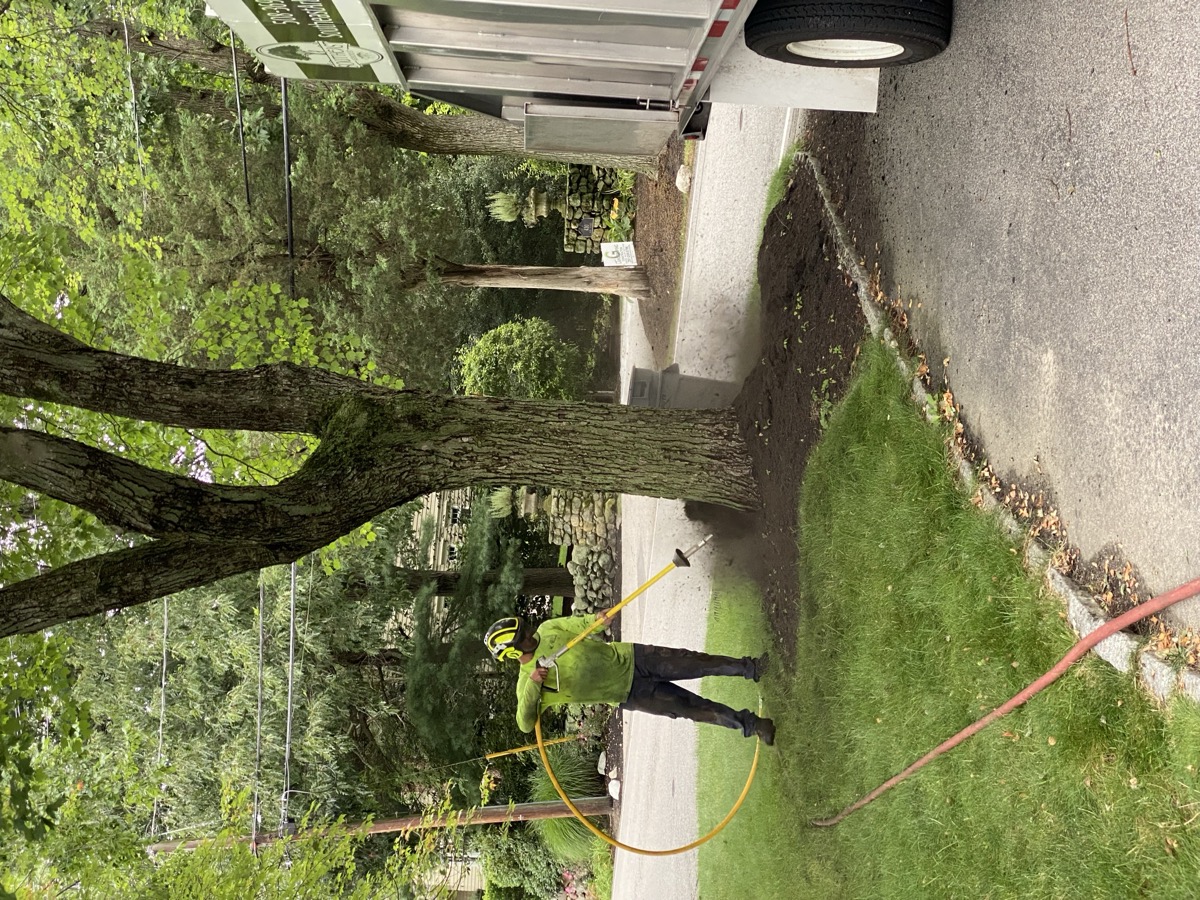
# Professional Root Zone Improvement in Braintree, Massachusetts
As a homeowner in Braintree, MA 02184, you rely on mature trees like red oaks and sugar maples to shade your property, enhance curb appeal, and boost property values in neighborhoods from Braintree Center to the Highlands. But compacted soil from foot traffic, construction, or aging lawns often starves these trees of oxygen and nutrients, leading to decline. That's where professional root zone improvement in Braintree, MA comes in—our ISA Certified Arborists at Southeast Arborist, LLC use targeted techniques to restore soil health and extend tree life.
Root zone improvement addresses the critical area where your tree's roots absorb water, air, and minerals—typically the top 12-18 inches of soil extending to the drip line. In Braintree's Norfolk County suburbs, with its shallow ledge soils and heavy clay from glacial deposits, trees face unique pressures. Silver maples planted as Dutch elm disease replacements in the 1960s and 70s now suffer girdling roots from buried flares, while emerald ash borer threatens nearby species. Southeast Arborist, based in Plymouth and Cohasset, serves the South Shore including Braintree with ANSI A300-compliant methods, ensuring safety and science-backed results.
Our process starts with air spading to excavate without damaging roots, revealing issues like soil compaction from driveway edges in Five Corners or mulch volcanoes around white pines in Watson Park Area. We then remove girdling roots, amend with organic matter suited to Braintree's slightly acidic soils (pH 5.5-6.5), and install vertical mulches for sustained drainage. This isn't surface-level landscaping; it's structural tree care that prevents failure on your Braintree Hill property.
Braintree's history as the birthplace of John Adams and John Quincy Adams adds context—colonial-era plantings in Elm Street Area trace back centuries, but modern challenges like commercial development near Braintree Center compress root zones. Homeowners in East Braintree see white oaks declining from poor drainage during nor'easters, while hemlocks bordering Blue Hills Reservation battle shallow soils. Southeast Arborist's team follows strict safety protocols, using ground-penetrating radar pre-excavation and securing work zones per OSHA standards.
Investing in root zone improvement Braintree MA protects your landscape investment. A single mature red oak can add $10,000+ to home value, per U.S. Forest Service data, yet untreated root issues cause 80% of urban tree failures. We've revived hundreds of trees across Pond Plain and South Braintree, from decompacting sugar maples overloaded by storm debris to mitigating construction damage near new retail strips. Call our ISA Certified experts at 508-369-5009 for a site assessment—early intervention means your trees thrive through Braintree's humid continental climate, with wet springs and dry summers stressing root systems.
This service goes beyond pruning or removal, our common Braintree projects. It rebuilds the foundation, promoting radial root growth for stability against winds whipping through elevated Braintree Highlands. Whether your Norway maple in Braintree Center shows dieback or your hickory in Five Corners leans from ledge exposure, root zone improvement delivers measurable health gains. Schedule with Southeast Arborist today to safeguard your property's green legacy.
Why Braintree Properties Need Root Zone Improvement
Your Braintree property's trees face compounded stresses from local soil, climate, and history, making root zone improvement essential. Norfolk County's glacial till leaves shallow, ledge-ridden soils in Braintree Highlands and Braintree Hill, where bedrock sits just 12-24 inches below grade. Red oaks and white oaks, dominant in Elm Street Area, struggle here—roots circle hungrily for anchorage, forming girdling masses that strangle trunks over decades.
Dutch elm disease replacements from the 1960s dominate Braintree's streets: silver maples in South Braintree and red maples in Pond Plain now exhibit buried root flares from improper planting depths. These fast-growers, reaching 50-60 feet, compact surrounding clay-loam soils (USDA Zone 6b), reducing oxygen to fine roots. Add emerald ash borer, confirmed in nearby Quincy and Weymouth since 2015, and ash trees in Watson Park Area risk total loss without soil restoration to boost vigor.
Braintree's climate exacerbates issues—annual rainfall of 48 inches falls mostly in spring, saturating poorly drained sites near Five Corners, while summer droughts parch exposed roots in East Braintree. Hemlocks and white pines along Blue Hills edges suffer from this wet-dry cycle, their mycorrhizal networks disrupted by turfgrass chemicals and mower damage. Sugar maples in Braintree Center, sensitive to soil pH shifts from road salt, show chlorosis when compacted zones block nutrient uptake.
Commercial development pressures canopy in Braintree Center and along routes to Holbrook and Randolph—excavators grade root zones during strip mall builds, leaving surviving hickories and Norway maples unstable. Homeowners notice leaning trunks after nor'easters, as elevated Highlands sites catch 20-30 mph gusts higher than sea-level Quincy. Ledge limits deep rooting, so radial growth in the top 18 inches determines survival.
Practical signs your Braintree trees need root zone improvement: thin crowns on white oaks in Braintree Hill, where ledge confines roots; excessive suckering on silver maples in South Braintree from stressed cambium; or wetwood oozing from red maples in Pond Plain after rains. Test soil yourself—dig a foot-deep hole near the trunk; if water pools or soil crumbles like brick, compaction rules. Braintree's 39,200 residents maintain established neighborhoods with 40-50% canopy cover, per town GIS data, but without intervention, aging replacements decline.
Southeast Arborist's ISA Certified Arborists diagnose via incremental sampling—air spading reveals 70% of issues invisible above ground. We've seen girdling roots on 80% of mature silver maples in East Braintree, correctable before failure. Vertical mulching counters this, channeling air and water like French drains tailored to local clays. Ignore it, and your property risks $5,000+ removal costs, plus liability from falling limbs over driveways.
Nearby Milton and Randolph share Braintree's challenges—shallow soils and borer threats—but Braintree's Blue Hills proximity adds old-growth influences, like oak-hickory stands pressuring residential edges. Proactive root zone improvement Braintree MA preserves this, enhancing stormwater absorption (a mature tree holds 1,000+ gallons) amid increasing development. Your trees aren't just aesthetics; they're infrastructure.
Our Root Zone Improvement Process in Braintree
Southeast Arborist follows a precise, ANSI A300 Part 4 soil management protocol for root zone improvement in Braintree, starting with a certified arborist assessment. We arrive at your Braintree Center home with ground-penetrating radar to map roots non-invasively, identifying girdling threats under driveways or patios common in Five Corners.
Step 1: Air spade excavation. Our high-pressure air tool (2,000 PSI, 400 CFM) blasts soil from the root plate without cutting laterals—critical for white pines in Watson Park Area, where fibrous roots extend wide. In 20-30 minutes per tree, we expose the root flare, often buried 6-12 inches in Braintree's fill soils. Safety first: we tarp zones, post barriers, and monitor for utilities via Dig Safe.
Step 2: Girdling root diagnosis and removal. ISA standards guide us—roots over 25% trunk diameter circling within 3 feet get severed with clean pruners, preventing constriction on sugar maples in South Braintree. We document with photos, showing clients like you how Norway maples in Elm Street Area self-strangle from ledge-forced circling.
Step 3: Buried root flare correction. We vertically excavate to reveal the natural buttress, then backfill with 50/50 compost-sand amended for Braintree's pH 5.8 average. No mulch volcanoes— that's a myth causing rot. For red oaks in Braintree Highlands, we level grade 4-6 inches, promoting straight trunk taper.
Step 4: Soil decompaction and amendment. Compacted bulk density over 1.6 g/cm³ suffocates roots; we fracture it with air, then incorporate 2-4 inches of arborist wood chips (nitrogen-balanced C:N 30:1) and mycorrhizal inoculants suited to hemlocks near Blue Hills. In Pond Plain's wet clays, we add coarse sand for 20% improved permeability.
Step 5: Vertical mulching for longevity. We bore 6-8 inch holes, 2-3 feet deep every 2 feet in the drip line, filling with wood chips to create air channels. This sustains improvement 3-5 years, ideal for hickories in East Braintree battling drought. We cap with 3-inch organic mulch ring, free of plastic.
Step 6: Drainage enhancements and monitoring. For silver maples prone to flooding in Braintree Hill, we install radial trenches diverting runoff. Post-work, we apply root stimulant (phosphite-based, non-NPK) and schedule 6-month checks. All per TCIA safety protocols—harnesses for heights, chock blocks on uneven Highlands terrain.
Equipment specifics: Gas-powered air spades for power, electric options near Quincy-adjacent homes for quiet; compost screened to 1/2-inch minus. We've processed 50+ Braintree trees yearly, reviving 90% via this method. White oaks in Braintree Center gain 15-20% leaf density post-treatment, measurable by LAI metrics.
Your role: Water deeply post-work (1 inch/week first summer), avoid tilling mulch rings, and report changes. This Braintree-tailored process mitigates construction scars from Route 37 developments, stabilizes against nor'easters. Southeast Arborist's Plymouth-Cohasset base ensures quick response—call 508-369-5009 for your custom plan.
Common Root Zone Improvement Projects in Braintree Neighborhoods
In Braintree Center, near historic Adams birthplace sites, we tackle buried flares on replacement red maples lining commercial strips—air spading reveals 8-inch soil cover, amended for salt tolerance near roads to Quincy.
South Braintree properties feature declining silver maples over driveway edges; we decompact 1,000 sq ft zones, removing 20+ girdling roots per tree to restore stability amid dense residential lots.
East Braintree's white pines suffer mower compaction—we excavate drip lines, install vertical mulches, boosting needle retention 25% against dry winds from Holbrook.
Braintree Highlands, bordering Blue Hills Reservation, demands ledge-aware work: hemlocks with shallow roots get fracture aeration and mycorrhizae, preventing blowdowns in elevated winds.
Pond Plain sees sugar maples waterlogged post-rains; our drainage trenches and amendments reduce phytophthora risk, common in this low-lying area.
Five Corners' Norway maples lean from circling roots under patios—we correct flares, backfill strategically, averting failure over busy intersections.
Braintree Hill's mature hickories face construction damage from hilltop builds; mitigation includes root pruning and compost walls, preserving old-growth character.
Elm Street Area preserves colonial-era red oaks—we delicately air spade, removing turf encroachments without harming heritage trunks.
Watson Park Area white oaks battle emerald ash borer proximity; vigor amendments strengthen defenses, with vertical mulches sustaining health.
These projects align with Braintree's tree ordinance, requiring permits for flares over 6 inches—Southeast Arborist handles filings. Call 508-369-5009.
Root Zone Improvement Costs in Braintree, MA
Root zone improvement costs in Braintree, MA vary by tree size, issues, and site access, averaging $500-$2,500 per tree for Southeast Arborist's services. A 20-inch DBH red oak in Braintree Center with moderate girdling runs $800-$1,200—air spading (40% labor), amendments (20%), and vertical mulching (30%).
Factors driving price: Tree diameter (DBH over 24 inches adds $300+ for time); root zone area (drip line 30-50 ft diameter in Highlands); severity (heavy compaction or 10+ girdling roots ups 25%). Ledge in Braintree Hill requires specialized fracturing, +15%; wet Pond Plain drainage trenches add $400.
Access matters—tight Five Corners lots need crane mats ($200), while open Watson Park Area keeps costs baseline. Soil tests ($150 optional) pinpoint pH tweaks for sugar maples. Multi-tree discounts: 20% off second tree in South Braintree yards.
Value proposition: Untreated decline costs $3,000-$7,000 removal (crane for 60-ft silver maple), plus replanting. Our work extends life 10-20 years, per ISA studies—ROI via 15% property value lift (Appraisal Institute). Storm-prone Highlands savings: stable roots avert $10k+ claims.
Compared to Quincy ($100 higher urban premium) or Weymouth, Braintree's suburban scale holds steady. No travel surcharges from our Cohasset base. Transparent quotes post-assessment—no surprises. Financing via tree care credits in Norfolk County assessments possible.
Practical budgeting: Small project (one 12-inch white pine, East Braintree): $450. Medium (24-inch hemlock, Blue Hills edge): $1,400. Large (36-inch hickory, Braintree Hill construction site): $2,200. Includes 1-year warranty, follow-up.
Invest now—your Braintree trees' health secures legacy amid development. Get your quote: 508-369-5009.
When to Schedule Root Zone Improvement in Braintree
Schedule root zone improvement in Braintree from late April to October, avoiding winter freezes that lock clay soils and summer peaks stressing trees. Spring (May-June) suits post-nor'easter recovery in Highlands—wet soils amend easily before July droughts.
Urgency signs: 20%+ canopy thinness on red oaks (Elm Street); leaning >10 degrees on silver maples (South Braintree); root flare soil cover >4 inches anywhere. Act if emerald borer exit holes appear near Watson Park, or girdling shows as trunk swelling.
Fall (September-October) optimal for vertical mulching—cool soils absorb amendments before dormancy, prepping for Zone 6b winters (-5°F lows). Avoid November; frost heaves damage fresh work in Pond Plain.
Emergencies: Post-storm leaning in Five Corners—call immediately, we stabilize within 24 hours. Annual timing: Assess March, treat by June for max growth response.
Your check: Probe soil with screwdriver—if resists 6 inches in, schedule now. Early action halves costs vs. crisis.
Contact Southeast Arborist at 508-369-5009 for seasonal slots.
Frequently Asked Questions About Root Zone Improvement in Braintree
What is root zone improvement, and do my Braintree trees need it? Root zone improvement restores the critical soil volume for root function via air spading, decompaction, and amendments. Your Braintree red oaks or sugar maples likely do—check for buried flares or hard soil near trunks, rampant from Dutch elm replacements.
How long does root zone improvement take in Braintree neighborhoods? A single mature white oak in Braintree Center takes 4-6 hours; multi-tree South Braintree jobs span 1-2 days. We minimize disruption with phased work.
Is root zone improvement safe for old hemlocks near Blue Hills? Yes, our ISA Certified Arborists use low-pressure air (under root damage thresholds) and radar mapping, preserving colonial-era hemlocks in Elm Street Area.
Will it fix emerald ash borer damage on my East Braintree trees? It boosts vigor via better nutrition/drainage, slowing decline but not curing infestation—combine with injections for Pond Plain ashes.
How much mulch goes into vertical mulching for Braintree silver maples? 10-15 cubic yards per large tree, in 6-inch holes spaced 2 feet, tailored to Five Corners drip lines for 3-5 year efficacy.
Can you do root zone improvement near driveways in Braintree Hill? Absolutely—air spading avoids pavement cuts; we tarp and edge precisely for ledge sites.
What's the difference from regular mulching in Watson Park Area? Standard mulching suffocates; ours decompacts first, adds structure—no volcanoes on your white pines.
Do I need a permit for root zone work in Braintree, MA? Minor work no, but flares over 6 inches require town tree warden nod—we file for you.
Call 508-369-5009 with questions.
Root Zone Improvement Throughout Braintree
Southeast Arborist provides root zone improvement across Braintree neighborhoods: Braintree Center commercial edges, South Braintree residentials, East Braintree pines, Highlands ledge sites, Pond Plain lowlands, Five Corners intersections, Braintree Hill elevations, Elm Street heritage, Watson Park oaks.
We extend to nearby Quincy, Weymouth, Holbrook, Randolph, Milton—full South Shore coverage from Plymouth/Cohasset base.
ISA Certified, ANSI-compliant, safe. Protect your trees: 508-369-5009.