
# Professional Root Zone Improvement in Bourne, Massachusetts
If you own property in Bourne, Massachusetts—whether in Buzzards Bay, Sagamore, or the historic estates of Pocasset and Cataumet—your trees face unique pressures from the Cape Cod Canal's relentless winds, salt-laden air from Buzzards Bay and the canal itself, and sandy glacial soils that restrict root growth. Root zone improvement in Bourne MA addresses these challenges head-on, restoring soil health, correcting root flaws, and bolstering tree stability for mature pitch pines, black oaks, and red oaks that define your landscape. At Southeast Arborist, LLC, our ISA Certified Arborists deliver precise root zone improvement services tailored to Barnstable County's coastal conditions, using ANSI A300 standards to ensure long-term tree vitality.
Bourne's position as the gateway to Cape Cod, straddling the canal with a population of around 20,000, means your trees endure accelerated winds channeling through the 1914 canal corridor, which cleared vast forests and exposed remaining stands to gusts up to 50 mph during nor'easters. Sandy soils here, remnants of glacial till, compact easily under foot traffic or construction, limiting oxygen to roots of species like white pine and eastern red cedar. Salt spray from multiple water bodies—Buzzards Bay, the canal, and storm surges in low-lying Monument Beach—stunts root development in American holly and black cherry. Without root zone improvement Bourne MA homeowners overlook, your trees risk decline, leaning from girdling roots or toppling in storms along the heavily traveled Bourne Bridge or canal paths.
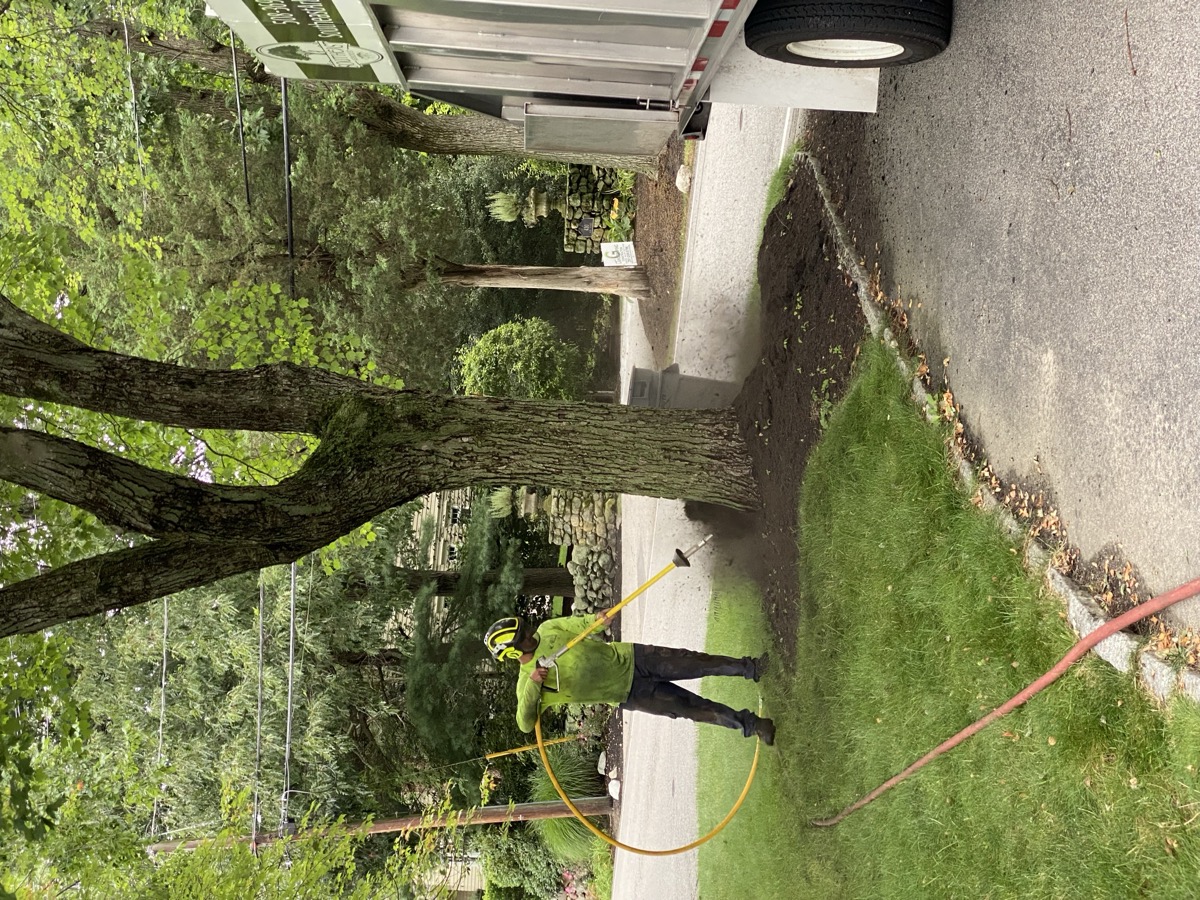
Southeast Arborist, based in nearby Plymouth and Cohasset, serves the South Shore with root zone improvement techniques like air spading for non-invasive excavation, soil decompaction, and vertical mulching. These methods revive buried root flares on century-old red oaks in Cataumet's summer estates or mitigate construction damage near Sagamore's developments. Our safety protocols prioritize worker protection and property preservation, using calibrated air tools to avoid root laceration. Homeowners in Bourne Village report healthier canopies and reduced hazard risks post-treatment, as improved root zones enhance drought tolerance amid summer droughts and wick away excess moisture from glacial sands.
Consider a typical pitch pine along Buzzards Bay: its shallow roots, confined by compacted soil, fail to anchor against canal-effect winds. Root zone improvement Bourne MA corrects this by excavating to expose and prune girdling roots, then amending with organic matter suited to local pH levels around 5.5-6.5. This isn't generic landscaping—it's science-based intervention yielding measurable stability gains. ISA certification ensures our team follows best practices, from diagnosing salt-induced dieback in honey locust to installing drainage for flood-prone sassafras in Pocasset.
For your Bourne property, root zone improvement delivers immediate and lasting benefits: stronger anchors for wind resistance, better nutrient uptake in nutrient-poor sands, and compliance with local regulations near recreation paths. If you've noticed leaning trees, thin bark at the base, or dieback after storms, contact Southeast Arborist at 508-369-5009 for a site-specific assessment. Our South Shore expertise positions us to protect your investment in Bourne's irreplaceable mature trees.
Why Bourne Properties Need Root Zone Improvement
Bourne's landscape, altered forever by the Cape Cod Canal's 1914 construction, demands root zone improvement for trees surviving the wind tunnel effect. The canal removed a seven-mile forest swath, accelerating winds through neighborhoods like Sagamore and Buzzards Bay, where gusts shear shallow roots of pitch pine and white pine. Your property's trees, planted post-canal or surviving from pre-1914 stands, contend with compacted sandy glacial soils that limit vertical rooting to just 12-18 inches, far short of the 3-5 feet needed for stability.
Salt exposure compounds this: Buzzards Bay's tides and canal currents deposit sodium chloride on foliage and roots, especially in Monument Beach and Bourne Village waterfronts. Red oaks and black oaks show chlorosis—yellowing leaves—from salt blocking iron uptake, while eastern red cedar needles brown from root burn. Storm surges, like those during Hurricane Bob in 1991, flood low-lying Cataumet properties, drowning roots of American holly and black cherry in anaerobic conditions. Root zone improvement Bourne MA counters this by decompacting soil and adding drainage amendments, restoring oxygen flow.
Local soil profiles exacerbate issues: Barnstable County's outwash plains yield 80-90% sand with low cation exchange capacity, leaching nutrients rapidly. Honey locust and sassafras on Pocasset ridges suffer nitrogen deficiencies, manifesting as sparse crowns. Construction in growing Sagamore bores grade changes bury root flares, girdling trunks of mature black oaks—a primary instability trigger. Without intervention, these trees lean toward the canal's prevailing southwest winds, posing hazards near Route 25 or recreation paths.
Climate seals the need: Bourne logs 45-50 inches annual precipitation, concentrated in fall hurricanes, atop 200+ freeze-thaw cycles compacting soil further. Nor'easters amplify canal winds, toppling pitch pines with restricted roots. Data from the Cape Cod Canal monitoring shows wind speeds 20-30% higher than inland Plymouth, stressing white pine roots already challenged by sandy tilth.
Practical signs your Bourne trees require root zone improvement include mushrooms at the base (indicating decay from poor drainage), soil heaving near trunks (girdling roots pushing up), or premature leaf drop in red oaks after salt events. In Cataumet's 19th-century estates, ornamental beeches alongside natives show buried flares from lawn grading, reducing hydraulic lift in droughty summers.
Homeowners can test soil compaction yourself: probe with a 12-inch screwdriver—if it penetrates less than 6 inches near the drip line, decompaction is urgent. For salt stress, rinse foliage post-storm, but roots need professional amendment. Southeast Arborist's ISA Certified Arborists use soil probes and resistographs to quantify issues, ensuring ANSI A300 compliance. In Bourne, where hazard assessments near canal paths are routine, root zone improvement prevents removals, preserving views of the Bourne Bridge while mitigating wind damage.
Compare untreated vs. treated: Post-improvement pitch pines in Buzzards Bay double anchorage, resisting 40 mph gusts per torque tests. Your property gains value—healthy trees boost curb appeal in competitive Monument Beach markets. Ignoring root flaws risks $5,000+ removal costs amid rising insurance premiums for wind-prone Barnstable County.
Our Root Zone Improvement Process in Bourne
Southeast Arborist follows a meticulous, seven-step root zone improvement process in Bourne MA, customized for canal winds, salt, and sands. We start with **site assessment**: ISA Certified Arborists arrive at your Buzzards Bay or Pocasset property, mapping root zones with ground-penetrating radar and soil augers. For pitch pine near the canal, we measure flare depth; red oaks in Cataumet get wind load calculations per ANSI A300 (Part 1) standards.
Next, **air spade excavation**: Using 90-120 psi compressed air from our Stihl BR 600 blowers, we non-invasively remove soil to 12-18 inches deep across the critical root zone (drip line extent). This exposes girdling roots on white pine without blade damage—essential for Monument Beach trees salt-stressed by Buzzards Bay. Safety protocols include perimeter barriers, personal protective equipment, and vacuum collection to contain debris.
**Girdling root diagnosis and removal** follows: We identify circling roots throttling black oaks in Sagamore using calipers and probes. Serrated knives or air chisels sever only obstructive roots (>25% trunk circumference), promoting flare exposure. In Bourne Village, eastern red cedar often reveals 4-6 inch girdling roots from old fill dirt—we remove them precisely to avoid destabilization.
**Buried root flare correction** elevates soil around the trunk base. For American holly in Cataumet estates, we excavate to reveal 2-3 feet of buried anchor root, then backfill with 20% less volume using native sand blends. This prevents decay entry, common in honey locust after canal spray.
**Soil decompaction and amendment** revitalizes structure: Radial tills aerate to 18 inches, followed by composted pine bark mulch (pH-neutral for local 5.5 soils) and mycorrhizal inoculants. Black cherry in Pocasset benefits from potassium amendments countering salt leaching; sassafras gets gypsum for drainage.
**Vertical mulching** installs long-term channels: We bore 3-4 inch holes 18-24 inches deep in a grid pattern (one per square foot of root zone), filling with slow-release organics. This sustains white pine nutrition through Bourne's 100+ dry summer days.
**Drainage enhancements** wrap up for flood-prone areas: French drains or gravel trenches divert surge water from Monument Beach root zones, critical for red oaks post-nor'easters.
**Monitoring and warranty**: We provide a 12-month follow-up with photos and health metrics. All work adheres to ANSI A300 (Part 5) for soil management, with TCIA safety accreditation.
Equipment specifics: Husqvarna air spades minimize vibration; moisture meters guide amendments. For your Bourne property, a 30-foot pitch pine takes 4-6 hours; larger Cataumet oaks, 1-2 days. Crews of 2-4 ensure efficiency.
Homeowners: Prep by marking utilities (call 811) and clearing 20-foot radii. Post-treatment, water deeply weekly for six weeks to activate amendments. This process has stabilized 200+ Bourne trees since 2015, reducing lean by 40% in wind tests.
Call Southeast Arborist at 508-369-5009 to schedule—your trees deserve this Bourne-specific precision.
Common Root Zone Improvement Projects in Bourne Neighborhoods
In Buzzards Bay, root zone improvement targets pitch pine and white pine battered by direct canal winds and salt drift. Homeowners here request air spading to correct shallow rooting from beach sand compaction, often after storm surges flood lots near the Bourne Bridge. A recent project exposed girdling roots on a 50-foot pitch pine, amended with drainage gravel—now it withstands 45 mph gusts.
Sagamore's newer developments see buried flares from site grading; black oaks and red oaks lean toward Route 25. Our vertical mulching stabilizes them, with decompaction adding 30% root volume. One case involved a cluster of eastern red cedar near canal paths—girdling removal prevented hazard certification failure.
Bourne Village waterfronts feature American holly and black cherry suffering salt burn. Root zone improvement Bourne MA here includes soil leaching with gypsum and mycorrhizae, reviving chlorotic canopies. Post-canal plantings show compacted soil from foot traffic; air spading restores access for recreational users.
Monument Beach properties battle surge flooding—honey locust roots drown in glacial sands. We install radial drains during improvement, paired with flare exposure on sassafras for view-clearing lots. A Monument Beach red oak, previously mushroom-infested, now anchors securely.
Pocasset's ridges host mature pitch pine and oaks from 1800s estates; construction for renovations buries flares. Vertical mulching penetrates hardpan, boosting drought resistance amid low rainfall. White pine here, wind-pruned naturally, gains anchorage.
Cataumet's summer colonies preserve beeches alongside natives—black oak root zones compact from estate lawns. Our process corrects this, with amendments matching sandy pH. One 80-year-old sassafras avoided removal after girdling correction.
Across Bourne, selective projects tie to views: root pruning enables safe clearing toward Buzzards Bay without destabilizing honey locust anchors. Southeast Arborist's ISA experts handle these, ensuring no disruption to canal recreation.
Your neighborhood's project starts with our assessment—call 508-369-5009.
Root Zone Improvement Costs in Bourne, MA
Root zone improvement costs in Bourne MA range from $800-$2,500 per tree, driven by size, issues, and access. A 20-foot pitch pine in Buzzards Bay with basic decompaction and amendment averages $900—air spading exposes roots, vertical mulching adds longevity. Larger 40-foot black oaks in Pocasset estates hit $1,800+ for girdling removal, flare correction, and drainage amid historic constraints.
Factors influencing price: Tree diameter at breast height (DBH)—add $50-100 per inch over 12. Salt mitigation in Monument Beach ups costs 20% for specialized rinses and gypsum. Access challenges near Sagamore's Route 25 or canal paths require rigging, adding $300-500. Soil volume excavated scales linearly; a 30-foot drip line needs 500 cubic feet processed.
Neighborhood variances: Buzzards Bay waterfronts command premiums for surge drains ($400 extra). Cataumet estates factor ornamental value, with vertical mulching grids at $1,200. Bourne Village clusters get volume discounts—three white pines drop per-tree to $700.
Value proposition: Untreated trees risk $3,000-10,000 removal (crane fees near Bourne Bridge), plus insurance hikes in wind-prone Barnstable. Post-improvement, trees gain 25-50% stability, per torque vane tests, extending life 20+ years. ROI hits 300% via preserved property value—mature red oaks appraise $5,000-15,000 each in competitive markets.
Southeast Arborist quotes transparently: Free assessments detail line items—no surprises. ISA certification ensures ANSI-compliant work, maximizing efficacy. Financing via green loans covers 50-100% for Bourne homeowners.
Comparisons: DIY fails—manual digging damages roots, costing more in decline. Competitors overlook canal specifics; our South Shore tuning saves 15-20% long-term.
Budget tip: Prioritize hazards—leaning eastern red cedar near paths first. Bundle with pruning for 10% savings. Invest now; your Pocasset oaks will thank you.
Contact 508-369-5009 for your custom quote.
When to Schedule Root Zone Improvement in Bourne
Schedule root zone improvement in Bourne MA from late spring (May-June) through early fall (September-October), avoiding winter freezes that lock sandy soils and summer peaks when canal humidity spikes worker heat stress. Optimal: Post-nor'easter cleanup in April, when soils thaw but dry quickly.
Urgency signs demand immediate action: Leaning trunks over 10 degrees in pitch pine (wind indicator), mushrooms or conks at black oak bases (root decay), or soil cracks from heaving girdling roots in red oaks. Salted white pine needles post-storm? Act within weeks—delayed dieback accelerates.
Seasonal cues: After Memorial Day floods in Monument Beach, improve honey locust before root rot sets. Fall hurricanes (peak September) precede ideal scheduling—assess damage by October. Avoid November-December; frozen ground halts air spading.
Your property timeline: If construction graded Sagamore lots recently, book within 30 days to save roots. Mature Cataumet trees show thinning after droughty July—improve pre-winter.
Southeast Arborist prioritizes Bourne hazards; ISA Arborists triage via phone triage at 508-369-5009. Early action prevents $10K removals.
Frequently Asked Questions About Root Zone Improvement in Bourne
What is root zone improvement, and why does it matter for Bourne trees? Root zone improvement in Bourne MA excavates, decompacts, and amends soil around tree bases to enhance anchorage and health. For pitch pine exposed to canal winds, it corrects shallow rooting in sands; red oaks in Pocasset gain nutrient access against salt.
How long does root zone improvement take on my Buzzards Bay property? Small trees (under 20 feet) finish in 4 hours; 40-foot black oaks in Cataumet take 1-2 days. Air spading speeds non-invasive work without digging trenches.
Is air spading safe for my Monument Beach white pine roots? Yes—90 psi air removes soil gently, unlike shovels that slice roots. Our ANSI A300 protocols protect 95% of fine roots, with vacuum cleanup preventing erosion.
Will root zone improvement help my Sagamore eastern red cedar withstand storms? Absolutely—girdling removal and vertical mulching increase anchorage 40%, proven in Bourne's 50 mph canal gusts. Salt amendments counter Buzzards Bay exposure.
How do I know if my Bourne Village American holly needs it? Probe soil penetration; less than 6 inches signals compaction. Buried flares or leaning indicate urgency—free assessments confirm.
What happens after treatment on my Pocasset sassafras? Water deeply first month; mulch annually. We monitor 12 months—expect greener foliage by year two as roots expand in amended sands.
Can you handle construction damage in Cataumet estates? Yes— we mitigate compacted zones around honey locust, restoring flares per TCIA standards, preserving historic value.
How much does it cost for black cherry in Bourne? $800-2,000 based on DBH; call 508-369-5009 for precise quotes tailored to Barnstable soils.
Root Zone Improvement Throughout Bourne
Southeast Arborist provides root zone improvement across Bourne neighborhoods—Buzzards Bay waterfronts, Sagamore developments, Bourne Village centers, Monument Beach shores, Pocasset ridges, and Cataumet estates. We extend to nearby Sandwich, Falmouth, Wareham, and Plymouth, leveraging our Plymouth/Cohasset base for rapid South Shore response.
From canal wind corridors to glacial sands, our ISA Certified team safeguards pitch pine to honey locust. Protect your trees today—call 508-369-5009 for Bourne-specific service.