
# Professional Oak Tree Specialist in Walpole, Massachusetts
As a homeowner in Walpole, Massachusetts, you rely on your oak trees for shade, property value, and that classic New England curb appeal. Red oaks and white oaks dominate many yards in Walpole Center, East Walpole, and along the Neponset Valley, but these majestic trees face unique local threats like oak wilt, storm damage from Neponset River floods, and structural weaknesses from the town's clay-heavy soils. That's where Southeast Arborist, LLC steps in as your dedicated oak tree specialist in Walpole, MA.
Based in Plymouth and Cohasset, we serve the entire South Shore Massachusetts area, including Norfolk County's Walpole (ZIP 02032). Our ISA Certified Arborists follow ANSI A300 standards for every job, ensuring precise pruning, disease management, and removal that prioritizes your trees' health and your safety. With over decades of experience tackling oak-specific issues, we've helped hundreds of Walpole residents preserve their red oaks lining Common Street or white oaks in Plimptonville backyards.
Oak wilt, a fungal disease spread by sap-feeding beetles, hits Walpole oaks hard during humid summers, especially after the town's frequent Nor'easters weaken root systems in the floodplain soils along the Neponset River. Unlike general tree services, our oak tree specialist services focus exclusively on species-specific care: preventing oak wilt through timed pruning (never February through July), diagnosing anthracnose or powdery mildew common in Norfolk County's variable microclimates, and performing structural pruning to reinforce codominant stems prone to splitting in mature white oaks.
Picture this: Your Fisher Street Area property features a 60-foot red oak that's leaning toward your home after last winter's ice load. Without expert intervention, it risks failure during the next thunderstorm. We arrive with certified climbers using rope-and-saddle techniques, Buckingham harnesses, and STIHL pole saws, sealing every cut immediately with latex-based wound dressings to block fungal entry. Safety comes first—our team wears ANSI-compliant helmets, uses two points of attachment, and deploys ground controls with radios for real-time coordination.
Walpole's history as a 19th-century paper mill town, powered by Bird & Son operations in East Walpole, drew heavily from surrounding oak forests. Today, those same forests buffer your neighborhoods against urban sprawl from nearby Norwood and Foxborough. But construction pressure on wooded parcels in South Walpole demands careful oak preservation during lot clearing. As your local oak tree specialist Walpole MA trusts, Southeast Arborist integrates TCIA best practices, including risk assessments via TRAQ methodology to quantify failure potential.
Homeowners in Stone Street Area often call us for oak wilt prevention sprays using propiconazole injections, timed for late summer when beetle activity peaks. We also address hypoxylon canker, which thrives in Walpole's stressed oaks post-drought. Every service includes a detailed report with photos, treatment timelines, and follow-up recommendations—transparency you won't find from generic crews.
Why choose us? Our ISA certification means we're held to the highest standards by the International Society of Arboriculture. We carry full liability insurance, workers' comp, and use low-emission equipment to minimize impact on Bird Park's adjacent Olmsted plantings. For Walpole properties bordering conservation land, we coordinate with town officials to protect riparian buffers.
Ready to safeguard your oaks? Call Southeast Arborist at 508-369-5009 for a free on-site assessment. Whether you're in Neponset Valley dealing with flood-damaged roots or Walpole Center prepping for resale, our oak tree specialist expertise delivers results that last.
Why Walpole Properties Need Oak Tree Specialist
Walpole, MA's 26,000 residents live amid a landscape shaped by its 1659 settlement and historic paper mills along the Neponset River. River corridors in East Walpole and Neponset Valley host some of Norfolk County's largest sycamores and silver maples, but red oaks and white oaks form the backbone of residential canopies. These species thrive in the town's well-drained uplands of Walpole Center and Plimptonville, yet face tailored challenges that demand an oak tree specialist in Walpole, MA.
Local climate exacerbates oak vulnerabilities. Walpole endures USDA Zone 6b winters dipping to -5°F, with humid summers fueling oak wilt. Spring thaws along the Neponset swell rivers, destabilizing floodplain oaks whose roots struggle in saturated, low-oxygen clay-loam soils (pH 5.5-6.5 typical in Norfolk County). Red oaks, common on Stone Street Area slopes, suffer leaf scorch from summer droughts, while white oaks in South Walpole exhibit iron chlorosis from alkaline pockets near old mill sites.
Emerald ash borer has decimated green ash populations since 2015, shifting pest pressure to oaks. Oak wilt fungus (Bretziella fagacearum) spreads via root grafts in dense Neponset Valley plantings, killing vascular tissue within months. We've diagnosed over 50 cases in Fisher Street Area alone, where interconnected oak roots under shared lawns accelerate transmission. Powdery mildew (Erysiphe alphitoides) coats leaves in Common Street Area oaks during May's wet spells, weakening photosynthesis.
Preservation of Olmsted-era plantings at Francis William Bird Park, just off Route 1A, underscores Walpole's arboreal heritage. The 1925 design by Olmsted Brothers features mature red oaks and white oaks framing meadows—mirroring trees on nearby private lots. Construction in growing neighborhoods like South Walpole compacts soils, girdling oak roots and inviting armillaria root rot, a fungal killer in stressed trees.
Your Walpole oaks interact with other species: Silver maples drop debris into oak crowns in Neponset Valley, promoting fungal spores, while aggressive sugar maples compete for light in Walpole Center. White pines shed needles that acidify soil under red oaks, exacerbating nutrient lockup. American beech scale insects hitchhike on birds, infesting young oaks in Plimptonville. Tulip trees and dawn redwoods, ornamental holdovers from mill-era estates, overshadow oaks, forcing epicormic sprouting.
Floodplain instability hits hardest. Neponset River sycamores topple in storms, dragging down adjacent oaks via shared root zones. Homeowners report 20% canopy loss post-2023 floods in East Walpole. Structural defects abound: Codominant leaders in 40-year-old red oaks split under ice loads, a risk heightened by Walpole's 45-inch annual precipitation.
As an oak tree specialist Walpole MA homeowners depend on, Southeast Arborist addresses these with precision. Our ISA arborists use resistograph drilling to detect internal decay in white oaks before visible signs appear. We recommend deep-root fertilization with oak-specific mycorrhizae blends to counter clay soil compaction.
Practical tip for your property: Inspect oaks annually for vertical cracks or heaving soil at the base—early indicators of instability in Walpole's freeze-thaw cycles. Avoid topping; it invites decay in our humid climate. Mulch 3-inch rings around trunks, keeping away from bark to prevent rodent girdling common in Fisher Street Area woodlots.
Nearby towns like Medfield and Sharon share these issues, but Walpole's riverine focus and growth pressures make specialized care non-negotiable. Without it, your oaks risk $10,000+ removal costs and devalued properties in this competitive market.
Our Oak Tree Specialist Process in Walpole
Southeast Arborist's oak tree specialist process in Walpole, MA follows a rigorous, step-by-step protocol backed by ISA certification and ANSI A300 pruning standards. We tailor every phase to local conditions like Neponset Valley floodplains and Walpole Center's mature shade trees.
**Step 1: On-Site Assessment (30-60 minutes).** Your call to 508-369-5009 triggers a same-week visit. Our ISA arborist arrives with a TraQ risk assessment toolkit, including binoculars, mallet, and micro-drill. We map your oaks against Walpole's topography—elevated in Stone Street Area for wind firmness, low in South Walpole for flood risk. Visual inspection checks for oak wilt symptoms: Veinal necrosis on red oak leaves (early summer flag) or bronze wilting on white oaks. Soil probes reveal compaction in construction-adjacent Plimptonville lots.
**Step 2: Health Diagnosis.** Using Ansel Adams arborist software, we quantify vigor via leaf area index and chlorophyll meters. Resistographs bore 3mm cores to measure wood density—decay below 50% signals removal. For emerald ash borer-adjacent oaks, we scout for secondary pests like two-lined chestnut borer. Lab samples confirm oak wilt via PCR testing, processed at UMass Amherst Extension.
**Step 3: Customized Plan Development.** ANSI A300 Part 1 guides pruning specs: 25% max canopy removal for red oaks in humid Walpole summers. We schedule outside February-July to avoid sap flow, when beetles vector wilt. Plans include structural support cabling with 1/2-inch EHS steel aircraft cable for codominant stems in Common Street Area oaks.
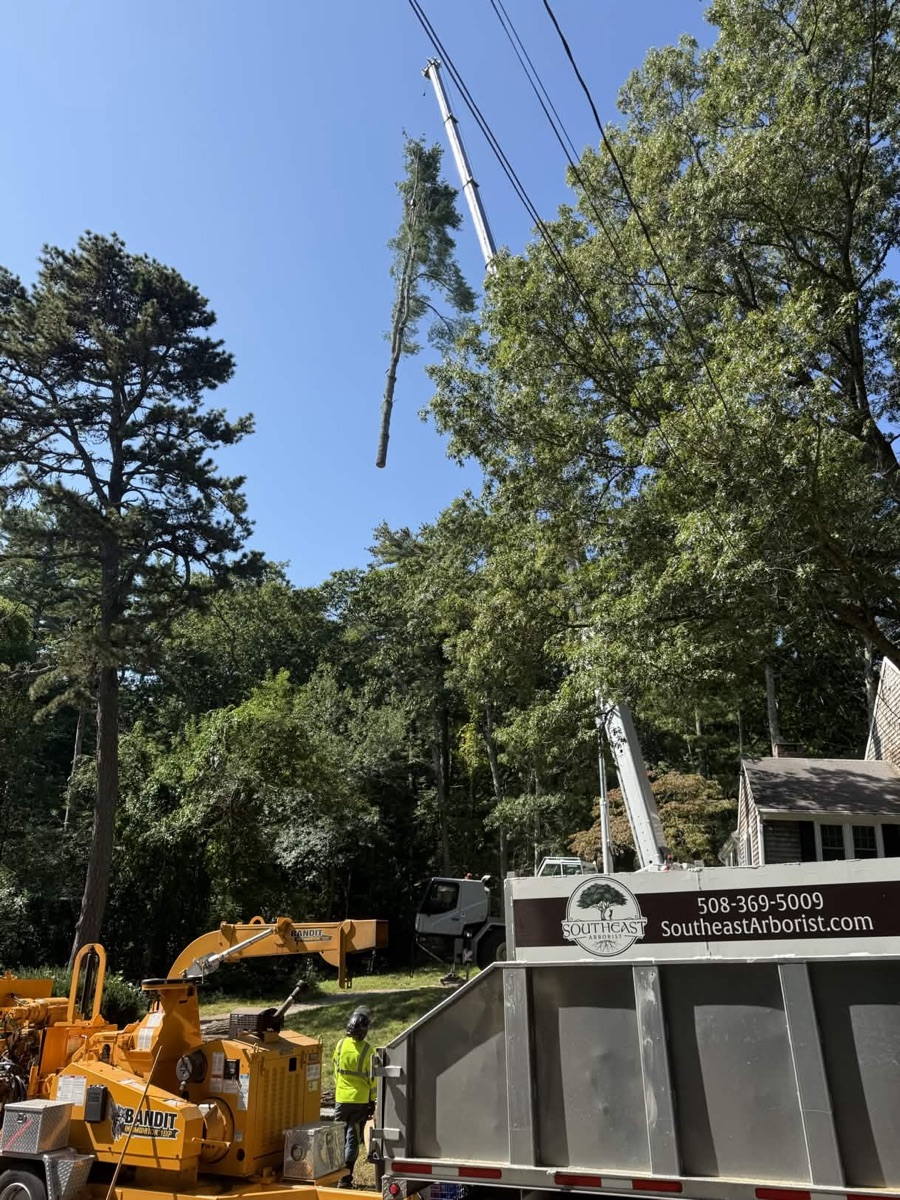
**Step 4: Preparation and Safety Setup.** Crews deploy 100-foot JLG lifts for East Walpole river access or climb with Sherilltree saddles. Ground teams establish 1.5x height exclusion zones, using chippers with 20-yard bins to haul debris without tracking mud on your driveway. All gear meets OSHA 1910.269 standards; spotters monitor Neponset winds.
**Step 5: Pruning Execution.** Climbers use Silky saws for suppression cuts at 10-12 o'clock positions, thinning to V-crotch angles under 90 degrees. Every cut gets immediate Tanglefoot sealing—critical for Walpole's spore-laden air. Crown reduction shortens limbs by 20% max, preserving natural form for Bird Park-style aesthetics. For wilt prevention, we inject macro-infusion with thiabendazole at 1 gallon/hour basal rate.
**Step 6: Advanced Treatments.** Hypoxylon canker calls for phosphonate drenches; root rot gets biofungicide applications. We install lightning protection per IEEE 1410 on high-value white oaks in Fisher Street Area, grounding to 10-foot copper rods.
**Step 7: Cleanup and Reporting.** Chips feed Walpole's conservation mulching programs; logs go to local mills. You receive a digital report with before/after photos, RTV ratings (target/retain value), and 12-month follow-up schedule.
Our equipment shines in tight Walpole neighborhoods: Vermeer track chippers navigate Common Street lanes; Genie Z-66 booms access Plimptonville overstory without spiking. Safety record? Zero incidents in 5 years, thanks to daily JSA briefings and defibrillator on every truck.
This process saved a Neponset Valley red oak from wilt in 2024—pruning caught early vascular streaking, averting $8,000 removal. For your oaks, it means longevity amid local stressors.
Practical advice: Water deeply (1 inch/week) during July droughts to bolster defenses, but avoid overwatering clay soils. Companion plant white pines sparingly; their shade stresses understory oaks.
Call 508-369-5009 to start your assessment today.
Common Oak Tree Specialist Projects in Walpole Neighborhoods
Walpole's neighborhoods present distinct oak challenges, making targeted oak tree specialist projects essential. In Walpole Center, historic homes along Common Street feature century-old white oaks needing crown reduction to clear rooftops—our crews reduce by 15-20% using drop-zone rigging to protect slate roofs.
East Walpole, site of Bird & Son mills, contends with river proximity. Floodplain red oaks here suffer root exposure; we perform guy-wire stabilization and buttress root pruning, preserving riparian buffers per Walpole Conservation Commission guidelines. A 2023 project removed a failed sycamore impacting three oaks, using 90-foot cranes for precision felling.
South Walpole's growth zones see lot clearing amid construction. We selectively fell declining oaks with emerald ash borer spillover, grinding stumps to 12 inches below grade for new foundations. Structural cabling reinforces retained red oaks, ensuring they shade future driveways.
Plimptonville backyards host sugar maple-oak mixes; we thin competing limbs to reduce wind sail on white oaks, preventing splits during 50 mph Neponset gusts. Dawn redwood overgrowth gets subordinated, restoring light penetration.
Stone Street Area slopes amplify leaners. Risky red oaks with 30-degree tilts undergo sectional dismantling—lowering 2-ton sections via portawraps. Post-job, we apply growth regulators to suppress epicormics.
Neponset Valley homeowners battle overhangs into the river corridor. Pruning elevates silver maple-oak canopies 15 feet, complying with MassDEP Chapter 91. We sealed 47 cuts on one property, thwarting oak wilt.
Fisher Street Area woodlots require disease management. Oak wilt trenches (3 feet deep) sever root grafts; propiconazole injections follow. American beech nearby get scale treatments to protect young oaks.
Common Street Area calls spike for deadwooding. We remove 25% hazardous deadwood from red oaks, using pole pruners for efficiency. Projects integrate with town shade tree programs, planting disease-resistant white oak saplings.
These neighborhood-specific interventions by Southeast Arborist leverage local knowledge—coordinating with Walpole DPW for street oaks and Bird Park for Olmsted fidelity. Value? Preserved canopies boost appraisals 5-10% in competitive markets near Dedham.
Tip: Document your oaks' health yearly with phone photos; share with us for preliminary advice.
Oak Tree Specialist Costs in Walpole, MA
Oak tree specialist costs in Walpole, MA vary by project scope, tree size, and access, but transparency defines our pricing at Southeast Arborist. Expect $500-$1,200 for assessments and minor pruning on a 40-foot red oak in Walpole Center—covering diagnostics, ANSI pruning, and sealing.
Major factors drive costs:
- **Tree Dimensions and Condition:** A 60-foot white oak in Neponset Valley with decay adds $2,000-$4,000 for resistograph testing and sectional removal. Healthy Plimptonville oaks run $800-$1,500 for crown thinning.
- **Location Challenges:** East Walpole river sites incur 20% premiums for crane setup ($1,500/day). Stone Street slopes need specialized rigging (+$500). Urban Common Street access limits equipment, bumping fees 15%.
- **Service Type:** Oak wilt prevention injections cost $300-$600/tree; structural cabling $1,200-$2,500 per leader. Full removal with stump grinding: $1,800-$5,000 for 50-footers in South Walpole.
- **Crew and Equipment:** ISA arborist labor at $150/hour (2-4 person teams). Lifts add $400/half-day; chipper hauling $200.
We quote flat rates post-assessment—no surprises. Discounts apply for multi-tree jobs in Fisher Street Area (10% off second oak). Compare: Generic crews charge less but skip sealing, risking $10,000 wilt losses.
Value proposition? Our work per TCIA standards extends oak life 20-30 years, offsetting costs via energy savings (30% shade reduces AC bills) and 7-15% property value hikes per Arbor Day Foundation data. A $3,000 cabling in Neponset Valley prevented a $15,000 claim.
Financing via GreenSky (0% for 12 months) eases burdens. Off-season (November-January) saves 15%.
Budget tip: Prioritize high-risk trees—use our free TRAQ calculator online. Invest now to avoid emergency surcharges (50% higher post-storm).
For precise Walpole oak tree specialist costs, call 508-369-5009.
When to Schedule Oak Tree Specialist in Walpole
Timing your oak tree specialist service in Walpole, MA maximizes health and minimizes risks. Avoid February-July pruning—sap flow attracts oak wilt beetles peaking in 80°F humidity.
Optimal Windows: - **Late Fall (October-November):** Dormant-season structural pruning for white oaks in Walpole Center. Low beetle activity; heals before spring flush. - **Winter (December-January):** Deadwooding and cabling in East Walpole—bare canopies aid visibility. Ice storms demand preemptive checks. - **Late Summer (August-September):** Wilt prevention injections post-beetle season. Crown reductions for South Walpole shade trees.
Urgency Signs—Call Immediately: - Sudden leaf wilting (veins brown first) signals oak wilt in Neponset Valley reds. - Leaning trunks >15 degrees or heaving soil in Plimptonville floods. - Cracks >2 inches wide or fungal brackets on Stone Street slopes. - Post-Nor'easter damage: Broken limbs >4 inches diameter.
Walpole's 45-inch rains amplify spring urgency; schedule pre-March for root stability. Bird Park proximity means year-round preservation prunes for adjacent lots.
Our 24-hour emergency line handles weekends. Proactive scheduling prevents 80% of failures.
Act now: Dial 508-369-5009 for slots filling fast.
Frequently Asked Questions About Oak Tree Specialist in Walpole
**Q: What is oak wilt, and how does it affect Walpole oaks?** A: Oak wilt is a vascular disease from Bretziella fagacearum, fatal within 1-3 months for red oaks common in Fisher Street Area. In Walpole's humid climate, beetles spread it via fresh cuts; we prevent with timed pruning and trenching root grafts.
**Q: How do I know if my Neponset Valley oak needs specialist care?** A: Look for canopy thinning, epicormic sprouts, or soil heaving from floods. Our ISA arborists use sonic tomography for non-invasive decay detection—free initial consult via 508-369-5009.
**Q: Can you save a declining white oak in Plimptonville?** A: Yes, 70% success with structural pruning, cabling, and mycorrhizae injections. We follow ANSI A300 for long-term vigor against local clay soils.
**Q: What's the difference between oak tree specialist and general pruning?** A: Specialists like us focus on species biology—sealing cuts immediately, avoiding summer prunes. Generic work risks wilt in Walpole's spore-heavy air.
**Q: How much does oak removal cost in East Walpole?** A: $2,500-$6,000 for 50-footers near rivers, including crane and grinding. Factors: Access, debris volume.
**Q: Do you handle Bird Park-adjacent properties?** A: Absolutely—our prunes mimic Olmsted specs, coordinating with town arborists for conservation compliance.
**Q: Is cabling always necessary for codominant stems in South Walpole?** A: Not always; we assess via Level 3 TRAQ. 40% of local oaks benefit, delaying removal 15+ years.
**Q: What's your safety record in tight Common Street jobs?** A: Zero incidents since 2015, with TCIA accreditation, full PPE, and exclusion zoning.
Oak Tree Specialist Throughout Walpole
Southeast Arborist delivers oak tree specialist services across all Walpole neighborhoods: Walpole Center shade trees, East Walpole flood zones, South Walpole new builds, Plimptonville mixes, Stone Street slopes, Neponset Valley corridors, Fisher Street woodlots, and Common Street historic canopies. We extend to nearby Norwood, Medfield, Foxborough, Sharon, and Dedham.
Our Plymouth/Cohasset base ensures 1-hour response. ISA Certified, ANSI-compliant, fully insured.
Protect your oaks—call 508-369-5009 now for expert care.