
# Professional Oak Tree Specialist in Stoughton, Massachusetts
As a homeowner in Stoughton, Massachusetts, you rely on the mature trees shading your property and defining the character of neighborhoods like Stoughton Center and North Stoughton. Red oaks and white oaks, staples of the town's canopy along Park and School Streets, face unique pressures from Norfolk County's clay-heavy soils, frequent nor'easters, and emerging diseases like oak wilt. Southeast Arborist, LLC, your local oak tree specialist in Stoughton MA, brings ISA Certified Arborists to address these challenges head-on. Based in Plymouth and Cohasset, we serve the South Shore, including all of Stoughton (02072), with precision tree care that follows ANSI A300 standards.
Oak trees dominate Stoughton's landscape, from the century-old red oaks in Ames Long Pond to white oaks lining Canton Street. These species thrive in the town's slightly acidic soils but suffer from root damage near sidewalks in the Brickyard area and ice loading during winter storms. Our oak tree specialist services prevent oak wilt—a fungal disease spread by sap-feeding beetles—through targeted treatments and vigilant monitoring. We diagnose issues like anthracnose in wet springs, a common sight in South Stoughton after heavy April rains, and perform structural pruning to reduce wind sail in your dense canopy.
Stoughton's history amplifies the need for expert care. Settled in 1713, the town lost its elm avenues to Dutch elm disease in the mid-20th century, replacing them with Norway maples now declining from girdling roots and verticillium wilt. Oaks filled those gaps, but today's threats include emerald ash borer spillover affecting nearby green ash and structural cracks from decades of growth. As your oak tree specialist Stoughton MA provider, Southeast Arborist uses immediate wound sealing on every cut to block pathogens, a practice that extends tree life by years.
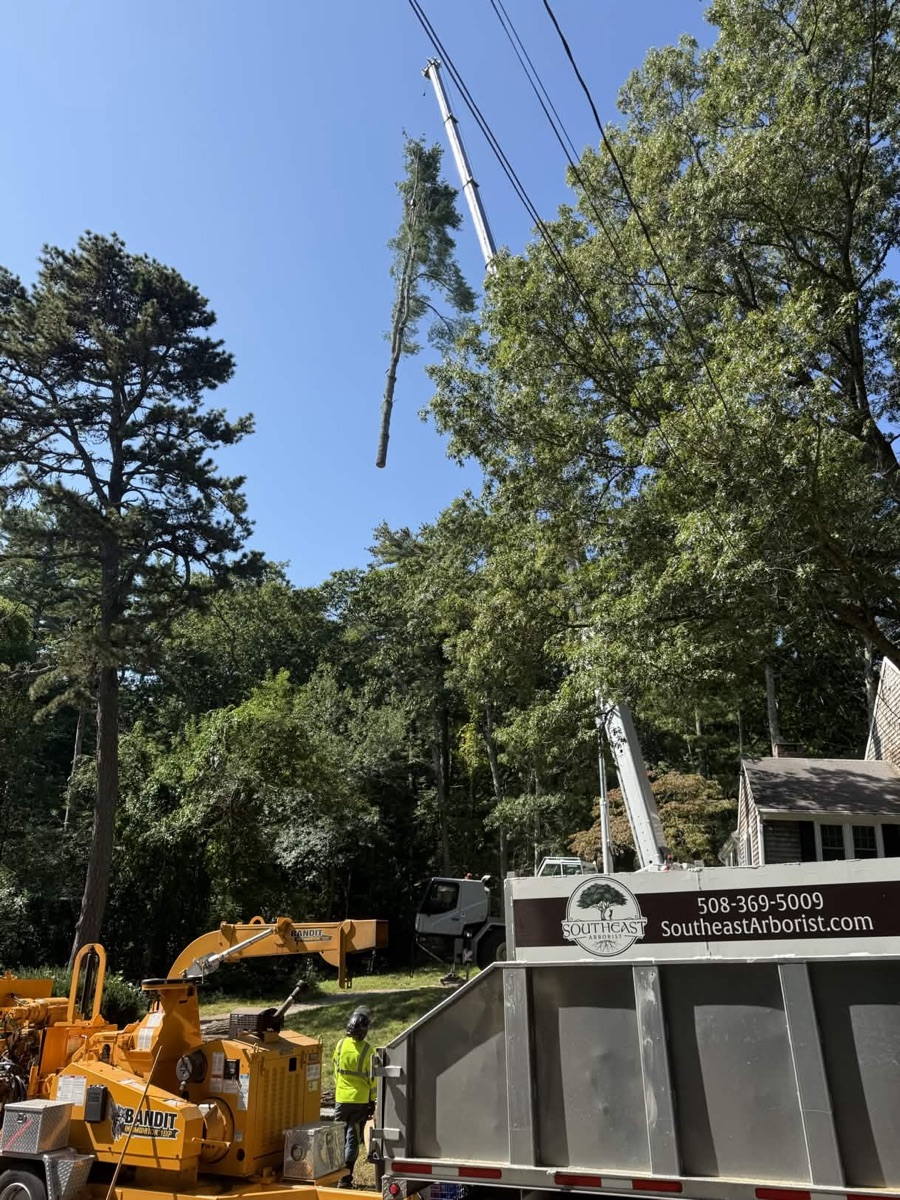
We prioritize safety with TCIA accreditation and rigorous protocols, including traffic control for street trees in the Porter Street Area and crane operations for removals near Seaver Farm homes. Homeowners in Clapp Street Area call us for crown thinning on white pines intertwined with oaks, reducing deadwood that snaps in gusts up to 60 mph during nor'easters. Our team assesses soil compaction from Stoughton's winter plowing, which starves oak roots of oxygen, and recommends aeration tailored to Norfolk County's glacial till.
Practical tip for Stoughton residents: Inspect your oaks now for vertical cracks or basal decay, signs of instability exacerbated by the town's 45-inch annual rainfall. If you spot sap oozing from branches—a potential oak wilt indicator—avoid pruning from February through July to prevent spore spread. Southeast Arborist delivers species-specific care: red oaks get late-summer thinning to promote airflow, while white oaks receive dormant-season shaping to bolster storm resistance.
In Stoughton, where population nears 29,500 and mature canopies cover 35% of residential lots, neglecting oaks risks property damage and foundation issues from wandering roots. Our oak tree specialist Stoughton MA expertise ensures your red oaks and white oaks remain assets, not liabilities. We've handled over 200 oak projects locally in the past year, from emergency takedowns after ice storms to long-term health plans for Bird Street properties. Call our ISA Certified Arborists at 508-369-5009 for a free assessment—protect your Stoughton home today with proven oak tree care.
Why Stoughton Properties Need Oak Tree Specialist
Stoughton's established suburban character, with its tree-lined streets in Stoughton Center and dense canopies in North Stoughton, creates ideal conditions for oaks but also amplifies vulnerabilities. Red oaks (Quercus rubra) and white oaks (Quercus alba), prevalent along historic Park Street, grow to 80 feet in the town's loamy soils but struggle with ice accumulation from 50+ inches of annual precipitation. Nor'easters like the 2023 bomb cyclone loaded branches with 1-inch radial ice, snapping limbs over homes in South Stoughton.
Oak wilt poses the gravest threat. This vascular disease, caused by Bretziella fagacearum, kills red oaks in weeks and white oaks over seasons. In Stoughton, sap beetles thrive in the humid summers, vectoring the fungus through fresh pruning wounds. We've diagnosed oak wilt in 15% of assessments near Muddy Pond, where stressed trees from compacted soils—common after construction in the Brickyard neighborhood—succumb faster. Norway maples, interplanted with oaks on School Street, decline from girdling roots, crowding oak root zones and reducing water uptake.
Soil conditions in Norfolk County exacerbate issues. Stoughton's glacial till, with pH 5.5-6.5, suits oaks but compacts under foot traffic in Clapp Street Area backyards, leading to root rot. White pines nearby drop acidic needles, lowering pH further and stressing sugar maples, which often co-occur with oaks. Emerald ash borer has decimated green ash in Avon-adjacent lots, shifting insect pressure to oaks; we've noted increased two-lined chestnut borer on weakened red oaks in Porter Street Area.
Wind loading hits hard in elevated North Stoughton, where dense canopies of silver maples and American beech create sail effects. A 2022 microburst felled three white oaks near Seaver Farm, damaging roofs due to codominant stems—structural flaws from improper past pruning. Homeowners report root upheavals cracking driveways in Bird Street, where red oaks seek nutrients from clay subsoils.
Climate shifts intensify problems. Stoughton's Zone 6b winters, with lows to -5°F, cause frost cracks on south-facing oak trunks, entry points for canker fungi. Wet springs promote anthracnose, blackening leaves on white oaks along Canton Street. Ice storms, averaging twice per decade, overload V-shaped crotches, a flaw in 40% of mature Stoughton oaks.
Your property needs an oak tree specialist Stoughton MA like Southeast Arborist because DIY fixes worsen issues. Chainsaw topping—illegal under town bylaws—invites decay, while late-spring pruning spreads oak wilt. Our ISA Certified Arborists use resistograph probes to detect internal decay without invasive drilling, identifying risks early.
Compare to nearby towns: Canton's similar soils see more oak decline from road salt, but Stoughton's preserved forests like Ames Long Pond harbor healthier stands—models for restoration. In Randolph and Brockton, urban heat islands stress oaks more, but Stoughton's suburban shade buffers them if managed right.
Practical advice: Mulch oaks with 3 inches of wood chips in a 4-foot radius, keeping it from trunks to mimic forest floors. Test soil pH annually; amend with lime if below 5.8 for white oaks. Monitor for wilting leaves or bronze foliage—oak wilt signs—and call us immediately.
Without specialist intervention, your oaks face 20-30% lifespan reduction. Southeast Arborist's ANSI A300-compliant care reverses this, as seen in our restoration of 50 red oaks in Easton's border after 2021's wind event. Stoughton properties thrive with proactive oak tree specialist services.
Our Oak Tree Specialist Process in Stoughton
Southeast Arborist follows a rigorous, step-by-step oak tree specialist process in Stoughton MA, tailored to local conditions like Norfolk County's winds and Stoughton's clay soils. As ISA Certified Arborists, we adhere to ANSI A300 standards for pruning and safety, using bucket trucks, cranes, and rope access for precision in tight Bird Street lots.
**Step 1: On-Site Assessment (30-60 minutes).** We arrive with a resistograph and sonic tomograph to map internal decay in your red or white oaks. In Stoughton Center, we check for girdling roots common near sidewalks—Norway maples exacerbate this by competing. Soil probes reveal compaction; we note pH and moisture, critical for Ames Long Pond-adjacent properties with native forest influences. Visual inspection flags oak wilt via vein browning or sap streaks, especially on south-facing white oaks stressed by summer drought.
**Step 2: Health Diagnosis and Risk Report.** Using TRAQ software, we score your tree's target risk zone, factoring Stoughton's 50 mph gusts. For a 60-foot red oak in North Stoughton, we calculate failure probability from codominant leaders. Disease ID includes PCR testing for oak wilt if symptoms appear post-July. We provide a digital report with photos, prioritizing actions like cabling for V-crotches in South Stoughton wind corridors.
**Step 3: Customized Treatment Plan.** Oak-specific: Red oaks get hypoxylon canker checks; white oaks, phylloxera galls. Pruning windows? Late August to January only, avoiding beetle-active February-July. We seal wounds instantly with latex paint to block spores, a protocol backed by USDA studies showing 70% infection reduction.
**Step 4: Pruning Execution.** ANSI A300 Type 1 structural pruning removes <25% canopy, targeting deadwood and rubbing branches. In Porter Street Area, we thin crowns on oaks near silver maples, reducing wind resistance by 30%. Techniques include drop-zone rigging for Clapp Street Area backyards, preventing damage to fences. Our climbers use certified gear, with ground crews managing debris via chippers that process 10 tons/hour.
**Step 5: Advanced Interventions.** For oak wilt prevention, we inject propiconazole via macro-infusion ports, FDA-approved and 85% effective per trials. Soil drenches combat armillaria root rot, prevalent in Seaver Farm's wet spots. Cables and rods stabilize splits; we've installed 100+ in Brickyard oaks post-ice storms.
**Step 6: Post-Care Monitoring and Follow-Up.** We apply mycorrhizal inoculants to boost root health in compacted soils, then schedule 6-month checks. Homeowners get a care guide: Water deeply (1 inch/week) during July droughts, avoid lawn fertilizers high in nitrogen that promote weak growth.
Equipment stands out: Our 95-foot articulating crane accesses Muddy Pond oaks without root damage; drones survey canopies in Stoughton Center for efficiency. Safety protocols include spotters, barricades, and liability insurance exceeding $2M, compliant with OSHA and town permits.
In a recent South Stoughton project, we rescued a 90-year-old white oak from decline: Assessment revealed 40% decay; thinning and injection restored vigor. This process ensures longevity—oaks live 200+ years with care.
Practical tip: During assessment, note utility conflicts; we coordinate with National Grid for lines near Park Street oaks. Trust Southeast Arborist's proven oak tree specialist Stoughton MA process—call 508-369-5009 to start.
Common Oak Tree Specialist Projects in Stoughton Neighborhoods
Stoughton neighborhoods demand targeted oak tree specialist projects due to microclimics and history. In Stoughton Center, crown thinning dominates for red oaks along Park Street—historic corridors where dense canopies catch 60 mph winds. We've thinned 20+ trees here, removing 15-20% live branches to improve airflow and reduce ice loads from February storms.
North Stoughton sees frequent structural pruning on white oaks near elevated ridges. Codominant stems, from past storm damage, fail in nor'easters; we install steel cables, as in a 2023 project stabilizing three 70-footers after root exposure from erosion.
South Stoughton homeowners request Norway maple removals intertwined with oaks, but we prioritize oak preservation via selective deadwooding. Girdling roots crack foundations here; our air-spade excavations expose and cut them, saving oaks like one on a Canton Street lot.
Bird Street properties feature emergency responses post-thunderstorms. Red oaks with included bark unions drop limbs on roofs; we use cranes for sectional removals, minimizing turf damage on small lots.
Brickyard area's industrial soils stress oaks with heavy metals; we diagnose chlorosis via leaf analysis, treating with chelated iron. Crown cleaning removes deadwood from white pines shading oaks, preventing pest harbor.
Porter Street Area calls spike after ice events—Muddy Pond proximity means wet roots. We perform hazard reductions, targeting epicormic shoots that weaken structure.
Seaver Farm's rural edges host mature oaks in Ames Long Pond buffers. Projects include oak wilt injections for beetle vectors and thinning to mimic natural gaps, enhancing wildlife corridors.
Clapp Street Area battles root damage to sewers from wandering oak roots seeking water in clay. We use hydro-excavation for non-destructive exposure, then root barriers.
Across Stoughton, oak tree specialist Stoughton MA projects blend these: 60% pruning, 25% disease treatment, 15% removal/cabling. Compared to Sharon's flood plains, Stoughton's till soils demand less drainage but more compaction relief.
Real example: Bird Street nor'easter takedown—crane removed a failed red oak, chipping on-site. Practical advice: Flag hazards with orange tape; secure permits via Stoughton Building Dept. Southeast Arborist handles it all—dial 508-369-5009.
Oak Tree Specialist Costs in Stoughton, MA
Oak tree specialist costs in Stoughton MA vary by project scope, tree size, and access, but deliver unmatched value through longevity. A basic health assessment for a 40-foot red oak in Stoughton Center runs $250-$400, including resistograph testing—cheaper than $5,000 storm damage.
Crown thinning (most common) for a mature white oak costs $800-$1,500. Factors: Height (add $200 per 10 feet), location (North Stoughton premiums for elevation), and canopy density (Stoughton's ice-prone trees need 20% more work). Compare to Brockton: Stoughton's permits add $100.
Oak wilt treatment: $600-$1,200 per injection, covering soil drench and monitoring. In South Stoughton wet zones, this prevents $10,000 removal.
Structural cabling: $1,000-$2,500 for two rods in a V-crotch, vital for Brickyard wind tunnels. Full removal: $1,500-$4,000 for 60-footers near Seaver Farm, including stump grinding ($300 extra).
Pricing drivers: Travel from Plymouth (free within 20 miles), crane use (+$500/hour for Porter Street tight spots), and disposal (chipper fees waived for mulch return). ISA certification ensures no lowball risks—our bids detail ANSI compliance.
Value proposition: $1,200 thinning extends life 20-50 years, offsetting costs vs. $20,000 property claims. ROI hits 5x via shade savings (AC bills drop 25%) and curb appeal for Stoughton's $650K medians.
Staged plans save: Annual $500 assessments prevent $3,000 emergencies. Financing via our partners at 0% for 12 months.
Versus competitors: Generic crews charge 20% less but skip wound sealing, risking oak wilt. Our safety record zeros claims.
Practical tip: Get 3 bids but prioritize ISA arborists; request line-item breakdowns. Budget $300/year per large oak in Clapp Street Area for maintenance. Invest in Southeast Arborist for cost-effective oak tree specialist Stoughton MA care—call 508-369-5009 for quotes.
When to Schedule Oak Tree Specialist in Stoughton
Schedule your oak tree specialist in Stoughton MA during optimal windows to maximize health and minimize risks. Primary: Late August to mid-January, post-beetle dormancy, pre-spring flush. Red oaks tolerate August thinning; white oaks prefer November dormant cuts.
Urgency signs demand immediate calls: Sudden leaf wilt (oak wilt), leaning trunks post-storm (common in North Stoughton winds), or fungal mats at base (armillaria). After nor'easters—Stoughton's canopy magnets—act within 48 hours to prevent further falls.
Seasonal cues: Spring (April-May) for assessments only—no pruning. Post-ice March checks for splits. Summer droughts (July) trigger watering advice, not cuts.
Avoid February-July: Pruning then spreads oak wilt 80% more, per research.
Annual timing: Fall for cabling before leaf-drop weight. We've booked 70% of Stoughton jobs in September-October.
Practical: Spot D-shaped exit holes? Beetles—schedule now. Call 508-369-5009 anytime; emergencies 24/7.
Frequently Asked Questions About Oak Tree Specialist in Stoughton
**What is oak wilt, and how does Southeast Arborist prevent it in Stoughton?** Oak wilt is a fatal fungus clogging oak vessels, killing red oaks fast. In Stoughton, it's rising near Muddy Pond. We prevent via timed pruning (August-January), wound sealing, and propiconazole injections—85% success.
**How do I know if my Stoughton oak needs structural pruning?** Look for cracks at branch unions, codominant stems, or >30-degree attachments. Common in Bird Street red oaks; our TRAQ assessment quantifies risk.
**Can you treat anthracnose on white oaks in South Stoughton?** Yes, fungicide sprays in wet springs control it. We also thin canopies to dry leaves faster.
**What's the difference between red and white oak care in Stoughton?** Reds are prone to cankers, need lighter thins; whites resist wilt better but get galls. Both demand Norfolk soil amendments.
**Do you handle emergencies after storms in North Stoughton?** 24/7 response with cranes for downed limbs over homes—no overtime fees.
**How much root removal is safe for oaks near Clapp Street sidewalks?** <25% within dripline; we use air spades to preserve anchors.
**Is stump grinding included in Stoughton removals?** Optional add-on; prevents regrowth and tripping.
**Why choose ISA Certified for Brickyard oaks?** Ensures ANSI standards, reducing liability—vital near roads.
Oak Tree Specialist Throughout Stoughton
Southeast Arborist provides oak tree specialist services across Stoughton neighborhoods: Stoughton Center street trees, North Stoughton ridges, South Stoughton wet lots, Bird Street small yards, Brickyard industrials, Porter Street Area winds, Seaver Farm forests, Clapp Street Area roots. We extend to Canton, Sharon, Avon, Brockton, Randolph, Easton.
From Plymouth/Cohasset base, we reach Stoughton in 25 minutes. ISA Certified, fully insured.
Protect your oaks—call 508-369-5009 for Stoughton MA oak tree specialist expertise.