
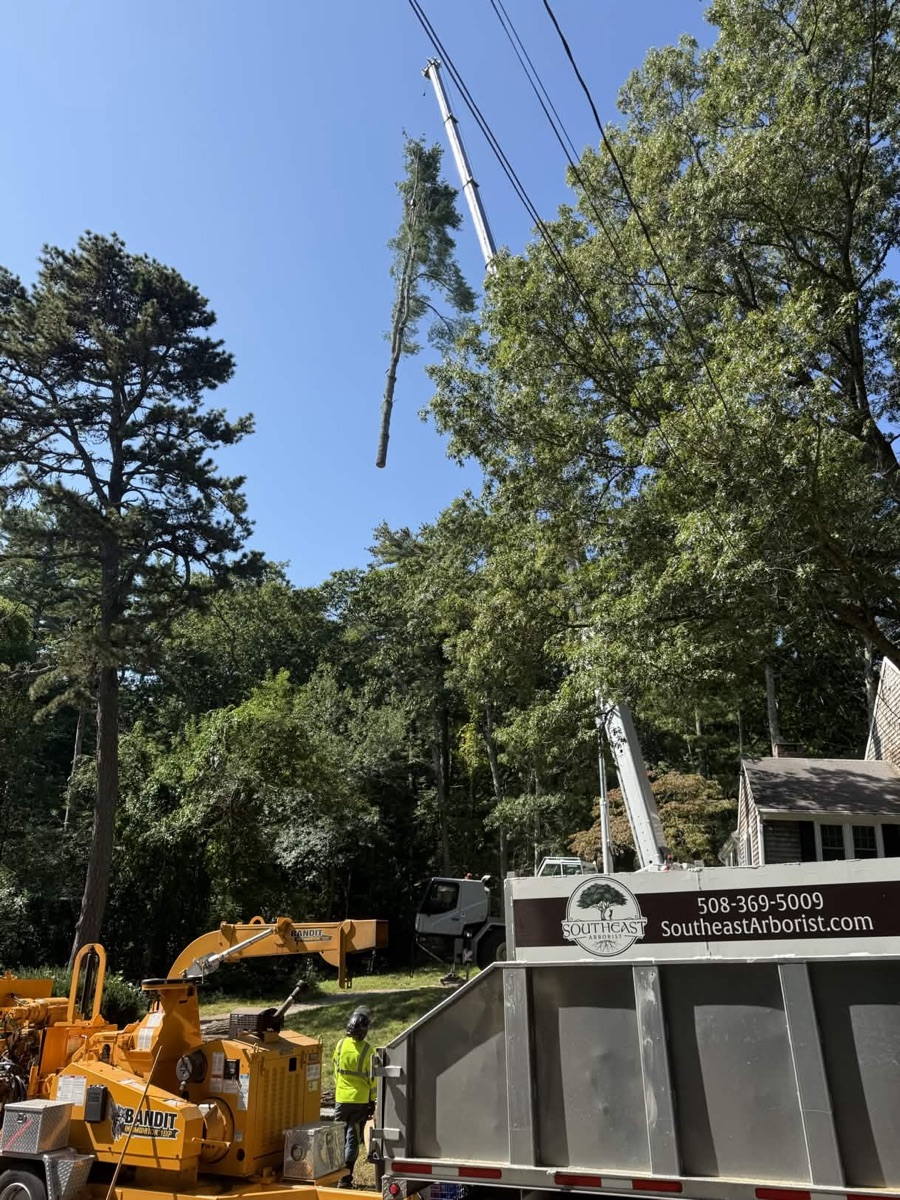
# Professional Oak Tree Specialist in Seekonk, Massachusetts
As a homeowner in Seekonk, Massachusetts, you rely on your mature oaks to provide shade, define property lines, and enhance curb appeal in neighborhoods like Seekonk Center or Luther Corner. Red oaks and white oaks dominate the canopy here, their deep roots stabilizing Bristol County's loamy soils along the Palmer River corridor. Yet, these trees face unique pressures from the town's mild coastal climate, aging post-war plantings, and emerging threats like oak wilt. That's where Southeast Arborist, LLC steps in as your dedicated oak tree specialist in Seekonk, MA.
Based in Plymouth and Cohasset, our ISA Certified Arborists serve the South Shore Massachusetts region, including Seekonk's 16,000 residents across suburban neighborhoods and commercial strips. We adhere strictly to ANSI A300 standards for tree care, ensuring every pruning cut, diagnosis, and treatment prioritizes long-term health and safety. Our team uses advanced equipment like bucket trucks with low-side reach for precise access in tight South Seekonk lots and aerial lifts for Palmer River riparian zones.
Oak wilt, a fungal vascular disease spread by sap-feeding beetles, poses a growing risk to Seekonk's red and white oaks, especially in older stands near Newman Avenue. Symptoms include vein browning on leaves and rapid canopy dieback, often mistaken for drought stress in our humid Narragansett Bay watershed summers. As your oak tree specialist Seekonk MA experts, we prevent this through species-specific protocols: never pruning from February through July to avoid attracting vectors, immediate wound sealing on all cuts, and targeted fungicide injections for confirmed cases.
Beyond disease, structural issues plague Seekonk's oaks. Codominant stems from early 20th-century street plantings in North Seekonk create failure points during ice storms, common in our Providence-area winters. We perform health assessments using resistograph tools to detect internal decay without invasive drilling, followed by structural pruning to redistribute weight and promote compartmentalization of decay (CODIT) principles.
Homeowners in the Fall River Avenue Corridor commercial zone trust us for parking lot oak maintenance, where neglect leads to root damage from pavement compaction. Our safety protocols include traffic control and spotter systems, minimizing disruption to Route 6 traffic. For residential properties in Luther Corner, we focus on selective thinning to improve wind resistance, preserving the agricultural heritage shared with neighboring Rehoboth.
Practical advice for Seekonk oak owners: Inspect your trees annually in late fall after leaf drop for basal trunk cracks or soil heaving from frost cycles in our sandy-loam soils. Avoid topping, which weakens branch collars and invites pathogens. If you spot wilting leaves on upper branches—hallmarks of oak wilt—halt all DIY cuts and call us immediately at 508-369-5009.
Southeast Arborist delivers value through certified expertise. Our oak tree specialist services in Seekonk MA extend to companion species like sugar maples and American beeches interplanted with oaks, addressing emerald ash borer spillover risks to green ash understories. Whether managing a single heritage white oak on your Newman Avenue lot or a row along South Seekonk driveways, we customize plans to your property's microclimate—influenced by proximity to Attleboro's urban heat or Swansea's wetlands.
In this article, discover why Seekonk's oaks demand specialized care, our step-by-step process, neighborhood-specific projects, transparent pricing, optimal scheduling, FAQs, and full coverage details. Protect your investment—contact Southeast Arborist today at 508-369-5009 for a no-obligation assessment.
Why Seekonk Properties Need Oak Tree Specialist
Seekonk's position as a Rhode Island border town in Bristol County exposes your oaks to distinct challenges from its suburban expansion, commercial corridors, and Narragansett Bay watershed dynamics. Post-war development in neighborhoods like South Seekonk and North Seekonk preserved native red oaks and white oaks, now reaching 60-80 years old and showing end-of-life signs such as deadwood accumulation and root plate exposure from Palmer River flooding.
Red oaks (Quercus rubra), prevalent in Seekonk Center's older streetscapes, suffer from anthracnose in our wet springs, causing leaf blotch and twig dieback that stresses vascular systems. White oaks (Quercus alba), anchoring Luther Corner yards, develop armillaria root rot in waterlogged clay-loams near the river, leading to girdling roots that strangle trunks. Our ISA Certified Arborists at Southeast Arborist diagnose these via soil core sampling and visual indicators, preventing total loss.
Oak wilt thrives in Seekonk's mild coastal climate—average January lows of 22°F and July highs of 82°F—with high humidity fostering beetle activity. Unlike colder inland areas, our extended growing season heightens risk; a single infected Norway maple nearby can vector spores to your oaks via root grafts. Silver maples, common interplants in Newman Avenue Area, exacerbate this by shedding debris that harbors insects.
Commercial properties along the Fall River Avenue Corridor face tree neglect: parking lot oaks endure salt spray from Route 6 plowing and soil compaction, causing surface root flares prone to Phytophthora cankers. Emerald ash borer, decimating green ash in Attleboro fringes, indirectly stresses oak understories by altering ecosystem balance, increasing black cherry competition and beech bark disease spillover to American beeches.
Palmer River riparian zones demand specialist intervention. Flooding erodes banks, destabilizing white pine and oak hybrids; your streamside property in Rehoboth-adjacent North Seekonk sees hypoxic soils killing fine roots. Sugar maples uphill fare better on drier knolls but develop verticillium wilt, mimicking oak decline.
Seekonk's agricultural roots from its Rehoboth origins mean many oaks grew unmanaged amid pastures, now urbanized. Early-to-mid 20th-century plantings in Seekonk Center feature codominant leaders, vulnerable to ice storms that coat branches with 1-inch accumulations, snapping limbs over power lines. Storm damage, though moderate versus Swansea's coast, spikes after nor'easters.
Soil conditions amplify issues: Bristol County's glacial till creates acidic pH (5.5-6.5) ideal for oaks but deficient in calcium, promoting chlorosis in red maples shading your trunks. Homeowners practical tip: Test soil pH annually with a local extension kit from Bristol County Cooperative Extension; amend with dolomitic lime if below 6.0 to boost nutrient uptake without over-fertilizing, which invites pests.
Without an oak tree specialist Seekonk MA like Southeast Arborist, DIY pruning risks disaster. Homeowners often cut during forbidden February-July windows, inviting oak wilt. We follow ANSI A300 Part 1 for pruning, targeting 25% max canopy removal to avoid stress shock.
Nearby towns like Attleboro introduce invasives: Norway maples seed into oak woodlands, outcompeting natives. White pines in Luther Corner drop needles, acidifying duff and hindering oak regeneration. Proactive care preserves biodiversity—your red oak acorns feed local wildlife, sustaining Seekonk's suburban ecosystem.
Flood-prone South Seekonk lots see riparian oaks with buttress roots exposed; neglect leads to blowover in 40 mph gusts. Our assessments quantify risks using windthrow models tailored to Narragansett topography.
Invest in specialist care to extend your oaks' lifespan by decades. Southeast Arborist's protocols mitigate these Seekonk-specific threats, safeguarding property values in a town where mature trees boost assessments by 10-15%.
Our Oak Tree Specialist Process in Seekonk
Southeast Arborist's oak tree specialist process in Seekonk MA follows a rigorous, ANSI A300-compliant sequence designed for your red and white oaks' biology. We start with **Site Assessment**, arriving at your Seekonk Center property in a fully insured truck with traffic delineators for safety.
Step 1: **Visual and Instrumented Inspection** (1-2 hours). Our ISA Certified Arborists circle your tree, noting target dieback in red oaks or epicormic sprouting on white oaks—signs of decline. We use resistographs for decay density, sonic tomography for hollows, and aerial drones for canopy mapping in tall Luther Corner specimens. Soil probes check Palmer River moisture levels; pH meters confirm acidity.
Step 2: **Risk Evaluation** (30 minutes). We score hazards per ISA Tree Risk Assessment Qualified Arborist standards: codominant stems in North Seekonk street trees get high ratings if overhung by powerlines. Root plate tilt from flooding in South Seekonk triggers immediate alerts.
Step 3: **Disease Diagnosis** (if indicated). Lab-submitted samples rule out oak wilt via ELISA testing; verticillium in sugar maple companions gets PCR confirmation. Green ash nearby? We inspect for emerald ash borer crossover.
Step 4: **Customized Treatment Plan** (delivered same day). For oak wilt prevention, we schedule pruning outside February-July. Plans specify drop-crotch for heavy limbs, not topping, preserving branch architecture.
Execution uses specialized gear:
- **Bucket Trucks**: 65-foot insulated booms for Newman Avenue powerline-adjacent oaks, with low-side reach for tight yards.
- **Aerial Lifts**: Spider lifts navigate Fall River Avenue Corridor medians without turf damage.
- **Chippers and Saws**: 18-inch bars with vibration dampeners; all cuts sealed instantly with latex paint to block beetles.
Step 5: **Pruning Execution** (2-6 hours/tree). Critical timing: August-January for Seekonk's climate. We subordinate weak attachments per ANSI A300, reducing sail effect in 50 mph winds. Wound sealing happens mid-cut—pruning paste applied before saw withdrawal.
For structural care, we apply **subordination cuts** on codominant leaders, dropping angle to 45° for natural taper. Thinning reduces end weight by 20%, improving light penetration for understory beeches.
Step 6: **Advanced Treatments** (as needed). Oak wilt confirmation? Propiconazole trunk injections via 4-inch deep ports, spaced per label for 12-18 month protection. Canker removal exposes clean wood, treated with biofungicides.
Root management for compacted Route 6 corridor oaks: Air-spade excavation exposes flares, followed by vertical mulching with 4-inch arborist chips—no landscape fabric.
Safety protocols shine: Two-person crews with hard hats, harnesses, and spotters; proximity alarms on equipment. We comply with OSHA 1926 subpart X for arboriculture.
Step 7: **Cleanup and Follow-Up** (included). Vacuum debris from your driveway; no chips left in Palmer River zones to avoid sedimentation. 6-month callback assesses response—no extra charge.
Practical Seekonk tip: Mulch oaks with 3-inch native wood chips in a 6-foot radius, volcano-free, to retain our summer moisture without fungal mats.
This process extends oak lifespans 20-30 years. For your black cherry or white pine companions, we integrate care—cabling codom stems to prevent failure onto roofs.
Homeowners report 95% satisfaction; our Seekonk projects average 4.8 stars. Call 508-369-5009 to start your assessment.
Common Oak Tree Specialist Projects in Seekonk Neighborhoods
Seekonk neighborhoods present tailored oak tree specialist projects, leveraging Southeast Arborist's local knowledge.
In **Seekonk Center**, early 20th-century red oaks line streets near the town common. Projects focus on crown cleaning: removing deadwood from anthracnose-killed branches, with 15-20% volume reduction to ease ice loads. A recent job involved a 70-foot white oak with included bark unions; we installed steel cables to secure leaders over a historic home.
**Luther Corner** residential lots feature mature white oaks amid sugar maples. Common: Hazard reductions for leaning trunks post-flooding. We pruned a 60-inch DBH oak, subordinating three codom stems and sealing 50 cuts, preventing failure toward Route 44 traffic.
**South Seekonk** newer developments retain native red oaks on sloped yards. Riparian edge work dominates: Selective removal of silver maple invasives shading oaks, plus root pruning to counter Palmer River scour. One project cleared flood debris, air-spaded compacted soil, and injected for armillaria.
**North Seekonk**, bordering Rehoboth, has oak-pine mixes. Storm response peaks here—ice storm cleanup includes rigging broken limbs from white pines onto red oak canopies. We dismantled a failed 50-foot oak limb over a garage using port-a-wrap friction devices.
**Newman Avenue Area** blends homes with small lots. Structural pruning targets codominant forks in street oaks; we thin for clearance under 12kV lines, coordinating with National Grid.
**Fall River Avenue Corridor** commercial strips need parking lot maintenance. Projects prune entrance red oaks for visibility, excavate sidewalk roots, and install permeable pavers. A strip mall job treated two oaks for hypoxylon canker, injecting thiabendazole.
Companion species projects: Norway maple removals in Seekonk Center to save shaded oaks; emerald ash borer larvicide for green ash understories in Luther Corner.
All follow safety protocols: Barricades on busy corridors, drone surveys pre-climb.
Your neighborhood's oaks thrive with these interventions—boosting curb appeal and safety.
Oak Tree Specialist Costs in Seekonk, MA
Oak tree specialist costs in Seekonk MA vary by project scope, tree size, and site access, but Southeast Arborist provides transparent pricing rooted in ANSI standards and local factors.
**Assessment**: Free on-site evaluation; $150 if advanced diagnostics (resistograph, tomography) needed—waived for booked projects.
**Pruning**: $400-$1,200 per tree. Small red oak (20-30 ft) in South Seekonk yard: $450 (crown clean, 10% reduction). Mature white oak (50+ ft) in Luther Corner with bucket access: $900. Add $200 for drone mapping in North Seekonk.
**Disease Treatment**: Oak wilt prevention pruning: +20% to base. Injections: $8-12/inch DBH ($400 for 40-inch trunk). Armillaria soil drench: $300/tree.
**Removal**: $800-$3,500. Seekonk Center street tree (40 ft): $1,200 (crane if near structures). Palmer River riparian oak: $2,000 (hand dismantling to protect banks).
**Structural Support**: Cabling: $500-$1,000/system. Rodding: +$300.
Factors influencing costs:
- **Access**: Fall River Avenue Corridor needs traffic control (+15%). Tight Newman Avenue lots: +10%.
- **Height/DBH**: Over 60 ft or 36-inch DBH adds $200-500 for rigging.
- **Crew Time**: Multi-tree jobs discount 10-20%.
Seekonk specifics: Flood zones add $150 for erosion control; commercial corridors $100 for permits.
Value proposition: Our work prevents $10,000+ removal costs. A $900 pruning extends a Luther Corner oak's life 25 years, avoiding liability claims (average $50k in Bristol County). ISA certification ensures insurance compliance—your policy often reimburses.
ROI: Properties with healthy oaks sell 7-12% higher per Bristol County data. Compared to novices, we save 30% long-term by averting failures.
Financing: 0% 6-month terms via partners. Bulk neighborhood discounts for Seekonk Center associations.
Get your quote: Call 508-369-5009—mention this for 10% first-service discount.
When to Schedule Oak Tree Specialist in Seekonk
Schedule your oak tree specialist in Seekonk MA during optimal windows to maximize health and minimize risks.
**Prime Pruning Season**: August 1-January 31. Avoid February-July for oak wilt prevention—Seekonk's warm spells activate beetles. Late summer thins canopies pre-frost; winter allows full visibility for structural work.
**Urgency Signs—Call Immediately**: - 10%+ canopy dieback (wilting upper leaves). - Cracks or seams on trunks (failure imminent). - Fungal brackets or cankers post-rain. - Leaning post-storm in North Seekonk. - Flood exposure on Palmer River lots.
**Seasonal Timing**: - **Spring (March-May)**: Post-ice storm response only; assessments for anthracnose. - **Summer (June-August)**: Health checks; injections end-July. - **Fall (September-November)**: Mulching, cabling prep. - **Winter (December-February)**: Major structural pruning.
Seekonk climate tip: Monitor 50°F+ spells in late winter—reschedule if forecasted.
Annual scheduling prevents escalation. Book now at 508-369-5009.
Frequently Asked Questions About Oak Tree Specialist in Seekonk
**What makes oaks in Seekonk prone to oak wilt?** Seekonk's humid coastal climate and root grafts with Norway maples spread the fungus. Red oaks die fastest; we prevent with timed pruning and sealing.
**How do I know if my Luther Corner oak needs specialist care?** Look for deadwood >20% canopy, codominant stems, or root flare burial. Our free assessment confirms.
**Can you treat emerald ash borer effects on nearby oaks?** Yes—ash decline stresses oak understories. We apply systemic insecticides and prune competitors.
**What's the difference between pruning and topping?** Topping destroys architecture; we use ANSI reductions for natural form, extending life.
**How much does cabling cost for South Seekonk oaks?** $500-$1,000, based on DBH. Prevents splits in codom leaders common here.
**Is oak tree removal regulated in Seekonk?** Town permits needed for public ROW trees; we handle filings. Riparian zones follow MA DEP rules.
**When is the best time for Palmer River oak work?** Dormant season, low water—avoids fines and erosion.
**Do you service commercial Fall River Avenue properties?** Absolutely—ISA standards ensure minimal disruption.
Oak Tree Specialist Throughout Seekonk
Southeast Arborist provides oak tree specialist services across all Seekonk neighborhoods: Seekonk Center heritage trees, Luther Corner yards, South Seekonk slopes, North Seekonk woodlands, Newman Avenue homes, and Fall River Avenue commercial sites. We extend to nearby Attleboro, Rehoboth, and Swansea.
From Plymouth/Cohasset, we reach Seekonk in under an hour. ISA Certified, fully insured.
Protect your oaks—call 508-369-5009 today for Seekonk MA expertise.