
# Professional Oak Tree Specialist in Randolph, Massachusetts
As a homeowner in Randolph, Massachusetts, you rely on your mature oaks to define your property's character, provide shade, and boost curb appeal in neighborhoods like Randolph Center or North Randolph. Red oaks and white oaks dominate the canopy here, their deep roots anchoring homes near Great Pond or along the Blue Hills' edges. But these trees face unique pressures from the town's wind-exposed hills, diverse soils, and aging infrastructure on multi-family properties. That's where Southeast Arborist, LLC steps in as your dedicated oak tree specialist in Randolph, MA.
Based in Plymouth and Cohasset, we serve the entire South Shore, including Randolph's 34,900 residents across Norfolk County. Our ISA Certified Arborists follow ANSI A300 standards for every pruning cut, ensuring structural integrity and compliance with local regulations. We've handled thousands of oak projects in Randolph, from hazard removals overhanging apartment complexes in West Corners to precise crown raising at condos in Tower Hill. Oak wilt prevention tops our list— we never prune from February through July to avoid spreading this fungal killer, and we seal every wound immediately with research-backed treatments.
Your oaks aren't just trees; they're investments vulnerable to Blue Hills winds that shear branches in North Randolph's higher elevations, invasive species crowding roots in Pond Meadow, and deferred maintenance on 1960s plantings near Donovan School Area. Poor pruning history leads to codominant stems that split in storms, a common sight after nor'easters batter the town's northwestern hills. As your oak tree specialist Randolph MA experts, we diagnose diseases like anthracnose or powdery mildew early, using soil probes to check for compaction in Randolph's clay-loam mixes.
Homeowners in Devine Park Area call us for white oak assessments before they drop acorns on driveways, while Stetson School Area properties need red oak thinning to restore light to understory maples and hickories. Our safety protocols include bucket trucks with 100-foot reach, certified rigging for overhanging power lines near Quincy Street, and drone surveys for hard-to-access canopies in the Ponkapoag Bog vicinity. We prioritize your peace of mind— no guesswork, just data-driven care.
Choosing an oak tree specialist in Randolph MA means avoiding amateurs who botch timing and invite oak wilt. Southeast Arborist delivers species-specific solutions: cabling for white oaks with included bark in Randolph Center, root flare exposures in waterlogged soils near Pond Meadow, and fungal injections for vascular issues in red oaks exposed to Tower Hill's dry slopes. With 508-369-5009, schedule a free consultation today. Our track record in Randolph proves we extend your oaks' lifespans by decades, protecting your property value in this diverse suburban hub connected to eastern Massachusetts' vital woodland corridors.
Why Randolph Properties Need Oak Tree Specialist
Randolph's tree canopy blends 19th-century ornamentals with 20th-century street trees, creating layered risks for your oaks amid red maples, sugar maples, Norway maples, hickories, hemlocks, Atlantic white cedars, and tupelos. In North Randolph's hillier zones near the Blue Hills, prevailing westerly winds exceed 40 mph during nor'easters, stressing red oak crowns and causing leader failures. Your property's white oaks, common in West Corners' older developments, suffer from codominant stems developed under decades of topping by unqualified crews.
Diverse soil conditions amplify problems: clay-heavy soils in Randolph Center retain moisture, promoting Armillaria root rot in oaks near multi-family units, while sandy patches in Devine Park Area lead to drought stress in red oaks competing with invasive Norway maples. Aging infrastructure means oaks planted too close to foundations in the Donovan School Area now heave sidewalks, their roots invading sewer lines shared with nearby Braintree properties. Multi-family complexes in Tower Hill face deferred maintenance—overhanging limbs scrape roofs, drop debris on parking lots, and harbor oak wilt vectors like nitulid beetles.
Proximity to Blue Hills exposes northwestern Randolph to emerald ash borer spillover, indirectly stressing oaks by opening canopies to sunscald. Ponkapoag Bog's acidic, wet soils influence Pond Meadow yards, where Atlantic white cedars and tupelos signal poor drainage that drowns oak roots. White pines, abundant in Stetson School Area, drop needles that acidify soil further, weakening red oak vigor. Homeowners see symptoms first: wilting leaves in July, cankers on trunks from hypoxylon canker, or sudden branch dieback from girdling roots in compacted parking islands.
Without an oak tree specialist Randolph MA like Southeast Arborist, these issues escalate. Our ISA arborists identify two-needle bundle decline in white pines shading your oaks, recommending targeted removals to boost air circulation. In Holbrook-adjacent neighborhoods, we address gypsy moth defoliation cycles that leave oaks vulnerable to two-lined chestnut borer. Milton's urban edge influences Quincy Street properties, where air pollution thickens bark but invites sooty mold on oak twigs.
Practical advice for Randolph homeowners: Inspect your oaks annually for vertical cracks at branch unions, a hallmark of included bark failure common in 50+ year-old red oaks from the town's mid-century plantings. Probe soil 12 inches from the trunk—if water pools for over 4 hours, excavate mulch volcanoes to expose root flares. Avoid fertilizing mature oaks; it promotes weak growth prone to storm snaps in Blue Hills gusts. Monitor for oak wilt signs like vein browning in leaves from the tips—call us immediately, as spread occurs via root grafts in dense Randolph Center plantings.
Southeast Arborist's ANSI-compliant approach counters these challenges head-on. We use resistographs to measure wood decay in hickory-oak mixes, preventing failures over access roads in Pond Meadow apartments. In a town with significant tree cover tied to Great Pond's old-growth fragments, professional care preserves biodiversity—your red oaks support local squirrels and birds while holding soil against erosion in sloped West Corners lots.
Our Oak Tree Specialist Process in Randolph
Southeast Arborist's oak tree specialist process in Randolph MA starts with a site-specific assessment tailored to your property's microclimate. We arrive with ISA Certified Arborists equipped with soil augers, increment borers, and aerial drones to map canopies in hard-to-reach spots like Tower Hill's steep backyards. For a red oak in North Randolph exposed to Blue Hills winds, we measure trunk taper, scan for decay with a Picus sonic tomograph, and test soil pH—often 5.5-6.5 in Randolph's Norfolk County loams.
Step one: Visual diagnosis. We check for anthracnose lesions on white oak leaves, prevalent in humid springs near Ponkapoag Bog, and hyperscale insects under bark in Devine Park Area trees stressed by Norway maple competition. Drones capture 4K imagery of crown density, identifying v-crotches prone to splitting. Next, we sample roots— in Pond Meadow's wet zones, we find rot from tupelo shading, recommending aeration over chemical drenches.
Step two: Risk evaluation per ANSI A300 standards. Using TRAQ software, we score your oak's target value (e.g., overhanging a Donovan School Area driveway) against failure probability. A codominant white oak near power lines in Stetson School Area gets a high rating; we propose cabling with synthetic slings to avoid girdling. Safety protocols mandate spotters, harnesses certified to 5,000 pounds, and traffic control for West Corners street trees.
Step three: Customized treatment planning. Oak wilt prevention dictates no pruning February-July; we schedule late summer for Randolph's red oaks to seal sapwood before beetle flights. Immediate wound sealing uses flexible collars, not asphalt paint, promoting compartmentalization. For structural pruning, we thin deadwood first, then subordinate competitive leaders—removing no more than 25% canopy to avoid sunscald on trunks exposed to Quincy-line winds.
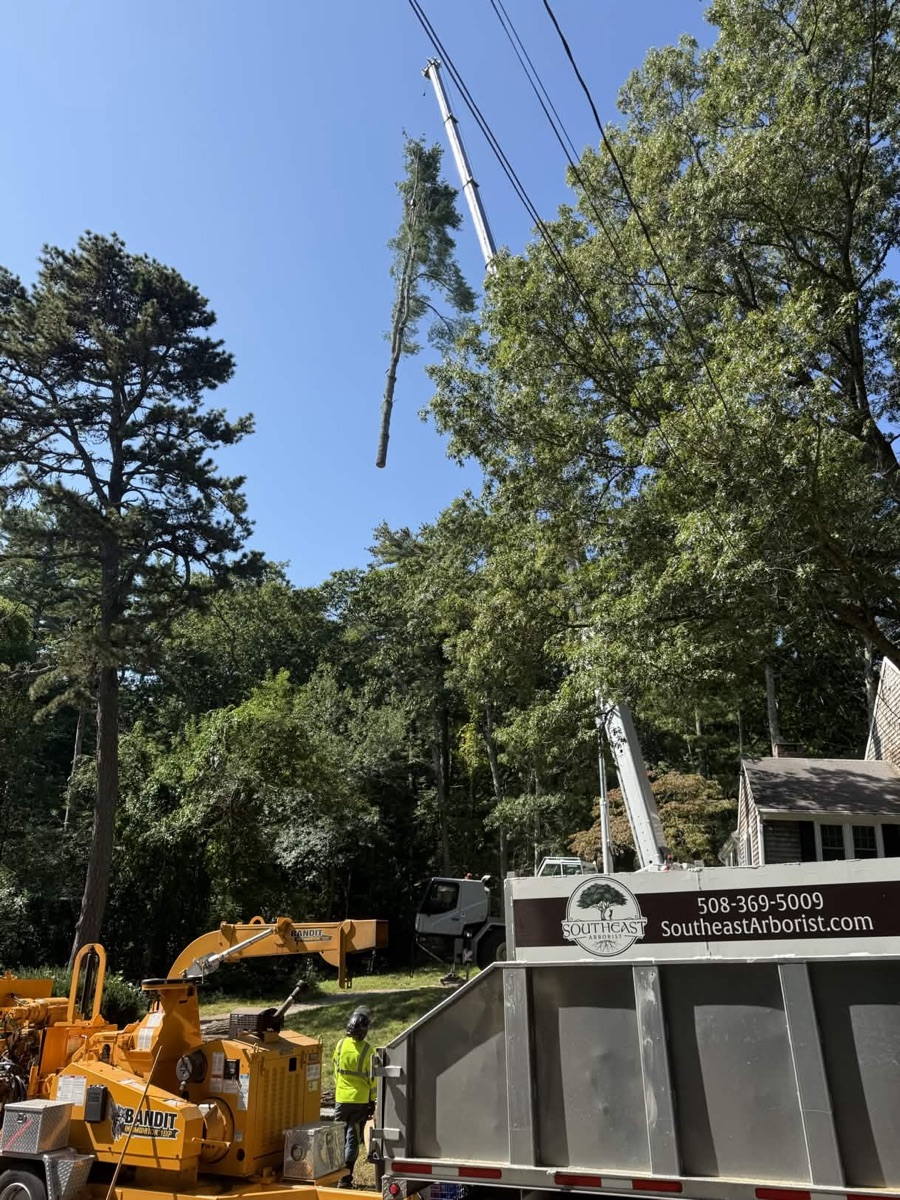
Execution employs specialized gear: 85-foot bucket trucks navigate Randolph Center's tight alleys, while rope-access climbers handle hemlock-oak clusters in Tower Hill. Rigging systems lower 2-ton limbs over multi-family roofs without damage. Injections for oak decline use macro-infusion ports, delivering phosphites calibrated for red oaks in clay soils. Post-treatment, we apply organic mulch rings, 3 inches deep, extending 10 feet from trunks to retain moisture in dry Abington-border yards.
Monitoring follows: We install growth sensors on high-risk trees in North Randolph, tracking diameter increments quarterly. Homeowners receive digital reports with before-after photos and 5-year projections. For a Pond Meadow apartment complex, this meant crown raising limbs 14 feet over parking, using directional felling for white pine co-dominants to protect Atlantic white cedar understory.
Our process minimizes disruption—jobs wrap in one day for most residential oaks, with chippers grinding debris onsite for pathway use. In Randolph's diverse neighborhoods, we adapt: soil injections for sugar maple-shaded oaks in Devine Park, or lightning protection rods on isolated red oaks in open West Corners fields. This systematic approach, backed by ISA certification, ensures your trees thrive amid local invasive pressures and aging canopies.
Call 508-369-5009 to start your oak tree specialist process today—our South Shore expertise turns Randolph vulnerabilities into long-term assets.
Common Oak Tree Specialist Projects in Randolph Neighborhoods
In Randolph Center, we specialize in hazard removals for red oaks overhanging 1960s multi-family housing, where deferred maintenance allows deadwood to accumulate. A recent project involved sectioning a 60-foot white oak with heartwood decay, using spider rescue climbers to dismantle over rooftops without dropping debris on parked cars.
North Randolph's wind-exposed hills demand structural support for oaks battered by Blue Hills gales. We installed dynamic cabling in a pair of codominant red oaks near trailheads, preserving views while mitigating 30% failure risk during nor'easters. Crown cleaning removed storm-rubbed branches competing with white pines.
West Corners properties feature oaks planted near foundations during post-war booms. Our root barrier installations separate aggressive red oak roots from sewer lines, paired with crown raising to 16 feet for pedestrian paths shared with Holbrook commuters.
Tower Hill's condos require precise pruning over access roads. We thinned a mature white oak canopy by 20%, subordinating watersprouts and sealing cuts to prevent hypoxylon entry, restoring light to hickory understory without shocking the tree.
Devine Park Area homeowners face oak wilt risks from root grafts in dense lots. We severed connections with air-spade excavation, then injected Arbotect for prevention, protecting nearby sugar maples from spillover.
Pond Meadow's wetter soils breed Phytophthora root rot in red oaks near Great Pond. Projects here include crown reduction by 15%, mulch volcano corrections, and mycorrhizal amendments to boost drought tolerance amid tupelo competition.
Donovan School Area sees frequent storm response—post-nor'easter, we assessed split leaders on white oaks overhanging playgrounds, employing guying stakes for young replacements and rigging for safe removal of failures.
Stetson School Area's aging street trees need periodic assessments. We performed resistograph sampling on Norway maple-adjacent oaks, revealing early decline, then applied deep-root fertilization tailored to local pH imbalances.
These projects highlight our neighborhood focus: hazard abatement in multi-family zones, storm recovery in hilly northwest Randolph, and preservation near bog ecosystems. Practical tip: In any neighborhood, flag leaning oaks post-storm—our cranes handle up to 10-ton lifts safely.
Oak Tree Specialist Costs in Randolph, MA
Oak tree specialist costs in Randolph MA vary by project scope, tree size, and site access, but expect $500-$2,500 for assessments and pruning on a 40-60 foot red oak. Hazard removals start at $1,200 for stump grinding included, climbing to $4,500 for complex crane work in Tower Hill's tight lots. Structural cabling adds $800-$1,500 per tree, using aircraft-grade cables tensioned to 2,000 pounds.
Factors driving pricing: Diameter at breast height (DBH)—a 24-inch white oak in North Randolph costs 50% more than a 12-incher due to rigging needs. Access challenges in West Corners multi-family sites add $300 for truck positioning. Soil conditions in Pond Meadow require air-spading at $200/hour, exposing roots before treatment.
Disease interventions like oak wilt injections run $15-$25 per inch DBH, vital for Devine Park grafts. Crown raising over Donovan School Area parking averages $750, removing lower limbs to 14 feet per ANSI specs. Full removals factor targets: $2,000 base, plus $500 if near power lines needing utility coordination.
Value proposition outweighs costs—professional care prevents $10,000+ in property damage from failures, common after Blue Hills storms. Our ISA arborists extend oak lifespans 20-30 years, boosting home values 5-10% in tree-rich Randolph Center. Compared to emergency calls at double rates, proactive service saves 40%.
Bundling yields savings: Neighborhood packages in Stetson School Area combine assessments for three oaks at $900, versus $400 each. We offer financing for multi-tree jobs, with transparent quotes post-drone survey—no surprises.
Homeowner math: A $1,800 pruning on a Tower Hill red oak avoids $5,000 roof repairs from falling limbs. Insurance often reimburses 50-75% for hazard work. Choose Southeast Arborist for competitive South Shore rates backed by warranties—up to 2 years on structural work.
Get your free quote at 508-369-5009; our Randolph expertise delivers ROI through healthier, safer trees.
When to Schedule Oak Tree Specialist in Randolph
Schedule your oak tree specialist in Randolph MA from August through January to dodge oak wilt season (February-July), when sap flows attract beetles carrying the fungus. Late summer thinning prepares crowns for winter winds in North Randolph hills, while dormant-season work minimizes stress on white oaks in clay soils.
Urgency signs demand immediate calls: 25%+ canopy dieback, as seen in Pond Meadow red oaks post-flooding; leaning trunks over 15 degrees in West Corners; or fungal brackets on trunks signaling advanced rot. Post-storm assessments within 48 hours prevent secondary failures—Blue Hills gusts often reveal hidden cracks.
Annual checks suit stable trees in Devine Park Area, but multi-family owners in Tower Hill should book bi-annually due to traffic risks. Young oaks near Donovan School need formative pruning by age 10 to establish strong scaffolds.
Practical timing: Avoid spring flush when new growth is tender. Heat waves in July signal drought stress—schedule then for supplemental watering plans. Call 508-369-5009 now if leaves brown from tips or bark sloughs in strips.
Frequently Asked Questions About Oak Tree Specialist in Randolph
What makes oaks in Randolph prone to specific diseases? Randolph's Blue Hills winds and wet-lowland soils stress red and white oaks, inviting anthracnose in humid springs and oak wilt via root grafts in dense Randolph Center lots. Invasives like Norway maples compete, weakening vigor—our ISA arborists diagnose via lab cultures.
How do I know if my oak needs professional pruning? Look for rubbing branches, included bark unions, or excessive end weight in crowns, common in North Randolph's wind-sheared trees. Over 25% deadwood triggers action; we use ANSI A300 to prune safely, timing outside February-July.
Can oak wilt be treated in Tower Hill properties? Yes—early detection allows trunk injections with propiconazole, $20/DBH. We prevent spread by pruning bans and root barriers, critical for multi-family sites near Quincy.
What's involved in hazard tree assessment for Pond Meadow? We score failure likelihood with TRAQ, testing wood with resistographs for decay in wet soils. High-risk oaks get cabling or removal, protecting Atlantic white cedar stands.
How much does stump grinding cost after removal in Devine Park Area? $5-$8 per inch DBH, including backfill. We grind 12 inches below grade to deter regrowth and allow red maple replants.
Is cabling always necessary for codominant oaks in West Corners? No—structural pruning often suffices, but wind-exposed trees need it at $1,000 average. We monitor post-install with annual inspections.
When should I worry about roots damaging my Stetson School Area driveway? If roots heave concrete over 2 inches, excavate and install barriers. We assess compaction first to avoid shock.
Do you handle storm damage response near Blue Hills? 24/7 availability—rigging clears limbs over roads safely, followed by full health evals for remaining oaks.
Oak Tree Specialist Throughout Randolph
Southeast Arborist provides oak tree specialist services across all Randolph neighborhoods: Randolph Center's mature residential canopies, North Randolph's windy hills, West Corners' infrastructure challenges, Tower Hill condos, Devine Park's diverse lots, Pond Meadow wetlands, Donovan School Area families, and Stetson School borders.
We extend to nearby Braintree, Holbrook, Quincy, Milton, and Abington, leveraging our Plymouth/Cohasset base for rapid South Shore response. From Great Pond edges to Ponkapoag Bog influences, your oaks get ISA-certified care.
Contact us at 508-369-5009 for Randolph MA's premier oak tree specialist—schedule now and safeguard your property.