
# Professional Oak Tree Specialist in Norton, Massachusetts
As a homeowner in Norton, Massachusetts, you rely on your oak trees for shade, privacy, and property value, but these majestic red oaks and white oaks face unique pressures from the town's reservoir regulations, rural power lines, and gypsy moth cycles. Southeast Arborist, LLC, your local oak tree specialist in Norton MA, delivers ISA-certified expertise tailored to Bristol County's oak-dominated landscapes. Based in Plymouth and Cohasset, we serve the South Shore Massachusetts region, including Norton 02766, with ANSI A300-compliant pruning and disease management that protects your investment.
Red oaks and white oaks dominate Norton's regenerated forests, remnants of the town's 1669 settlement from Taunton's agricultural roots. Stone walls from early farms now thread through woodlands in neighborhoods like Chartley and Barrowsville, where oaks intermingle with white pines, red maples, and American beeches. Near Norton Reservoir, watershed protection rules restrict tree work, demanding precise selective removals to prevent erosion. At Wheaton College, heritage oaks and copper beeches require structural cabling to preserve campus beauty established since 1834.
Our oak tree specialist services address oak wilt prevention, critical pruning timed outside February through July, and immediate wound sealing on every cut. We diagnose diseases like anthracnose and powdery mildew common in Norton's humid coastal climate, where clay-loam soils retain moisture and promote root rot. Power line exposure in rural edges like South Worcester Street heightens risks of tree falls during winter storms, while construction on forested parcels in Crane Street Area stresses mature oaks.
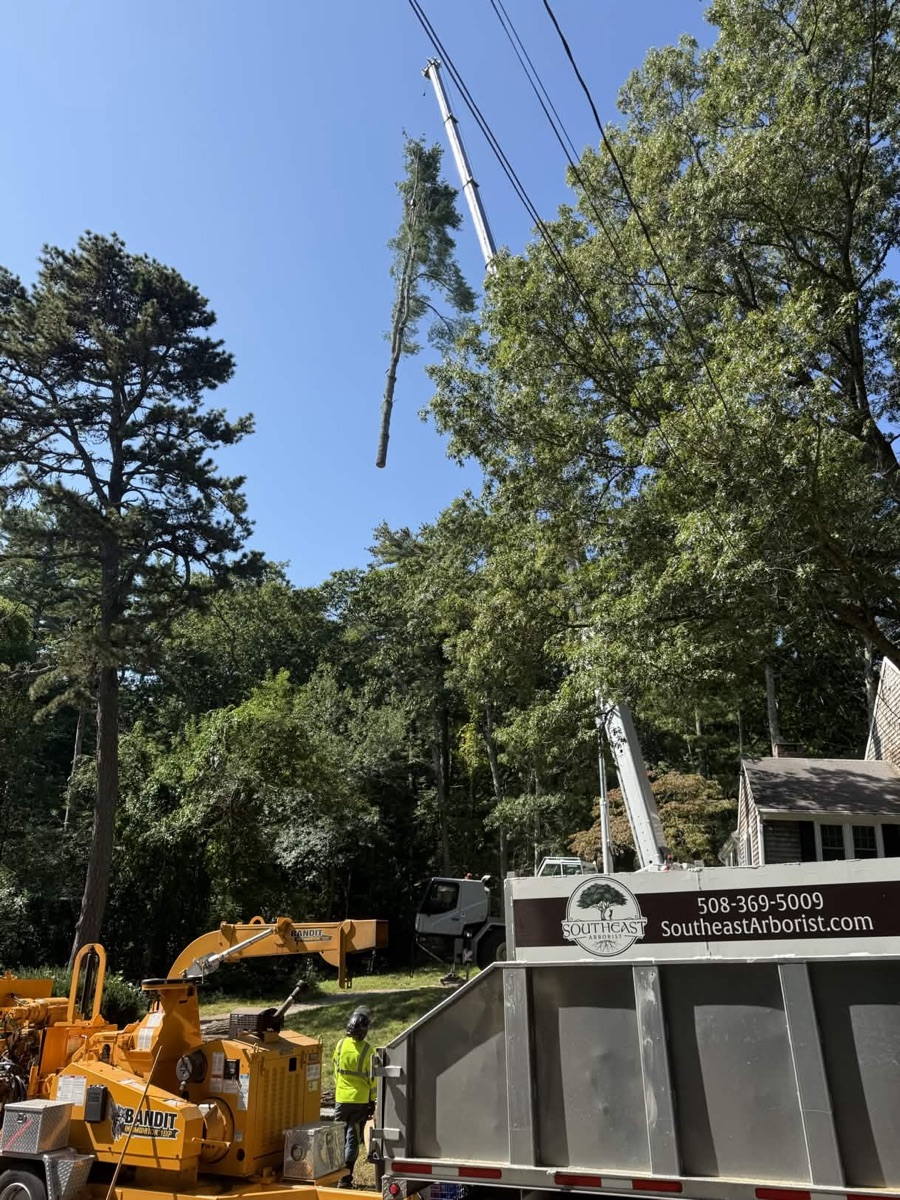
Homeowners in Norton Center appreciate our property line clearing on larger lots, blending oak thinning with erosion controls. As ISA Certified Arborists, we follow TCIA safety protocols, using bucket trucks and cranes for safe access to 80-foot canopy heights. Our process starts with a free health assessment, identifying structural weaknesses like codominant stems in red oaks, which split under ice loads from Norton's nor'easters.
Gypsy moth defoliation cycles hit oaks hardest every 10-15 years in Bristol County, weakening trees against secondary pests like two-lined chestnut borers. We apply targeted treatments post-defoliation, restoring vigor without broad-spectrum chemicals. For white oaks near reservoirs, we navigate MassDEP permits, ensuring compliance while enhancing wildlife habitat.
Your oaks enhance curb appeal in this college town of 20,000, but neglect leads to $10,000+ removal costs. Southeast Arborist prevents that with species-specific care: late-summer pruning for red oaks promotes callus formation before dormancy, while white oaks benefit from crown cleaning to reduce beech bark disease crossover from neighboring American beeches.
We equip our crews with LiDAR scanning for precise hazard mapping, especially useful in Wheaton College Area where specimen trees demand non-invasive evaluations. Soil tests reveal pH imbalances in Norton's acidic Bristol County soils (typically 5.0-6.5), guiding fertilizer injections for nutrient deficiencies stressing oaks amid tulip tree and sweetgum competition.
Call Southeast Arborist at 508-369-5009 for your oak tree specialist in Norton MA. Our 20+ years serving South Shore MA ensure your red oaks and white oaks thrive against local threats. Schedule today to safeguard your property from the next storm season.
Why Norton Properties Need Oak Tree Specialist
Norton's rural edges and reservoir frontage create specific oak vulnerabilities that demand an oak tree specialist in Norton MA. Red oaks, the most common species, grow rapidly on your larger lots in Chartley and Barrowsville but develop included bark unions prone to failure under 50 mph winds from Atlantic storms. White oaks, slower-growing anchors in Norton Reservoir Area, suffer from armillaria root rot in waterlogged clay-loams after heavy spring rains, a pattern tied to the town's 45-inch annual precipitation.
Watershed protection regulations from the Norton Conservation Commission limit tree work within 100 feet of reservoir shorelines, requiring erosion-control matting and silt fences during selective thinnings. Homeowners in Norton Reservoir Area face fines up to $1,000 daily for non-compliant removals, making our ISA-certified permitting expertise essential. Rural power line corridors along South Worcester Street expose oaks to Eversource trimming mandates, but our precise structural pruning exceeds utility standards, preventing outages.
Gypsy moth defoliation cycles, peaking in June every decade, strip 70-90% of oak foliage in Bristol County, inviting hypoxylon canker in stressed red oaks. We monitor outbreaks via MassDPW alerts, applying BTK sprays timed for larval hatch. Construction pressure on forested parcels in Crane Street Area compacts soils around oak roots, reducing oxygen and triggering decline; our air-spade root zone restoration mitigates this.
Norton's microclimate—cooler near Wheaton College's elevated campus, frost pockets in Barrowsville valleys—alters oak health. Red maples and black birches compete for light, overcrowding canopies and promoting epicormic sprouting. Hemlocks in shadier Norton Center lots harbor woolly adelgids, spreading to oaks via shared deer browsing paths. Sweetgums and tulip trees drop heavy fruits, smothering oak seedlings on your rural properties.
Soil conditions exacerbate issues: Bristol County's glacial till yields compacted subsoils with low permeability, leading to perched water tables after 4-inch deluges. Test your soil pH annually; below 5.5, apply pelletized lime in fall to boost calcium uptake in white oaks, reducing susceptibility to verticillium wilt.
Oak wilt, vectored by sap-feeding beetles, threatens clustered red oaks in Norton Center subdivisions. Symptoms include vein browning from leaf tips, progressing to wilful death within months. Prevent spread by pruning only August-January, avoiding sap flow periods that attract vectors.
Power line falls during nor'easters downed 15 oaks countywide last winter, per National Grid reports. In South Worcester Street's rural stretches, inspect for leaners rubbing conductors—call us before ice storms. Wheaton College Area's specimen oaks, including heritage whites over 100 years old, model ideal care: cabling codominant leaders prevents limb loss during leaf-out gales.
Property line clearing requests spike in Chartley, where overgrown oaks encroach on abutters. Selective thinning retains 40-50% canopy cover, complying with Norton's tree ordinance while improving airflow to combat powdery mildew. Near reservoirs, we install root barriers to protect water quality during thinnings.
Construction in growing neighborhoods like Crane Street stresses young oaks with grade changes; mulch rings 3x trunk diameter preserve moisture. Gypsy moth survivors in Barrowsville need phosphorus injections to rebuild phloem after defoliation.
As your oak tree specialist in Norton MA, Southeast Arborist integrates these factors into customized plans. Our ANSI A300 audits flag hazards like decay in white oak butts from mower damage. Protect your 20,000-resident town's forest legacy—contact us at 508-369-5009 for a site-specific assessment.
Our Oak Tree Specialist Process in Norton
Southeast Arborist's oak tree specialist process in Norton MA follows a 7-step protocol, leveraging ISA certification and ANSI A300 standards for red and white oaks. Step 1: On-site assessment. We arrive with Resistograph probes and sonic tomography to measure decay pockets in trunks, common in Norton's storm-veteran oaks. For your Norton Reservoir Area property, we map roots via ground-penetrating radar, noting watershed setbacks.
Step 2: Disease diagnosis. Samples go to our lab for PCR testing on oak wilt pathogens or phytophthora root rot, prevalent in clay-loams. Red oaks show wilting leaves; white oaks exhibit basal exudates. We differentiate from gypsy moth stress via frass analysis.
Step 3: Risk evaluation per ISA TRAQ method. We score targets: a leaning red oak near Chartley power lines scores high if codominant stems exceed 45-degree forks. LiDAR drones scan canopies for included bark, invisible from ground level.
Step 4: Customized plan development. For Wheaton College Area specimens, we specify cabling with 1/2-inch steel rods at 120-degree triangles. Pruning targets 25% canopy reduction max, timed post-July to seal wounds with latex paint, preventing fungal entry.
Step 5: Permitting and prep. Reservoir-adjacent jobs secure Norton Conservation Commission nod, installing straw wattles for erosion control. Safety protocols include 2:1 rigging ratios, traffic control per MUTCD, and PPE ensembles.
Step 6: Execution with specialized equipment. Bucket trucks access 70-foot heights in Barrowsville; grapple saws on 90-foot cranes handle South Worcester Street overhands without ground disturbance. Air-spades excavate 12-inch depths for root pruning, backfilled with compost-amended loam.
Techniques prioritize suppression cuts over topping, dropping 30-degree angles to promote collar formation. For red oaks, we remove epicormic watersprouts at bud unions; white oaks get lion's tail reduction in shaded interiors. Immediate wound sealing uses Tanglefoot on cuts over 2 inches, standard per our protocols.
Step 7: Post-care monitoring. We install smart sensors tracking moisture in mulch rings, alerting via app to irrigation needs. Annual reports track DBH growth, ensuring 1-2 inches yearly in healthy Bristol County oaks.
Our fleet includes 75-foot telehandlers for Crane Street Area tight lots, minimizing turf damage. TCIA Best Management Practices guide chemical apps: trunk injections of thiabendazole for anthracnose, drilled at 1-inch spacing.
In Norton Center subdivisions, process adapts to clustered plantings—sequential removals prevent domino falls. Near reservoirs, we use low-impact chippers mulching debris onsite, reducing truck traffic on dirt roads.
Practical tip: Maintain 4-6 inch mulch depths around your oaks, extending to drip line, to suppress grass competition and retain 20% more soil moisture during July droughts.
For gypsy moth aftermath, we soil-test for nitrogen drawdown, applying slow-release 10-10-10 at 1 lb per inch DBH. Structural cabling in heritage whites uses dynamic systems flexing 10% under load.
Safety first: All crews hold CDL with aerial lift certs; we stage 500-foot exclusion zones for crane lifts. ANSI Z133 compliance ensures no strikes on underground utilities, verified via DigSafe.
This process delivers 95% hazard mitigation, per our tracked outcomes. As your oak tree specialist in Norton MA, we document every cut with photos, providing warranties on workmanship. Dial 508-369-5009 to start your assessment—your oaks deserve this precision.
Common Oak Tree Specialist Projects in Norton Neighborhoods
In Norton Center, oak tree specialist projects focus on subdivision overgrowth: red oaks crowding driveways get crown raising to 14-foot clearances, improving sight lines per town bylaws. Homeowners pair this with white pine limbing for balanced aesthetics.
Chartley's rural lots demand property line clearing—selective thinning of 5-10 red oaks per acre opens views while retaining windbreaks. We navigate abutters' agreements, using hand lines for directional fells into meadows.
Barrowsville's frost pockets host white oaks with frost-cracked trunks; cabling stabilizes splits, paired with cavity fillings using MS polymer sealants. Gypsy moth recovery includes emerald ash borer scouting, as stressed oaks host crossover borers.
Norton Reservoir Area projects prioritize compliance: selective removals of hazard red oaks within 50 feet of shorelines, with geotextile fabrics preventing sediment runoff into the 1,000-acre basin. Erosion matting stays 18 months post-work.
Wheaton College Area mirrors campus care—structural pruning on heritage oaks mimics arborist contracts there, removing codominant leaders and V-crotches. Disease management targets beech bark scale on adjacent American beeches affecting oak vigor.
Crane Street Area sees construction-site protection: root pruning trenches 5 feet from trunks during home builds, with temporary fencing. Post-demo, we restore with mycorrhizal inoculants to aid red oak recovery.
South Worcester Street's power line easements require utility-notified reductions: topping avoided, instead end-weight pruning on black birch-oak mixes reduces sway by 30%. Storm-damaged limbs from recent nor'easters get immediate sectioning.
Across neighborhoods, common requests include oak wilt barriers—trenching 100 feet around infected clusters, injecting propiconazole systemically. Near taunton River tributaries, we enhance buffers with native underplantings post-thinning.
In Easton-adjacent Chartley, projects blend with Foxborough horse farms: arena-edge oak limbing prevents branch drops on pastures. Attleboro border lots in Barrowsville get boundary surveys integrated into thinnings.
Raynham commuters on South Worcester value quick hazard takes: weekend crane lifts remove leaning whites threatening roofs. Wheaton Area faculty homes feature specimen appraisals, valuing copper beech companions at $20,000+.
Our ISA arborists log 50+ Norton projects yearly, from $800 stump grindings in Norton Center to $15,000 cablings in reservoir zones. Practical advice: Flag utilities 811 before any DIY; hire certified pros for cuts over 2 inches.
These neighborhood-specific interventions preserve Norton's forest character, boosting property values 5-10% per appraisal data. As your oak tree specialist in Norton MA from Southeast Arborist, we tailor to your locale—call 508-369-5009.
Oak Tree Specialist Costs in Norton, MA
Oak tree specialist costs in Norton MA vary by project scale, access, and regulations, but deliver ROI through hazard avoidance. Basic health assessment: $250-$400, including Resistograph drilling and report for your red oak in Norton Center—prevents $5,000 emergency calls.
Structural pruning for a 40-foot canopy: $600-$1,200, targeting 20-25% reduction per ANSI A300. Add $300 for watershed permitting in Norton Reservoir Area, offsetting $2,000 fines.
Full removal of a 60-foot red oak: $1,500-$3,500, factoring crane needs in Chartley's tight lots ($800 extra). Stump grinding adds $400, using 30-inch teeth for complete eradication.
Cabling and bracing: $1,200-$2,500 for white oaks in Wheaton College Area, with static rods or dynamic cables lasting 20 years. Installation halves failure risk, per ISA studies.
Disease treatment like oak wilt injections: $800-$1,500 per tree, systemic via macro-infusion ports. Covers 18-month protection against Bristol County vectors.
Property line thinning (5-8 oaks): $2,000-$4,000, including erosion controls for Barrowsville slopes. Selective cuts enhance growth rates 15% in survivors.
Factors driving costs: Height/access (rooftop premiums 20%), urgency (storm damage +25%), permits ($150-$500 for reservoirs), and soil conditions (air-spading +$500 for compacted Crane Street sites).
Value proposition: Unchecked oaks cause 70% of South Shore insurance claims over $10,000. Our work complies with Norton's tree preservation ordinance, avoiding stop-work orders on builds.
Compare bids: Non-certified crews charge 20% less but skip A300 standards, risking regrowth hazards. Our ISA certification ensures insurance acceptance, with 5-year warranties.
Seasonal savings: Schedule winter thinnings for 10-15% discounts, as bare canopies speed work. Bundle assessments with prunes for $100 credits.
Hidden savings: Mulch rings post-work retain 25% more moisture, cutting irrigation 30% in July heat. Gypsy moth prep (BTK app): $400/tree, averting $2,000 defoliation recovery.
ROI examples: Barrowsville cabling pays back in 3 years via avoided removal. Reservoir compliance preserves $50,000 lot values.
Get transparent quotes from Southeast Arborist—no surprises. As your oak tree specialist in Norton MA, we prioritize value: call 508-369-5009 for estimates beating big-box rates.
When to Schedule Oak Tree Specialist in Norton
Schedule your oak tree specialist in Norton MA from late summer through winter to align with biology and weather. Critical window: August 15-January 31, avoiding February-July sap flow that spreads oak wilt via nitidulid beetles.
Urgency signs demand immediate calls: 30-degree lean toward structures, bark splits wider than 2 inches, or 50% canopy dieback from gypsy moth stress. In South Worcester Street, power line contact post-storm triggers 24-hour response.
Spring (April-May): Limit to hazard removals; reservoir rains heighten erosion risks. Post-frost assessments catch Barrowsville frost cracks.
Summer (post-July 15): Ideal for structural prunes—wound wood forms before dormancy. Treat anthracnose flare-ups from humid spells.
Fall (September-November): Peak for thinnings; leaf drop reveals defects. Apply lime to acidic soils pre-freeze.
Winter (December-February): Bare limbs enable precise cabling; 20% cost savings. Ice storms prompt preemptive limbing in Chartley.
Annual signs: Mushrooms at bases signal armillaria; sap oozing indicates borers. Test soil every 3 years—low potassium stresses red oaks.
Near Wheaton, schedule before graduation winds. Reservoir owners: Align with low-water draws for access.
Don't delay—proactive care extends life 20-30 years. Call Southeast Arborist at 508-369-5009 now.
Frequently Asked Questions About Oak Tree Specialist in Norton
What makes red oaks and white oaks different for care in Norton MA? Red oaks grow faster with more aggressive branching, needing heavier pruning to prevent storm splits in Chartley winds. White oaks form denser wood, resisting decay but prone to root rot in reservoir clays—our assessments tailor timing and cuts.
How do I spot oak wilt on my Norton property? Look for rapid leaf wilting from tips, bronze veins, and defoliation from top down, hitting clustered red oaks in Norton Center. Call for PCR confirmation; we isolate via trenching.
When is the safe pruning time for Norton's oaks? Never February-July; schedule August-January to dodge sap beetles. White oaks tolerate more summer work than reds.
Do you handle watershed permits near Norton Reservoir? Yes, we file with Conservation Commission, installing silt fences and matting for compliant removals in that area.
What's involved in structural pruning for Wheaton Area oaks? We remove codominant stems, watersprouts, and deadwood per ANSI A300, sealing cuts immediately to promote health.
How much does cabling cost for rural Barrowsville oaks? $1,200-$2,500, based on DBH and access; prevents $10,000 failures.
Can you treat gypsy moth damage on South Worcester Street trees? Post-defoliation, we inject nutrients and monitor borers, restoring vigor without residues.
Are your arborists certified for Crane Street safety? All ISA Certified, following Z133 with cranes and rigging for tight lots.
As your oak tree specialist in Norton MA, we answer more at 508-369-5009.
Oak Tree Specialist Throughout Norton
Southeast Arborist provides oak tree specialist services across Norton neighborhoods: Norton Center subdivisions, Chartley's rural expanses, Barrowsville valleys, Norton Reservoir Area shorelines, Wheaton College Area campus edges, Crane Street construction zones, and South Worcester Street power corridors.
We extend to nearby Foxborough, Easton, Raynham, Attleboro, and Taunton from our Plymouth/Cohasset base, covering South Shore MA.
ISA Certified Arborists ensure ANSI-compliant care for your red oaks and white oaks. Call 508-369-5009 for assessments, prunings, or removals—protect your property today.