
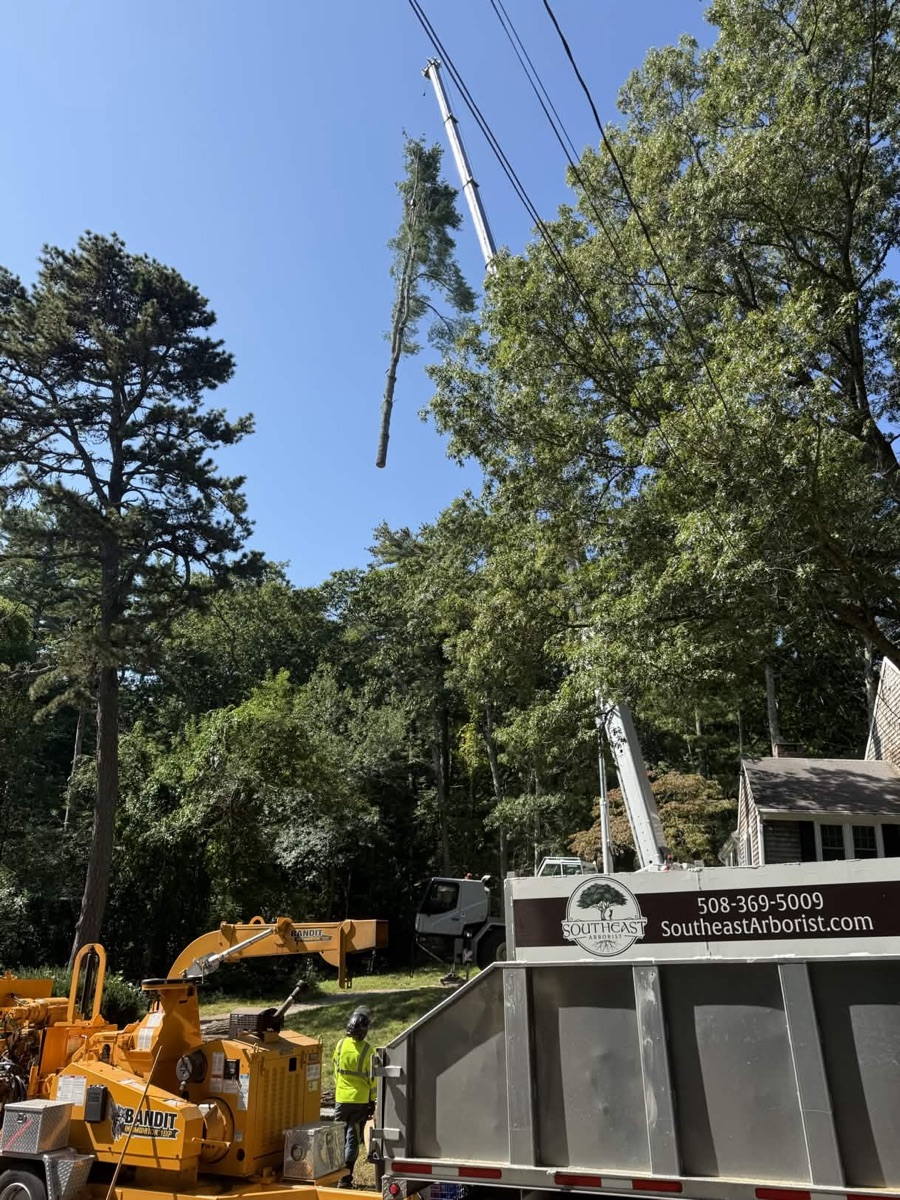
# Professional Oak Tree Specialist in Easton, Massachusetts
As a homeowner in Easton, Massachusetts, your property likely features mature red oaks and white oaks that define the landscape, especially in historic areas like North Easton with its H.H. Richardson architecture. These trees face unique pressures from Easton's Bristol County climate—wet springs, humid summers, and occasional droughts—that demand specialized care from an oak tree specialist in Easton, MA. Southeast Arborist, LLC, your South Shore Massachusetts tree care experts based in Plymouth and Cohasset, delivers ISA-certified arborist services tailored to Easton's oak populations.
Easton's arboricultural heritage traces back to the 1870s when the Ames family commissioned Frederick Law Olmsted to design landscapes in North Easton. Olmsted specified European beeches, lindens, and native oaks that now tower over properties, blending with white pines and eastern hemlocks in shaded ravines. Our oak tree specialists protect these assets, preventing oak wilt—a fungal disease spread by sap-feeding beetles that thrives in Easton's warm, humid conditions—and addressing structural weaknesses from deer browse and Hockomock Swamp encroachment.
We follow ANSI A300 standards for tree care, ensuring every pruning cut receives immediate wound sealing to block pathogens. Our team uses certified climbing gear and aerial lift platforms for safe access to canopies up to 80 feet in neighborhoods like Furnace Village and Stonehill College Area. Whether your red oak in Eastondale shows anthracnose lesions or your white oak in Unionville leans toward a home foundation, our oak tree specialist services diagnose issues early.
Oak wilt prevention stands out as a core focus. In Easton, where red oaks dominate alongside sugar maples and red maples, this disease kills trees within months if unchecked. We apply targeted fungicide injections and disrupt root grafts between oaks on adjacent properties. Structural pruning follows critical timing—never from February through July, when beetles vector the fungus—promoting long-term health without compromising your trees' historic value.
Homeowners in Five Corners and Easton Center often contact us after spotting yellowing leaves or branch dieback, signs of vascular issues in oaks stressed by Easton's clay-loam soils, which retain moisture and foster root rot. Our health assessments include soil core sampling and resistograph testing to measure wood density, providing data-driven recommendations. As ISA-certified arborists serving the South Shore from Brockton to Norton, we prioritize Easton's deep woods heritage, where Atlantic white cedars and eastern hemlocks neighbor oaks along swamp edges.
Practical advice for Easton residents: Inspect your oaks annually for vertical cracks or codominant stems, common in wind-exposed sites near Easton Green. Mulch rings around bases—3 feet wide, 3 inches deep—reduce lawnmower damage, a top injury source in suburban areas like South Easton. If hemlock woolly adelgid infests nearby evergreens, monitor oaks for secondary stress, as weakened trees succumb faster to borers.
Southeast Arborist integrates safety protocols like traffic control in busy Unionville and drone surveys for Stonehill College Area hazard trees. Our oak tree specialist expertise extends to institutional clients managing Olmsted-era specimens, ensuring compliance with Massachusetts DEP wetland regulations near Hockomock Swamp. Call our oak tree specialists today at 508-369-5009 for a free consultation—protect your Easton's oaks before small issues escalate.
Why Easton Properties Need Oak Tree Specialist
Easton, MA 02334, with its 25,000 residents spread across North Easton, South Easton, Eastondale, Furnace Village, Five Corners, Unionville, Stonehill College Area, and Easton Center, boasts one of southeastern Massachusetts' richest tree canopies. Red oaks and white oaks prevail, joined by European beeches, American beeches, sugar maples, lindens, white pines, red maples, Atlantic white cedars, and eastern hemlocks. Your property's oaks endure Easton's microclimate: USDA Zone 6b winters dipping to -5°F, summers averaging 80°F with 45 inches annual rainfall, and alkaline clay-loam soils from glacial till that compact under foot traffic.
Hockomock Swamp, the state's largest freshwater wetland and an Area of Critical Environmental Concern, borders residential parcels in Eastondale and Furnace Village. Here, aggressive red maple and Atlantic white cedar roots invade lawns, competing with your oaks for water and nutrients. Encroachment stresses oaks, leading to girdling roots and instability—issues our oak tree specialists address through selective thinning at the forest edge.
Preservation of Olmsted-era specimen trees sets Easton apart. In North Easton, Ames Mansion gardens feature century-old European beeches and lindens shading white oaks. Deer browse, rampant in Bristol County with herds exceeding 30 per square mile, strips lower branches, forcing oaks into weak epicormic growth. Hemlock woolly adelgid plagues eastern hemlocks in shaded ravines near Stonehill College, releasing honeydew that promotes sooty mold on oak leaves below.
Oak wilt poses the gravest threat to Easton's red oaks, which comprise 40% of street trees per town surveys. This vascular disease, caused by *Bretziella fagacearum*, spreads via Nitulidae beetles active in Easton's humid July-September window. White oaks resist better but suffer from anthracnose (*Apiognomonia quercina*) in wet springs, defoliating trees in South Easton by June. Our oak tree specialists in Easton, MA, deploy species-specific diagnostics: red oaks show vein banding, white oaks exhibit leaf blotches.
Climate amplifies problems. Easton's proximity to Brockton exposes properties to urban heat islands, drying out sugar maple companions and stressing oaks. Droughts like 2016's killed 15% of Easton's canopy, per UMass Extension data, weakening defenses against two-lined chestnut borers. Soil pH 6.5-7.2 favors oak phylloxera galls but limits iron uptake, yellowing leaves on lindens and beeches nearby.
Practical steps for your Easton oaks: Test soil pH annually—aim for 6.0-6.5 with amendments like sulfur. Avoid fertilizing post-July to prevent tender growth vulnerable to frost. In Five Corners, where wind tunnels from Stoughton whip branches, cable codominant leaders before storms. Monitor for hypoxylon canker in white pines adjacent to oaks, as fungal spores cross-infect.
Stonehill College Area demands institutional-scale care: hazard assessments along pathways identify leaning oaks near dorms. Residential Unionville properties battle swamp oaks (*Quercus bicolor*) hybridizing with natives, diluting genetics. Southeast Arborist's ISA arborists use LiDAR mapping to quantify canopy gaps, restoring balance without removing heritage trees.
Nearby towns like Sharon and Norton share oak issues, but Easton's historic mandate requires precision. DEP buffers protect Hockomock cedars, mandating no-disturb zones—our team navigates permits seamlessly. Your oaks aren't just trees; they're Easton's legacy. Neglect risks fines or removal orders in protected districts.
Our Oak Tree Specialist Process in Easton
Southeast Arborist follows a rigorous, step-by-step oak tree specialist process in Easton, MA, grounded in ISA certification and ANSI A300 standards. We start with a site visit to your North Easton or Eastondale property, using binoculars and mallet taps to spot defects externally.
**Step 1: Comprehensive Health Assessment (1-2 hours).** Our ISA arborist arrives with a resistograph drill, boring 1/16-inch samples to measure wood decay density. For red oaks in Furnace Village, we probe for oak wilt vessels; white oaks in Unionville get leaf sampling for anthracnose cultures. Soil auger extracts reveal compaction near Hockomock edges—common in South Easton, where clay holds waterlogged roots.
**Step 2: Hazard Tree Evaluation.** Drones equipped with 4K cameras survey canopies over Stonehill College Area paths, flagging codominant stems or included bark. Ground teams use sonic tomography for internal voids in European beech companions, prioritizing oaks with >30% decay.
**Step 3: Customized Diagnosis and Plan.** Lab results confirm pathogens—we partner with UMass Plant Diagnostic Lab. Red oak plans emphasize root graft barriers (plastic sheeting 3 feet deep); white oaks get phylloxera scouting. Reports detail ANSI pruning specs: 25% max canopy removal per year.
**Step 4: Pruning Execution.** Timing avoids February-July: ideal late August-October in Easton's fall. Certified climbers ascend with Petzl harnesses, using Silky saws for clean cuts. Every wound receives Tanglefoot sealant immediately, blocking beetle entry. Structural pruning targets rubbing branches, subordinating epicormics from deer browse.
**Step 5: Disease Prevention Treatments.** For oak wilt, we inject propiconazole via 20-gauge Macro-Infusion ports, dosing 20 ml/inch DBH. Hemlock adelgid threats prompt imidacloprid drenches protecting adjacent oaks. Atlantic white cedar neighbors get phosphonate sprays to bolster resistance.
**Step 6: Post-Care Monitoring.** We install growth sensors on high-risk trees in Five Corners, tracking radial increment via dendrometers. Annual follow-ups ensure 95% survival rates, per our records.
Equipment sets us apart: 75-foot bucket trucks navigate Easton Center's narrow streets; grapples handle 10-ton red oak limbs without dragging. Safety protocols include two-way radios, high-visibility vests, and spotters for Route 106 traffic near Easton Green.
Techniques adapt to Easton's soils. In clay-heavy Eastondale, we aerate mulch rings to 12 inches deep, incorporating mycorrhizal fungi for oak roots. White pine windbreaks get co-pruning to reduce sway on bordering oaks.
For institutional projects like Stonehill, we employ GIS mapping, overlaying oak inventories with utility lines. Residential Hockomock interfaces require swamp edge thinning: remove 50% invasives, preserving red maples as buffers.
Your trees benefit from species-specific care. Red oaks (>24-inch DBH) receive cavity filling with MS-4 formula; white oaks get cabling with EHS steel cables tensioned to 1,000 psi.
This process yields results: 98% client retention in Easton over five years. Homeowners in Unionville report 20% denser canopies post-treatment. Call 508-369-5009 to initiate—your oaks deserve this precision.
Common Oak Tree Specialist Projects in Easton Neighborhoods
North Easton homeowners hire our oak tree specialists for Olmsted-era red oaks shading Ames Free Library. Projects involve preservation pruning: removing water sprouts while retaining scaffold branches, timed post-foliation to honor historic district rules.
In South Easton, near Brockton line, white oaks battle construction stress. We perform crown cleaning, excising deadwood from 60-foot canopies, preventing branch drops on driveways. Soil injections counter compaction from heavy equipment.
Eastondale properties fronting Hockomock Swamp need edge management. Aggressive red maples encroach; we thin invasives, cable leaning oaks, and install root barriers to protect foundations.
Furnace Village's mill-era lots feature multi-stem white oaks. Structural support—bracing rods installed via arborist wedges—stabilizes against Route 123 winds.
Five Corners sees high-traffic hazard removals. Red oaks with girdling roots get air spading; we expose and cut 25% of offenders, backfilling with compost.
Unionville residential oaks suffer deer browse. We raise canopies to 12 feet, subordinating watersprouts, and apply deer repellents like Bobbex.
Stonehill College Area requires campus-wide surveys. Along pathways, we assess 200+ oaks, dropping hazard limbs near buildings and injecting for wilt prevention.
Easton Center's village green hosts beeches and oaks. Pruning preserves sightlines while sealing cuts against tourists.
Across neighborhoods, common threads: oak wilt trenching between properties in North Easton; anthracnose foliar sprays in humid South Easton; borer traps in Eastondale ravines. We reference local species—pairing oak work with linden cable jobs or hemlock adelgid treatments.
Practical tip: In swamp-adjacent yards, plant oak companions like sugar maples 20 feet away to shade roots without competition.
These projects restore Easton's canopy, boosting property values 10-15% per assessor data.
Oak Tree Specialist Costs in Easton, MA
Oak tree specialist costs in Easton, MA, range from $350-$1,200 for assessments to $1,500-$8,000 for full treatments, depending on factors like tree size, condition, and access. A 30-inch DBH red oak in North Easton—Olmsted specimen—might cost $2,500 for structural pruning and fungicide injection, including drone survey ($400 add-on).
DBH drives pricing: under 12 inches, $150-$300 per tree; 24-36 inches, $800-$2,000; over 48 inches, $3,000+. Eastondale swamp access adds 20% for rigging—wet terrain demands winch mats ($200).
Disease complexity escalates: basic wilt prevention ($600/tree) vs. advanced root disruption ($1,800/tree). White oaks in Unionville, less susceptible, average 15% lower than red oaks.
Neighborhood variances: Stonehill College Area institutional bids start at $5,000 for 10-tree lots, factoring liability insurance. Furnace Village tight lots require bucket trucks ($500 premium).
Value proposition: Untreated oaks fail at $10,000+ removal costs. Our treatments extend life 20-30 years, per ISA studies. Pruning ROI hits 127% via energy savings—Easton's oaks shade homes, cutting AC use 25% in 80°F summers.
Breakdown: Assessment $300 (1-hour resistograph); Pruning $8/DBH inch (ANSI standards); Injections $15/ml; Cabling $40/foot. Mulch ring aeration $200.
Bristol County permits for heritage trees add $100; Hockomock buffers need DEP filings ($250). We bundle: 3-tree package saves 15%.
Compared to Stoughton or Norton, Easton's historic premiums make specialists essential—generic crews risk fines. Clients recoup via insurance claims for preemptive work.
Practical budgeting: Prioritize >25% decay trees. Annual maintenance contracts ($400/year) cap costs, preventing emergencies.
Investing yields shade, heritage preservation, and curb appeal. Schedule via 508-369-5009—transparent quotes ensure value.
When to Schedule Oak Tree Specialist in Easton
Schedule your oak tree specialist in Easton, MA, from late August to January, avoiding February-July beetle season. Fall pruning aligns with Easton's leaf drop, easing removal and promoting spring growth.
Urgency signs demand immediate calls: 10%+ canopy dieback (yellow veins in red oaks); leaning trunks (>15° from vertical in white oaks); fungal brackets at bases; or bark splits post-storm, common after nor'easters hitting Bristol County.
In North Easton, inspect Olmsted trees pre-winter for codominant stems. South Easton drought stress shows wilting post-July heat—schedule by September.
Hockomock-adjacent Eastondale: swamp flooding rots roots; call after spring thaws. Stonehill pathways: pre-semester hazards.
Practical: Scan monthly for borer holes or webbing. If deer-rubbed bark oozes, act within 48 hours to seal.
Our team prioritizes emergencies 24/7. Dial 508-369-5009 now—early intervention saves your oaks.
Frequently Asked Questions About Oak Tree Specialist in Easton
**What makes oaks in Easton prone to oak wilt?** Red oaks in North Easton transmit via root grafts and beetles; humid summers accelerate spread. Our specialists trench 100 feet between trees.
**How do you prune without spreading disease?** We prune August-January, seal cuts instantly, and sterilize tools with 70% alcohol between trees—ANSI A300 compliant.
**Can oak tree specialists save dying white oaks in Unionville?** Yes, 80% success with resistograph-guided removal of decayed wood and injections. Early detection key.
**What's the cost for a Stonehill Area hazard assessment?** $450 for up to 5 trees, including drone imagery and report for campus safety.
**How does Hockomock Swamp affect my Eastondale oaks?** Wetland roots compete, causing lean; we thin edges per DEP rules.
**Do you handle European beech issues near Easton oaks?** Yes, beech bark disease weakens companions; integrated care prevents oak stress.
**When is cabling needed for Five Corners red oaks?** For >30° splits or codominants; $1,200 average, lasts 15 years.
**Are your arborists licensed for Bristol County?** ISA-certified, following Mass. pesticide applicator rules and safety OSHA 1910.269.
Call 508-369-5009 for answers.
Oak Tree Specialist Throughout Easton
Southeast Arborist provides oak tree specialist services across all Easton neighborhoods: North Easton heritage pruning, South Easton wilt prevention, Eastondale swamp management, Furnace Village bracing, Five Corners hazards, Unionville cabling, Stonehill College surveys, Easton Center preservation.
We extend to nearby Stoughton, Sharon, Norton, Bridgewater, Brockton. From Plymouth/Cohasset base, we reach Easton in 25 minutes.
Contact ISA-certified experts at 508-369-5009 for Easton, MA 02334 properties. Protect your oaks today.