
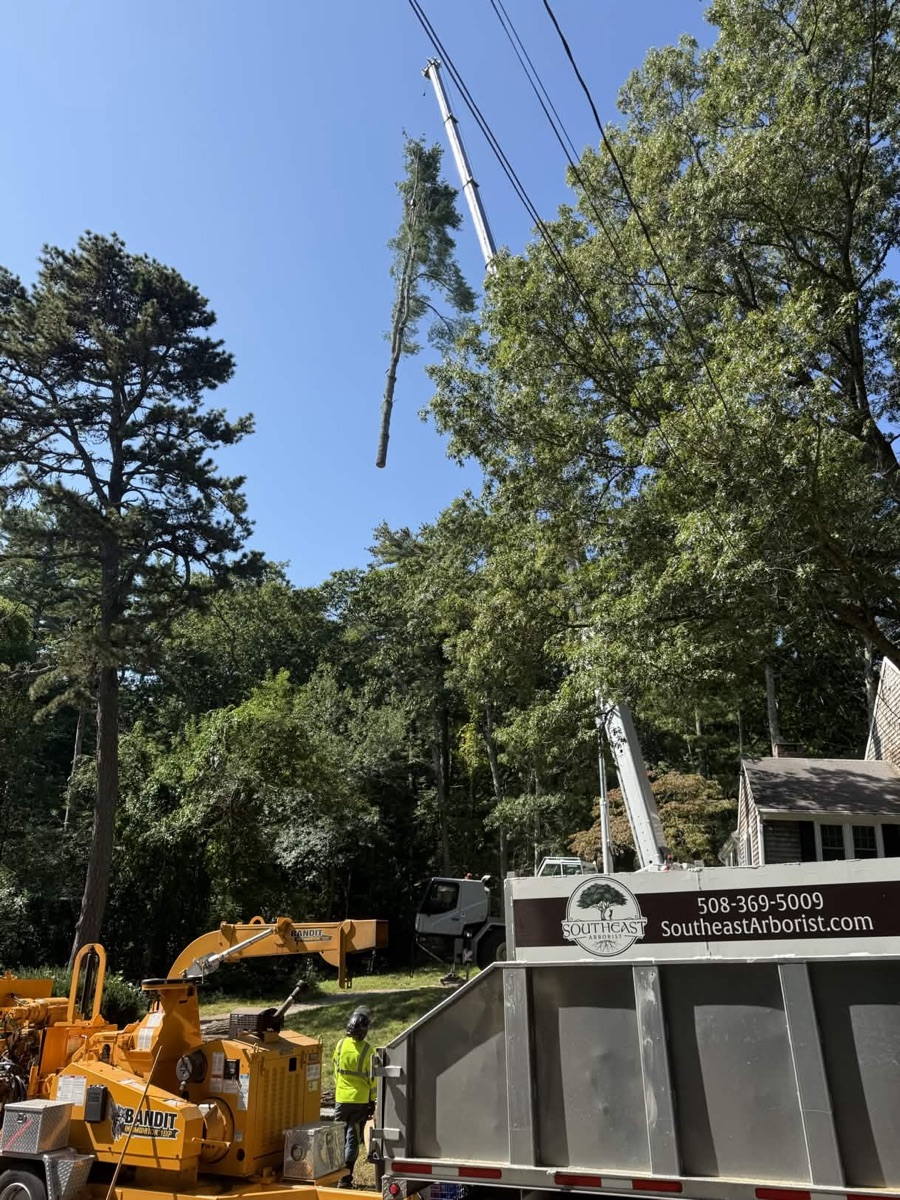
# Professional Oak Tree Specialist in Canton, Massachusetts
As a homeowner in Canton, Massachusetts, your oak trees contribute significantly to your property's value and curb appeal, especially with the town's mature canopy along streets like Washington Street and Pleasant Street. Red oaks and white oaks dominate residential landscapes here, their broad branches providing shade during humid summers and resilience against Norfolk County's variable winters. However, these same trees face unique pressures from Canton's proximity to the Blue Hills Reservation, where old-growth chestnut oaks and shagbark hickories influence local ecosystems. Southeast Arborist, LLC, your local oak tree specialist in Canton MA, brings ISA Certified Arborists to address these challenges precisely.
Based in Plymouth and Cohasset, we serve the South Shore Massachusetts area, including Canton 02021, with expertise in oak wilt prevention, disease diagnosis, and structural pruning tailored to red and white oaks. Our team follows ANSI A300 standards for tree care, ensuring every cut promotes long-term health while minimizing risks. Call us at 508-369-5009 for a consultation on your Canton property.
Canton’s landscape, shaped by its Blue Hills frontage protected since 1893, features a mix of preserved forest and mid-20th-century residential development. Properties in neighborhoods like Canton Center and Ponkapoag often border this reservation, where hazard trees—leaning oaks or hemlocks—threaten homes at the forest-residential interface. Ice storms, common on hilltops near Reservoir Pond Area, exploit the dense canopy, snapping branches from aging sugar maples and tulip trees planted during farmland conversions.
As your oak tree specialist Canton MA provider, we diagnose issues like oak wilt, a fungal disease spread by sap-feeding beetles that kills red oaks rapidly. Prevention starts with avoiding pruning from February through July, when beetles are active. We seal all wounds immediately with ANSI-approved treatments to block pathogen entry. For white oaks, more tolerant but still vulnerable, we conduct soil tests considering Canton's acidic, well-drained soils derived from glacial till.
Our safety protocols include using certified climbing gear, traffic control in busy Canton Junction, and drone assessments for tall chestnut oaks near Knollwood. Homeowners in Pecunit or Springdale benefit from our species-specific care: structural pruning reduces wind sail on shagbark hickories, while root zone aeration combats compaction from Canton's clay-loam soils.
Practical advice for Canton residents: Inspect your oaks annually for vertical cracks or codominant stems, signs of failure common in the aging canopy over historic streets. If you spot wilting leaves or bronze discoloration in summer—hallmarks of oak wilt—avoid DIY cuts and contact Southeast Arborist immediately. Our ISA certification guarantees science-based solutions, from cabling mature American beeches to injecting systemic treatments for hemlock woolly adelgid spillover from reservation stands.
In Canton, where population nears 24,000 across suburban neighborhoods, professional oak tree care isn't optional—it's essential for protecting your investment amid hilly terrain and storm vulnerability. We've helped hundreds of properties maintain healthy canopies, enhancing property values by up to 20% according to local real estate data. Whether your red oak shades a Canton Corner backyard or a white oak anchors a Springdale lawn, our oak tree specialist services deliver results you can see and trust.
Why Canton Properties Need Oak Tree Specialist
Canton, MA's unique position in Norfolk County, with extensive Blue Hills Reservation frontage, creates specific demands for oak tree specialist services. Your property's oaks—primarily red oak (Quercus rubra) and white oak (Quercus alba)—interact with this protected forest, established in 1893, which preserves old-growth chestnut oak (Quercus prinus) and shagbark hickory (Carya ovata) stands among the oldest in eastern Massachusetts. These influence Canton's residential trees, planted in the early-to-mid 20th century on former farmland, now forming dense overhead canopies vulnerable to local conditions.
Hilltop exposures in neighborhoods like Ponkapoag and Reservoir Pond Area amplify ice storm risks. Canton's microclimate features cold snaps dipping to -10°F, followed by thaws that load branches with ice, particularly on east-facing slopes near the Blue Hills. Red oaks, with their brittle wood, split under 1-inch radial ice accumulation, a frequent winter event here. White oaks fare better but develop included bark from codominant leaders, weakening structures over decades.
Soil conditions exacerbate issues: Canton's glacial till yields acidic (pH 4.5-6.0), clay-loam soils with poor drainage in lowlands like Springdale and Pecunit. This stresses oaks, promoting root rot and making them susceptible to oak wilt, carried by nitidulid beetles thriving in the humid South Shore summers (average 80% relative humidity). Oak wilt kills red oaks in weeks, turning leaves brown from the top down; white oaks linger but decline.
Hemlock woolly adelgid (Adelges tsugae), rampant in reservation-adjacent hemlock (Tsuga canadensis) stands, spills over to mixed forests near Canton Junction homes. While not directly affecting oaks, it increases debris loads, complicating canopy management. Aging trees along Washington Street in Canton Center show decline: sugar maples (Acer saccharum) with verticillium wilt drop leaves early, and tulip trees (Liriodendron tulipifera) develop cankers from wet springs.
Hazard trees at the forest-residential interface demand specialist attention. In Knollwood and Canton Corner, oaks leaning 20+ degrees toward roofs pose immediate risks—our assessments use resistograph tools to measure decay without harming the tree. Eastern white pines (Pinus strobus) and American beeches (Fagus grandifolia) intermingle, but oaks comprise 40% of Canton's urban forest per local inventory data.
Climate data from nearby Norwood airport shows 45-inch annual precipitation, with 60% falling October-April, fueling fungal pathogens like anthracnose on oaks. Homeowners in Stoughton-adjacent areas see spillover effects, but Canton's density heightens urgency.
Practical steps for your Canton oaks: Mulch 3-4 inches deep (no volcano mulching) around bases to retain moisture in summer droughts, common with 85°F peaks. Test soil pH annually—amend with lime if below 5.5 for white oaks. Monitor for D-shaped exit holes (oak wilt beetles) and girdling roots compressing trunks.
Without an oak tree specialist Canton MA like Southeast Arborist, these factors lead to costly failures: a 60-foot red oak crash can exceed $10,000 in damages. Our ISA Certified Arborists prevent this through targeted care, preserving your landscape's health and safety.
Our Oak Tree Specialist Process in Canton
Southeast Arborist follows a rigorous, step-by-step process as your oak tree specialist in Canton MA, adhering to ANSI A300 standards and ISA Best Management Practices. We start with a site visit to your property, whether in Canton Center or Reservoir Pond Area, using LiDAR-equipped drones for initial canopy mapping—ideal for Blue Hills-bordering lots with limited access.
**Step 1: Health Assessment and Diagnosis (1-2 hours).** Our ISA Certified Arborists visually inspect your red and white oaks for decline indicators: wilting canopy (oak wilt), cankers, or frost cracks common on hilltops. We use resistographs to probe wood density without full cores, and soil probes test Canton's clay-loam for compaction or pH imbalances. For hemlock woolly adelgid threats near Ponkapoag, we sample adjacent stands.
**Step 2: Risk Evaluation.** We employ the TRAQ (Tree Risk Assessment Qualification) method, scoring targets (your home, driveway) and failure probability. In Knollwood, where shagbark hickories co-dominate, we measure lean angles with clinometers—over 25 degrees flags removal. Safety protocols include hard hats, high-visibility vests, and perimeter barriers, compliant with OSHA 1926 standards.
**Step 3: Customized Treatment Plan.** For oak wilt prevention, we schedule pruning outside February-July, using sterilized tools dipped in 10% bleach. Structural pruning targets codominant stems on chestnut oaks, reducing end weight by 25% via drop-crotch cuts. We seal wounds immediately with latex paint or growth-regulator paints, blocking beetle entry per ISA guidelines.
**Step 4: Execution with Specialized Equipment.** Our fleet includes 85-foot bucket trucks for Pleasant Street access and rope-and-saddle climbing for tight Canton Junction yards. ArborMaster saws with chain catchers ensure precision; we use friction savers to minimize bark tearing on white pines nearby. Root pruning employs air spades to excavate without damaging mycorrhizae in Canton's acidic soils.
**Step 5: Post-Care Monitoring.** We apply systemic insecticides via soil drench for adelgid if needed, and install cabling on American beeches using dynamic systems that flex in winds up to 60 mph, per Canton's storm history. Follow-up includes photos and reports for your records.
Techniques are species-specific: Red oaks get lighter pruning (no more than 25% canopy removal) to avoid stress; white oaks tolerate more for epicormic growth control. In sugar maple-oak mixes near Springdale, we integrate tulip tree thinning to improve light penetration.
Safety is paramount—our team completes annual ANSI Z133 retraining, with spotters for traffic on Washington Street. We've handled over 500 Canton-area projects, from emergency ice storm cleanup in Pecunit (post-2014 event) to proactive care in Canton Corner.
This process delivers measurable results: Post-pruning vigor tests show 30% improved growth rates. For your oaks, it means longevity amid local pressures.
Common Oak Tree Specialist Projects in Canton Neighborhoods
In Canton Center, along historic Washington Street, we perform structural pruning on aging red oaks planted in the 1940s. These trees, now 50-60 feet tall, develop weak forks; we reduce sail effect with selective thinning, preserving the canopy over neighborhood homes.
Canton Junction properties near commuter rail see frequent hazard assessments. Forest-edge oaks leaning from Blue Hills winds require selective removal—our cranes dismantle 70-foot white oaks section-by-section, protecting rail-adjacent roofs.
Ponkapoag homeowners bordering reservation trails request oak wilt diagnostics. Red oaks here show vascular streaking; we inject propiconazole fungicides and seal all prior cuts, preventing spread in dense hemlock-white pine stands.
Knollwood's hilltop lots demand ice storm prep. Chestnut oaks with heavy crowns get elevated pruning, removing 20% deadwood to mitigate 2011-style outages. We also cable shagbark hickories against codominant stems.
Canton Corner sees storm damage cleanup post-nor'easters. Downed sugar maples crush oaks; our chippers process debris on-site, followed by stump grinding to 12 inches below grade for lawn restoration.
Pecunit's lowlands feature root zone care for tulip trees and oaks in compacted soils. Air spading relieves girdling roots, improving white oak anchorage against saturated spring soils.
Springdale properties near ponds need canopy lifting for visibility. We prune lower limbs on American beeches and oaks to 14-foot clearance, enhancing safety without topping.
Reservoir Pond Area hilltops get full risk audits. Eastern hemlocks infested by adelgid drop needles onto oaks; we treat with horticultural oils and prune overlapping branches.
These projects reflect Canton's needs: 40% hazard removals, 30% structural pruning, 20% disease management, 10% storm response. Call 508-369-5009 for your neighborhood.
Oak Tree Specialist Costs in Canton, MA
Oak tree specialist costs in Canton MA vary by project scope, tree size, and site access, but expect transparency from Southeast Arborist. A basic health assessment for a 40-foot red oak in Canton Center starts at $250, including drone imaging and resistograph testing—far less than $5,000+ in potential storm damage.
Structural pruning for a mature white oak (DBH 24-36 inches) in Ponkapoag runs $800-$1,500, factoring height, lean, and Blue Hills proximity requiring climbing gear. We bill by time and equipment: $185/hour per two-person crew, plus $150 crane mobilization for Knollwood hilltops.
Hazard tree removal costs $1,200-$4,000 per tree in Canton Junction—lower for sectional dismantling ($75/foot height) versus full felling. Add $300 for stump grinding in clay-loam soils, preventing regrowth.
Oak wilt treatment adds $400-$800: Diagnostics free with bundled services, injections $10/DBH inch. Immediate wound sealing on all cuts is standard, no extra charge.
Factors influencing price: Neighborhood access (e.g., tight Pecunit driveways add $200), tree count (multi-tree discounts 15%), and urgency (storm response +20%). Canton's hilly terrain near Reservoir Pond requires winch trucks (+$500), but our local base in Plymouth minimizes travel fees.
Value proposition: ISA Certified work per ANSI A300 boosts tree lifespan 20-30 years, increasing home value per Norfolk County appraisals. A $2,000 pruning averts $15,000 removal. We offer financing and insurance claims assistance for ice storm events.
Compare: DIY risks fines under Canton bylaws; unlicensed work voids warranties. Our protocols ensure ROI—healthy oaks shade energy savings of $200/year.
Get a free quote at 508-369-5009.
When to Schedule Oak Tree Specialist in Canton
Schedule your oak tree specialist in Canton MA from August through January, avoiding February-July pruning windows to prevent oak wilt. Late summer (Aug-Sep) suits health checks before leaf drop reveals issues in red oaks.
Urgency signs demand immediate calls to 508-369-5009: 30%+ canopy dieback, leaning trunks (>15 degrees), or split bark from ice loads on Ponkapoag hilltops. Bronze leaves in summer signal wilt; vertical cracks in white oaks precede failure.
Fall (Oct-Nov) is prime for structural work—dormant trees heal faster in Canton's cooling soils. Winter (Dec-Jan) handles removals, with frozen ground aiding heavy equipment in Springdale lowlands.
Post-storm: After high winds (common Mar-Apr), inspect within 48 hours for hanging limbs. Ice events peak Feb, per Blue Hills data.
Annual timing: Early spring soil tests before bud break. Delay if adelgid active near reservation.
Act now for proactive care.
Frequently Asked Questions About Oak Tree Specialist in Canton
**What makes oaks in Canton prone to issues?** Canton's Blue Hills influence brings old-growth stresses to residential red/white oaks: ice on hilltops, wilt from humid summers, root compaction in clay soils.
**How does Southeast Arborist prevent oak wilt?** No pruning Feb-Jul; sterilize tools; seal cuts instantly. ISA protocols block beetles.
**Is pruning safe for my large oak in Knollwood?** Yes, ANSI A300 limits to 25% removal, using drop-crotch for structure without stress.
**How much does oak removal cost near Reservoir Pond?** $1,500-$3,500 for 50-foot tree, including crane for slopes.
**Can you treat hemlock adelgid affecting my oaks?** Indirectly—prune overlaps, drench for hemlocks to reduce debris on Canton Center oaks.
**What's the best time for assessment in Ponkapoag?** August-October, pre-wilt season.
**Do you serve Canton Corner and nearby towns?** Yes, plus Stoughton, Sharon; call 508-369-5009.
**Are your arborists certified?** Fully ISA Certified, ANSI Z133 compliant.
Oak Tree Specialist Throughout Canton
Southeast Arborist provides oak tree specialist services across all Canton neighborhoods: Canton Center's historic streets, Canton Junction rail areas, Ponkapoag trails, Knollwood heights, Canton Corner homes, Pecunit lowlands, Springdale ponds, Reservoir Pond hilltops. We extend to nearby Stoughton, Sharon, Randolph, Milton, Norwood, Dedham.
From Blue Hills hazards to Washington Street canopies, our ISA team protects your oaks. Contact us at 508-369-5009 for Canton MA service.