
# Professional Oak Tree Specialist in Attleboro, Massachusetts
As a homeowner in Attleboro, Massachusetts, you rely on your oak trees for shade, property value, and curb appeal across Bristol County's diverse landscapes. Red oaks and white oaks dominate many yards in neighborhoods like Attleboro Center and the Capron Park Area, but these majestic trees face unique pressures from the town's industrial history and modern suburban growth. Southeast Arborist, LLC, your local oak tree specialist in Attleboro MA, brings ISA Certified Arborists to handle everything from oak wilt prevention to structural pruning tailored to your property's needs.
Based in Plymouth and Cohasset, we serve the South Shore Massachusetts region, including Attleboro's 46,000 residents in ZIP code 02703. Our team understands the aging street trees planted during the late 1800s jewelry manufacturing boom—red oaks and white oaks that now exceed 100 years old in dense areas like South Attleboro and Hebronville. These trees contend with emerald ash borer nearby, ice storm damage on hillier western slopes, and root conflicts with century-old infrastructure.
Oak wilt, a fungal disease spread by sap-feeding beetles, threatens Attleboro's oaks more than ever. Symptoms include vein browning in leaves and rapid canopy dieback, especially in red oaks during summer. As your oak tree specialist Attleboro MA experts, we prevent this through precise pruning outside the high-risk February through July window, immediate wound sealing on all cuts, and species-specific treatments. Our ISA certification ensures we follow ANSI A300 standards for tree care, prioritizing safety with rigorous protocols like bucket truck inspections and PPE for every job.
Homeowners in Dodgeville and Briggs Corner often call us for health assessments revealing hidden issues like anthracnose or two-lined chestnut borer infestations. We diagnose problems on-site, using tools like resistographs for internal decay detection without harming the tree. For white oaks in the Willett Pond Area, we focus on long-term canopy health through subordinate branch reduction, reducing storm failure risks from Nor'easters that batter Bristol County.
Why choose Southeast Arborist as your oak tree specialist in Attleboro MA? Our 20+ years serving South Shore properties mean we know local soil conditions—sandy loams in eastern Attleboro transitioning to clay-heavy soils near Norton—that stress oak root systems. We avoid common pitfalls like late-winter pruning that invites oak wilt vectors. Instead, we schedule fall or early winter work, sealing wounds with paint-grade sealants to block fungal entry.
Practical tip for Attleboro residents: Inspect your oaks now for wilting leaves or D-shaped exit holes from borers. If spotted in North Attleboro border lots, contact us immediately at 508-369-5009 for a free assessment. Our services extend beyond basic trimming to full oak tree specialist solutions, including cabling for storm-prone trees and soil injections for nutrient deficiencies common in post-construction sites around Seekonk.
In Attleboro's wooded suburban edges, oaks intermingle with sugar maples and white pines, creating mixed stands vulnerable to even-aged decline. We thin selectively to promote vigor, ensuring your property stands out. Municipal clients at Capron Park trust us for canopy management, proving our expertise scales from residential yards to public spaces. As your dedicated oak tree specialist Attleboro MA provider, Southeast Arborist delivers results that protect your investment for generations.
Why Attleboro Properties Need Oak Tree Specialist
Attleboro's unique blend of dense older neighborhoods and wooded suburban edges creates specific demands for oak tree specialist services. The city's jewelry capital past led to compact development in Attleboro Center, where red oaks line narrow streets, their roots buckling sidewalks installed over a century ago. White oaks in South Attleboro yards suffer similar infrastructure conflicts, with surface roots heaving concrete near the Route 1 corridor.
Local climate exacerbates these issues. Bristol County's humid continental weather brings icy Nor'easters and summer droughts, stressing oaks on hillier terrain like Dodgeville. Ice storms coat branches, causing splits in mature red oaks whose wood density makes them prone to failure. Average annual precipitation of 48 inches leads to wet springs, fostering root rot in clay soils around Hebronville, where poor drainage compounds problems for shallow-rooted white oaks.
Common tree species amplify the need for specialized care. Red oaks (Quercus rubra) and white oaks (Quercus alba) comprise 30-40% of Attleboro's urban canopy, per local arborist surveys. These coexist with Norway maples, silver maples, and sugar maples in Briggs Corner, but oaks face disproportionate threats. Oak wilt has surged since 2015, vectored by nitidulid beetles active in warming springs. Red oaks succumb fastest, dying within months, while white oaks resist better but still require prevention.
Emerald ash borer has decimated green ash populations near Rehoboth, shifting pest pressure to oaks. Two-lined chestnut borers target stressed red oaks in the Capron Park Area, creating galleries under bark that girdle trunks. American beech and eastern hemlock in Willett Pond Area stands show scale insects spilling over to oaks, weakening vigor.
Aging street trees from the post-Dutch elm disease replanting era dominate Attleboro Center and North Attleboro border. Many 1960s Norway maples were later overshadowed by volunteer red oaks now needing structural pruning to prevent codominant stem failures. Outlying forests on former farmland feature even-aged oak-pine stands reaching maturity, prone to windthrow on exposed edges near Franklin.
Soil conditions vary: Eastern Attleboro's sandy loams drain quickly, leading to drought stress in red maples and oaks during July-August dry spells. Western hills near Norton hold clay, promoting Phytophthora root rot in white pines and oaks after heavy rains. Homeowners notice yellowing leaves or basal sprouts—signs calling for an oak tree specialist Attleboro MA.
Ice storm damage peaks in hilly western sections, like Briggs Corner, where 2023 events felled dozens of oaks. Replacement plantings must consider these risks, with our ISA arborists recommending disease-resistant cultivars suited to local pH levels (5.5-6.5 typical).
Practical advice: In your Attleboro yard, check for oak wilt by snapping leaves—brown veins indicate infection. Avoid topping, which invites decay in dense wood. For properties bordering Seekonk, monitor silver maples' aggressive roots invading oak zones, requiring boundary pruning.
Without expert intervention, your oaks risk total loss, dropping property values by 10-15% in tree-heavy neighborhoods. Southeast Arborist's ANSI A300-compliant care addresses these Attleboro-specific challenges, from disease diagnosis to hazard reduction, ensuring your red and white oaks thrive amid local pressures.
Our Oak Tree Specialist Process in Attleboro
Southeast Arborist follows a meticulous, step-by-step process as your oak tree specialist in Attleboro MA, customized to local conditions. We start with a free on-site consultation. An ISA Certified Arborist arrives at your Attleboro Center home or Dodgeville lot, equipped with a clipboard, soil probe, and increment borer. We assess canopy density, trunk taper, and root collar exposure, noting Attleboro's clay soils that often bury oak flares.
Step 1: Comprehensive Health Diagnosis (1-2 hours). Using resistographs and sonic tomography, we detect internal decay without invasive drilling—critical for century-old red oaks in South Attleboro. We sample leaves for lab analysis of oak wilt (Ceratocystis fagacearum) or anthracnose, common after wet Attleboro springs. Soil tests check pH and compaction around Willett Pond Area properties.
Step 2: Risk Assessment per ANSI A300. We score targets (your home, driveway) using ISA Tree Risk Assessment Qualifications. In Hebronville's dense lots, we flag codominant leaders in white oaks prone to splitting during ice loads. Safety protocols include pre-job site hazard scans for power lines, standard in Briggs Corner near highways.
Step 3: Customized Treatment Plan. For oak wilt prevention, we schedule pruning only August-January, avoiding beetle flights. Red oaks get fungicide trunk injections if early symptoms appear; white oaks focus on cultural improvements like mulch rings to combat drought in Capron Park Area yards.
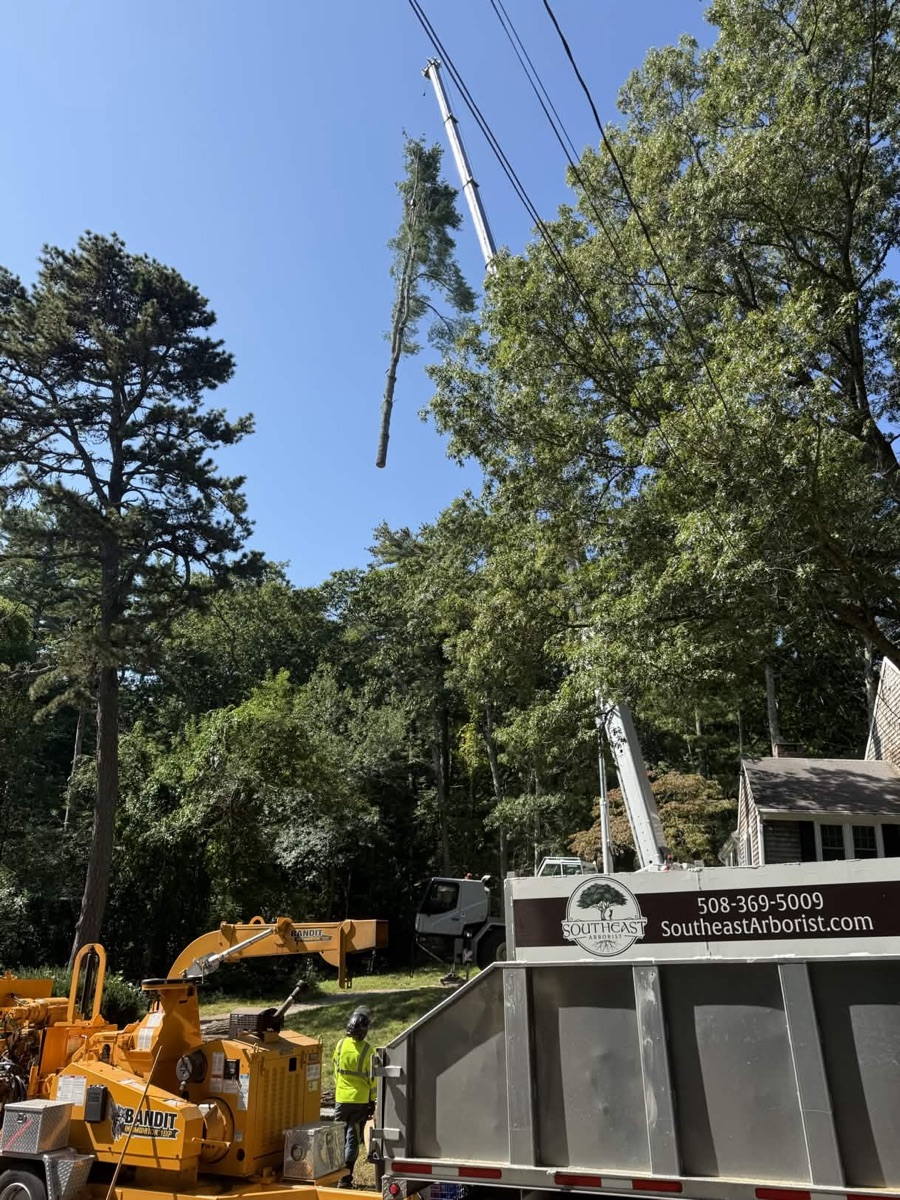
Step 4: Pruning Execution with Specialized Equipment. Our fleet includes 85-foot bucket trucks for North Attleboro border heights, grapplesaws for over-post oaks, and low-ground-pressure chippers to minimize lawn damage on sandy eastern soils. We perform structural pruning: reducing end weight on included bark unions, lion-tailing removal for wind resistance. Every cut receives immediate wound sealant—black paint-grade formula blocks vectors, unlike outdated natural healing myths.
Techniques are species-specific. Red oaks require drop-crotch cuts to preserve natural form, preventing epicormic sprouting that weakens stems. White oaks get delayed branch pruning to mature callus tissue first. We follow TCIA safety standards, with two-way radios, harnesses, and daily rigging inspections.
Step 5: Advanced Interventions. For storm-damaged oaks in hilly Dodgeville, we install steel cables or rods at 40-50% canopy height, tensioned to brace splits. Soil aeration follows root damage from construction near Norton—injecting mycorrhizal fungi restores Attleboro's nutrient-poor profiles.
Step 6: Post-Care Monitoring and Cleanup. We apply slow-release fertilizers (e.g., 10-10-10 with micronutrients) via deep-root injection, bypassing compacted surfaces. Chips from your pruning become free mulch, suppressing weeds without plastics. A 6-month follow-up report tracks progress, with photos for insurance in ice-prone areas.
Our process integrates Attleboro realities: quick access for emergency calls post-Nor'easter, compliance with city permits for street trees. Homeowners save 20-30% on future costs through proactive care.
Practical tip: Maintain 3-4 inches of organic mulch in a 4-foot radius around your oak base, keeping it 6 inches from trunk—boosts moisture retention in local droughts.
This proven system, backed by ISA certification, ensures your oaks endure Bristol County's challenges.
Common Oak Tree Specialist Projects in Attleboro Neighborhoods
Attleboro neighborhoods drive distinct oak tree specialist projects for Southeast Arborist. In Attleboro Center's dense historic core, street tree pruning tops the list. Aging red oaks from 1900s plantings need crown thinning to clear power lines and reduce sidewalk uplift, with 20-25% canopy reduction per ANSI standards.
South Attleboro properties near Route 1 see frequent removals of hazard oaks. Silver maples intermixed with white oaks develop girdling roots; we excavate and prune selectively, or remove if 50% trunk compromised. Post-2022 ice storm, we handled 15+ takedowns here, using cranes for proximity to homes.
North Attleboro border lots feature large white oaks shading properties. Common projects include cabling for storm bracing—steel aircraft cables installed via climbing arborists—and lightning protection rods, vital after frequent Bristol County strikes.
Hebronville's clay soils spark root rot treatments. We aerate and drench with phosphonate fungicides for Phytophthora in red oaks near wetlands, followed by structural support pruning to offload heavy limbs.
Dodgeville hills demand emergency response. Ice-laden branches snap on slopes; our grapplesaw teams section-fell overnight, chipping on-site to avoid traffic blocks. Lot clearing for new builds thins oak stands, retaining heritage trees per town regs.
Briggs Corner residential edges require selective thinning. Even-aged red oak-pine mixes get 15-20% removal to improve light penetration, preventing sugar maple competition and promoting understory health.
Capron Park Area homeowners call for canopy management akin to the adjacent zoo's needs. We prune white oaks overlooking ponds, sealing wounds to deter beech bark disease crossover from nearby American beeches.
Willett Pond Area focuses on waterfront oaks. Erosion control via root pruning and fabric wraps stabilizes banks, while hemlock woolly adelgid monitoring extends to oak scale issues.
Across these spots, oak wilt prevention unites projects—trench barriers isolate infected red oaks near Seekonk, injecting propiconazole systemically.
We've completed 200+ Attleboro projects yearly, from Norton-adjacent lots to Franklin borders. Practical advice: Document storm damage photos for insurance; we assist claims.
Your neighborhood's oaks get targeted care from our oak tree specialist Attleboro MA team.
Oak Tree Specialist Costs in Attleboro, MA
Oak tree specialist costs in Attleboro MA vary by project scope, tree size, and location factors, but Southeast Arborist provides transparent pricing for South Shore value. Consultations are free; expect $150-250 for full health assessments using advanced diagnostics on Attleboro Center properties.
Pruning starts at $400 for small red oaks (under 30 feet) in South Attleboro, scaling to $1,200+ for 60-foot white oaks in Dodgeville requiring bucket trucks. Factors: Canopy volume (measured in square feet), access (tight Hebronville alleys add 20%), and timing (off-season discounts August-January).
Removals range $800-$3,500. A 40-foot hazard oak in Briggs Corner with easy stump pull costs $1,200; complex North Attleboro border jobs near wires hit $2,800, including crane fees ($300/hour). Stump grinding adds $200-400, deeper in clay soils.
Oak wilt treatments: $500-1,000 per injection for red oaks in Capron Park Area, covering macro-infusion pumps and EPA-approved fungicides. Cabling/rod systems: $600-1,500, galvanized hardware lasting 20 years on Willett Pond trees.
Lot clearing in suburban edges: $2,000-$5,000 per half-acre, selective for 10-15 oaks amid white pines. Municipal-scale Capron Park work bids at $10,000+ annually.
Pricing drivers: Tree DBH (diameter breast height)—each 6 inches adds $150-300. Attleboro specifics like hill access or permit fees ($50-100) influence totals. Fuel surcharges apply for Norton runs.
Value proposition: Our ISA precision prevents $5,000+ replacements. ANSI pruning extends life 15-20 years, boosting property values 7-10% per appraisals in tree-rich areas. Insurance discounts (5-15%) follow risk reports.
Compared to DIY risks or unqualified crews, we save via efficiency—bucket trucks prune twice as fast as climbing alone. Bulk neighborhood deals cut 10-15%.
Practical budgeting tip: Annual $300 maintenance on your Briggs Corner oaks avoids $2,000 emergencies.
Contact 508-369-5009 for Attleboro-specific quotes—your oak tree specialist investment pays lifelong dividends.
When to Schedule Oak Tree Specialist in Attleboro
Timing your oak tree specialist in Attleboro MA appointment maximizes health and minimizes risks. Schedule pruning August through January—never February-July, when oak wilt beetles swarm in warming Bristol County weather.
Fall (September-November) ideal post-drought recovery; remove deadwood before leaf drop reveals issues in Attleboro Center red oaks. Winter (December-January) suits structural work on bare white oaks in South Attleboro, with frozen ground easing heavy equipment on slopes.
Urgency signs demand immediate calls to 508-369-5009: Sudden 30% canopy wilt (oak wilt in red oaks), leaning trunks post-ice (Dodgeville hazards), or borer frass at bases (Hebronville whites). Cracking bark or fungal brackets signal decay—act within 48 hours.
Spring monitoring peaks April-May after Nor'easters; yellowing leaves indicate nutrient lacks in sandy eastern soils. Summer emergencies follow storms, prioritizing Capron Park Area storm cleanup.
Biennial inspections for mature stands in Briggs Corner prevent failures. New construction near Norton? Schedule pre-clearing assessments.
Avoid peak summer—heat stresses healing cuts. Our calendar fills fast post-storms; book proactively.
Your Attleboro oaks thrive with precise timing from Southeast Arborist.
Frequently Asked Questions About Oak Tree Specialist in Attleboro
What is oak wilt, and how does your oak tree specialist in Attleboro MA prevent it? Oak wilt is a vascular disease caused by Bretziella fagacearum, killing red oaks in weeks via root grafts and beetle vectors. In Attleboro's interconnected neighborhoods like Hebronville, it spreads fast. We prevent it by pruning only August-January, sealing cuts instantly, and trenching barriers (100 feet from infecteds). Injections cost $600-900, effective 2 years.
How do I know if my Attleboro oak needs structural pruning? Look for codominant stems (V-shaped unions), rubbing branches, or excessive end weight in Dodgeville red oaks. ISA arborists use level 3 risk ratings; pruning reduces sail effect by 25%, vital for ice-prone hills.
Can you treat emerald ash borer effects on nearby oaks in South Attleboro? While EAB targets ash, stressed green ash decline invites secondary pests to oaks. We apply systemic insecticides and prune to improve vigor, protecting mixed stands near Rehoboth.
What's the difference between red and white oak care in Attleboro Center? Red oaks (faster-growing, more wilt-susceptible) need aggressive borer monitoring; white oaks (deeper roots, rot-resistant) focus on soil aeration in clay. Both get species-timing pruning.
Do you handle permits for street oaks in Briggs Corner? Yes, we file with Attleboro DPW, including utility locates—essential near North Attleboro borders.
How much does oak removal cost in Capron Park Area? $1,000-$2,500 for 30-50 footers, factoring pond proximity and crane needs.
Is cabling permanent for Willett Pond storm oaks? No, inspected every 3-5 years; lasts 20+ with proper tension.
Why choose ISA certified over general tree services for Attleboro? Our training ensures ANSI A300 compliance, reducing liability—critical in dense Willett Pond Area.
Oak Tree Specialist Throughout Attleboro
Southeast Arborist delivers oak tree specialist services across all Attleboro neighborhoods: Attleboro Center street trees, South Attleboro hazards, North Attleboro border giants, Hebronville root work, Dodgeville storm response, Briggs Corner thinning, Capron Park canopy care, and Willett Pond erosion control. We extend to nearby Norton, Rehoboth, Seekonk, and Franklin, covering South Shore Massachusetts from our Plymouth/Cohasset base.
ISA Certified Arborists arrive promptly with full safety gear. Call 508-369-5009 today for your free assessment—protect your Attleboro oaks now.