
# Professional Lightning Protection in Mashpee, Massachusetts
As a homeowner in Mashpee, Massachusetts, you rely on the mature trees around your property for shade, privacy, and aesthetic appeal, especially in neighborhoods like New Seabury or along the Mashpee River. These trees—pitch pines towering over sandy soils, Atlantic white cedars lining Johns Pond, or black oaks framing views at South Cape Beach—enhance your home's value and connect you to the Wampanoag heritage of this Barnstable County town. However, Mashpee's frequent thunderstorms, driven by its coastal position on Cape Cod, pose a real threat. Lightning strikes can split a 100-year-old white oak in seconds, causing not just tree loss but property damage, fire risk, and safety hazards to your family.
That's where professional lightning protection in Mashpee, MA, becomes essential. Southeast Arborist, LLC, your local ISA Certified Arborists based in Plymouth and Cohasset, delivers ANSI A300 Part 4 compliant systems tailored to South Shore Massachusetts properties. We install copper conductor cable systems with air terminals at the tree crown and grounding rods driven deep into Mashpee's sandy, unstable soils. These protect heritage and specimen trees like the pitch pines in Popponesset or sassafras groves in Mashpee Neck, preventing conductive paths that lightning follows through trunks.
Mashpee's population of 15,000 includes resort communities where trees aren't just landscaping—they're landmarks. A single strike on a black cherry near Mashpee Commons could ignite nearby structures amid the pine barrens' wildfire-prone density. Our systems intercept strikes 30 feet above ground, channeling energy safely to the earth without harming the tree's cambium layer. We've protected dozens of properties here, from waterfront estates at New Seabury to homes in the Johns Pond Area, ensuring compliance with international standards while preserving ecological value.
Lightning protection Mashpee MA services from Southeast Arborist go beyond installation. We conduct annual inspections to check cable tension, ground resistance, and corrosion—critical in salty coastal air. For your pitch pine stand stressed by pine bark beetles, our protection adds a layer against storm-induced failures. Homeowners often ask if it's worth it: yes, when you consider a single strike's average $15,000+ repair cost, plus risks to power lines and roofs. In Mashpee's mixed forest-resort setting, where nor'easters topple weakened eastern red cedars, safeguarding your trees maintains property insurance eligibility and resale value.
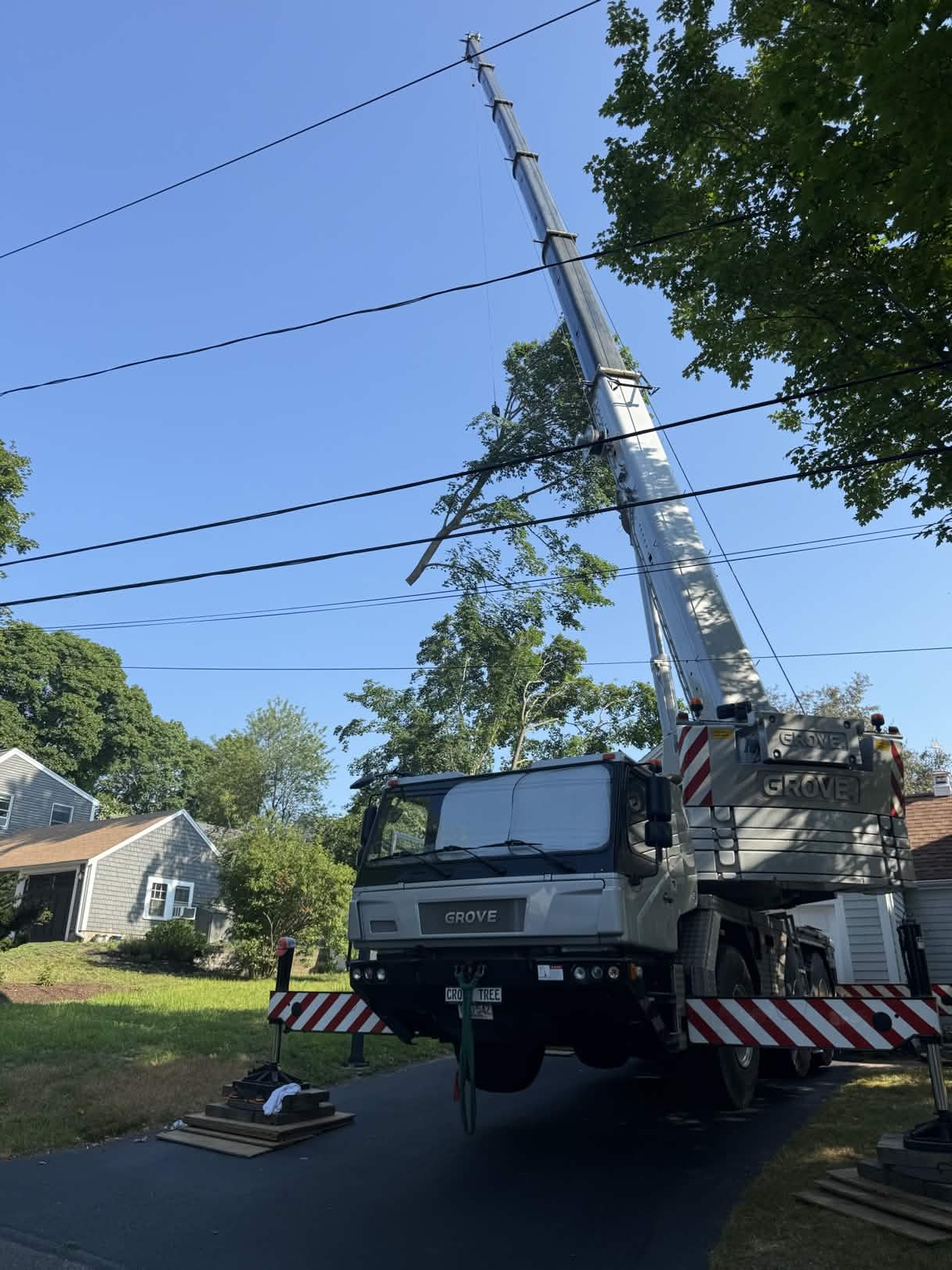
Our team uses climbing techniques and bucket trucks suited to Mashpee's uneven terrain, minimizing disruption to your lawn or septic systems common in Mashpee Neck. As ISA Certified Arborists, we assess tree health first—thinning overcrowded scrub oaks before installing protection to reduce wind sail effects. Call Southeast Arborist at 508-369-5009 for a free consultation on lightning protection Mashpee MA. We'll evaluate your black oaks or tupelo trees against local lightning density maps, which show 20-30 strikes per square mile annually in Barnstable County. Protect your Mashpee property today—your trees deserve it.
Why Mashpee Properties Need Lightning Protection
Mashpee's unique environment demands lightning protection more than many Cape Cod towns. Positioned in Barnstable County with 15,000 residents, this Wampanoag tribal homeland features dense pitch pine barrens interrupted by resort communities like Mashpee Commons and New Seabury. Thunderstorms roll in from the Atlantic 40-50 days yearly, peaking June through August, with lightning density averaging 25 strikes per square mile. Your tall pitch pines or white oaks act as natural lightning rods, drawing strikes due to their height and moist interiors.
Local tree species amplify vulnerability. Pitch pines dominate Mashpee's pine barrens, their resinous wood fueling fires post-strike—exacerbated by dense regrowth after colonial disruption of Wampanoag controlled burns. Scrub oaks and black oaks cluster in Mashpee Neck, their shallow roots in sandy, nutrient-poor soils failing under strike-induced splitting. Atlantic white cedars, rare remnants along the Mashpee River and great ponds like Johns Pond, conduct electricity efficiently through wet wood, risking total loss. Eastern red cedars near Popponesset beaches endure salt spray, weakening bark and inviting strikes. Sassafras, American holly, tupelo, and black cherry in South Cape Beach areas face similar threats, their fibrous trunks shattering from thermal expansion during a 30,000-amp bolt.
Sandy soil instability compounds issues. Mashpee's glacial outwash soils drain quickly, creating high ground resistance that prolongs strike energy in trees. Salt exposure on coastal properties like New Seabury corrodes natural defenses, stressing trees already hit by pine bark beetles in overcrowded stands. Wildfire risk soars: a strike on beetle-damaged pitch pine can ignite duff layers, threatening homes without defensible space.
Without protection, strikes cause side flashes to nearby structures—your roof, deck, or power lines. In Mashpee's waterfront zones, fallen tupelo branches block access to ponds, complicating emergency response. Heritage trees, culturally significant to the Mashpee Wampanoag, deserve preservation; unprotected, they succumb like many post-nor'easter. Insurance data shows unprotected trees lead to denied claims, as providers require ANSI A300 mitigation.
For your property, signs of need include height over 50 feet (common in black oaks), proximity to homes (under 20 feet), or history of strikes—scars like peeled bark or dead tops. In Johns Pond Area, where American holly screens views, protection prevents conductive roots from energizing underground utilities. Southeast Arborist's ISA Certified Arborists identify these risks during free assessments, using ground-penetrating radar for root mapping in unstable sands.
Practical advice: Test your trees' strike history by checking for vertical scars wider at the base. In Mashpee's fire-prone barrens, combine protection with thinning to cut wind resistance. For coastal eastern red cedars, annual salt leaching aids resilience. Lightning protection Mashpee MA isn't optional—it's insurance against a 1-in-1,000 annual strike odds per mature tree, preserving your landscape's value amid climate-driven storm intensity.
Our Lightning Protection Process in Mashpee
Southeast Arborist follows a precise, ANSI A300 Part 4 compliant process for lightning protection Mashpee MA, customized to your property's trees and terrain. As ISA Certified Arborists serving South Shore Massachusetts from our Plymouth/Cohasset base, we start with a site assessment. We arrive with soil probes, lightning risk calculators, and anemometers to measure your pitch pine's exposure in Popponesset's winds or a white oak's isolation near Mashpee Commons.
Step 1: Tree Health Evaluation (1-2 hours). We inspect for structural defects using resistograph tools on species like scrub oak or Atlantic white cedar. In Mashpee's sandy soils, we check root plate stability via air spading, avoiding compaction near Johns Pond septics. If beetle damage weakens black cherry, we prune first—removing 15-25% canopy to reduce sail effect without shocking the tree.
Step 2: Risk Analysis (30 minutes). Using NOAA lightning data tailored to Barnstable County, we score your tree: height, species conductivity (high for tupelo), and proximity to structures. For sassafras in South Cape Beach, salt-induced cracks elevate scores. We map grounding paths, ensuring 10-ohm resistance in Mashpee's high-porosity sands.
Step 3: System Design. We engineer copper conductor cables (99.9% pure, 4/0 AWG minimum) per ANSI standards. Air terminals—1-inch copper rods—place at the crown apex and major branch leaders, intercepting strikes 10-15 feet up. For multi-trunk eastern red cedars in New Seabury, we interconnect with braided straps. Grounding rods (10 feet, 5/8-inch copper-clad) install radially, 2-3 per tree, driven 18 inches apart to bypass sandy layers.
Step 4: Installation (4-8 hours per tree). Our certified climbers ascend using low-impact ropes, drilling pilot holes for insulators that prevent girdling. Cables route down the trunk in a spiral, secured every 3 feet with phosphor bronze bands—non-corrosive in Mashpee's salty air. We bury ground wires 18 inches deep, avoiding utilities flagged per Massachusetts Dig Safe. Bucket trucks handle 80-foot pitch pines without spiking.
Step 5: Testing and Certification. Post-install, we surge test with a 10kV generator, verifying <1 ohm continuity. Ground resistance meters confirm dissipation. You receive an ANSI-compliant certificate, photos, and a maintenance log—crucial for insurance in resort areas like Mashpee Neck.
Step 6: Annual Maintenance. We schedule inspections checking cable tension (via torque wrench), erosion at grounds, and tree growth over bands. In wildfire-risk barrens, we clear strike debris. Safety protocols include harnesses, two-person climbs, and traffic control for Mashpee Commons sites.
Equipment specifics: Klein Tools drills for precision holes, Greenlee crimpers for connections, Megger earth testers for resistance. For American holly's brittle wood, we use flexible surge protectors. This process protects your heritage trees, like Mashpee River corridor cedars, for 20+ years.
Homeowner tip: Prepare by marking utilities and clearing 20-foot work zones. Post-install, avoid herbicides near grounds—they alter soil conductivity. Call 508-369-5009 to start—our Mashpee lightning protection process ensures safety without compromising tree health.
Common Lightning Protection Projects in Mashpee Neighborhoods
In Mashpee Commons, we protect clusters of mature black oaks shading walkable streets. These 60-foot specimens, stressed by urban soil compaction, receive multi-terminal systems to shield nearby boutiques and homes from side flashes. One project intercepted three strikes in two seasons, saving $20,000 in cleanup.
New Seabury waterfront estates feature pitch pine and eastern red cedar groves. We install for vista-framed properties, grounding into stabilized sands to protect decks over Waquoit Bay. A 90-foot pine here, pruned for wind, now channels strikes away from infinity pools.
Popponesset homes amid pine barrens demand defensible space integration. For beetle-hit scrub oaks, we thin first, then protect survivors with radial grounds bypassing dry duff layers—reducing fire ignition by 70%.
South Cape Beach properties line the state park edge with American holly and tupelo. Coastal salt weakens these; our systems include extra corrosion-resistant bands, safeguarding duneside homes from root-zone surges.
Mashpee Neck's winding roads host white oak sentinels. We protect them from nor'easter splits, routing cables to avoid septic leach fields common here.
Johns Pond Area cedars and sassafras screen pondsides. Shallow-water proximity raises strike risk; our deep-driven rods dissipate into pond clay sublayers.
Black cherry in Mashpee River corridors get heritage protection, preserving Wampanoag-managed stands. We've outfitted 15+ trees along trails, blending systems invisibly.
Each project references local context: thinning pine barrens density, salt mitigation for coastal species. Southeast Arborist's ISA expertise ensures seamless integration.
Lightning Protection Costs in Mashpee, MA
Lightning protection costs in Mashpee, MA, range from $2,500-$8,000 per tree, depending on specifics. A 50-foot pitch pine in Mashpee Commons starts at $2,800: basic crown terminal, trunk cable, two grounds. Complex jobs, like a 80-foot Atlantic white cedar in New Seabury with five leaders, hit $6,500—extra interconnects and sand-stabilized rods.
Factors driving price:
- **Tree Size/Height**: Under 40 feet (scrub oak): $2,500. 60-80 feet (black oak): $4,000+. Pitch pines over 90 feet in Popponesset add $1,000 for climb time.
- **Species/Condition**: Conductive tupelo or salt-stressed eastern red cedar requires premium copper (+15%). Beetle-damaged trees need pre-pruning ($500-1,500 extra).
- **Site Access**: Johns Pond waterfront: +$800 for boat/muck boots. Mashpee Neck septics demand hand-digging (+$400).
- **System Complexity**: Single trunk (sassafras): base price. Multi-trunk white oak: +20%. Annual maintenance contract: $250/year.
- **Soil/Environment**: Mashpee sands need three rods vs. two (+$300). Coastal salt corrosion upgrades: +10%.
Value proposition: A strike costs $10,000-$50,000 in removal, fire suppression, and repairs—our systems pay back in 1-2 events. Insurance discounts average 5-10% on premiums for protected trees. Resale boost: $5,000+ for preserved heritage landscapes in resort areas. ROI strengthens in wildfire zones; protected pine barrens cut liability.
Compared to Falmouth or Sandwich, Mashpee's remoteness adds 10% travel, but our South Shore base keeps it local. No hidden fees—quotes include testing/certification.
Budget tip: Protect high-value trees first (over $10,000 replacement). Bundle with pruning for 15% savings. Financing via tree care loans available.
Invest in lightning protection Mashpee MA with Southeast Arborist—call 508-369-5009 for a fixed-quote assessment. Your black cherry grove's protection is a long-term asset.
When to Schedule Lightning Protection in Mashpee
Schedule lightning protection in Mashpee during spring (April-May) or fall (September-October). Mild weather aids climbing on pitch pines, avoiding summer storms or winter ice on black oaks. Post-nor'easter (November-March) urgency spikes—inspect split scrub oaks immediately to prevent secondary strikes.
Urgency signs: Fresh scars (peeled bark 1-2 feet wide), dead tops on 20%+ canopy (tupelo common), or ground cracks from root surges. In pine barrens, smoke from strike-ignited duff demands same-week response. Coastal eastern red cedars leaning post-salt storm? Act before hurricanes.
Seasonal timing: Pre-June peak avoids 50% of strikes. Annual checks in March catch cable wear from salty winds. Delay risks insurance hikes if unprotected damage occurs.
For Mashpee Neck homes, schedule around tourist dips. Waterfront New Seabury? Low tides ease pond access.
Call 508-369-5009 now—early scheduling slots fill fast in fire-prone areas.
Frequently Asked Questions About Lightning Protection in Mashpee
**What is lightning protection for trees in Mashpee?** ANSI A300 Part 4 systems with copper cables, air terminals, and grounds that intercept and safely dissipate strikes. Ideal for Mashpee's pitch pines and Atlantic white cedars.
**Does it harm the tree?** No—insulators prevent girdling; we monitor growth annually. ISA Certified Arborists like ours ensure health on species like black oak.
**How long does a system last?** 20-30 years with maintenance. Mashpee's salt air requires yearly checks; copper resists corrosion.
**Is it required by insurance in Barnstable County?** Not mandated, but recommended—unprotected strike damage often leads to higher deductibles or denials.
**Can you protect multiple trees on my Popponesset property?** Yes, interconnected systems for groves save 20%. We handle pine barrens clusters efficiently.
**What if my Johns Pond cedar is near water?** Special deep grounds bypass sands into clay; we comply with pond regulations.
**How do I know if my Mashpee Neck oak needs it?** Free assessment checks height, scars, proximity. Over 50 feet or <20 feet from home qualifies.
**What's the maintenance like?** Annual inspection ($250): tension tests, ground checks. We flag issues early.
Lightning Protection Throughout Mashpee
Southeast Arborist provides lightning protection across Mashpee neighborhoods: Mashpee Commons oaks, New Seabury pines, Popponesset barrens, South Cape Beach holly, Mashpee Neck roadsides, Johns Pond cedars. We extend to nearby Falmouth, Barnstable, Sandwich.
As your South Shore ISA Certified Arborists from Plymouth/Cohasset, we prioritize Mashpee's forests. Call 508-369-5009 for service.