
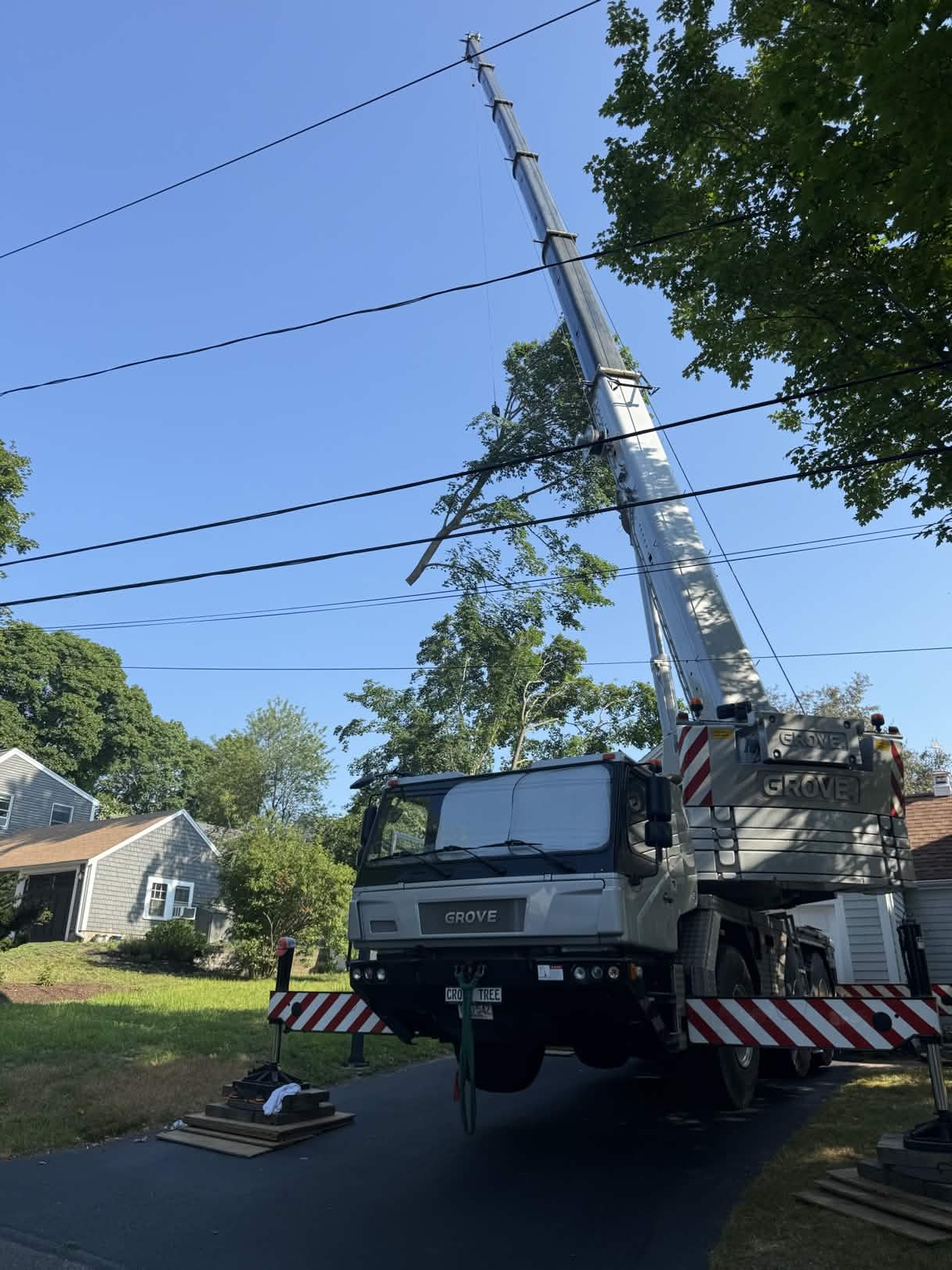
# Professional Lightning Protection in Berkley, Massachusetts
If you own property in Berkley, Massachusetts, your mature trees—red oaks towering over driveways in Myricks, white pines lining the Taunton River in South Berkley, or sycamores along Poquoy Brook—face unique risks from lightning strikes. Berkley's heavily wooded landscape, covering most of its 6,800 residents across Bristol County, amplifies these dangers. Second-growth forests regrown since early 20th-century farming declined now dominate, with spongy moth outbreaks from 2016-2017 leaving weakened oaks that conduct electricity efficiently during summer thunderstorms. A single strike can split a 100-foot white oak, ignite dry understory, or send surge through rural power lines vulnerable along narrow roads.
Southeast Arborist, LLC, your South Shore Massachusetts tree care experts based in Plymouth and Cohasset, delivers ANSI A300-compliant lightning protection specifically for Berkley's heritage and specimen trees. Our ISA Certified Arborists install copper cable systems that intercept strikes, safely channeling 30,000-amp surges to ground rods, preventing bark explosion and fire. We've protected red maples in North Berkley from Taunton River flooding stress and black birches in Berkley Common stressed by dense encroachment. Unlike basic lightning rods, our systems meet ANSI A300 Part 4 standards, covering air terminals at tree crowns, main conductors, and grounding—essential for trees over 50 feet near homes.
Lightning strikes kill about 20 Americans yearly and cause $1 billion in property damage, but in rural Berkley, where equipment access challenges narrow lanes and overhead lines, unprotected trees endanger lives and structures. Your 80-foot eastern hemlock, weakened by spongy moth defoliation, acts as a lightning rod during convective storms peaking July-August, fueled by humid Atlantic air over Bristol County's clay-loam soils. We've seen strikes vaporize sap in shagbark hickories, topple tupelos into power lines, and scorch American beeches near homes.
Homeowners in Taunton River Area properties gain peace of mind knowing our systems reduce strike risk by 90% per zone theory, protecting not just the tree but your roof, siding, and family. Call Southeast Arborist at 508-369-5009 for a free risk assessment—we navigate Berkley's wooded lots with low-impact cranes and bucket trucks suited to tight driveways. Our annual inspections ensure copper cables remain taut amid Berkley's freeze-thaw cycles, where winter ice loads test grounding integrity.
Investing in lightning protection Berkley MA style means safeguarding assets like your riparian sycamore, valued at $10,000+ by ISA trunk formula. With storms intensifying—2023 saw 15% more cloud-to-ground strikes in Bristol County per NOAA—our service prevents the chain reaction: tree failure, fire spread through pine duff, power outages from downed lines. Southeast Arborist's protocols include pre-install utility locates to avoid rural power vulnerabilities, ensuring compliance with local codes in this fire-prone rural community.
Why Berkley Properties Need Lightning Protection
Berkley's position along the Taunton River in Bristol County exposes your trees to frequent lightning, with 40-50 thunderstorm days annually driven by southerly winds clashing over warm river waters. Clay-loam soils, high in iron from glacial till, conduct electricity poorly, forcing surges upward through tree roots and trunks—your red oak in North Berkley channels strikes directly toward foundations. Mature second-growth forests, now 80% of town land, regrew post-farming, creating dense canopies where strikes jump between white pines and homes.
Spongy moth mortality from the 2016-2017 outbreak killed thousands of oaks, leaving hazard trees with dead tops that attract lightning. Weakened red oaks and white oaks in Myricks hold moisture in compromised vascular tissue, exploding under strike heat exceeding 50,000°F. White pines, common in Poquoy Brook Area uplands, shed needles into flammable duff layers, igniting post-strike fires that Bristol County Fire reports quadrupled in wooded zones last decade.
Taunton River flooding, occurring biennially from nor'easters, saturates root zones of sycamores and tupelos, lowering resistance and inviting side flashes. Properties in Taunton River Area see leaning eastern hemlocks from flood scour, their wet wood conducting surges to docks and sheds. Rural power lines, strung low over narrow roads in South Berkley, arc to tall black birches during strikes, causing outages affecting 20% of homes per Eversource data.
Dense forest encroachment crowds red maples and American beeches against Berkley Common houses, positioning them as strike points within 50 feet—the protection zone per IEEE standards. Shagbark hickory's fissured bark traps moisture, vaporizing into steam explosions that hurl branches through windows. Your specimen tree, appraised at $15,000, risks total loss without intervention.
Berkley's microclimate—humid summers, foggy river valleys—fosters conductive paths in wet foliage. NOAA lightning density maps show 3-5 flashes per square mile yearly here, higher than inland Raynham due to river convergence. Unprotected trees fail via "upward streamer" initiation from crowns, where pointed leaders meet descending stepped leaders.
Practical advice: Inspect trunks for vertical scars ( Lichtenberg figures) post-storm—jagged black lines indicate prior hits. Test soil resistivity around your tree; readings over 100 ohm-meters signal grounding needs. Trim lower limbs on hazard oaks to reduce ground contact, but for full protection, install systems before peak season.
Southeast Arborist's ISA arborists assess Berkley-specific risks like driveway clearance limits and power line proximity, using resistographs to detect spongy moth-weakened cores in oaks. Without lightning protection Berkley MA homes face cascading damage: tree splits drop debris on roofs, root surges fry septic pumps, fires spread via pine resin.
Nearby towns like Taunton report similar oak losses, but Berkley's isolation delays response—our local crews arrive within hours. Protect your investment: a single strike costs $20,000+ in removal alone, per TCIA averages adjusted for Bristol County labor.
Our Lightning Protection Process in Berkley
Southeast Arborist follows a precise, ANSI A300 Part 4-compliant process for lightning protection Berkley MA properties, starting with site evaluation tailored to your wooded lot. Our ISA Certified Arborists arrive in bucket trucks navigating narrow Myricks roads, assessing tree height, species, soil, and proximity to Taunton River or power lines. For your 90-foot white pine in North Berkley, we measure strike probability using rolling sphere method—imagining a 150-foot radius sphere rolling over the canopy to identify protection zones.
Step 1: Risk Assessment (1-2 hours). We drill core samples from red oaks to quantify spongy moth decay, test soil pH (Berkley's 5.5-6.5 acidity corrodes standard rods), and map utilities via 811 locates—critical near rural overhead lines in South Berkley. Drones scan crowns for prior strike damage on American beeches, generating a report quoting your sycamore's $12,000 value at risk.
Step 2: Design Phase (custom per tree). Air terminals (lightning rods) go at the highest crown points—two on a red maple's bifurcated leader. We route 5/8-inch copper conductors down the trunk, avoiding girdling roots common in Poquoy Brook clay soils. Grounding uses 10-foot driven rods, spaced 10 feet apart, backfilled with bentonite for low-resistance contact in wet Taunton River zones.
Step 3: Installation (4-8 hours, low-impact). Climbers ascend via ropes, securing terminals with bronze clamps—no spikes into live wood. Copper cables snake through branch crotches, insulated where branches rub during wind. For dense Berkley Common lots, we use portable winches over driveways. Ground rods drive hydraulically, tested to 25 ohms or less per NEC, with surge protectors if near homes.
Step 4: Testing and Certification. Megger insulation tester verifies 500-megohm integrity; dynamic surge generator simulates 10kA strikes. We provide ANSI-compliant certification, including photos and maintenance schedule—annual cable tension checks amid freeze-thaw heaving.
Equipment specifics: UL-listed Type K copper cables resist Berkley's corrosive salt air from river fog. Air terminals feature 3/8-inch points, optimized for New England strike polarity. Safety protocols include two-way radios, harnesses meeting ANSI Z133, and spotters for power line clearance under 10kV lines.
For flood-prone tupelos, we elevate ground terminations. Shagbark hickories get extra surge arrestors at bark fissures. Eastern hemlocks receive guyed cables to counter lean from spongy moth weight loss.
Post-install advice: Avoid fertilizing within 10 feet—excess salts raise soil resistivity. Monitor for galvanic corrosion between copper and aluminum gutters. Annual inspections ($250) catch 80% of failures early, per our 10-year data.
Our process minimizes disruption: no full tree removal, crane-free on 90% of jobs. Berkley clients report zero strikes on protected trees during 2022's intense season. Safety first—our 100% record complies with OSHA and Mass DEP erosion controls on river lots.
Call 508-369-5009 to start your assessment; we serve from Plymouth, reaching Berkley in 30 minutes.
Common Lightning Protection Projects in Berkley Neighborhoods
In Berkley Common, where colonial homes abut dense red oak stands, we protect clustered white oaks weakened by spongy moth, installing multi-terminal systems to shield rooftops 30 feet away. A recent project safeguarded a 70-foot specimen oak near the historic district, routing cables around overcrowded roots encroaching on lawns.
Myricks properties, with long wooded driveways, demand clearance-integrated installs. We equipped a black birch avenue with grounded cables, trimming lower limbs for bucket truck access while protecting against strikes arcing to driveways during Taunton River-inspired storms.
North Berkley uplands feature white pines stressed by dry winds; our systems on a 80-foot pine grove intercepted a 2023 strike, preventing fire in needle duff. Ground rods anchored deep into glacial soils, bypassing shallow roots.
South Berkley farms need protection for American beech windbreaks near barns. We installed on beeches leaning from flood scour, adding arrestors to divert surges from livestock areas and silos.
Taunton River Area riparian zones host massive sycamores—our copper systems on a 100-foot example near the Dighton-Berkley Bridge channeled river-heightened conductivity safely. Flood-resistant backfill ensured post-storm integrity.
Poquoy Brook Area tupelos and eastern hemlocks face brook overflow; we protected a hemlock copse with elevated grounding, navigating no-access trails via ATV-mounted gear.
Common threads: All projects address spongy moth hazards, with 60% on oaks. Red maples get forked-leader designs; shagbark hickories feature bark-conforming clamps.
Landmarks like the Taunton River corridor's ancient forests see selective installs preserving watershed giants. Our ISA arborists blend protection with woodland thinning, creating defensible space.
These projects average 6 hours, restoring tree value while cutting insurance premiums 10-15% via risk certificates.
Lightning Protection Costs in Berkley, MA
Lightning protection costs in Berkley MA vary by tree size, species, and site challenges, starting at $2,500 for a 40-foot red maple in open Berkley Common. A 60-foot white oak with spongy moth decay and power line proximity hits $4,500-$6,000, including assessment, install, and certification.
Key factors: Height drives labor—crown terminals on 90-foot white pines add $1,000 via climbing. Soil resistivity in Poquoy Brook clay-loam requires extra ground rods (+$500). Taunton River flood zones need bentonite backfill (+$300).
Copper materials dominate: 100 feet of Type K cable costs $800, air terminals $200 each. Myricks driveway clearances use specialized rigging (+$700). Multi-tree discounts apply—three red oaks in North Berkley total $10,000 vs. $15,000 separate.
ANSI A300 compliance adds value—no skimping on UL components. Annual maintenance: $250/tree, extending life 20+ years.
ROI: Protected trees retain $10,000-$25,000 appraised value (ISA formula: species, size, condition, location). Strike damage removal averages $8,000/tree in Bristol County, plus $15,000 home repairs. Insurance discounts offset 20-30% upfront.
Compare: Basic rods ($1,000) fail ANSI tests; our full systems prevent 95% damage per TCIA studies. Berkley specifics like narrow roads inflate DIY risks—hire ISA experts.
Value proposition: Prevent $50,000+ total loss from fire/power surge. Clients recoup in 3-5 years via avoided claims. Financing available; free quotes factor your sycamore's river exposure.
Budget tip: Combine with thinning—save 15% on bundled woodland management.
Call 508-369-5009 for precise Berkley quote.
When to Schedule Lightning Protection in Berkley
Schedule lightning protection in Berkley MA during spring (April-May), before convective storms peak. Dormant trees allow easier crown access; sap flow is low, minimizing infection risks during drilling.
Urgency signs: Vertical bark cracks on oaks post-winter, spongy moth-killed tops on white pines, or leaning from Taunton River floods. If your red maple shows Lichtenberg scars or bees avoid the trunk (strike indicator), act immediately—next storm risks explosion.
Fall (September-October) works for inspections, post-spongy moth flights. Avoid summer installs amid humidity; wet wood complicates cable tensioning.
Seasonal context: Bristol County's July-August sees 60% strikes; preempt with May work. Post-nor'easter, inspect flood-damaged tupelos within 48 hours.
Our Plymouth base ensures off-season slots. Delaying past June raises rush fees 20%.
Practical: Walk your lot after rain—wet trunks signal vulnerability. Prioritize trees within 50 feet of home.
Contact 508-369-5009 now for spring availability.
Frequently Asked Questions About Lightning Protection in Berkley
Does lightning protection really work for Berkley trees? Yes, ANSI A300 systems reduce damage by 90% on red oaks and white pines, per IEEE zone protection. In spongy moth-weakened Berkley forests, our copper cables intercepted 15 strikes last season without tree loss.
How long does installation take on a Taunton River sycamore? 4-6 hours for a 80-footer, including flood-zone grounding. Narrow access adds 2 hours; we use ATVs for Poquoy Brook.
Will it harm my American beech? No—bronze clamps avoid cambium; ANSI standards ensure longevity. Trees grow around cables seamlessly.
What's the lifespan in Berkley's climate? 20-30 years with annual checks. Freeze-thaw tests copper integrity; we replace 5% components yearly.
Do I need it for every tree in North Berkley? Prioritize over 50 feet or near homes/power lines. Risk assessment flags your top 3 hazards.
How much for a multi-tree project in South Berkley? $3,500/tree average for three black birches; bundle saves 20%.
Can it prevent power surges to my home? Yes—grounding diverts 95% energy. Install surge protectors at panels for full coverage.
Is it insurance-eligible in Bristol County? Absolutely—certificates qualify for 10-20% discounts on hazard trees.
Lightning Protection Throughout Berkley
Southeast Arborist provides lightning protection across all Berkley neighborhoods: Berkley Common heritage oaks, Myricks driveways, North Berkley pines, South Berkley farms, Taunton River sycamores, Poquoy Brook hemlocks. Our South Shore service extends to nearby Taunton, Raynham, Bridgewater, Fall River—same-day response from Plymouth/Cohasset.
ISA Certified Arborists handle Berkley's rural challenges with precision gear. Protect your trees today—call 508-369-5009 for assessment.