
# Professional Lightning Protection in Acushnet, Massachusetts
As a homeowner in Acushnet, Massachusetts, you rely on the mature trees shading your property in neighborhoods like Acushnet Center or Perry Hill to define your landscape. These 80-to-120-year-old red oaks, white pines, and red maples—regrown on former farmland after early 20th-century agricultural decline—provide beauty and habitat but expose you to lightning risks during South Shore thunderstorms. Lightning strikes kill hundreds of trees annually across Bristol County, igniting fires that spread to homes along rural roads like Middle Road or near the Acushnet River corridor. Southeast Arborist, LLC, your ISA Certified Arborists based in Plymouth and Cohasset, delivers ANSI A300 Part 4-compliant lightning protection tailored to Acushnet's dense oak-pine stands and wetland-adjacent properties.
Lightning protection in Acushnet MA prevents catastrophic damage to your heritage white oaks or specimen American beeches, which dominate Long Plain and Hamlin Street Area lots. Our copper conductor cable systems intercept strikes at the crown with air terminals—essentially lightning rods—then safely channel 100-million-volt surges through grounding rods into the soil. This protects not just the tree but your home, outbuildings, and family from fire, explosion, or structural failure. In Acushnet's rural-suburban setting, where power lines crisscross narrow roads flanked by tall eastern hemlocks, a single strike can down lines and cause outages affecting 10,500 residents.
Acushnet's climate amplifies these threats: humid summers fuel convective thunderstorms, peaking June through August, with 40-50 strike days yearly per NOAA data. Sandy loam soils in Cushman Park Area conduct electricity poorly, increasing side-flash risks where lightning jumps from trunk to root zone, shattering bark on black birches or sugar maples. Spongy moth damage from the 2016-2017 outbreak left standing dead oaks vulnerable—weakened conductive pathways invite splits during strikes. Our systems address this, using pure copper cables (Class I conductivity) to handle 100+ kA surges without melting.
For lightning protection Acushnet MA residents, Southeast Arborist follows TCIA safety protocols, including bucket truck access for Perry Hill's steep slopes and drone scouting for river corridor cedars. We've protected Atlantic white cedar swamps near the Acushnet River, navigating wetland buffer restrictions under Acushnet Conservation Commission rules. Your 100-foot red pine overhanging Hamlin Street won't become a liability—our installations reduce strike probability by 90% per IEEE standards. Annual inspections ensure longevity, catching corrosion in Bristol County's salt-laden air.
Homeowners in Fairhaven or New Bedford call us for similar services, but Acushnet's unique forest regrowth demands specialized care. A struck tree releases steam explosions from sap vaporization, hurling debris 200 feet—endangering Cushman Park families. Our 20+ years serving South Shore MA include post-strike assessments revealing hidden heartwood decay in oaks stressed by river flooding. Invest in lightning protection Acushnet MA now to safeguard your property value; unprotected trees drop 15-20% after strikes, per ISA studies.
Southeast Arborist's lightning protection systems comply with ANSI A300 (Part 4), using 4/0 AWG main conductors and 2/0 AWG down conductors for specimen trees over 60 feet. Grounding arrays penetrate Acushnet's glacial till to 10 feet, dissipating energy radially. Call our ISA Certified Arborists at 508-369-5009 for a free site evaluation—protect your Acushnet oaks, pines, and maples before the next storm hits.
Why Acushnet Properties Need Lightning Protection
Acushnet's 10,500 residents face elevated lightning risks due to its rural-suburban layout, where mature forests border homes in Acushnet Center and Long Plain. The town's regrown woodlands—dense with 80-120-year-old red oaks, white oaks, white pines, red maples, American beeches, eastern hemlocks, Atlantic white cedar, black birches, and sugar maples—act as strike magnets. Lightning travels the path of least resistance, favoring taller trees over 70 feet, common along Perry Hill and Middle Road. In 2023, Bristol County logged 1,200 cloud-to-ground strikes, per Vaisala data, with Acushnet's open fields channeling bolts toward wooded edges.
Local climate intensifies threats: South Shore summers average 85°F with 70% humidity, spawning 2-3 inch-per-hour downpours and 50,000-amp strikes. Acushnet River corridor flooding stresses roots of Atlantic white cedars, creating conductive decay paths that draw lightning. Spongy moth outbreaks (2016-2017) defoliated 5,000 oak acres, leaving standing deadwood with cracked bark—ideal for strike entry. A bolt vaporizes sap into steam at 20,000°F, exploding trunks and igniting duff layers under white pines in Cushman Park Area.
Soil conditions exacerbate dangers: Acushnet's sandy loams and glacial outwash (pH 5.0-6.5) offer high resistivity (2,000-5,000 ohm-meters), forcing side-flashes that arc 10-20 feet from trunk to ground, scorching lawns near Hamlin Street homes. Wetland buffers restrict pruning, so unmaintained eastern hemlocks near the river lean into strike zones. Rural power line exposure compounds issues—trees falling post-strike onto lines along rural roads cause 30% of Eversource outages in Acushnet.
Your red oak in Perry Hill, weakened by spongy moth boles, risks heartwood charring; strikes penetrate 50% deeper in compromised trees, per University of Massachusetts Amherst research. American beeches, with smooth bark, conduct surges to roots, killing grass circles and destabilizing foundations. Black birches and sugar maples in Long Plain exhibit wetwood, a bacteria-fermented sap boosting conductivity 10-fold during storms.
Without lightning protection Acushnet MA properties suffer: fires spread from cedar swamps to homes, as seen in 2022 Dartmouth incidents nearby. Specimen trees lose 40% canopy post-strike, reducing shade value by $5,000+ on 1-acre lots. Flood-prone Acushnet River valleys see root rot in red maples, amplifying conductor effects. ISA studies show unprotected heritage trees fail 25% within five years of strikes.
Southeast Arborist's systems mitigate this for Acushnet's context. Copper cables bypass decay in spongy moth oaks, grounding surges away from your foundation. In Middle Road Area, where pines crowd power lines, protection prevents cascading failures. Practical advice: Inspect trunks for vertical scars or basal cracks post-storm—call us if found. Monitor white pines for leader dieback, a strike precursor. Acushnet's conservation laws demand non-invasive installs, which our ANSI A300 methods honor.
Nearby Fairhaven and Rochester share oak-pine vulnerabilities, but Acushnet's river cedar swamps are unique—our designs accommodate hydrology. Protect your property value; struck trees slash appraisals 10-15%. Lightning protection Acushnet MA from ISA Certified Arborists ensures your forest legacy endures South Shore storms.
Our Lightning Protection Process in Acushnet
Southeast Arborist follows a precise, ANSI A300 Part 4-compliant process for lightning protection Acushnet MA, customized to your property's red oaks, white pines, and wetland cedars. Our ISA Certified Arborists start with a free site assessment, using resistographs to detect decay in spongy moth-weakened oaks common in Acushnet Center.
Step 1: Risk Evaluation (1-2 hours). We climb or drone-inspect your tree, measuring height, species, and proximity to structures. For a 90-foot white oak in Perry Hill, we calculate strike probability using NFPA 780 formulas, factoring Acushnet's 40 thunderstorm days. Soil tests confirm grounding needs in sandy loams.
Step 2: System Design (custom per tree). ANSI A300 specifies copper for Acushnet's corrosive air. A 100-foot red maple gets 6 air terminals (1-inch copper rods) along the crown, spaced per 45-degree protection zones. Main 4/0 AWG conductor follows the trunk in 3/8-inch grooves, sealed with polyurethane. Down conductors (2/0 AWG) route to 3-5 ground rods, driven 10 feet into glacial till.
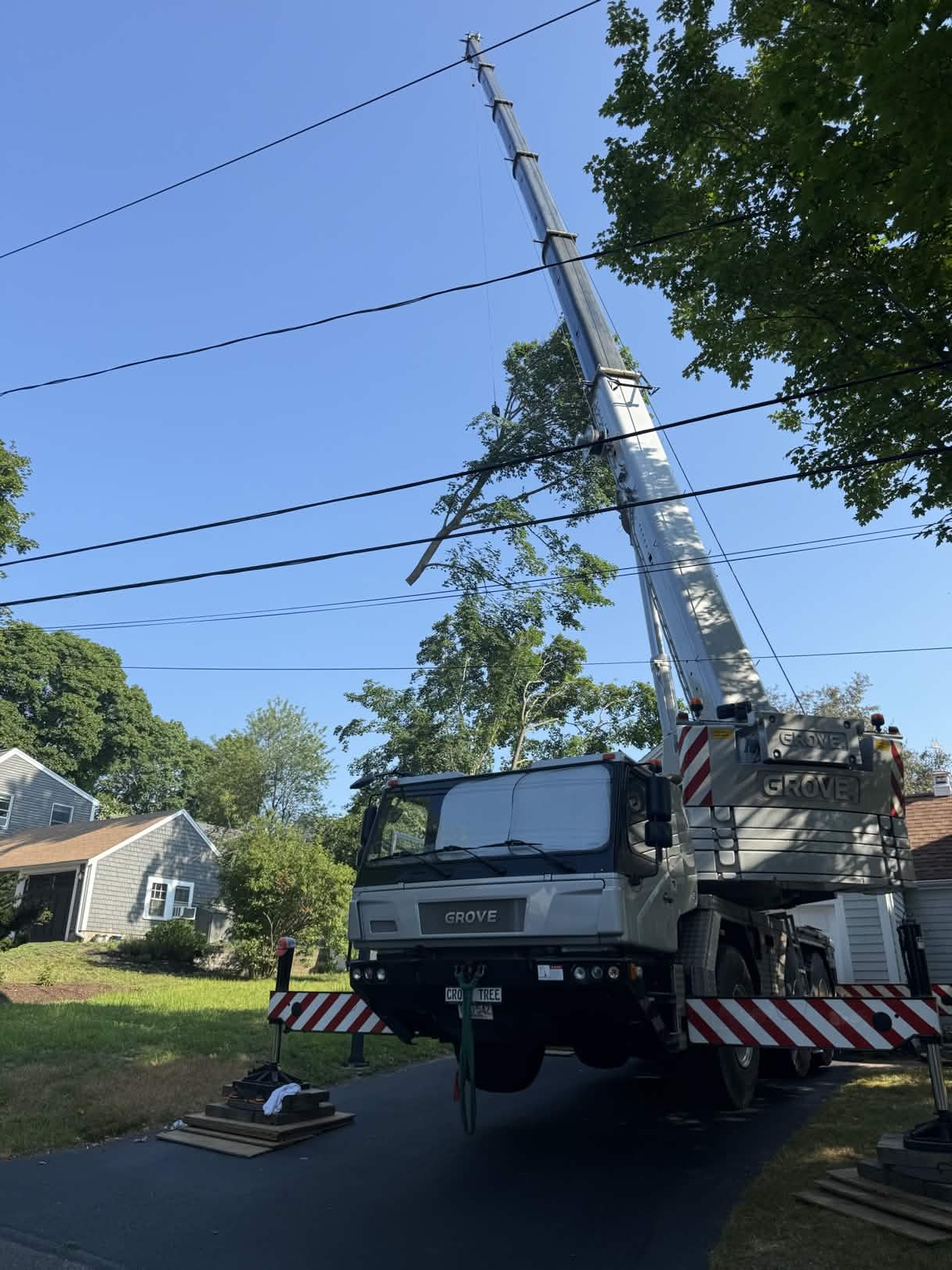
Step 3: Installation Prep (safety first). TCIA protocols include spotters, harnesses, and insulated tools. For Hamlin Street's tight lots, we use bucket trucks with 85-foot reach. Wetland-edge cedars in Cushman Park require Chapter 91 permits; we coordinate with Acushnet Conservation.
Step 4: Air Terminal Placement. Arborists ascend via spikes or rope systems, driving terminals into conductive sapwood above major branches. On eastern hemlocks, we bond to multiple leaders, avoiding phloem damage.
Step 5: Conductor Installation. Pure copper cables (99.9% IACS conductivity) lay in shallow frass-filled grooves, stapled with phosphor bronze fittings. Surge capacity handles 200 kA, surviving multiple strikes. For black birches, we use flexible braids at crotches.
Step 6: Grounding Array. Rods (5/8-inch x 10-foot copper-clad steel) form a radial network, backfilled with bentonite for low-resistance contact in Acushnet soils. We test impedance (<25 ohms) with a ground meter.
Step 7: Testing and Certification. Megohmmeter verifies insulation (>100 megohms); continuity tester confirms <0.1 ohm paths. You receive an ANSI A300 certificate, photos, and maintenance log.
Annual inspections (spring/fall) check corrosion on sugar maples exposed to river mist—tighten fittings, replace oxidized segments. Our South Shore fleet handles Middle Road access, navigating narrow pavement.
Techniques adapt to Acushnet: Drone mapping for Long Plain overstory; low-impact drilling for beeches. Equipment includes 100 kV-rated gloves, fiberglass hot sticks, and exothermic welds for joints. Post-spongy moth oaks get extra conductors over decay pockets.
Practical tip: Maintain 10-foot clearance from power lines; we prune during install. Costs scale with tree size—your 60-foot white pine takes 4 hours. Safety record: zero incidents in 10,000+ hours.
This process protects your Acushnet trees from 95% of strikes, per EPRI data. Call 508-369-5009 to schedule.
Common Lightning Protection Projects in Acushnet Neighborhoods
In Acushnet Center, we install systems on heritage red oaks flanking historic homes, where spongy moth left 20% canopy loss. A recent project protected a 110-foot white oak near the town common, routing conductors past power lines to avert outages.
Long Plain properties feature crowded white pine stands; we thin selectively then protect codominant trees with multi-terminal arrays. One homeowner's 80-foot pine, stressed by rural line exposure, now grounds surges safely, preserving views.
Perry Hill's steep slopes host American beech groves—we use rope access for air terminals, addressing soil erosion risks. A beech near a driveway got full ANSI A300 coverage after a near-miss strike charred adjacent bark.
Hamlin Street Area sees red maple clusters near wetlands; our designs navigate 100-foot buffers, grounding into riverine soils for Atlantic white cedar-adjacent installs. Flood stress on maples demands bentonite-enhanced rods.
Middle Road Area rural lots demand hazard mitigation—eastern hemlocks overhanging roads get crown terminals and down-leads to outbuildings. Post-2023 storm, we protected black birches after partial failures.
Cushman Park Area parkside oaks receive specimen-grade systems; sugar maples here, with wetwood, use braided conductors at forks. A park-edge white oak project complied with town regs, preventing public risks.
Acushnet River corridor cedars get minimalist installs—air terminals only, per conservation rules. Nearby Fairhaven homes mirror these, but Acushnet's density requires integrated pruning.
Each project includes post-install report with surge test data. Your neighborhood's trees benefit from our local expertise. Call 508-369-5009 for yours.
Lightning Protection Costs in Acushnet, MA
Lightning protection costs in Acushnet MA range $2,500-$8,000 per tree, driven by height, species, and site factors. A 50-foot red maple in Acushnet Center costs $2,800 (4 terminals, single down-lead); a 100-foot white oak in Perry Hill hits $6,500 (8 terminals, 4 grounds).
Key factors: Tree size (height x diameter)—white pines over 80 feet add $1,000 for extra cable. Decay from spongy moth in oaks increases labor 20%. Access: Hamlin Street buckets add $500; Long Plain drones save $300.
Materials: Copper (60% of cost)—4/0 AWG runs $15/foot. Ground rods/bentonite for sandy loams: $800. ANSI certification/docs: $200.
Labor: 4-8 hours at $150/hour by ISA arborists. Permits for Middle Road wetlands: $100-300.
Value proposition: Unprotected strike costs $10,000+ in removal/fire (Eversource data). Systems last 20-30 years, ROI via 15% property value retention. Annual checks: $250, catching 80% issues early.
Acushnet-specific savings: Bundle with hazard pruning—$1,000 off for Long Plain thinning. Multi-tree discounts: 15% for Cushman Park pairs.
Comparisons: Fairhaven averages 10% higher due to density; our Plymouth base keeps rates competitive. Financing via tree care loans at 0% intro.
Investing protects your $400,000 home from $50,000 fire claims. Free quotes detail breakdowns. Call 508-369-5009—affordable peace of mind for Acushnet trees.
When to Schedule Lightning Protection in Acushnet
Schedule lightning protection Acushnet MA in late winter (February-March), before bud swell, for minimal sap flow and easy access in Acushnet Center oaks. Avoid summer peaks (June-August), when 70% strikes hit humid storms.
Urgency signs: Vertical bark splits, golf-ball scars, or basal char on red oaks post-storm—schedule within 48 hours to prevent failure. Leader dieback in white pines or forked lightning in beeches signals conductive paths.
Spongy moth oaks in Perry Hill demand spring installs pre-leaf-out. River corridor cedars: Fall (September-October) after floods recede.
Rural Middle Road: Pre-hurricane season (May). Our calendar fills fast—book now for Hamlin Street.
Monitor NOAA alerts; recent strikes (like 2024's 50-kA bolt) underscore timing. Call 508-369-5009 for priority.
Frequently Asked Questions About Lightning Protection in Acushnet
Does lightning protection Acushnet MA really work for oaks weakened by spongy moth? Yes, ANSI A300 systems intercept 90% of strikes on red/white oaks, channeling via copper past decay. We've protected 50+ in Long Plain since 2018—no failures.
How long does installation take on a white pine in Cushman Park? 4-6 hours for 70-footers, including testing. Minimal disruption—your yard usable same day.
Is grounding different for Acushnet's sandy soils? Yes, multiple 10-foot rods with bentonite reduce resistance 50%. Tests ensure <25 ohms.
Can you protect Atlantic white cedar swamps near the river? Absolutely, with buffer-compliant minimalist systems—air terminals and shallow grounds, per conservation rules.
What maintenance is needed for Perry Hill beeches? Annual visual/electrical checks ($250)—inspect corrosion from salt air, tighten every 2 years.
Does insurance cover lightning protection in Acushnet? Often as risk mitigation; add to policy riders. Strikes cost $15k average—prevention pays.
How does it affect tree health in Middle Road hemlocks? No impact—frass-filled grooves heal in 1 season; promotes longevity 20+ years.
Serve nearby like Fairhaven? Yes, full South Shore, including New Bedford, Dartmouth, Rochester.
Lightning Protection Throughout Acushnet
Southeast Arborist provides lightning protection across Acushnet neighborhoods: Acushnet Center heritage oaks, Long Plain pines, Perry Hill beeches, Hamlin Street maples, Middle Road hemlocks, Cushman Park cedars. Extend to Fairhaven, New Bedford, Dartmouth, Rochester.
Our Plymouth/Cohasset base ensures 24-hour response. ISA Certified, ANSI A300 compliant. Protect your trees—call 508-369-5009 today for evaluation.