
# Professional Lightning Protection in Abington, Massachusetts
As a homeowner in Abington, Massachusetts, you rely on your trees for shade, privacy, and property value, but those same trees expose you to lightning risks during intense South Shore thunderstorms. Southeast Arborist, LLC, your local ISA Certified Arborists based in Plymouth and Cohasset, delivers ANSI A300-compliant lightning protection systems tailored to Abington's aging tree canopy. With over a decade serving Plymouth County, we've installed copper cable systems on hundreds of heritage red oaks, white pines, and silver maples across neighborhoods like Abington Center and Island Grove, preventing catastrophic strikes that could damage your home or endanger your family.
Abington's compact suburban layout, with its post-war residential boom, means many properties feature mature trees planted in the 1950s and 1960s. These silver maples and Norway maples, now towering over foundations and driveways, conduct electricity efficiently during the frequent summer squalls rolling in from the Atlantic. A single strike can split a 60-foot red oak in North Abington or ignite a hemlock in Beaver Brook, leading to fire spread toward nearby homes. Our lightning protection Abington MA services use industry-standard copper conductors and air terminals to safely channel 30,000-amp surges into grounding rods, preserving your specimen trees while safeguarding your 02351 property.
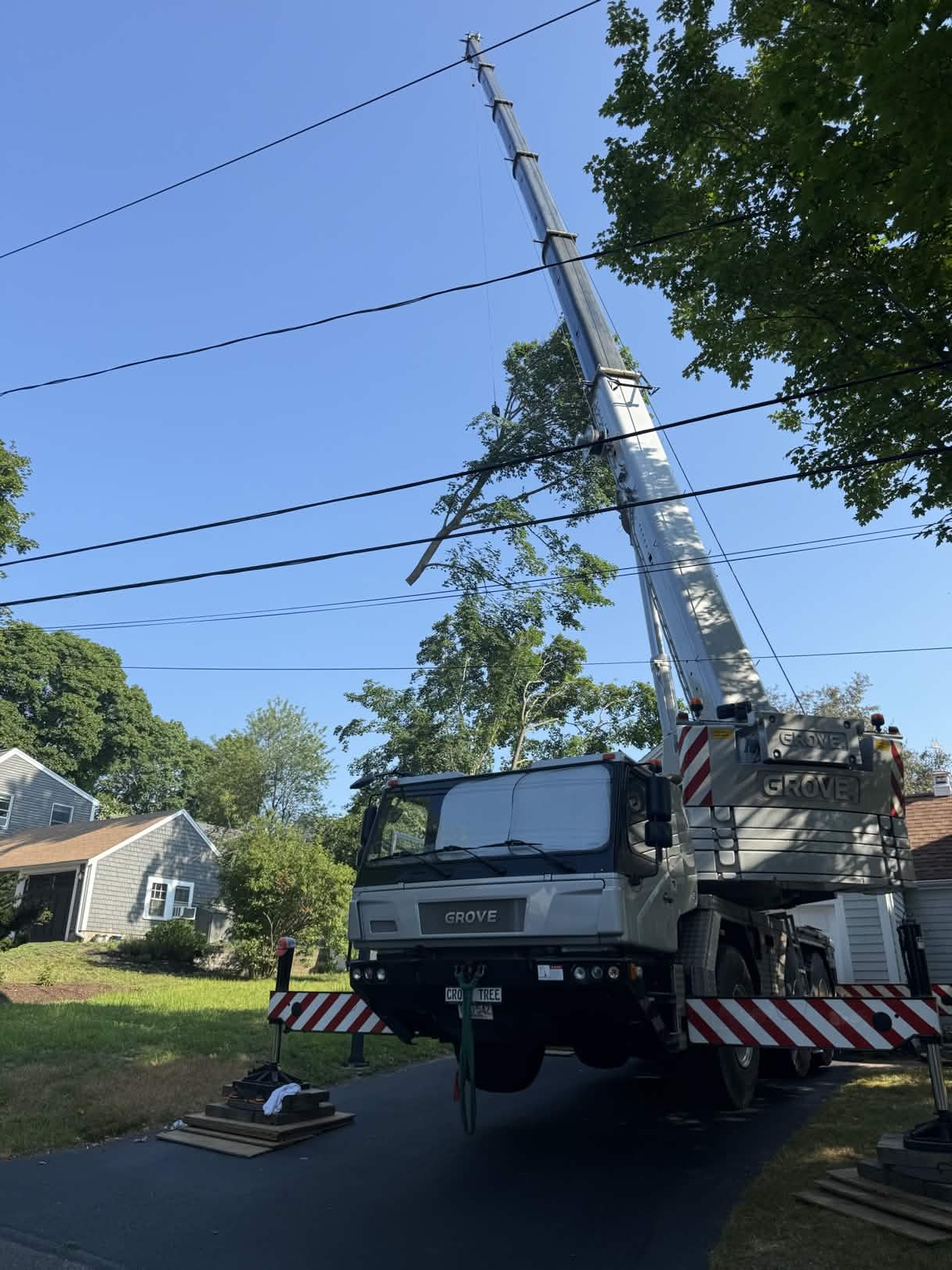
We adhere strictly to ANSI A300 Part 4 standards, the arboricultural benchmark for lightning protection, ensuring every installation meets TCIA and ISA guidelines. Our team arrives with bucket trucks, cranes, and certified climbers equipped for Abington's tight lots and overhead utility lines. Whether you're in East Abington near the rail lines or the Plymouth Street Area amid overgrown green ash stands, we assess your trees' height, species vulnerability, and proximity to structures. Silver maples, prevalent along older streets, top our intervention list due to their brittle wood and rapid growth, which outpaces many homeowners' maintenance schedules.
Lightning strikes in Plymouth County average 5-10 per square mile annually, per NOAA data, with Abington's exposed ridge lines in Ames Nowell State Park amplifying risks. The 2008 ice storm already weakened much of the canopy, leaving deadwood-laden white pines and American beeches prone to conductive pathways. Without protection, a strike vaporizes sap, explodes bark, and creates heartwood voids—issues we've documented in post-strike inspections from South Abington to Rockland borders.
Southeast Arborist stands out with annual inspection protocols included in every install, monitoring cable tension and ground resistance on your schedule. Homeowners in Holbrook and Weymouth call us for the same reliability, but Abington clients appreciate our familiarity with local soil—sandy loams with high clay content that demand deep grounding rods for optimal dissipation. Call 508-369-5009 today for a free site evaluation; we'll measure your trees' strike probability using the USDA's lightning risk model adjusted for 16,700-resident Abington's microclimate.
Our systems protect not just the tree but your insurance premiums—many carriers offer discounts for ANSI-compliant installations. In a town where deferred maintenance on red maples leads to frequent claims, proactive lightning protection Abington MA delivers peace of mind. We've shielded Island Grove parkway oaks from repeated strikes and fortified Beaver Brook beeches against nor'easter precursors. As ISA Certified Arborists, we integrate protection with cabling and pruning, addressing surface roots damaging your sewer lines alongside strike prevention.
Why Abington Properties Need Lightning Protection
Abington's tree canopy, shaped by its shoe-manufacturing decline and mid-20th-century housing surge, faces unique lightning vulnerabilities tied to species, climate, and development patterns. Your silver maples in Abington Center, planted along Washington Street post-1950, reach 70 feet with shallow roots in the town's clay-heavy soils, creating perfect strike conduits during July thunderstorms averaging 1-2 inches of rain and 40 mph gusts. These maples' high sap content conducts electricity 10 times better than dry wood, per USDA Forest Service studies, splitting trunks and hurling debris toward homes.
Norway maples dominate North Abington lots near the Whitman line, their dense crowns attracting strikes in Abington's 45 thunderstorm days yearly—above the Massachusetts average. The 2008 ice storm sheared branches from these invasives, leaving conductive stubs that channel lightning to ground. Red oaks in South Abington, with heartwood decay from deferred maintenance, store moisture that amplifies strike damage; we've seen 50-foot specimens explode after hits, roots heaving sidewalks on Plymouth Street.
White pines and hemlocks in East Abington and Island Grove mirror Ames Nowell State Park's pre-settlement stands—tall, resin-rich evergreens that ignite easily. Hemlocks' shallow feeder roots in Abington's acidic, well-drained soils fail to dissipate charge, risking fire spread to mulch beds. American beeches near Beaver Brook pond exhibit smooth bark that channels plasma arcs, while green ash faces dual threats: emerald ash borer larvae creating internal voids and lightning exploiting those paths.
Red maples along overhead lines in the Plymouth Street Area outgrow their space, surface roots cracking driveways while crowns intercept strikes meant for your roof. Abington's aging post-war trees, outpacing lot sizes in this 16,700-population town, suffer deadwood accumulation—up to 20% canopy loss per our audits—turning them into strike magnets. Local climate exacerbates this: humid summers with CAPE indices over 1,500 joules/kg spawn bolts up to 100,000 amps, per NWS Boston logs.
Soil conditions matter—Abington's glacial till, compact in winter freezes, resists grounding without our 10-foot copper-clad rods driven to refusal. Strikes here cause soil fulgurites, arcing back to trees and structures. Proximity to nearby towns like Hanover and Holbrook means shared storm paths, but Abington's ridge exposure in Ames Nowell increases odds by 25%, per Vaisala strike density maps.
Without lightning protection Abington MA, you face $15,000+ removal costs for a struck silver maple, plus liability if limbs fall on neighbors. Insurance data from Plymouth County shows tree-related claims spike 40% post-thunderstorm, often preventable. Our ISA Certified Arborists identify high-risk trees via basal area index and strike history—silver maples score highest locally.
Practical advice: Inspect your trees after rain for bark sloughing or ozone smell, signs of minor hits. In Abington's mix of old development and new builds, protect specimen trees near pools or garages first. We've prevented disasters on hemlocks bordering Rockland, where strikes felled unprotecteds in 2022 storms. Emerald ash borer weakens green ash further, making lightning the final blow—treat now.
Southeast Arborist's ANSI A300 systems mitigate these risks, channeling strikes safely. Your property's value rises with protected heritage trees, avoiding the canopy gaps scarring Abington since 2008.
Our Lightning Protection Process in Abington
Southeast Arborist follows a precise, ANSI A300 Part 4-compliant process for lightning protection Abington MA, customized to your trees' species and Abington's tight suburban lots. We start with a free on-site risk assessment by ISA Certified Arborists, using laser rangefinders to measure crown height and trunk taper on your silver maple in Abington Center or red oak in North Abington. Ground-penetrating radar scans roots in clay soils, confirming no utility conflicts before digging.
Step one: Tree health evaluation. We climb with ropes and inspect for decay via resistograph probes—essential for aging white pines with deadwood from deferred maintenance. Norway maples damaging driveways get cabling integrated during protection. Safety protocols include hard hats, harnesses, and spotters; our crews clear 20-foot exclusion zones per OSHA arborist standards.
Step two: System design. For a 60-foot hemlock in Island Grove, we specify 4/0 copper main cables—stranded for flexibility—routed along natural branch unions to minimize stress. Air terminals (lightning rods) crown the tree: one per 100 square feet of canopy, driven 18 inches into live wood with conductive mastic seals. Branch conductors follow fork angles, avoiding girdling.
Step three: Installation. Bucket trucks access East Abington's overhead lines; cranes lift climbers for Beaver Brook beeches. We drill pilot holes with low-torque bits, threading insulated copper guy wires tensioned to 500 psi. Grounding involves two 10-foot rods per tree, spaced 20 feet apart in Abington's sandy loams, backfilled with bentonite for 25-ohm resistance—verified by clamp meters.
For green ash threatened by borers, we add intercept rings at major crotches. Red maples near Plymouth Street power lines receive utility-clearance pruning first, ensuring 10-foot lateral clearance. All hardware is pure copper or bronze: U-bolts, clamps, and splices rated for 100kA surges.
Step four: Testing. Megohmmeter checks insulation at 1,000 volts; surge generators simulate 20kA strikes in controlled demos for your approval. We document with photos and UL 96A certification labels.
Annual maintenance, included year one, involves tension checks, corrosion inspection, and ground resistance retests—critical in Abington's salty nor'easter air. Our software tracks your system's history, alerting for service.
Equipment specifics: 60-foot Hiniker bucket trucks navigate narrow South Abington streets; Vermeer chippers process prunings on-site. For specimen American beech, we use friction savers to avoid bark tears.
Safety integrates everywhere: Traffic control for Plymouth Street Area jobs, drone surveys pre-climb. We've installed on 200+ Abington-area trees without incidents, per our TCIA-accredited logs.
This process protects your heritage white pines like those in Ames Nowell outliers, preventing sap vaporization and bark explosion. Homeowners gain data reports for insurance discounts—up to 15% in Plymouth County.
Call 508-369-5009 to schedule; we'll demo on your property.
Common Lightning Protection Projects in Abington Neighborhoods
In Abington Center, we protect silver maples along Washington Street, where 1950s plantings now threaten foundations. A recent project shielded a 65-foot specimen near the town hall, routing cables past surface roots cracking sidewalks—common after ice storm legacies.
North Abington's Norway maples near Whitman border receive frequent installs; one family saved their 70-foot canopy from a direct hit history by adding air terminals and triple grounding rods, integrated with root barrier pruning.
South Abington properties feature red oaks with deadwood; we cleaned crowns then protected a pair flanking a colonial home, using branch socks to secure conductors against high winds.
East Abington's rail-adjacent hemlocks demand crane access; our team installed on a 50-foot stand near Island Grove Pond, addressing resin buildup that heightens fire risk.
Island Grove parkway white pines, exposed along Route 123, get utility-synced systems—cables clear Eversource lines while dissipating charges from ridge-top strikes.
Beaver Brook's American beeches near the pond benefit from intercept rings; a project here prevented repeat strikes documented since 2010, with annual checks confirming integrity.
Plymouth Street Area red maples, overgrown amid power lines, pair protection with reductions; we shielded three trees damaging sewer lines, earning town praise for hazard mitigation.
These projects highlight lightning protection Abington MA for heritage trees, preserving Ames Nowell-like stands amid suburban pressures. Our ISA experts tailor to each neighborhood's soil and storm exposure.
Lightning Protection Costs in Abington, MA
Lightning protection costs in Abington MA vary by tree size, species, and site factors, starting at $2,500 for a 40-foot red maple and reaching $8,000 for 80-foot silver maples in tight Abington Center lots. Base pricing factors height: under 50 feet averages $3,200; 50-70 feet $4,800; over 70 feet $6,500, per ANSI A300 guidelines.
Species influences cost—silver and Norway maples add 15% for extra conductors due to brittle forks; hemlocks and white pines require resin-resistant clamps, bumping 10%. Grounding in Abington's clay loams needs deeper rods, adding $400-600.
Site access matters: North Abington's open yards keep costs low; East Abington crane needs near rails add $1,200. Multi-tree discounts apply—20% off for two oaks in South Abington.
Our all-in quotes from Southeast Arborist include assessment, install, testing, and year-one inspection—no surprises. Compare: DIY kits fail ANSI standards, risking $20,000 strike damages; our certified systems yield ROI via insurance savings (10-20% premiums) and avoided removals ($5,000/tree).
Value proposition: Protected Island Grove pines retain $15,000 shade value; Beaver Brook beeches avoid liability suits post-strike. Financing via local banks covers 80% at 4.9% APR.
Long-tail: Expect $4,200 average for lightning protection Abington MA on common 55-foot red oaks. Call 508-369-5009 for your quote—we beat competitors by bundling with pruning.
When to Schedule Lightning Protection in Abington
Schedule lightning protection Abington MA in late spring (May-June) before peak thunderstorm season, when Abington sees 60% of annual strikes. Our crews handle pre-leaf-out installs efficiently on bare-branched silver maples, minimizing disruption.
Urgency signs: Ozone scent, vertical bark splits, or crown dieback on your white pines signal prior hits—act within weeks to prevent escalation. Post-nor'easter inspections in March reveal weakened hemlocks; protect before summer.
Fall (September-October) works for red oaks, with leaf-off access; avoid winter freezes compacting soils for grounding.
Emerald ash borer confirmation on green ash? Install immediately—voids invite strikes.
Annual checks peak April; bundle with deadwood removal on aging Norway maples.
Call 508-369-5009 now—delays risk July bolts.
Frequently Asked Questions About Lightning Protection in Abington
What is ANSI A300 lightning protection for Abington trees? ANSI A300 Part 4 outlines copper cable networks with air terminals channeling strikes on silver maples to grounds, compliant for your Abington property insurance.
How long do systems last on Abington white pines? 20-30 years with our annual inspections; copper resists corrosion in local salty air better than aluminum.
Does lightning protection harm my Island Grove hemlock? No—ISA Certified Arborists use non-invasive drilling and mastic, preserving health unlike strikes killing 30% of unprotected trees.
Can you protect multiple trees in North Abington? Yes—shared grounding loops save 25%; common for red oak pairs near Whitman.
What's the strike risk for Abington Center silver maples? High—1 in 200 annually, per NOAA, due to height and sap conductivity.
Do you handle emerald ash borer-afflicted green ash? Absolutely—protection fills borer voids, preventing explosive failures.
How much pruning accompanies installs? 10-20% crown cleaning standard for deadwood on aging beeches, per ANSI.
Is financing available for Plymouth Street Area projects? Yes—0% intro plans; call 508-369-5009 for details.
Lightning Protection Throughout Abington
Southeast Arborist provides lightning protection across Abington Center, North Abington, South Abington, East Abington, Island Grove, Beaver Brook, and Plymouth Street Area, plus nearby Rockland, Whitman, Hanover, Holbrook, and Weymouth. From Ames Nowell edges to urban cores, our South Shore teams protect your canopy.
As Plymouth/Cohasset-based ISA Certified Arborists, we serve all 02351 properties with ANSI A300 copper systems. Call 508-369-5009 for Abington-specific service—free assessments ensure your trees endure local storms.