
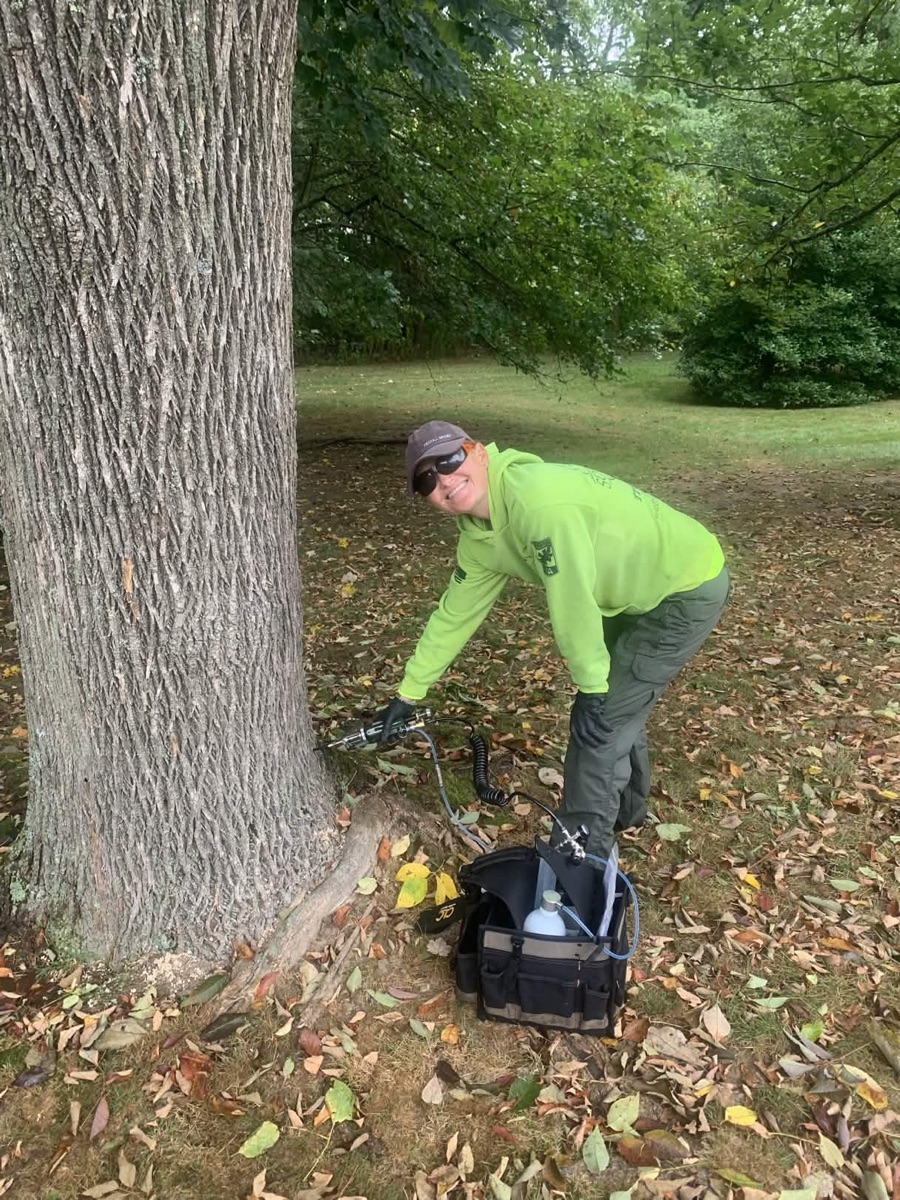
# Professional Arborist Consultation in Rochester, Massachusetts
As a homeowner in Rochester, Massachusetts, your property likely features dense pitch pine stands, red oak groves, or Atlantic white cedar thickets shaped by the town's glacial sandy soils and cranberry bog heritage. These woodlands enhance your landscape but introduce risks like spongy moth defoliation on oaks, wildfire potential in pine barrens, and structural failures from drought stress. An arborist consultation from Southeast Arborist, LLC delivers ISA Certified Arborist assessments tailored to Rochester's unique forest ecology, providing written reports for insurance claims, legal compliance, or pre-purchase decisions.
Southeast Arborist, based in nearby Plymouth and Cohasset, serves the South Shore including Rochester with ANSI A300 standards-compliant evaluations. Our ISA Certified Arborists inspect your trees for health issues, structural defects, and environmental stressors specific to Plymouth County's rural cranberry country. Whether you're in Rochester Center maintaining clearance around your septic system or along Cranberry Highway managing proximity to bogs, we assess risks to your home, driveway, and power lines.
Rochester's 5,800 residents manage properties transitional between coastal pine barrens and inland hardwoods, where pitch pine dominates dry uplands and tupelo thrives in wetlands. Common challenges include wetland regulations restricting work near Snipatuit Pond and storm damage from winter nor'easters. Our consultations identify these issues early, recommending prioritized maintenance like thinning dense white pine clusters to reduce wildfire fuel loads.
You gain a detailed written report outlining tree health, risk ratings, and action plans, essential for municipal permits along rural roads or insurance documentation after spongy moth outbreaks strip scarlet oak canopies. We evaluate construction impacts, such as root damage from new driveways in North Rochester, ensuring your project complies with local hydrology buffers.
Practical benefits include preventing costly removals—pitch pine snags from drought can topple onto homes—and preserving value in Rochester's woodlands, where forest cover boosts property appeal. Our safety protocols prioritize climber-secured inspections and ground-based resistograph sampling to minimize disturbance on sensitive sandy soils.
Schedule your arborist consultation in Rochester, MA today by calling Southeast Arborist at 508-369-5009. Our experts arrive equipped for Rochester's terrain, from Mattapoisett Road's rolling uplands to Dexter Lane's bog edges, delivering actionable insights that protect your investment amid the town's periodic droughts and insect pressures.
Why Rochester Properties Need Arborist Consultation
Rochester, MA's rural landscape in Plymouth County features extensive woodlands interspersed with cranberry bogs and wetlands, creating specific tree care demands for your property. Pitch pine barrens on sandy, acidic glacial soils dominate drier sections like North Rochester, while Atlantic white cedar swamps line Snipatuit Pond areas. These conditions foster resilient but vulnerable forests, where spongy moth larvae ravage red oak and scarlet oak canopies every 10-15 years, defoliating up to 80% of leaves and weakening branches.
Your trees face heightened wildfire risk in pitch pine stands near Rochester Center homes, as dry pine needles accumulate understories, igniting rapidly during summer droughts common in this transitional pine barrens zone. White pine, prevalent along Mattapoisett Road, suffers from white pine weevil attacks at trunk bases, causing girdling that leads to toppling in winds. Red maples in Cranberry Highway areas show iron chlorosis on alkaline pockets amid acidic sands, yellowing leaves and dieback.
Wetland regulations under Massachusetts Wetlands Protection Act limit tree work near bogs and ponds, requiring arborist reports to justify removals for septic clearances or driveway expansions in Dexter Lane neighborhoods. Proximity to cranberry infrastructure demands hydrology-aware assessments—tupelo and sassafras roots stabilize bog dikes, but overgrowth shades reservoirs, impacting yields.
Drought stress exacerbates issues on Rochester's fast-draining sands; black cherry and American holly exhibit wilting and bark splitting, increasing hazard potential along rural roads to Wareham or Middleborough. Storm damage from nor'easters piles Atlantic white cedar debris across power line corridors, necessitating risk evaluations to prevent outages.
An arborist consultation identifies these threats precisely. For instance, our ISA Certified Arborists use visual tree assessments (VTA) to score pitch pine lean angles exceeding 30 degrees as high-risk, common after spongy moth-weakened root plates shift in wet winters. We probe red oak codominant stems for included bark unions, prone to failure under ice loads.
Homeowners in Acushnet-adjacent Rochester overlook subtle signs like sassafras leaf scorch from salt spray off Route 28, mistaking it for drought. Our reports quantify canopy density—over 70% in unthinned woodlands signals wildfire hazards—and recommend species-specific interventions, like phosphite injections for white pine needlecast.
Without consultation, you risk fines for unpermitted wetland tree work or insurance denials post-storm. In Carver-border properties, hazard red maples near driveways go undetected until failure, costing thousands. Southeast Arborist's ANSI A300 evaluations provide defensible data for town boards, ensuring compliance while safeguarding your home.
Rochester's climate—45 inches annual rain unevenly distributed, with July-August deficits—amplifies soil moisture deficits for shallow-rooted scarlet oaks. Practical advice: Monitor for pitch pine pitch masses indicating southern pine beetle entry points, and thin underbrush annually to 10-foot clearance around structures. Call 508-369-5009 for a consultation that turns these challenges into managed assets.
Our Arborist Consultation Process in Rochester
Southeast Arborist's arborist consultation in Rochester, MA follows a structured, ISA Certified process adapted to local woodlands, ensuring thorough risk and health evaluations on your pitch pine, oak, or cedar-dominated property. We begin with a pre-visit site review using Plymouth County GIS maps to note wetland boundaries near Snipatuit Pond or bog buffers along Cranberry Highway.
Step 1: Initial Contact and Scheduling. Call 508-369-5009 to describe your concerns—spongy moth damage on red oaks in Rochester Center or leaning white pines in North Rochester. We schedule within 48 hours, prioritizing hazards like Atlantic white cedar snags post-storm.
Step 2: On-Site Arrival and Safety Setup. Our team, equipped with ANSI Z133 safety gear including climbing saddles and spike-free Arborists, establishes a 20-foot exclusion zone. In Dexter Lane's wet areas, we deploy mud mats to protect sandy soils.
Step 3: Visual Tree Assessment (VTA). ISA Certified Arborists circumnavigate each target tree, scoring defects on a 0-4 scale per ANSI A300. For pitch pines, we check codominant leaders for bark inclusions; scarlet oaks get canopy dieback mapping from spongy moth.
Step 4: Advanced Diagnostics. Resistographs probe wood density in red maples without coring, revealing decay in 85% accuracy. Sonic tomography maps internal rot in tupelo trunks near wetlands. Drones survey dense Mattapoisett Road canopies, identifying 30+ degree leans unsafe for ground access.
Step 5: Soil and Root Zone Evaluation. In Rochester's acidic sands (pH 4.5-5.5), we sample for compaction near septic systems, using penetrometers to measure resistance. Air spading exposes American holly roots without damage, assessing construction impacts.
Step 6: Risk Rating and Prioritization. Trees receive Target/Zone of Influence ratings—high risk if failure probability exceeds 40% within 5 years. Black cherry hazards near driveways score based on wind throw vectors toward structures.
Step 7: Written Report Delivery. Within 72 hours, you receive a PDF report with photos, diagrams, and ANSI A300 recommendations: prune scarlet oaks to reduce wind sail or thin pitch pine to 40% canopy gap. Legal sections cover wetland compliance for Snipatuit Pond properties.
Step 8: Follow-Up Consultation. We review findings via phone, advising on DIY monitoring like weekly pitch pine needle drop checks for drought stress.
Techniques suit Rochester's terrain: low-impact climbing for sassafras in bog edges avoids hydrology disruption. Equipment includes LiDAR handhelds for precise trunk volume calcs and moisture meters for white pine needle retention.
Our process minimizes ecosystem impact—zero chemicals, native soil backfill—while maximizing data utility for insurance or pre-purchase in Carver-adjacent homes. Homeowners gain tools like annual inspection checklists tailored to spongy moth cycles.
This rigorous approach, backed by ISA certification, ensures your Rochester property's trees remain safe assets amid pine barrens fire risks and wetland constraints.
Common Arborist Consultation Projects in Rochester Neighborhoods
In Rochester Center, consultations focus on hazard tree assessments for pitch pine clusters encroaching on historic homes and septic fields. Homeowners request evaluations after spotting leaners post-winter storms, with our ISA Arborists recommending directional felling to maintain clearances.
North Rochester properties along wooded lots near Middleborough see woodland thinning projects. Dense white pine and red oak stands heighten wildfire risk; consultations map fuel ladders, prioritizing 15-20 foot gaps around driveways per Massachusetts Fire Marshal guidelines.
Mattapoisett Road Area homes contend with scarlet oak defoliation from spongy moth. Our assessments quantify branch dieback over 25%, suggesting systemic insecticides or pruning to restore canopy health without wetland incursions toward Acushnet.
Snipatuit Pond Area demands pre-construction consultations for docks or paths. Atlantic white cedar and tupelo buffer zones require hydrology reports; we verify 25-foot no-disturb buffers, advising root pruning limits to comply with conservation commission rules.
Dexter Lane Area cranberry bog neighbors seek infrastructure clearance. Sassafras and American holly overgrowth shades reservoirs; consultations balance shade reduction with dike stability, recommending selective thinning to preserve hydrology.
Cranberry Highway Area properties face road-edge hazards. Black cherry and red maple lean toward Route 28; risk evals prioritize removals for sight lines, with reports supporting town highway department permits.
Storm response dominates post-nor'easter, like 2023's ice storm snapping pitch pines across Wareham Road. Consultations triage snags, rating red maples for root plate exposure on sandy slopes.
Pre-purchase inspections in Rochester reveal hidden issues: sonic tests uncover decay in 30-year-old white pines near new builds. Construction impact assessments for North Rochester additions evaluate compaction on oak roots, prescribing mulching zones.
Municipal projects along power corridors to Carver involve mass risk surveys of 50+ pitch pines, generating GIS-layered reports for utility pruning bids.
Each project delivers neighborhood-specific advice: In Snipatuit, monitor tupelo suckers quarterly; Dexter Lane, test bog-edge soil pH annually. Southeast Arborist's consultations turn these into proactive plans, protecting your Rochester home.
Arborist Consultation Costs in Rochester, MA
Arborist consultation costs in Rochester, MA from Southeast Arborist start at $350 for a single-tree hazard evaluation, scaling to $1,200+ for full-property woodland assessments covering 20+ trees across neighborhoods like Rochester Center or Snipatuit Pond. Pricing reflects travel from our Plymouth/Cohasset base (under 20 minutes to most sites), tree count, and diagnostic depth.
Base factors: Hourly rate of $150-175 per ISA Certified Arborist, with 2-hour minimums for Rochester Center quick checks on pitch pine leans. Add $100 for drone surveys in dense North Rochester canopies or $200 for resistograph probing red oaks post-spongy moth.
Property size drives variance—half-acre Mattapoisett Road lots with 10 white pines run $500-700; 5-acre Cranberry Highway parcels near bogs hit $1,000+ due to wetland mapping. Pre-purchase full audits, including soil probes for Dexter Lane sands, add $250 for GIS integration.
Written reports incur no extra; comprehensive 20-page documents with photos, risk matrices, and ANSI A300 plans justify costs through insurance savings—averting a $10,000 red maple removal pays for 20 consultations.
Value proposition: In Rochester's pine barrens, early detection prevents $5,000 wildfire mitigation fines. Wetland-compliant reports for Snipatuit Pond save permit delays valued at $2,000 in contractor downtime. Compared to unlicensed "tree guys" at $200 skim jobs, our ISA certification ensures court-admissible data, as in recent Carver town disputes.
Seasonal discounts: 10% off November-March for storm-damaged scarlet oaks, offsetting higher demand. Multi-service bundles—consult plus pruning—reduce per-hour rates 20%.
Practical budgeting: Expect $0.50-$1.50 per tree diameter inch; a 24-inch pitch pine equals $25 base. Homeowners recoup via 5-10% property value lift from documented healthy woodlands.
Factors lowering costs: Group neighborhoods like North Rochester with neighbors for shared $450/site visits. DIY prep—clearing underbrush—shaves 30 minutes.
ROI shines in drought-prone Rochester: One consultation identifies sassafras irrigation needs, avoiding $3,000 replacement. Call 508-369-5009 for a no-obligation quote tailored to your black cherry hazards or Atlantic white cedar buffers.
When to Schedule Arborist Consultation in Rochester
Schedule your arborist consultation in Rochester, MA in early spring (March-May) to assess winter storm damage on pitch pines before leaf-out hides cracks, or late fall (October-November) for spongy moth egg mass surveys on scarlet oaks.
Urgency signs demand immediate calls to 508-369-5009: Leaning trunks over 15 degrees in white pines near Rochester Center driveways, vertical cracks in red maple bark along Cranberry Highway, or soil heaving at tupelo bases in Snipatuit Pond wetlands signaling root failure.
Post-nor'easter, within 72 hours—ice-loaded Atlantic white cedar snags in North Rochester pose impale risks. Drought summers (June-August) trigger checks for sassafras wilting or American holly scorch on sandy Dexter Lane soils.
Pre-construction: 4-6 weeks before Mattapoisett Road additions to evaluate oak root zones. Pre-purchase: During home inspections for Wareham-border properties hiding black cherry decay.
Annual timing for ongoing care: July for pitch pine beetle pitch tubes amid dry spells. Avoid peak summer heat for climber safety.
Seasonal advice: Winter bare-stem views reveal codominant stems in red oaks; spring bud swell detects stress early. Delaying risks fines—unpermitted wetland removals near bogs cost $1,000+.
Our ISA Arborists fit Rochester's rhythm, prioritizing hazards while slotting routine evals efficiently.
Frequently Asked Questions About Arborist Consultation in Rochester
What does an arborist consultation in Rochester, MA involve? It includes ISA Certified on-site inspections of your pitch pine, red oak, or Atlantic white cedar trees, using VTA and diagnostics like resistographs for decay. You receive a written report with risk ratings, health diagnoses, and ANSI A300 recommendations tailored to Rochester's sandy soils and wetland rules.
How much does an arborist consultation cost in Rochester? Costs range $350-$1,200 based on tree count and complexity—$500 average for 10-tree North Rochester lots. Factors include drone use for Snipatuit Pond canopies or wetland mapping near Cranberry Highway bogs.
Do I need an arborist report for tree work in Rochester wetlands? Yes, for buffers over 25 feet near Snipatuit Pond or Dexter Lane bogs, conservation commission requires professional assessments to verify no hydrology impact on tupelo or cedar stands.
When should I call for an arborist consultation after a storm in Rochester? Immediately if white pines lean toward structures in Rochester Center or scarlet oaks show split crotches. Our team prioritizes post-nor'easter response for safe triage.
Can Southeast Arborist provide pre-purchase arborist consultations in Rochester? Absolutely—we inspect for spongy moth-weakened red maples or pitch pine wildfire risks in Mattapoisett Road properties, delivering reports for negotiations.
How do spongy moths affect Rochester trees, and what does consultation reveal? They defoliate oaks every decade; consultations map 25%+ canopy loss, recommending pruning or BTK sprays safe for cranberry bog proximity.
Is arborist consultation required for insurance claims in Rochester, MA? Often yes—written reports from ISA Certified experts substantiate claims for storm-felled black cherry, preventing denials common in rural Plymouth County.
What safety standards does Southeast Arborist follow in Rochester? ANSI Z133.1 for climbing and rigging, with site-specific protocols like mud mats for wet Dexter Lane soils and exclusion zones near power lines.
Arborist Consultation Throughout Rochester
Southeast Arborist provides arborist consultations across all Rochester neighborhoods: Rochester Center hazard checks, North Rochester thinning plans, Mattapoisett Road oak health evals, Snipatuit Pond wetland reports, Dexter Lane bog clearances, and Cranberry Highway road-edge risks.
We extend to nearby Wareham, Middleborough, Acushnet, and Carver, covering South Shore Massachusetts from our Plymouth/Cohasset base.
Your trees deserve expert care—call ISA Certified Southeast Arborist, LLC at 508-369-5009 today for a Rochester-specific consultation.