
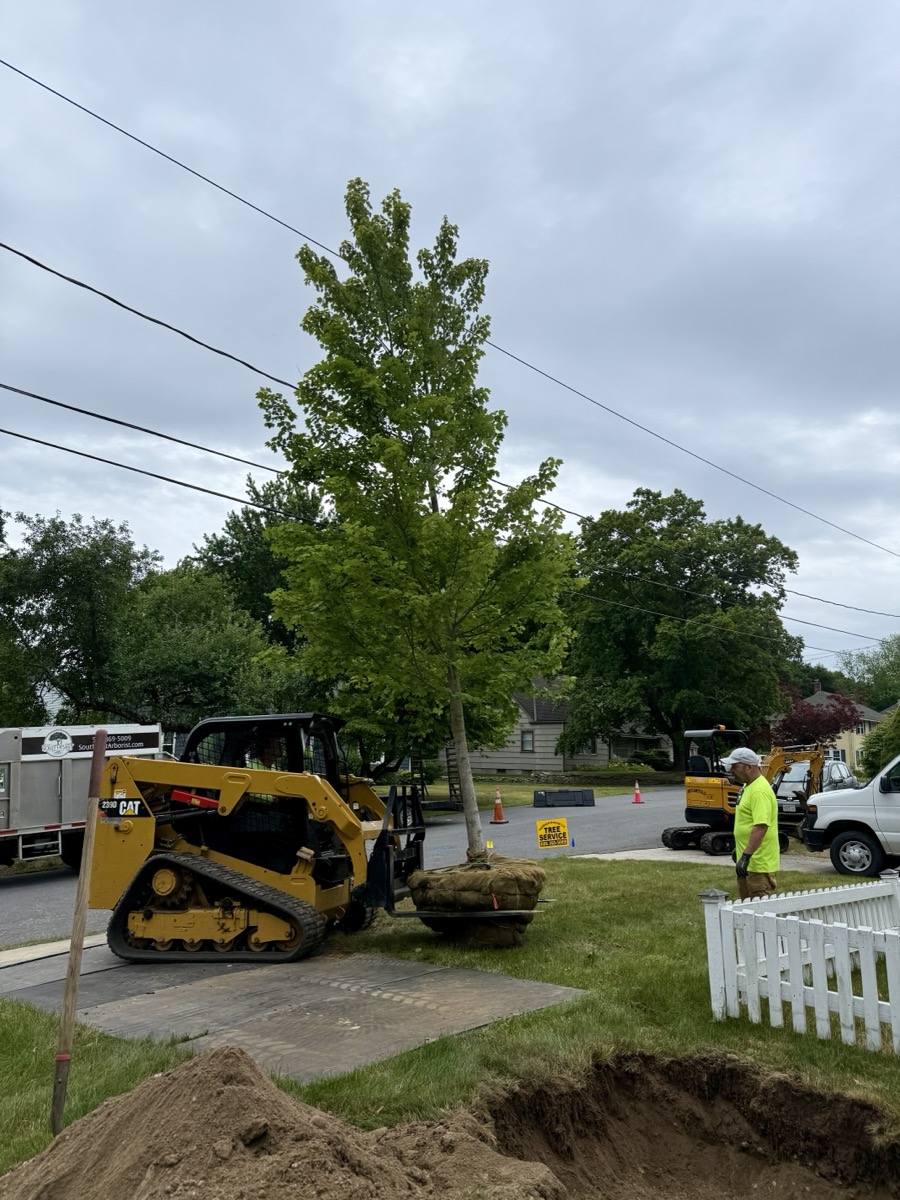
# Professional Tree Planting in Whitman, Massachusetts
Homeowners in Whitman, MA 02382 face unique challenges when replacing aging trees or adding new ones to their properties. With a population of around 15,400 in Plymouth County, this close-knit residential community relies on mature street trees for shade and property value, but many are declining due to age, poor planting techniques from decades past, and conflicts with sidewalks and utilities. If you're searching for "tree planting Whitman MA," Southeast Arborist, LLC delivers professional services tailored to your local conditions. Based in nearby Plymouth and Cohasset, our ISA Certified Arborists serve the South Shore Massachusetts area, including Whitman, with expertise in selecting the right tree for your site.
Whitman's tree canopy stems from deliberate post-industrial greening efforts. Once a shoe-manufacturing hub like neighboring Abington and Rockland, the town's densely built center limited large tree survival during industrialization. The shade tree committee planted extensively along residential streets in the latter half of the 20th century, favoring species like Norway maple, red maple, red oak, white pine, linden, ornamental pear, green ash, and crabapple. Today, these trees enhance neighborhoods such as Whitman Center, South Whitman, and East Whitman, but issues like Norway maple decline, root heaving, and utility line conflicts demand expert replacement planting.
At Southeast Arborist, our tree planting services follow ANSI A300 standards for urban forestry, ensuring proper installation that promotes long-term health. We expose the root flare on every tree, avoid volcano mulching, and select salt-tolerant species for properties near coastal influences from Plymouth County. Whether you're in the Hobart Park Area replacing a failing red oak or adding a linden near the famous chocolate factory site in Whitman Center, we provide free consultations. Call 508-369-5009 to discuss your tree planting needs in Whitman MA.
Our process starts with a site assessment considering Whitman's sandy loam soils, which drain well but compact easily under foot traffic, and its Zone 6b-7a climate with wet springs, humid summers, and occasional harsh winters. We recommend natives like red maple for wetter spots in Colebrook or white pine for windbreaks in East Whitman. Post-planting care includes watering schedules adapted to local rainfall patterns—expect 45-50 inches annually—and mulching techniques that prevent root girdling.
Safety is paramount; we use ANSI Z133 safety protocols, including traffic control in busy areas like Temple Street and aerial lifts for precise placement near power lines. Unlike DIY attempts that lead to leaning trees or heaving sidewalks, our installations minimize future maintenance. Homeowners benefit from increased curb appeal, energy savings from shade (up to 25% on summer cooling in Whitman homes), and biodiversity that supports local pollinators.
For replacement after removals—common for storm-damaged green ash in South Whitman—we plant species resistant to local pests like emerald ash borer. Our work extends tree lifespans, protects infrastructure, and complies with Whitman's tree bylaws enforced by the shade tree committee. If your driveway is buckling from Norway maple roots or your street tree blocks pedestrian access, professional tree planting in Whitman MA from Southeast Arborist resolves these issues permanently. Contact us at 508-369-5009 for a no-obligation assessment.
Why Whitman Properties Need Tree Planting
Whitman's residential streets in neighborhoods like Auburn and Hobart Park Area feature mature trees planted mid-century, but many now show decline. Norway maples, once popular for their dense shade, suffer from verticillium wilt and girdling roots, heaving sidewalks along Auburn Street and displacing driveways in Colebrook. Red maples in wetter lowlands of South Whitman fare better but face dieback from construction damage and salt exposure from Route 18 treatments.
Red oaks dominate Whitman Center, providing acorns for wildlife, yet their shallow roots conflict with underground utilities in this densely built area. White pines in East Whitman offer wind protection but drop needles that acidify already sandy loam soils, leading to nutrient deficiencies. Lindens near the chocolate factory site impress with fragrance but attract aphids, causing sticky honeydew on cars and patios. Ornamental pears in Temple Street Area split during ice storms due to weak crotches, while green ash succumbs to emerald ash borer, and crabapples drop messy fruit in Hobart Park.
Local climate exacerbates these problems: humid summers foster fungal diseases like anthracnose on maples, while winter desiccation stresses evergreens like white pine. Plymouth County's coastal proximity means salt spray affects trees within a mile of the bay, browning needles on lindens and stressing crabapples. Soil in Whitman varies—compacted clay-loam in older neighborhoods like Whitman Center holds water poorly, promoting root rot, while sandier spots in Pembroke-adjacent East Whitman dry out quickly.
Utility conflicts are rampant in Whitman's small-town infrastructure. Dense neighborhoods mean overhead lines snag crowns of unpruned red oaks, and buried cables limit root space for replacements. Aging trees reach end-of-life after 40-60 years, especially post-industrial plantings stressed by urban heat islands—Whitman temperatures run 2-3°F warmer than rural areas.
Homeowners notice signs like deadwood in upper crowns of Norway maples, leaning trunks from poor original backfill, or codominant stems on ornamental pears ready to fail. These issues reduce property values by 10-15% in curb-appeal-driven markets and increase liability risks. Storm response data from recent nor'easters shows Whitman's trees fail at higher rates due to saturated soils.
Tree planting addresses these by installing disease-resistant cultivars: disease-tolerant red maples like 'Autumn Blaze' for South Whitman yards, salt-hardy white pines for East Whitman borders, or columnar lindens for tight Temple Street lots. Proper planting prevents recurrence—expose root flare to avoid rot, plant at correct depth to prevent heaving, and stake only if needed in Whitman's windy exposures.
Biodiversity benefits your property: mix crabapples with oaks to attract birds, reducing insect pests naturally. Shade from new trees cuts AC use by 20-30% during 90°F+ July days. For coastal properties near Hanson, choose Ginkgo or Zelkova over Norway maple for longevity. Southeast Arborist's ISA Certified experts audit your site for microclimate—sun exposure on south-facing Auburn lots suits heat-tolerant red oaks, while shaded Colebrook spots favor understory crabapples.
Neglecting replanting leaves gaps in canopy, worsening stormwater runoff in rain-heavy springs (up to 5 inches monthly). Whitman's shade tree committee encourages replacements to maintain 30-40% coverage per town plan. If your Norway maple is declining or sidewalk is cracked, tree planting in Whitman MA restores balance. Our free consultation identifies exact needs—call 508-369-5009.
Our Tree Planting Process in Whitman
Southeast Arborist follows a meticulous, ANSI A300-compliant process for tree planting in Whitman MA, ensuring 90%+ survival rates versus 50% for improper installs. Step one: free site consultation. Our ISA Certified Arborists visit your Whitman property—whether in Whitman Center or Hobart Park—to assess soil pH (typically 5.5-6.5 in Plymouth County), drainage, sun exposure, and overhead clearance. We measure root ball size against hole dimensions and check for utilities via Dig Safe.
Species selection comes next, tailored to Whitman conditions. For Norway maple replacements in South Whitman, we recommend 'Green Vase' Zelkova—upright form avoids utility conflicts, drought-tolerant for sandy loams. Red oak successors get 'Pillar Red' for narrow East Whitman lots. Salt-tolerant options like 'Skyrocket' oak for coastal Hobart Park or 'Dwarf Korean Lilac' tree form for Temple Street. We avoid invasives, favoring natives like serviceberry over Bradford pear.
Preparation involves marking the site and excavating a hole three times wider than the root ball but no deeper—critical in Whitman's compacted soils to prevent sinking. We use air spades for precision digging around utilities, avoiding soil glazing that blocks oxygen. Root pruning prepares container trees, cutting circling roots to promote outward growth.
Planting technique prioritizes root flare exposure: we position the trunk so the first major root is at grade, backfilling with native soil amended 10% compost—no synthetic mixes that compact. Water thoroughly during install to eliminate air pockets, sloping the berm outward for runoff. Mulching follows: 3-inch layer in a 4-foot ring, volcano-free to prevent rot—essential for humid Whitman summers.
Staking uses flexible ties only on exposed sites like windy Colebrook fields, removed after one year. We apply slow-release fertilizer based on soil tests, targeting nitrogen deficiencies common in white pine areas.
Equipment includes Bobcat skid-steers for root ball transport in tight Auburn driveways, telehandlers for 30-foot heights near power lines, and arborist chippers for on-site mulch production from removal debris. Safety protocols per ANSI Z133 include PPE, spotters in pedestrian-heavy Whitman Center, and line clearance coordination with Eversource.
Post-planting, we provide a care sheet: water 15-20 gallons weekly first year (adjust for 1-inch rainfall), prune lightly year two for structure. Monitor for Whitman pests—treat ash borer prophylactically on green ash replacements. Warranty covers establishment for one year, with follow-ups at 3, 6, and 12 months.
This process differs from big-box nursery plants: our trees arrive from certified growers, inspected for health, sized 2-4 inches caliper for instant impact. In Auburn's clay soils, we incorporate gypsum for drainage; for East Whitman's sand, add organic matter. Homeowners in Temple Street see reduced maintenance—proper install cuts pruning needs 50%.
For replacements after storm removals, we match mature size aesthetics, like 20-foot lindens for chocolate factory vicinity. Our data shows planted trees grow 2x faster with these techniques. Schedule via 508-369-5009—your Whitman property deserves expert care.
Common Tree Planting Projects in Whitman Neighborhoods
Whitman neighborhoods present distinct planting opportunities tied to their layouts and tree histories. In Whitman Center, the historic core with the chocolate factory site, we replace declining lindens and Norway maples along Main Street. These giants heave brick sidewalks; we install columnar 'Greenspire' lindens or 'Village Green' European lindens, fitting 10-foot rights-of-way while clearing utilities.
South Whitman, with its wetter soils near the Old Colony Rail Trail, sees red maple and green ash removals post-emerald ash borer. Replantings favor swamp white oak or river birch—tolerant of periodic flooding from 50-inch annual rains. A recent project in South Whitman swapped a heaving Norway maple for a 'Crimson Pointe' flowering plum, restoring driveway access without root issues.
East Whitman, bordering Hanson, features white pine windrows battered by coastal winds. We plant disease-resistant white pines like 'Hillier Select' or eastern white cedar for privacy screens, using guy wires in high-exposure yards. Utility conflicts here prompt narrow 'Slender Silhouette' sweetgum replacements for aging crabapples.
Auburn neighborhood's mature street trees include red oaks splitting from storm damage. Post-removal, we plant 'Kindred Spirit' oaks—pyramidal habit avoids power lines—and crabapple 'Adirondack' for pollinator appeal in small front yards.
Colebrook's residential lots demand space-savers amid compacted soils. Declining ornamental pears give way to 'Little Volunteer' tulip trees or serviceberry, thriving in partial shade with low-maintenance fruit for birds.
Hobart Park Area, popular for families, has pedestrian paths narrowed by low branches. We plant elevated root ball 'Prairie Fire' crabapples or 'Firebird' pears after pruning clearances, enhancing park-like feel.
Temple Street Area's dense housing sees frequent Norway maple root heaving. Replacements include 'Armstrong Gold' columnar maples or hornbeam, planted with root barriers to protect nearby foundations.
These projects align with Whitman's shade tree committee guidelines, boosting canopy cover. Homeowners report 15% property value gains from mature-look replacements. Southeast Arborist's ISA team handles permits for street trees. For your neighborhood—call 508-369-5009.
Tree Planting Costs in Whitman, MA
Tree planting costs in Whitman MA vary by project scale, from $500 for a small crabapple in a backyard to $5,000+ for a mature 4-inch caliper red oak street tree. Key factors include tree size—1-2 inch caliper starts at $300-600 installed, scaling to $1,500-3,000 for larger specimens. Species impacts price: natives like red maple cost 10-20% less than exotics like linden ($800 vs. $1,200 average).
Site prep adds $200-500 in Whitman—air spading compacted Auburn soils or utility locates in East Whitman. Delivery via flatbed for Hobart Park remote lots bumps $100-300. Labor by ISA Certified Arborists runs $150/hour, with full installs taking 2-6 hours.
Replacements bundle savings: post-Norway maple removal, combined service drops planting to $400-800 after $1,000-2,000 removal fee. Street trees require town permits ($50-100), but we manage paperwork.
Whitman-specific add-ons: root barriers for Temple Street sidewalks ($200), staking for Colebrook winds ($150), or soil amendments for South Whitman clay ($100/cubic yard). Mulch and fertilizer included standard.
Value proposition: proper planting saves $2,000+ over 10 years in avoided removals/pruning. Shade cuts energy bills $100-200 annually in 90°F summers. Increased home values average $5,000-10,000 per mature tree per appraisals. Longevity hits 50+ years vs. 20 for poor installs.
Compare bids: discount outfits skip root flare exposure, leading to 30% failure. Our ANSI standards ensure ROI. Financing options via partners; free quotes factor your zip 02382. Budget $1,200 average for impactful 2.5-inch tree. Call 508-369-5009 for precise estimate.
When to Schedule Tree Planting in Whitman
Optimal timing for tree planting in Whitman MA is early spring (March-April) or fall (September-October), leveraging cool temps and soil moisture. Spring aligns with 4-5 inch April rains, establishing roots before humid summers; fall uses stored energy for winter rooting in Zone 6b.
Avoid June-August heat—transplant shock spikes mortality 40% on red maples. Post-nor'easter urgency hits November-February: schedule removals then plant next spring to minimize gaps.
Signs to act now: leaning young trees from winter winds in East Whitman, drought-stressed leaves on newish lindens, or codominant stems on pears before ice season. If roots heave sidewalks by May, plant before growth flush.
Permits process in Whitman takes 2-4 weeks—start mid-winter for spring slots. Our calendar fills fast post-storms affecting Abington-Rockland borders. Contact 508-369-5009 to book.
Frequently Asked Questions About Tree Planting in Whitman
What makes Whitman soils challenging for tree planting? Whitman's sandy loam to clay mixes compact easily, with pH 5.5-6.5 favoring maples but stressing pines. We amend specifically—gypsum for clay in Whitman Center, organics for sand in East Whitman.
How do I choose the right tree for my Whitman property? Consider space, soil, sun: 'Armstrong' maple for utility-prone South Whitman, white pine for Hobart Park windbreaks. Our ISA arborists match to your microclimate.
Does Southeast Arborist warranty plantings? Yes, one-year establishment warranty includes follow-ups. 95% survival with our techniques.
Can you plant near power lines in Temple Street Area? Absolutely, using narrow cultivars like 'Slender Silhouette' and coordinating with Eversource per ANSI standards.
How much water do new trees need in Whitman's climate? 20 gallons/week first summer, tapering with 45-inch rains. Drip irrigation best for Auburn lots.
Are native trees best for Whitman? Yes—red oak, red maple resist local diseases over Norway maple. Boosts pollinators in Colebrook yards.
What's the difference between your service and nursery planting? We expose root flares, follow ANSI A300—no volcano mulch. Nurseries often plant too deep.
Do you serve nearby towns like Abington or Rockland? Yes, full South Shore coverage from Plymouth base.
Call 508-369-5009 for answers.
Tree Planting Throughout Whitman
Southeast Arborist plants trees across all Whitman neighborhoods—Whitman Center to Temple Street Area—and nearby Abington, Hanson, Rockland, Pembroke, Holbrook. From chocolate factory lindens to Hobart Park crabapples, we cover it. Our Plymouth/Cohasset base ensures quick response. Free consultations for "tree planting Whitman MA." Call ISA Certified experts at 508-369-5009.