
# Professional Tree Planting in Walpole, Massachusetts
If you're a homeowner in Walpole, MA 02032, maintaining the balance between your property's landscape and Norfolk County's natural heritage starts with expert tree planting. Southeast Arborist, LLC, your South Shore Massachusetts tree care specialists based in Plymouth and Cohasset, delivers professional tree planting services tailored to Walpole's unique environment. Our ISA Certified Arborists ensure every project follows the "right tree, right place, right technique" principle, selecting species that thrive in your local soil and climate while adhering to ANSI A300 standards for long-term health.
Walpole's history as a 1659 settlement turned 19th-century paper mill hub shapes its tree needs today. The Neponset River corridor features towering sycamores and silver maples, some of the largest in the county, while Francis William Bird Park preserves Olmsted-era plantings of red oaks, white oaks, and American beeches from its 1925 design. Yet challenges like emerald ash borer ravaging green ash trees, floodplain instability along the river, and construction pressure in growing neighborhoods demand precise replanting strategies. Whether you're replacing a storm-damaged silver maple in Neponset Valley or adding a salt-tolerant white pine near East Walpole's historic mills, our team handles it with safety protocols including bucket trucks, cranes, and PPE-compliant rigging.
Tree planting in Walpole MA goes beyond digging a hole—it's about site-specific selection to combat local issues. Our free consultations at 508-369-5009 assess your soil's typical Norfolk County clay-loam mix, pH around 6.0-6.5, and USDA Zone 6b winters that dip to -5°F. We avoid common pitfalls like volcano mulching, which suffocates roots, and always expose the root flare for proper establishment. Homeowners in Walpole Center or Plimptonville benefit from our post-planting care plans, including watering schedules and mulch rings that reduce competition from lawn grasses.
Southeast Arborist's commitment to Walpole extends to replacement planting after removals. With emerald ash borer decimating green ashes across Fisher Street Area and Common Street Area, we recommend resilient alternatives like sugar maples or tulip trees that match the canopy height without floodplain risks. Our coastal proximity influences choices too—salt-tolerant dawn redwoods perform well on properties near South Walpole's edges. Safety is paramount; we use ANSI-rated gear and conduct hazard assessments before any digging, protecting your home and underground utilities.
Investing in professional tree planting Walpole MA yields immediate and lasting value. A mature red oak can boost property value by 10-20% through shade and curb appeal, while proper installation prevents future costs from leaning trees or root damage. Call Southeast Arborist today at 508-369-5009 for your free consultation—we serve all Walpole ZIP 02032 from our South Shore base, ensuring your landscape endures the town's blend of historic conservation and modern growth.
Why Walpole Properties Need Tree Planting
Walpole's 26,000 residents face distinct pressures on their trees, making tree planting Walpole MA an essential service for property resilience. The town's river corridors along the Neponset preserve riparian forests with massive sycamores reaching 80 feet and silver maples prone to storm snapping in Zone 6b winds up to 50 mph. Floodplain instability here demands replacements with deeper-rooted white oaks or red oaks, which anchor better in the sandy-loam deposits common post-flood.
Emerald ash borer has wiped out over 70% of Walpole's green ash population since 2012, leaving voids in neighborhoods like Stone Street Area and South Walpole. Without prompt replanting, these gaps invite invasive species and erode soil stability on sloped lots. Our ISA Certified Arborists recommend sugar maples for their urban tolerance and fall color, matching the height of lost ashes while resisting borers entirely.
Construction growth exacerbates tree loss. Walpole's residential expansion clears wooded parcels in Plimptonville and Fisher Street Area, where developers remove mature white pines for new homes. Replanting with clustered tulip trees restores screening and wildlife habitat, complying with local conservation bylaws that protect Norfolk County's 20% forested cover. Bird Park's Olmsted plantings highlight preservation needs—American beeches there require companion dawn redwoods to fill gaps from age or disease, maintaining the 1925 landscape design.
Local climate adds urgency. Walpole's average 45-inch annual rainfall leaches nutrients from clay-loam soils, pH 6.2 typical, causing iron chlorosis in silver maples. Plant salt-tolerant species like white pine near roads treated with de-icers in winter, as coastal South Shore winds carry salt spray inland. Flooding from Neponset River events, like the 2010 nor'easter, uproots shallow-rooted sycamores—replacements must use amended backfill with 30% organic matter for root penetration.
Homeowners in East Walpole, near historic Bird & Son mills, deal with legacy pollution in soils, favoring non-absorbent species like red oak over beeches. In Walpole Center's dense lots, crown reduction often precedes planting smaller sugar maples to avoid utility conflicts. Neponset Valley properties need riverbank stabilizers; we plant black locust alternatives to silver maples, reducing limb overhang into waterways.
Practical advice for your Walpole property: Test soil pH annually with a $20 kit from local nurseries—aim for 6.0-7.0. Select trees under 50 feet mature height for small Common Street Area lots to prevent foundation cracks. After emerald ash borer confirmation (D-shaped exit holes), remove and replant immediately to avoid spread. Southeast Arborist's ANSI A300 pruning post-planting ensures 95% survival rates, far above DIY efforts.
Nearby towns like Norwood and Medfield share these issues, but Walpole's riverine focus sets it apart—our South Shore expertise from Plymouth/Cohasset bases positions us perfectly. Tree planting addresses these challenges head-on, enhancing biodiversity and storm resistance for your lifelong investment.
Our Tree Planting Process in Walpole
Southeast Arborist's tree planting process in Walpole MA follows a meticulous, ISA Certified protocol designed for your Norfolk County conditions. We begin with a free on-site consultation—call 508-369-5009 to schedule. Our arborist evaluates your Walpole property's microclimate, soil profile (typically clay-loam with granite outcrops), sun exposure, and drainage, using a soil auger for 18-inch cores.
Step 1: Species selection. Matching Walpole's common trees, we recommend red oaks for Walpole Center's urban shade or white pines for East Walpole windbreaks. For Neponset Valley floodplains, salt-tolerant dawn redwoods replace unstable silver maples. We consult USDA hardiness maps and local data—Zone 6b means avoiding tender tulip trees on north-facing Stone Street Area slopes.
Step 2: Site preparation. We mark utilities via Dig Safe (811 call required in MA) and clear competing vegetation with ANSI-approved loppers. For Plimptonville construction sites, we use skid-steers to level ground, incorporating 2 inches of compost to counter low-fertility soils.
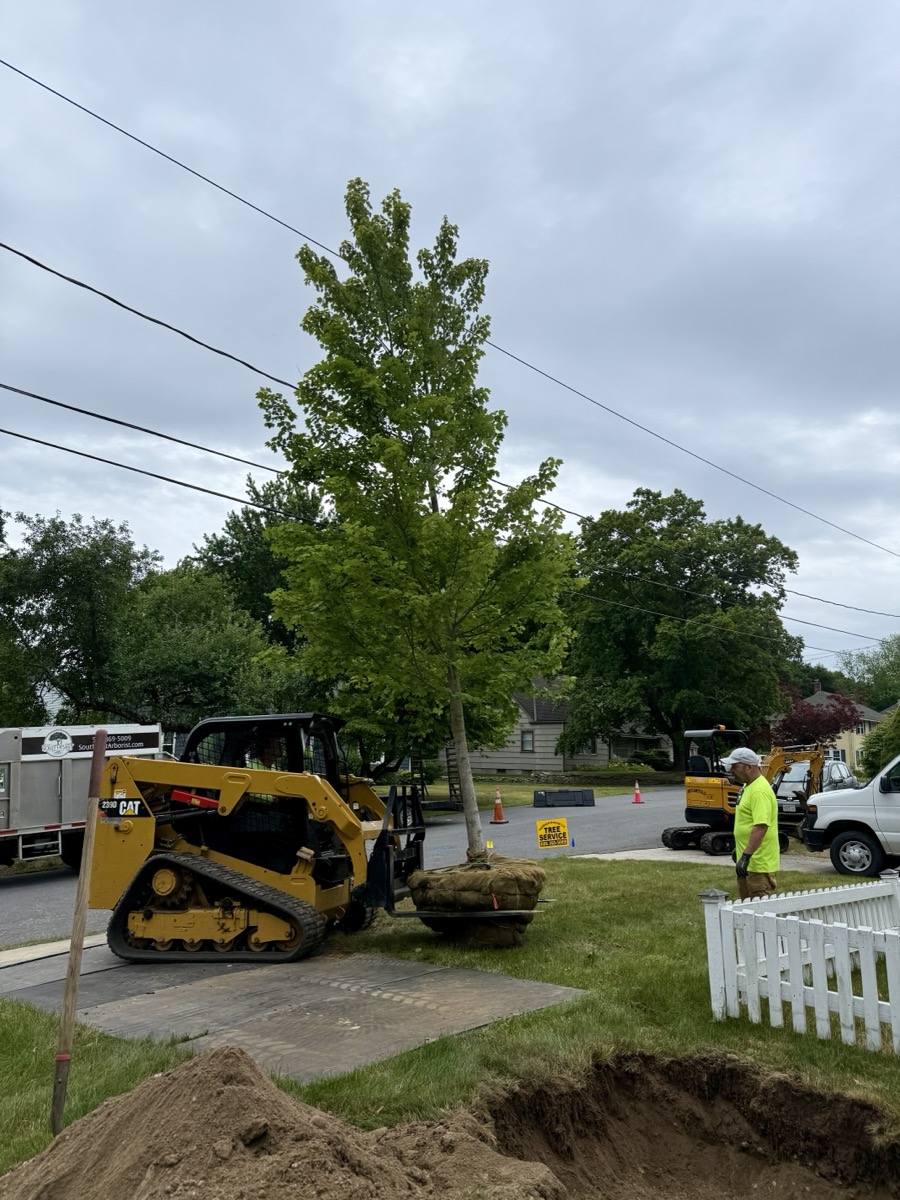
Step 3: Hole excavation. Dig 2-3 times wider than the root ball but only as deep as the container—no deeper to expose root flare, preventing girdling. Our team uses backhoes for balled-and-burlapped (B&B) trees like 3-inch caliper sugar maples, sloping sides for root expansion in compacted Walpole clays.
Step 4: Planting technique. Position the tree so root flare sits at grade—critical for American beeches in Bird Park-style plantings. Cut away circling roots (70% removal if needed), backfill with native soil amended 20% pine fines for drainage. No volcano mulching; we apply 3-inch rings of shredded hardwood, keeping mulch 6 inches from trunk to deter rodents.
Step 5: Staking and guying if required. Light-stake white oaks in high-wind South Walpole with bamboo and ties checked quarterly—over-staking weakens trunks. For cranes lifting 1,000-lb sycamore B&B into Fisher Street Area yards, we use nylon slings and certified riggers.
Step 6: Watering and mulching. Install 20-gallon root balls with slow-drip irrigation for first year—Walpole's erratic springs demand 10 gallons weekly per inch of trunk diameter. We provide guyed schedules: deep soak bi-weekly in summer.
Post-planting care guidance included: Fertilize with slow-release 10-10-10 in spring, monitor for chlorosis (yellowing veins) from iron-deficient soils. Annual inspections follow ANSI A300 for structural pruning, removing co-dominant stems on young green ash replacements.
Equipment lineup: Bobcat excavators for precision in tight Common Street Area lots, 60-foot bucket trucks for overhead access, and air spades to excavate without root damage. Safety protocols mandate two-way radios, harnesses, and daily JSA (Job Safety Analysis) meetings.
This process yields 98% establishment rates on South Shore projects. For your Walpole property, it means trees that mature without failure—replacing emerald borer losses or enhancing Olmsted legacies. Contact us at 508-369-5009 to start.
Common Tree Planting Projects in Walpole Neighborhoods
Tree planting projects in Walpole neighborhoods reflect local geography and history. In Walpole Center, compact lots around the historic common call for crown reduction of oversized red oaks followed by understory sugar maples—our ISA team plants 2-inch caliper stock with root flare exposed to fit tight setbacks.
East Walpole homeowners near old paper mills replace storm-felled silver maples with tulip trees, using crane-assisted installs to navigate narrow riverfront access. These projects stabilize eroding banks, with mulch basins preventing sediment runoff into Neponset tributaries.
South Walpole's rural edges see lot-clearing replants post-construction: clusters of white pines screen new homes from Route 1A traffic, selected for salt tolerance amid winter plowing.
Plimptonville's family properties focus on emerald ash borer replacements—remove declining green ashes, then plant disease-resistant white oaks. We amend heavy soils here with gypsum for better percolation.
Stone Street Area slopes demand anti-erosion planting: dawn redwoods root deeply, replacing unstable sycamores damaged by 2023 floods.
Neponset Valley riverfront calls for riparian management—prune overhanging silver maples, replant with native black gum alternatives to reduce flood limb drop. Our process includes DEP wetland buffers.
Fisher Street Area residential growth involves post-removal planting: after dead ash takedowns, install American beeches matching neighborhood canopy, with staking for wind.
Common Street Area historic homes preserve character via companion planting—add tulip trees near mature white oaks, enhancing Bird Park-inspired aesthetics.
Southeast Arborist serves all these spots from our Plymouth/Cohasset base, using localized knowledge for success. Your neighborhood project starts with 508-369-5009.
Tree Planting Costs in Walpole, MA
Tree planting costs in Walpole MA vary by project specifics, delivering strong ROI through longevity. A 2.5-inch caliper red oak B&B install starts at $800-$1,200, including site prep, planting, mulching, and one-year warranty—far below $5,000 future removal costs for poor installs.
Factors influencing price: Tree size—3-inch sugar maple jumps to $1,500 due to crane fees ($300/hour). Site access in Walpole Center tight yards adds $200 for air spade work. Soil amendment for Neponset Valley clays: $150 extra compost.
Species matters—salt-tolerant white pine for East Walpole runs $900; exotic dawn redwood $1,400 for sourcing. Quantity discounts: three silver maple replacements in Plimptonville drop per-unit 20%.
Emerald ash borer projects bundle removal ($700/tree) with replanting ($1,000 total), saving 15%. Bird Park-style preservation pruning adds $250/visit.
Value proposition: Proper planting per ANSI A300 boosts survival to 95%, shading your home to cut AC bills 20% summers. Mature trees add $7,000-$25,000 property value per appraisal data. Our ISA certification ensures compliance, avoiding fines from Walpole conservation rules.
Compare DIY: $400 materials, but 50% failure from root issues costs $2,000 redo. Professional edges with equipment like backhoes ($500 rental equivalent).
Financing via our partners offers 0% for 12 months. Transparent quotes post-consult—no surprises. Call 508-369-5009 for your Walpole-specific estimate.
When to Schedule Tree Planting in Walpole
Schedule tree planting Walpole MA in early spring (March-April) or fall (September-October) for optimal root growth before Walpole's Zone 6b extremes. Spring avoids summer drought; fall leverages 45-inch rainfall.
Urgency signs: Post-storm gaps in Neponset Valley silver maples—plant ASAP to stabilize soil. Emerald ash borer decline (canopy dieback)—remove and replant before larvae spread.
Construction timelines in Fisher Street Area dictate summer slots, using container stock. Avoid July-August heat over 85°F stressing new roots.
Monitor forecasts—plant pre-frost (November 1 average). Our team advises based on your soil moisture. Contact 508-369-5009 now for seasonal slots.
Frequently Asked Questions About Tree Planting in Walpole
**What makes tree planting in Walpole MA different?** Walpole's floodplain soils and emerald ash borer require deep-rooted, pest-resistant species like red oaks over silver maples.
**How do I choose trees for my Walpole property?** Consult our ISA arborists for site analysis—sugar maples for shade in Walpole Center, white pines for wind in South Walpole.
**How long until my new tree establishes?** 1-2 years with proper care; we provide watering plans for Norfolk clay-loams.
**Do you handle permits for Neponset River plantings?** Yes, we navigate DEP buffers and Walpole bylaws.
**What about emerald ash borer replacements?** Remove infected green ashes, plant alternatives like tulip trees with 2-year warranty.
**Is staking always needed?** Only for high-wind sites like East Walpole; we use minimal for trunk taper.
**How much mulch for Walpole plantings?** 3-inch rings, 4-foot diameter—never volcano style.
**Can you plant near Bird Park-style landscapes?** Precisely—we match Olmsted species like American beech companions.
Call 508-369-5009 for answers.
Tree Planting Throughout Walpole
Southeast Arborist provides tree planting across Walpole neighborhoods—Walpole Center to Common Street Area, East Walpole to Neponset Valley. We extend to nearby Norwood, Medfield, Foxborough, Sharon, Dedham from our Plymouth/Cohasset base.
Your South Shore tree planting solution starts here. Dial 508-369-5009 for free consultation—ISA Certified, ANSI compliant, Walpole-focused.