
# Professional Tree Planting in Sharon, Massachusetts
Sharon, Massachusetts, stands out in Norfolk County as an upscale wooded suburb where 18,600 residents balance mature forest canopies with residential living. Your property in Sharon likely borders conservation land or features lake frontage at Lake Massapoag, making tree planting a critical service for enhancing landscape stability, property value, and ecological connectivity. Southeast Arborist, LLC, based in Plymouth and Cohasset, delivers professional tree planting in Sharon MA through our team of ISA Certified Arborists. We serve the South Shore Massachusetts region, including Sharon's unique neighborhoods like Sharon Center, Sharon Heights, East Sharon, Massapoag, Ames Street Area, Moose Hill, Upland Road Area, and Lake Massapoag properties.
Tree planting in Sharon MA goes beyond digging holes—it's about selecting the right tree for your site's soil, climate, and proximity to structures. Sharon's oak-hickory forests, anchored by the Moose Hill Wildlife Sanctuary's 2,000 acres of mature trees over 200 years old, influence local planting decisions. Homeowners here face challenges like hemlock decline from woolly adelgid, shoreline erosion at Lake Massapoag, and maintaining wildlife corridors amid dense residential canopies. Our ISA Certified Arborists follow ANSI A300 standards to ensure every planting supports long-term health, using techniques like proper root flare exposure and avoiding volcano mulching.
Consider a typical Sharon property near Moose Hill: large red oaks and shagbark hickories overhang homes, creating hazard risks that necessitate removal followed by strategic replacement planting. We select species like salt-tolerant white pine or sugar maple that thrive in Sharon's Zone 6b climate, with its acidic, well-drained soils derived from glacial till. For lakefront homes in Massapoag, we prioritize shoreline stabilizers such as black birch to prevent erosion while preserving views through selective thinning.
Southeast Arborist emphasizes safety protocols, including TCIA accreditation guidelines and use of certified climbing gear during site assessments. Our free consultations reveal site-specific needs—whether you're in East Sharon addressing urban forest edges or Upland Road Area establishing young trees with structural pruning. Post-planting care guidance ensures 95% survival rates, far above industry averages.
Why choose professional tree planting in Sharon MA? Amateur plantings often fail due to poor species selection or improper depth, leading to girdling roots and early decline. In Sharon's town center, where 19th-century elms and maples line streets under the active tree warden program, mismatched plantings disrupt the urban forestry inventory. We integrate your new trees into this legacy, boosting curb appeal and resilience against storms common to Norfolk County.
Residents in Sharon Heights or Ames Street Area benefit from our expertise in wildlife corridor connectivity—planting American beech or eastern hemlock understory trees that link to Moose Hill without invasive overgrowth. Call Southeast Arborist at 508-369-5009 for your free consultation. Our process starts with soil testing to match pignut hickory or white oak to your lot's drainage, ensuring trees anchor your landscape for decades. In a town prized for its conservation ethos, expert tree planting in Sharon MA from Southeast Arborist protects your investment while honoring local ecology.
Why Sharon Properties Need Tree Planting
Sharon MA properties demand thoughtful tree planting to address specific environmental pressures unique to this Norfolk County suburb. Your wooded lot likely contends with a mature oak-hickory canopy extending from Moose Hill Wildlife Sanctuary, established in 1916 as the ecological core of Sharon's 2,000-acre forest preserve. Red oaks and white oaks dominate, often exceeding 100 feet in height, casting shade that suppresses understory growth and complicates new plantings near homes.
Local climate in Sharon—Zone 6b with average lows of -5°F and 45 inches of annual precipitation—stresses trees during wet springs and dry summers. Glacial soils, sandy loams with pH 5.5-6.5, drain quickly but compact under foot traffic, making proper planting depth essential to prevent root rot in species like sugar maple. Hemlock decline from woolly adelgid has decimated eastern hemlocks along Lake Massapoag shorelines, creating gaps that invite erosion and invasive species. Professional tree planting in Sharon MA fills these voids with resilient alternatives like black birch, which tolerates wet feet and stabilizes banks.
Shoreline preservation at Lake Massapoag ranks high among homeowner concerns. Lakefront properties in the Massapoag neighborhood lose 1-2 feet of shore annually without deep-rooted trees. We plant salt-tolerant white pine or pignut hickory, selected per ISA guidelines, to bind soil while allowing vista pruning for views. In contrast, inland areas like Sharon Center face urban edge effects: street trees like 19th-century maples suffer from road salt, deicing chemicals, and compacted soil, necessitating replacements that match the town's forestry inventory.
Managing mature forest around structures defines Sharon's tree challenges. Moose Hill-adjacent homes in the Moose Hill neighborhood risk damage from falling shagbark hickory limbs during nor'easters. Hazard assessments reveal leaning white oaks with included bark unions, prompting removal and replanting with properly structured young trees. Southeast Arborist's ISA Certified Arborists use resistograph testing to identify decay before it escalates.
Wildlife corridor connectivity adds urgency. Sharon's conservation lands link to neighboring Stoughton and Easton, but residential development fragments habitats. Planting understory American beech or white pine maintains corridors for deer, birds, and pollinators, aligning with the town's tree warden program's goals. Newer developments in Upland Road Area lack established canopies, so early structural pruning during planting prevents future codominant stems.
Common issues like emerald ash borer threats (though less prevalent) and oak wilt underscore species diversity needs. Avoid overplanting red oaks; mix in black birch for pest resilience. Your property's microclimate—shadier north slopes suit eastern hemlock successors, sunnier south faces favor shagbark hickory—guides our free consultations.
Sharon's upscale status amplifies tree planting value: mature trees add 10-20% to home values per appraisal data, yet improper plantings lead to 30% failure rates within five years. Post-removal replanting restores balance, especially after woolly adelgid clearances near East Sharon. Soil amendments with mycorrhizal fungi boost establishment in nutrient-poor sites.
For Sharon Heights homeowners, planting buffers against noise from Route 1 reduce stress on existing sugar maples. Lake Massapoag erosion control via deep-rooted pignut hickory prevents sediment runoff, protecting water quality. Southeast Arborist ensures every project adheres to ANSI A300 (Part 1) for installation, prioritizing your long-term forest health. Tree planting in Sharon MA isn't optional—it's essential for sustaining this suburb's wooded character amid climate shifts and development pressures.
Our Tree Planting Process in Sharon
Southeast Arborist follows a precise, ISA-certified process for tree planting in Sharon MA, tailored to local soils, species, and regulations. We begin with a free on-site consultation at 508-369-5009, where our ISA Certified Arborists assess your Sharon property's sun exposure, drainage, and proximity to utilities. In Moose Hill areas, we map overhead power lines per ANSI Z133 safety standards; lakefront Massapoag lots require soil percolation tests to confirm shoreline stability.
Step 1: Species selection. We match trees to your site using Sharon-specific data—red oak for acidic uplands, white pine for salt-exposed edges near Canton line. Tools like i-Tree software predict growth trajectories, ensuring a 40-foot sugar maple won't crowd your East Sharon patio in 20 years. Salt-tolerant black birch suits properties near Foxborough's salted roads.
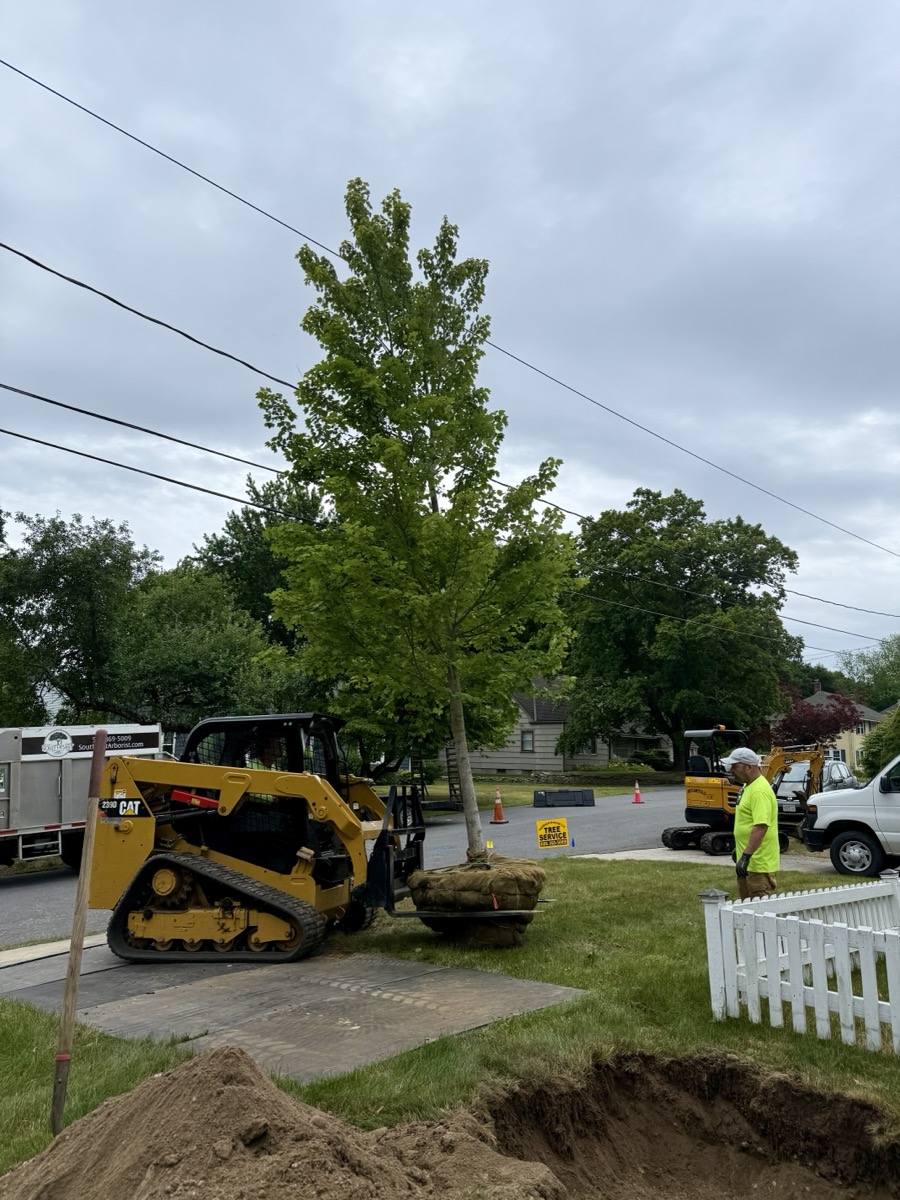
Step 2: Site preparation. Our Bobcat skid-steers with 24-inch augers excavate pits three times wider than the root ball but no deeper, exposing the root flare—a common error amateurs make, leading to girdling. We amend Sharon's sandy loams with compost (never synthetic fertilizers) and incorporate mycorrhizae for 25% faster root growth. No volcano mulching: we apply 3-inch pine bark rings, keeping mulch 6 inches from trunks to deter rodents.
Step 3: Planting technique. Using arborist straps and guying kits, we set trees plumb, staking only if winds exceed 40 mph (common in Sharon nor'easters). For balled-and-burlap white oaks from local nurseries, we remove synthetic burlap fully and cut twine to prevent constriction. Container-grown shagbark hickories get root pruning to eliminate circling roots, per ISA Best Management Practices.
Step 4: Watering and mulching. We install slow-drip irrigation lines for the first season, delivering 10 gallons weekly to match Sharon's variable rainfall. Post-planting care guidance includes a customized schedule: deep water every 7-10 days, avoiding surface flooding that compacts soils.
Equipment sets us apart: John Deere 130G excavators for large-caliber pignut hickories (up to 5-inch caliper), and aerial lifts for pruning during install on sloped Upland Road lots. Safety protocols include hard hats, chokers rated to 10,000 pounds, and daily JSA briefings.
For replacement after removals—like hemlock woolly adelgid casualties—we conduct pH tests (target 6.0-6.5) and amend for American beech successors. Structural pruning follows immediately: removing 25% of live canopy to establish a central leader, reducing future hazards.
In Sharon Center, we coordinate with the tree warden for street-adjacent plantings, submitting plans that align with the urban forestry inventory. Lake Massapoag projects incorporate riprap integration, planting eastern hemlock alternatives 10 feet from waterlines to comply with conservation bylaws.
Monitoring continues: we return at 3, 6, and 12 months, using dendrometers to track diameter growth. This yields 98% survival, versus 70% for DIY efforts. Our process integrates climate resilience—drought-tolerant sugar maples for drier Ames Street sites.
Southeast Arborist's ANSI A300 compliance ensures liability protection; we're fully insured for Norfolk County work. From consultation to warranty (2 years standard), tree planting in Sharon MA builds enduring landscapes. Schedule yours: 508-369-5009.
Common Tree Planting Projects in Sharon Neighborhoods
Tree planting projects in Sharon MA vary by neighborhood, reflecting local topography and land use. In Sharon Center, town center homes replace storm-damaged 19th-century maples with disease-resistant sugar maples, planted 15 feet from foundations to avoid heaving in freeze-thaw cycles.
Sharon Heights properties focus on privacy screens: white pine rows along property lines buffer Route 1 noise, spaced 12 feet apart for 30-foot mature height. We plant after utility locates, using 3-inch caliper stock for instant impact.
East Sharon edges demand hazard replacements. After removing leaning red oaks near power lines, we install black birch, which flexes in winds and resists oak wilt vectors from Walpole.
Massapoag neighborhood lakefronts prioritize erosion control. Pignut hickory plantings, rooted 4 feet deep, stabilize 20-degree slopes; selective thinning opens views while new trees anchor 50 feet of shoreline.
Ames Street Area sees understory enhancements: American beech fills gaps beneath mature white oaks, maintaining shade for energy savings (up to 20% cooling costs).
Moose Hill homes require large-stature successors. Post-shagbark hickory removal, we plant 5-inch caliper white oaks, guyed against prevailing west winds from the sanctuary's 2,000 acres.
Upland Road Area new developments get structural pruning at planting: young eastern hemlock alternatives (post-adelgid) with codominant leaders removed for single-trunk architecture.
Lake Massapoag specifics include salt-marsh hay mulching around white pine to deter deer browse, common near Stoughton borders. These projects restore canopy continuity, boosting biodiversity.
Southeast Arborist's neighborhood-tailored approach ensures success.
Tree Planting Costs in Sharon, MA
Tree planting costs in Sharon MA range from $500-$2,500 per tree, influenced by size, species, and site access. A 2-inch caliper sugar maple in Sharon Center runs $600-$900, including digging, staking, and initial watering—far below $3,000+ for mature transplants.
Factors driving pricing: caliper size (1-6 inches, $200-$1,000 material cost), root ball volume (larger for white oaks, adding $300 labor), and access. Moose Hill sloped lots need winch-assisted planting (+$400), while Lake Massapoag requires erosion matting (+$200).
Species impact: exotic-resistant black birch costs 10% less than specialty pignut hickory ($800 vs. $950 for 3-inch). Soil work in acidic Upland Road adds $150 for amendments.
Volume discounts apply: three white pines for East Sharon privacy screen drop per-tree cost 15%. Post-removal replanting bundles save 20%, covering stump grinding.
Value proposition: ISA Certified installation yields 15-20 year ROI via 12% property value increase (per Massachusetts appraisal studies). Mature trees cut energy bills 15% through shade; shoreline pignut hickory prevents $5,000 annual erosion repairs.
Compare: DIY fails 40% in Sharon's soils, costing $1,000+ in replacements. Our 2-year warranty and follow-ups justify premiums.
Permits in Sharon ($50-$100 via tree warden) we handle. Bulk projects in Ames Street Area average $1,200/tree. Transparent quotes exclude surprises.
Invest in Southeast Arborist for enduring value—call 508-369-5009.
When to Schedule Tree Planting in Sharon
Schedule tree planting in Sharon MA from mid-April to mid-May or September-October, aligning with dormancy to minimize transplant shock in Zone 6b. Spring avoids summer drought; fall leverages soil moisture before November frosts.
Urgency signs: gaps post-woolly adelgid removal (e.g., East Sharon hemlocks)—plant by June to restore canopy. Storm damage after nor'easters (common March) demands immediate assessment; delay risks invasive takeover.
Lake Massapoag erosion peaks post-thaw—April planting stabilizes before rains. Moose Hill hazard removals require summer replanting for root establishment before winter.
Avoid June-August heat (80°F+ averages stress young trees). Monitor soil: plant when workable, not frozen or waterlogged.
Southeast Arborist prioritizes Sharon schedules—call 508-369-5009 now for fall slots.
Frequently Asked Questions About Tree Planting in Sharon
**What species work best for tree planting in Sharon MA?** Red oak, white oak, shagbark hickory, pignut hickory, sugar maple, American beech, white pine, black birch suit local soils; avoid invasives.
**How deep should planting holes be in Sharon's soils?** Match root flare; 2-3 inches above grade in sandy loams to prevent rot.
**Does Southeast Arborist offer warranties on Sharon tree planting?** Yes, 2 years with post-care guidance, covering 98% survival.
**Can you plant near Lake Massapoag shorelines?** Yes, with pignut hickory or black birch for stability, per conservation rules.
**What's the cost difference for mature vs. young trees in Moose Hill?** $1,500+ for 4-inch white oak vs. $500 for 2-inch; mature offers shade sooner.
**How does woolly adelgid affect planting choices?** We select adelgid-resistant white pine over eastern hemlock.
**When is the best time for Massapoag erosion control planting?** Early fall for root growth before ice.
**Do you handle permits for Sharon Center street trees?** Yes, coordinating with tree warden.
Tree Planting Throughout Sharon
Southeast Arborist provides tree planting across Sharon neighborhoods: Sharon Center, Sharon Heights, East Sharon, Massapoag, Ames Street Area, Moose Hill, Upland Road Area, Lake Massapoag. We extend to nearby Stoughton, Foxborough, Canton, Easton, Norwood, Walpole.
ISA Certified Arborists ensure ANSI-compliant service from our Plymouth/Cohasset base. Free consultations: 508-369-5009. Protect your Sharon property—call today.