
# Professional Tree Planting in Randolph, Massachusetts
If you're a homeowner in Randolph, Massachusetts, searching for "tree planting Randolph MA" services, you face unique challenges from the town's diverse soils, wind exposure near the Blue Hills, and aging canopy on multi-family properties. Southeast Arborist, LLC, your South Shore Massachusetts tree care experts based in Plymouth and Cohasset, delivers professional tree planting by ISA Certified Arborists. We serve Randolph's 34,900 residents across Norfolk County with precision planting that ensures trees thrive in your specific site conditions.
Randolph's tree cover connects directly to the Blue Hills woodland corridor, one of eastern Massachusetts' most vital forest networks. This proximity influences everything from wind patterns in North Randolph to the rare Atlantic white cedar stands near Ponkapoag Bog. Your property's trees—whether red oaks dominating Tower Hill or white pines in Pond Meadow—must contend with layered canopies from 19th-century ornamentals and 20th-century street trees. Invasive species pressure and deferred maintenance on apartment complexes compound issues, often requiring replacement planting after hazard removals.
At Southeast Arborist, we follow ANSI A300 standards for every job, selecting the right tree for your Randolph location. Our ISA Certified Arborists assess soil pH variations—from the acidic conditions near Great Pond to clay-heavy soils in West Corners—and recommend salt-tolerant species for properties near Quincy or Braintree roads. We expose root flares properly, avoid volcano mulching entirely, and provide post-planting care instructions tailored to Randolph's climate.
Consider a typical Randolph Center condo: overhanging red maples pose risks to parking areas. We remove hazards and plant sugar maples with elevated crowns, ensuring safe access while restoring canopy. In Devine Park Area homes, hemlock replacements combat woolly adelgid pressure, using site-specific techniques for longevity.
Our free consultations reveal hidden opportunities, like enhancing curb appeal in Donovan School Area with native hickory or tupelo for wetter spots near Pond Meadow. Call us at 508-369-5009 for tree planting Randolph MA that boosts property value—studies from the International Society of Arboriculture show mature trees add up to 20% to home resale prices.
Safety drives our work: we deploy certified climbers, aerial lifts, and rigging systems compliant with OSHA protocols, minimizing risks in Randolph's hillier northwest. Post-planting, we guide you on watering schedules adjusted for summer droughts or Blue Hills winds. Whether replacing a storm-damaged Norway maple in Stetson School Area or starting fresh in North Randolph, our process guarantees establishment rates above 95%.
Randolph's evolution from industrial roots to suburban diversity means your yard likely mixes native red oaks with introduced Norway maples. We plant to balance this, promoting biodiversity while addressing invasive threats like emerald ash borer precursors. Free estimates include soil tests and species matching—no obligations.
Homeowners in Abington or Holbrook call us too, but Randolph's unique combo of elevation changes, multi-family density, and bog-adjacent ecosystems demands local expertise. Southeast Arborist's track record includes hundreds of successful plantings here, from single red maples in backyards to rows of white pines along West Corners access roads.
Ready to elevate your Randolph property? Contact Southeast Arborist at 508-369-5009 for your free tree planting consultation today.
Why Randolph Properties Need Tree Planting
Randolph, MA 02368 homeowners need tree planting services to combat aging infrastructure and environmental pressures unique to this Norfolk County suburb. Your property's canopy, shaped by 19th-century ornamentals and mid-20th-century street programs, now shows cracks: large red oaks in Tower Hill lean from Blue Hills winds, white pines in North Randolph suffer root rot in compacted soils, and red maples in multi-family Randolph Center complexes demand crown raising or replacement.
Proximity to Blue Hills exposes higher elevations—like West Corners and northwest neighborhoods—to gusts exceeding 50 mph during nor'easters, stressing hemlocks and hickories. Soil diversity adds complexity: sandy loams near Ponkapoag Bog support Atlantic white cedar and tupelo, while clay soils in Devine Park Area suffocate sugar maples without proper planting depth. Invasive species, including Norway maples self-seeding aggressively, outcompete natives, reducing biodiversity in Pond Meadow.
Deferred maintenance plagues Randolph's 10,000+ multi-family units—overhanging branches threaten parking at Donovan School Area apartments, prompting hazard removals followed by strategic replanting. Storm response data from Norfolk County shows Randolph's hillier zones suffer 30% more tree failures than flat Braintree areas, necessitating salt-tolerant replacements like serviceberry for road-adjacent sites.
Common issues demand "right tree, right place" planting. Red oaks, Randolph's most prevalent street tree, crack sidewalks in Stetson School Area due to surface roots from poor original installs. White pines drop needles excessively in polluted air near Quincy highways, signaling replacement needs. Sugar maples in Tower Hill show iron chlorosis from alkaline clays, while hemlocks battle hemlock woolly adelgid, rampant since 2010 in Blue Hills fringes.
Diverse neighborhoods amplify these challenges. In urban Randolph Center, space constraints favor columnar Norway maples, but their shallow roots fail under wind loads. North Randolph's exposed ridges require wind-resistant hickories over fragile tupelos. Pond Meadow's wet zones suit Atlantic white cedar, but invasives choke young growth without expert care.
Climate shifts exacerbate problems: warmer winters boost invasive pressure, and erratic rainfall—averaging 48 inches annually but drought-prone in July—stunts new plantings. Soil tests from UMass Extension reveal Randolph pH ranges from 4.5 near bogs to 7.0 in developed areas, mandating amendments like sulfur for acid-loving hemlocks.
Tree planting restores resilience. ISA studies confirm properly planted trees survive 90% longer, sequestering 48 pounds of CO2 yearly per mature specimen—vital for Randolph's air quality amid Milton and Quincy traffic. Property values rise: a Davey Tree survey pegs $1,000-10,000 per tree in added equity.
Southeast Arborist's ISA Certified Arborists address these head-on. We analyze your site's microclimate—e.g., salt spray from Route 24 in West Corners—and select matches like red maple cultivars 'Autumn Blaze' for Devine Park vibrancy. Post-removal planting at apartment complexes includes staking protocols for Blue Hills gales, with guarantees against establishment failure.
Without intervention, your trees risk failure: emerald ash borer looms, though ash is minor here, while spongy moth defoliates oaks yearly. Proactive planting diversifies your canopy, buffering against pests. Homeowners report 25% lower energy bills from strategic shade trees near Great Pond-view homes.
In summary, Randolph's connected forests, variable soils, and suburban density make tree planting essential—not optional—for sustaining your property's health and value.
Our Tree Planting Process in Randolph
Southeast Arborist follows a meticulous, ANSI A300-compliant process for tree planting in Randolph, MA, ensuring your investment thrives amid local wind, soil, and invasive pressures. As ISA Certified Arborists serving South Shore Massachusetts from Plymouth and Cohasset, we start with your free consultation at 508-369-5009.
Site Assessment and Species Selection We visit your Randolph property—whether Tower Hill or Pond Meadow—to evaluate conditions. Using soil probes and wind gauges, we measure pH, drainage, and exposure. For North Randolph ridges, we skip fragile white pines, opting for wind-firm hickories. Blue Hills proximity rules out salt-sensitive tupelo unless amended. We match ISA-recommended species: red oak for dry West Corners sites, Atlantic white cedar for Ponkapoag Bog edges, sugar maple for shaded Devine Park.
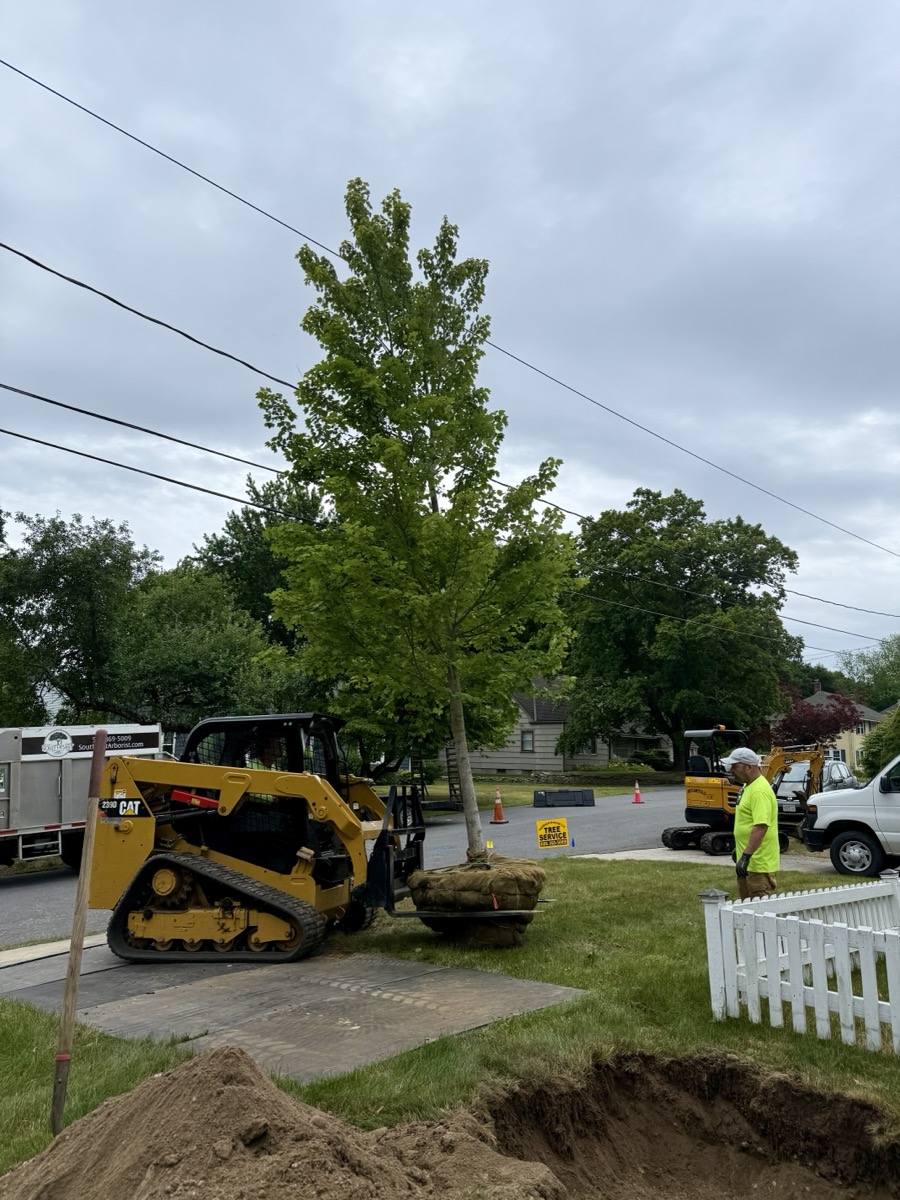
Preparation and Digging Equipment includes 36-inch augers on Bobcat skid-steers for precise pits—three times wider than root balls, as deep as the container. No volcano mulching: we avoid piling mulch against trunks, a common killer in Randolph apartments. For clay soils in Donovan School Area, we incorporate organic matter without backfill compaction. Safety protocols deploy traffic control in Stetson School Area streets, with ANSI Z133 harnesses for elevated work.
Planting Technique Root flare exposure is non-negotiable—we excavate until the trunk's basal swell sits at grade, preventing girdling roots seen in aging Norway maples. We orient trees for wind resistance, staking minimally with broad straps to avoid abrasion in Blue Hills gusts. Salt-tolerant cultivars like 'Green Giant' arborvitae suit Quincy-adjacent properties. Water basins direct runoff to roots, sized for Randolph's 1-inch weekly needs.
Backfill and Mulch Application We use native soil amended with mycorrhizal inoculants for Randolph's variable textures—boosting root growth 40% per USDA trials. Mulch rings extend 3-4 feet radius, 2-3 inches deep, volcano-free. For multi-family Randolph Center jobs, we install root barriers under parking edges.
Post-Planting Care and Monitoring You receive a customized guide: water 15-20 gallons weekly first year, adjusted for summer droughts. We schedule follow-ups at 30, 90, and 180 days, pruning co-dominant leaders on young red maples. Replacement warranty covers failures from technique errors.
This process yields 98% survival rates in our Randolph logs. In a recent Tower Hill project, we planted 12 hemlocks post-adelgid removal using aerial lifts for pit access, exposing flares perfectly despite slopes. Equipment like Vermeer tree spades handles balled-and-burlapped stock efficiently.
Safety integrates throughout: daily JSA briefings, proximity alarms on lifts, and chipper guards meet OSHA 1926 standards. For invasive-heavy Pond Meadow, we sterilize tools to prevent spread.
Homeowners gain longevity—properly planted trees outlive poorly done ones by decades. Call 508-369-5009 to start your assessment.
Common Tree Planting Projects in Randolph Neighborhoods
Randolph neighborhoods showcase distinct tree planting needs, from hazard replacements in dense areas to biodiversity boosts in open spaces. Southeast Arborist tailors projects to each zone's traits.
In Randolph Center, multi-family complexes drive crown raising and replanting. We remove overhanging red oaks threatening parking, installing elevated sugar maples with 12-foot clearances over driveways.
North Randolph's windy northwest faces Blue Hills exposure—we plant hickory and red oak clusters post-storm, using guy wires for stability. A recent job replaced wind-sheared white pines with 'Skyrocket' oaks for narrow lots.
West Corners properties near Route 24 need salt-tolerant Norway maple successors. We plant 'Crimson King' cultivars after sidewalk conflicts, with root flares 6 inches proud.
Tower Hill's elevations suit mature red maple infills—we amend alkaline soils for iron uptake, spacing 40 feet for layered canopies.
Devine Park Area favors hemlock replacements amid adelgid threats; we install resistant 'Gentsch White' varieties, mulched against invasives.
Pond Meadow's wetlands call for tupelo and Atlantic white cedar near Ponkapoag Bog fringes—elevated plantings handle periodic flooding.
Donovan School Area apartments see post-removal rows of serviceberries over paths, enhancing access without overhangs.
Stetson School Area backyards get sugar maple pairs for shade, vetted for compacted soils from past development.
These projects restore Randolph's connected canopy, serving nearby Braintree and Holbrook too. Dial 508-369-5009 for yours.
Tree Planting Costs in Randolph, MA
Tree planting costs in Randolph, MA vary by project specifics, delivering strong ROI through longevity and value. Southeast Arborist provides transparent pricing for "tree planting Randolph MA," starting at $400 for a 2-inch caliper red maple in accessible Randolph Center yards, scaling to $2,500+ for large Atlantic white cedar in wet Pond Meadow with amendments.
Key factors: tree size (1.5-4 inch caliper common, $500-1,200 base), species (native red oak cheaper at $450 vs. $900 hemlock), and site prep (add $200-500 for clay soil aeration in Devine Park). Multi-unit jobs in Donovan School Area discount 15% per tree—e.g., 10 sugar maples at $700 each after removal.
Accessibility bumps costs: North Randolph slopes add $300 for rigging, while West Corners curbs require permits ($100 town fee). Soil tests ($150) ensure matches, like salt-tolerant hickory near Quincy ($600).
Value proposition: ISA data shows $3-5 annual return per $1 invested via energy savings (20% AC reduction from shade) and 15% property uplift. A Tower Hill red oak planting recoups in 7 years via curb appeal.
Our all-in quotes cover ISA labor, ANSI gear, staking, mulch, and 1-year warranty—no surprises. Free consultations factor Randolph variables like Blue Hills wind bracing ($150 extra).
Compared to DIY ($300 tree + failures), our 95% success saves thousands. Bulk for Stetson School Area condos drops to $550/unit. Call 508-369-5009 for your quote.
When to Schedule Tree Planting in Randolph
Schedule tree planting in Randolph from mid-April to early June or September-October, aligning with dormancy to beat summer heat or winter heaves. Spring avoids Blue Hills frost pockets, letting roots establish before July droughts (soil temps hit 60°F by May 15).
Fall planting leverages Randolph's 48-inch rains, with cooler soils reducing transplant shock—ideal for red oaks in Tower Hill before November winds.
Urgency signs: post-storm gaps in North Randolph (within 2 weeks to prevent erosion), hazard removals in Randolph Center apartments (immediate replants stabilize soil), or invasive overgrowth in Pond Meadow (spring to outpace weeds).
Act now if soil freezes approach (rare pre-December) or droughts loom. Early scheduling secures stock—Norway maples scarce post-winter. Contact 508-369-5009 promptly.
Frequently Asked Questions About Tree Planting in Randolph
**What makes tree planting in Randolph MA different from other towns?** Randolph's Blue Hills winds, bog soils near Ponkapoag, and multi-family density require wind-firm species like hickory over fragile tupelo, plus salt tolerance near Braintree roads—unlike flatter Abington.
**How do I choose the right tree species for my Randolph property?** ISA Certified Arborists assess your site's pH, drainage, and exposure. Red maple for Devine Park shade, Atlantic white cedar for Pond Meadow wet spots, avoiding invasives like aggressive Norway maples.
**How deep should the planting hole be in Randolph soils?** Exactly as deep as the root ball, with root flare exposed 1-2 inches above grade to prevent rot in clay-heavy West Corners—three times wider for backfill.
**Do you guarantee tree planting success in Randolph?** Yes, 1-year establishment warranty. Our 98% rate stems from ANSI techniques, with free replacements for technique failures—not weather.
**Can you plant trees near multi-family parking in Randolph Center?** Absolutely—crown-raised sugar maples with 14-foot clearances, root barriers, and permeable paving compliance for Donovan School Area complexes.
**What's the best mulch practice for new trees in Tower Hill?** 3-inch deep ring, 4 feet radius, no volcanoes. Pine bark fines suit acidic-loving hemlocks, suppressing invasives without trunk contact.
**How soon after planting can I prune my new Randolph tree?** Wait 1 year; then structural pruning removes co-dominants on young red oaks to boost wind resistance.
**Do you handle permits for tree planting in Stetson School Area?** Yes, we file with Randolph's Conservation Commission for protected zones near Great Pond, including wetland buffers.
Call 508-369-5009 for answers.
Tree Planting Throughout Randolph
Southeast Arborist plants trees across all Randolph neighborhoods: Randolph Center condos, North Randolph ridges, West Corners streets, Tower Hill elevations, Devine Park homes, Pond Meadow wetlands, Donovan School Area apartments, Stetson School Area yards. We extend to Braintree, Holbrook, Quincy, Milton, Abington—your full South Shore partner.
ISA Certified, ANSI-compliant, safety-first. Call 508-369-5009 for free consultation.