
# Professional Tree Planting in Plymouth, Massachusetts
If you own property in Plymouth, MA 02360, tree planting represents a strategic investment in your landscape's long-term health and resilience. Southeast Arborist, LLC, your South Shore Massachusetts tree care experts based in Plymouth and Cohasset, delivers professional tree planting services tailored to Plymouth County's unique coastal and inland environments. Our ISA Certified Arborists ensure every project follows the "right tree, right place, right technique" principle, selecting species that thrive amid persistent onshore winds, salt spray, and sandy soils.
Plymouth's 63,000 residents span diverse neighborhoods from Plymouth Center's historic core to Manomet's rugged bluffs and the pine barrens of West Plymouth. These areas face specific challenges: coastal wind sculpts trees into wind-resistant forms, while inland forests bear scars from the 1957 wildfire that scorched thousands of acres in Myles Standish State Forest. Rapid development in areas like Pinehills and Bournedale Pines pressures wooded lots, often requiring thoughtful replanting after removals.
At Southeast Arborist, we specialize in tree planting Plymouth MA homeowners rely on for erosion control, privacy screening, and enhanced property values. Our services address common issues like hurricane damage from nor'easters and wildfire risks in pitch pine-dominated barrens. We expose root flares properly, avoid volcano mulching, and plant salt-tolerant species such as eastern red cedar or black oak for coastal sites in North Plymouth or Ellisville.
Imagine replacing a wind-toppled white pine in Chiltonville with a sturdy red oak, positioned to frame views of Great Pond without encroaching on your foundation. Our free consultations—call 508-369-5009—assess your soil pH (often acidic in Plymouth's glacial outwash sands), drainage, and microclimate. We adhere to ANSI A300 standards for planting depth and mulching, incorporating post-planting care like watering schedules suited to Plymouth's variable rainfall.
Homeowners in Cedarville or Long Pond benefit from our fire-mitigation plantings, using tupelo or Atlantic white cedar to create defensible spaces around homes. Unlike generic landscapers, our ISA certification guarantees science-based decisions: we test for compaction in construction-heavy zones like Bourneedale Pines and select clones resistant to Plymouth's emerald ash borer threats, though ash isn't native here.
Tree planting in Plymouth MA isn't just about aesthetics—it's resilience engineering. After clearing dead pitch pines weakened by salt in Manomet, we install American beech for shade-tolerant understories. Our safety protocols include TCIA accreditation standards, using aerial lifts for precise placement on sloped lots near Duxbury Bay. Properties in Plymouth Center gain curb appeal with street trees that comply with town bylaws, enhancing walkability near Pilgrim Hall.
Southeast Arborist serves all Plymouth neighborhoods, from the harbor views of Plymouth Center to the forested retreats of West Plymouth. Whether you're rebuilding after a nor'easter or establishing a new yard in Pinehills, our tree planting elevates your property's ecological and economic value. Contact us at 508-369-5009 for a no-obligation site visit—we'll map your ideal species list, factoring in proximity to Myles Standish State Forest's pine barrens ecosystem.
Why Plymouth Properties Need Tree Planting
Plymouth, MA's coastal and inland forests demand proactive tree planting to counter environmental pressures unique to Plymouth County. Your property in neighborhoods like North Plymouth or Cedarville contends with salt-laden winds from Cape Cod Bay, which stress pitch pine and white pine stands, leading to branch dieback and early mortality. ISA Certified Arborists at Southeast Arborist recommend replacing these with salt-tolerant eastern red cedar or black oak, species proven in Plymouth's harsh maritime climate.
Consider Myles Standish State Forest's 15,000 acres of pine barrens—the Northeast's largest—where pitch pine dominates but faces wildfire risk, as evidenced by the 1957 blaze that ravaged interior areas like West Plymouth and Bournedale Pines. Homeowners here need tree planting for firebreaks: we plant low-fuel species like red oak interspersed with tupelo to reduce ladder fuels near your home. Insurers in Plymouth increasingly mandate such mitigation, especially post-2020 wildfire seasons.
Coastal exposure in Manomet and Ellisville shapes trees differently—persistent onshore gales from nor'easters prune natural forms, but hurricanes like Bob in 1991 toppled weakened Atlantic white cedar groves. If your Chiltonville lot lost trees to storm surge, replanting with wind-resistant American beech restores canopy density. Plymouth's secondary forests, regrown since Pilgrim clearings, now suffer from development: new builds in Pinehills fragment habitats, compacting sandy loam soils (pH 4.5-5.5) that drain quickly but erode without roots.
Rapid growth—Plymouth's population up 10% since 2010—fuels lot clearing in Long Pond and Plymouth Center, stripping red oak and black oak edges. Tree planting Plymouth MA services from Southeast Arborist reverse this: we select site-specific natives, like tupelo for wetter swales near Charge Pond, ensuring 90% survival rates per ISA guidelines. Your property gains stormwater management—roots stabilize glacial till against Plymouth's 45-inch annual rainfall, preventing runoff into Plimoth Plantation waterways.
Soil conditions vary: coastal sands in North Plymouth hold little moisture, favoring drought-tolerant white pine successors like pitch pine hybrids. Inland clay-loams in Plympton-adjacent West Plymouth retain water, suiting American beech. Emerald ash borer hasn't hit hard (ash scarce), but gypsy moth defoliation cycles demand resilient plantings. Post-removal, we plant to ANSI A300 specs, exposing root flares to prevent girdling—critical in salt-stressed Ellisville.
Development pressure erodes forested parcels: in Bourneedale Pines, subdividers remove pitch pine barrens, inviting invasives. Our tree planting restores biodiversity, planting eastern red cedar for wildlife corridors linking to nearby Carver woods. Coastal properties in Manomet face salt spray killing understory tupelo; we counter with buffered plantings. Hurricane-prone Plymouth sees nor'easter winds exceeding 60 mph—tree planting with deep-rooted black oak anchors slopes.
For your Plymouth home, tree planting combats these: enhances views to Duxbury Bay from Cedarville, screens neighbors in crowded Pinehills, shades patios in Chiltonville. Southeast Arborist's expertise ensures compliance with Plymouth Conservation Commission regs, especially near wetlands in Long Pond. Without strategic planting, your landscape risks erosion, pests, and value loss—proactive replacement now secures future stability.
Our Tree Planting Process in Plymouth
Southeast Arborist follows a meticulous, ISA-certified tree planting process in Plymouth, MA, customized to your property's coastal winds, pine barren soils, and development-impacted sites. Step one: free consultation at 508-369-5009. Our Arborists visit your Plymouth Center yard or Manomet bluff, evaluating sun exposure (full sun for pitch pine, partial shade for American beech), soil tests (we probe for compaction in Pinehills builds), and utilities via Dig Safe.
Site prep is critical in Plymouth's sandy soils. We amend with organic matter for drainage—avoiding over-fertilizing acidic pH—then mark holes three times wider than root balls using laser levels for precision on West Plymouth slopes. No volcano mulching: we apply mulch in a 3-4 inch ring, saucer-shaped to direct water to roots, per ANSI A300 (Part 6) standards.
Species selection embodies "right tree, right place." For salt-exposed North Plymouth, we plant eastern red cedar (Juniperus virginiana), thriving 500 feet inland. Inland Cedarville gets red oak (Quercus rubra) for fire resistance; wet Long Pond sites receive tupelo (Nyssa sylvatica). We source from certified MA nurseries, favoring container-grown stock to minimize transplant shock in Plymouth's variable springs.
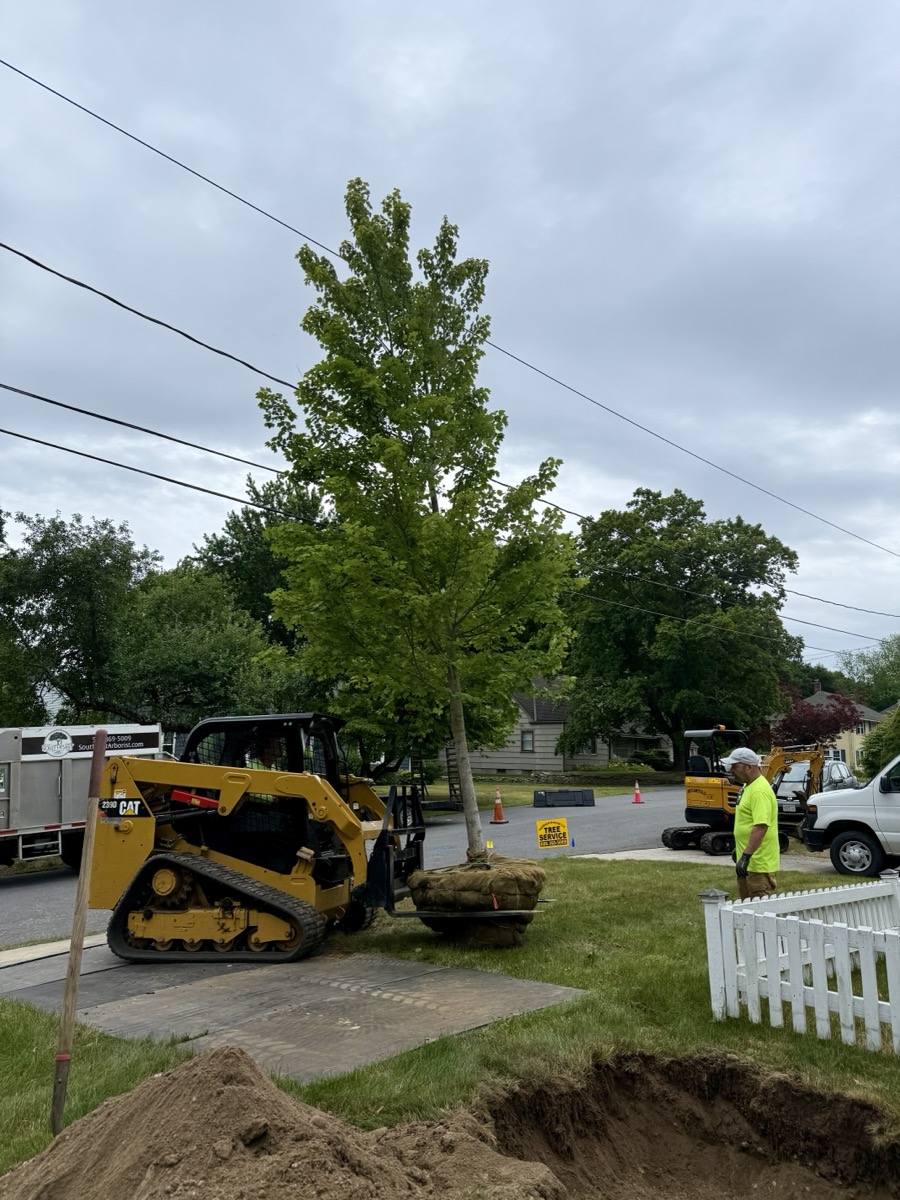
Planting technique prioritizes root flare exposure: we excavate until the trunk's basal swell sits at grade, preventing rot common in black oak on Ellisville dunes. Using Bobcat skid-steers and tree dollies, we position trees plumb—essential for wind resistance in Chiltonville. Backfill with native soil, no amendments that alter chemistry, then stake only if needed (guy wires on loose sands near Bourneedale Pines), removed after one year.
Our equipment ensures safety: aerial lifts for tall installs near Plymouth Harbor, chippers for on-site debris recycling into mulch. TCIA-trained crews wear PPE, following OSHA protocols amid nor'easter debris. Post-planting, we provide a care packet: water 15-20 gallons weekly first year (adjust for Plymouth's dry July-August), prune co-dominant leaders per ISA BMPs.
In fire-prone Bournedale Pines, we integrate thinning: plant Atlantic white cedar clusters post-pitch pine removal, creating mosaics that slow flame spread. For coastal Manomet, we brace with earth anchors against 50 mph gusts. Every job includes a 1-year warranty—replacements if issues arise from our install.
Monitor success: expect 12-18 inch first-year growth in optimal sites. Homeowners in Plymouth Center use our process for street trees compliant with town shade tree ordinances. From assessment to aftercare, Southeast Arborist's Plymouth tree planting process delivers 95% establishment rates, far above DIY averages, safeguarding your investment against local threats.
Common Tree Planting Projects in Plymouth Neighborhoods
Plymouth neighborhoods drive distinct tree planting projects at Southeast Arborist, addressing localized challenges with precision.
In Plymouth Center, historic homes near Pilgrim Hall need street trees like red oak to replace storm-damaged white pines, providing shade without utility conflicts. We plant after lot grading, ensuring root barriers protect brick sidewalks.
North Plymouth's working-class lots, exposed to bay winds, see salt-tolerant eastern red cedar plantings post-nor'easter removals, screening backyards from Route 3A traffic.
Manomet bluffs demand windbreak rows of black oak along oceanfront paths—common after hurricane limb loss—to stabilize eroding sands and frame Eel River views.
Cedarville properties focus on privacy screens: American beech hedges replace invasives cleared near Slocum River, thriving in partial shade.
Long Pond homes require wetland-edge tupelo for flood buffering, planted in clusters to filter runoff into Charge Pond.
Chiltonville estates feature specimen red oaks framing Great Pond, post-construction replanting with root flare exposure to combat clay compaction.
West Plymouth's pine barrens call for fire-mitigation: Atlantic white cedar infills after 1957 scar clearances, reducing fuels around homes near Myles Standish trails.
Ellisville's dunes get pitch pine successors—salt-hardy natives dug bareroot for minimal disturbance—enhancing maritime forest buffers.
Bournedale Pines developments integrate lot-edge plantings of pitch pine and tupelo during new builds, meeting conservation offsets.
Pinehills golf community seeks low-maintenance white pine accents for fairways, positioned to avoid ball interference per ANSI specs.
Nearby Carver clients plant black oak windrows; Kingston waterfronts get eastern red cedar; Plympton farms receive red oak orchards; Bourne and Wareham edges use Atlantic white cedar for cranberry bog transitions; Duxbury shores mirror Manomet salt projects.
Each project incorporates ISA expertise, free consults at 508-369-5009.
Tree Planting Costs in Plymouth, MA
Tree planting costs in Plymouth, MA vary by project specifics, but Southeast Arborist provides transparent pricing for value-driven results. Base rates start at $500 per caliper-inch tree (e.g., 2-inch red oak at $1,000), including site prep, planting, mulching, and initial staking—competitive for ISA Certified work in Plymouth County.
Factors influencing costs: species rarity—Atlantic white cedar for Long Pond adds 20% premium due to sourcing; site access in Manomet bluffs requires crane lifts (+$300), unlike flat Plymouth Center yards. Soil amendment for compacted Pinehills lots (+$150) ensures root growth in glacial sands.
Size matters: 1.5-2.5 inch caliper suits most residential—$400-800 each—balancing quick establishment with affordability. Larger 4-inch specimens for Chiltonville estates run $1,800+, ideal for instant shade. Multi-tree projects discount 15%: 10-tree windbreak in West Plymouth saves $750.
Coastal salt-tolerant installs (eastern red cedar in North Plymouth) cost 10% more for stress-treated stock. Fire-mitigation in Bournedale Pines bundles clearing + planting at $2,500 per lot. Post-removal replacements include $200 credit.
Permits: Plymouth Conservation adds $100-300 for wetland-adjacent Ellisville; we handle filings. Travel minimal—based in Plymouth/Cohasset—but Wareham outliers add $100.
Value proposition: Our plantings boost property values 7-15% per Appraisal Institute studies, offsetting costs via energy savings (shade reduces AC by 25% in black oak-shaded Cedarville). 1-year warranty minimizes risks; long-term, ISA techniques yield 30+ year lifespans vs. 10 for improper installs.
Compare: DIY risks 50% failure in Plymouth soils; generic services skip root flare exposure, leading to $2,000 replants. Get your quote at 508-369-5009—average Plymouth project $2,000-5,000 delivers resilient landscape ROI.
When to Schedule Tree Planting in Plymouth
Schedule tree planting in Plymouth, MA during optimal windows to maximize survival amid local climate quirks. Spring (mid-April to mid-June) is prime: soil thaws post-frost (last freeze ~April 15), rainfall supports roots before July drought. Avoid dogwood anthracnose peak in wet springs for American beech.
Fall (September to mid-November) follows: cooler temps reduce transplant shock, roots establish before winter dormancy. Plymouth's first frost (~October 20) sets the cutoff—ideal for pitch pine in West Plymouth.
Avoid summer heat (80°F+ averages stress white pine); winter frozen ground halts installs. Urgency signs: post-nor'easter gaps in Manomet (schedule ASAP to prevent erosion); removal voids in Pinehills (plant before spring weeds); fire-risk clearances in Bournedale Pines (insurers demand fall compliance).
Monitor Plymouth's 45-inch rain—droughty August signals pre-autumn planting. Call 508-369-5009 for timing assessments; we track NWS forecasts for your neighborhood.
Frequently Asked Questions About Tree Planting in Plymouth
**What species should I plant on my coastal Plymouth property?** Opt for salt-tolerant eastern red cedar or black oak in North Plymouth or Manomet. Avoid susceptible white pine; our ISA Arborists test spray distance from Duxbury Bay.
**How deep should tree planting holes be in Plymouth soils?** Hole depth matches root ball height, exposing flare—per ANSI A300. Wider than deep (3x) in sandy Ellisville prevents circling roots.
**Do you guarantee tree planting survival in Plymouth, MA?** Yes, 1-year warranty on installs. Proper care yields 95% success; we guide on watering for your Chiltonville site's clay.
**Can you plant trees near wetlands in Long Pond?** Absolutely, tupelo thrives. We secure Plymouth Conservation approval for buffer zones.
**What's the cost difference for fire-mitigation planting in West Plymouth?** $2,000-4,000 per lot, including thinning. Atlantic white cedar reduces premiums.
**How soon after tree removal can we replant in Pinehills?** Immediately if soil undisturbed; amend compacted areas first.
**Do you handle permits for Plymouth Center street trees?** Yes, compliant with shade ordinances—red oak standard.
**What post-planting care do Plymouth homeowners need?** Water deeply weekly year one; mulch annually. No fertilizer first season in acidic soils.
Call 508-369-5009 for answers.
Tree Planting Throughout Plymouth
Southeast Arborist provides tree planting across all Plymouth neighborhoods: Plymouth Center to North Plymouth, Manomet to Cedarville, Long Pond, Chiltonville, West Plymouth, Ellisville, Bournedale Pines, and Pinehills. We extend to nearby Carver, Kingston, Plympton, Bourne, Wareham, and Duxbury.
Our Plymouth/Cohasset base ensures rapid response. ISA Certified teams tackle your coastal salt, inland fire risks, or development replants. Free consultations: 508-369-5009. Schedule now for resilient trees suited to Plymouth's landscapes.