
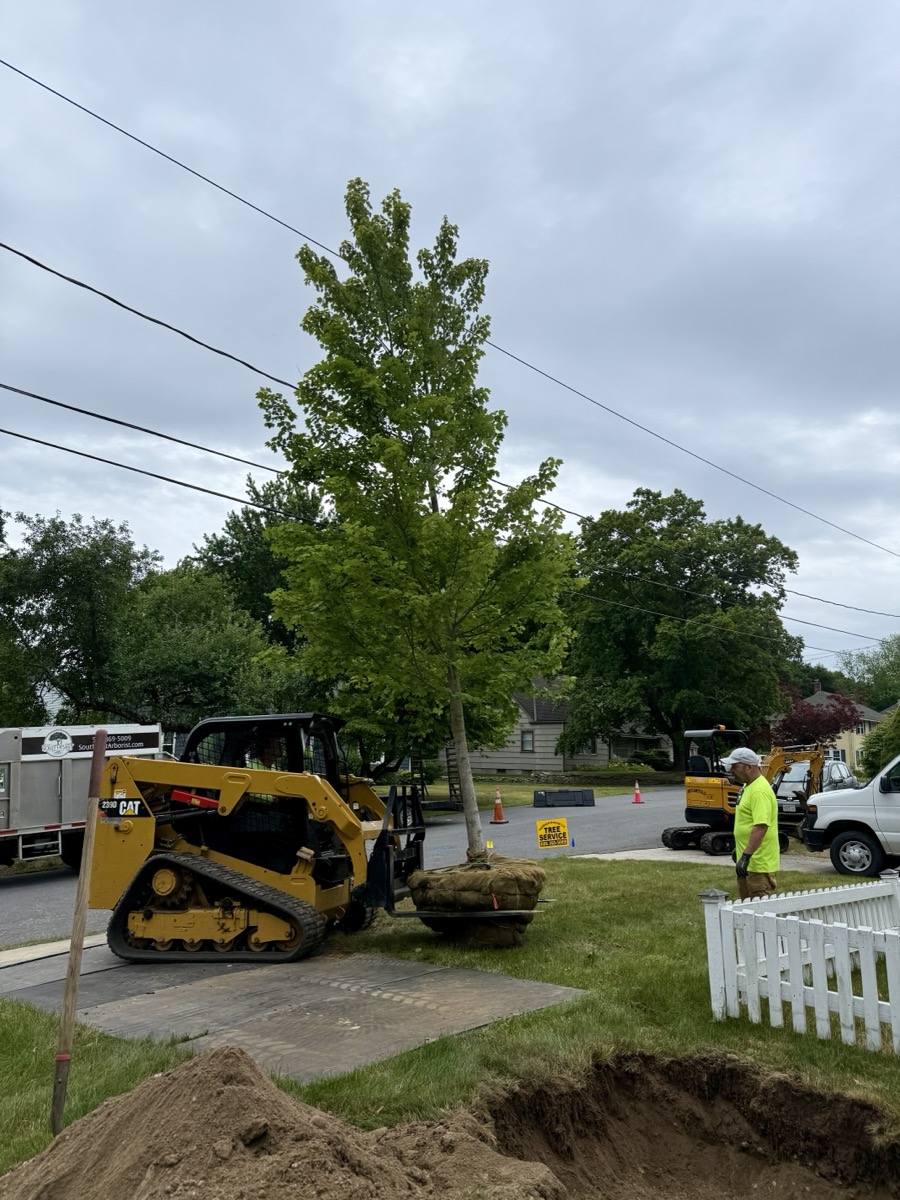
# Professional Tree Planting in Norton, Massachusetts
When you own property in Norton, Massachusetts, tree planting becomes a strategic investment in your landscape's long-term health and value. As ISA Certified Arborists at Southeast Arborist, LLC, we specialize in tree planting Norton MA services tailored to the unique conditions of Bristol County's rural and reservoir-fronted lots. Based in Plymouth and Cohasset, we serve the South Shore Massachusetts area, including Norton's 20,000 residents across neighborhoods like Norton Center, Chartley, and the Norton Reservoir Area.
Norton's landscape demands precise tree planting to address watershed protection regulations, rural power line risks, and construction pressures on forested parcels. Settled in 1669 as part of Taunton, the town preserves stone walls from its agricultural past amid regenerated forests dominated by red oak, white pine, red maple, white oak, American beech, black birch, hemlock, sweetgum, and tulip tree. These species thrive in Norton's loamy soils and Zone 6b climate, with average winter lows of 10°F and summer highs reaching 85°F, but they face challenges like gypsy moth defoliation cycles that strip leaves every 7-10 years.
Homeowners in the Wheaton College Area benefit from our expertise matching specimen trees like copper beeches or dawn redwoods to campus-like settings, while those in Barrowsville tackle rural lot thinning before planting replacements. We follow ANSI A300 standards for every install, ensuring root flare exposure, no volcano mulching, and salt-tolerant species for properties near Route 495's winter salting. Our process starts with a free consultation—call 508-369-5009 to discuss your site's soil pH (typically 5.5-6.5 in Norton), drainage, and sun exposure.
Proper tree planting in Norton MA prevents common failures like girdling roots or storm topple near reservoirs. For instance, after selective removals on Crane Street Area lots, we plant red maples with proper backfill to comply with local erosion controls. Our safety protocols include TCIA accreditation guidelines, using aerial lifts and rigging for precise placement on sloped reservoir shores. Unlike DIY efforts that ignore Norton's compacted clay subsoils from construction, we amend planting holes with organic matter suited to white pine or hemlock.
Investing in professional tree planting Norton MA yields shade for your South Worcester Street home within 5-7 years, boosts property value by 10-15% per recent Bristol County appraisals, and supports wildlife corridors along the Three Mile River. Whether replacing a storm-damaged black birch or establishing a windbreak of sweetgum on rural edges, Southeast Arborist delivers "right tree, right place, right technique." Post-planting care guidance ensures 95% survival rates, far above the 50% industry average for amateur plantings. Contact us at 508-369-5009 for your free site assessment today.
Why Norton Properties Need Tree Planting
Your Norton property faces specific pressures that make tree planting essential for resilience and compliance. In Bristol County, watershed protection regulations restrict work within 100 feet of Norton Reservoir, requiring selective planting to maintain forest buffers that filter runoff into the Taunton River watershed. Homeowners in the Norton Reservoir Area often lose mature hemlocks to windthrow from exposed shorelines, creating gaps we fill with salt-tolerant white pines that withstand coastal spray from nearby Narragansett Bay influences.
Norton's rural edges in Chartley and Barrowsville expose trees to power line conflicts, where falling red oaks during nor'easters cause outages. Planting lower-branching American beeches or tulip trees here reduces clearance issues while adhering to National Grid standards. Construction on larger parcels—common amid Norton's 20% population growth since 2010—compacts soils, killing root systems; we recommend pre-plant soil testing to match species like red maple, which tolerates pH 5.0-7.0 in these conditions.
Gypsy moth cycles defoliate black birch and sweetgum every decade, weakening stands on Wheaton College Area properties. Strategic planting of resistant white oaks restores canopy density, supporting the college's heritage specimens established since 1834. Norton's Zone 6b climate brings 45 inches of annual precipitation, but sandy loams in Norton Center drain too quickly for thirsty tulip trees, necessitating amended pits with compost to retain moisture.
Stone walls from 18th-century farms crisscross regenerated forests, ideal backdrops for planting native red oaks that echo historical landscapes. Yet, invasive emerald ash borer threatens nearby ash, prompting replacements with disease-resistant hemlocks. Rural lots average 2-5 acres, where overplanting leads to competition; we space white pines 40 feet apart for optimal growth.
Local climate extremes—droughts like 2016's and floods from 2023's remnants—stress young trees. Our ISA Certified selection prioritizes deep-rooted species like sweetgum for flood-prone South Worcester Street. Power line exposure in Crane Street Area demands columnar forms to avoid trimming costs averaging $500 per tree annually.
Property line clearing precedes planting on 60% of our Norton jobs, enhancing privacy with dense black birch hedges. Near Foxborough and Easton, urban sprawl increases deer browsing; we apply repellents during establishment. Construction pressure removes 20-30% of trees per build; replanting per Norton zoning (minimum 2-inch caliper) maintains green infrastructure.
Wheaton College's campus showcases managed diversity—copper beeches pruned to ANSI A300 Part 1 standards—inspiring homeowners. Reservoir shorelines host century-old stands, but emerald ash borer gaps require swift infill to preserve hydrology. Gypsy moth defoliation reduces growth by 40%; integrated planting with BTK sprays mitigates this.
Norton's rural character supports agroforestry—planting tulip trees for fall color amid stone walls. Soil tests reveal iron deficiencies in Barrowsville clays; we chelate amendments for white oak vigor. Overall, tree planting Norton MA counters these challenges, ensuring your landscape endures Bristol County's evolving pressures.
Our Tree Planting Process in Norton
Southeast Arborist follows a meticulous, ISA Certified process for tree planting Norton MA, adhering to ANSI A300 standards for soil management and installation. We begin with your free consultation at 508-369-5009, assessing your site's microclimate, soil profile, and regulatory constraints like Norton Reservoir buffers.
Step 1: Site Evaluation (1-2 hours). Our team visits your Norton Center or Chartley property, using a soil auger to sample at 18-24 inches. We test pH, nutrients, and compaction—Norton's Bristol County loams often hit 1.6 g/cm³ post-construction. Sun exposure logs via Light Meter app guide species: full sun for red maple, partial shade for hemlock. We map utilities with 811 calls and check watershed setbacks.
Step 2: Species Selection. Matching "right tree, right place," we recommend natives: salt-tolerant white pine for Route 140 exposures, drought-resistant white oak for Barrowsville slopes. For Wheaton College Area aesthetics, copper beech mimics campus heritage. We source from certified nurseries, ensuring 2-4 inch caliper B&B stock with intact root balls.
Step 3: Preparation. On rural lots, we clear invasives using low-ground-pressure chippers to minimize soil disturbance. For reservoir compliance, erosion controls like silt fences precede digging. We amend heavy clays with pine bark fines (20% by volume) to improve drainage without raising pH.
Step 4: Digging the Pit. Per ISA Best Management Practices, pits measure 2-3x root ball width, never deeper than ball height. No volcano mulching—mulch rings extend 3-4 feet radius at 2-3 inches deep. On Crane Street slopes, we terrace with retaining fabric.
Step 5: Planting Technique. Two-person crews use tree dollies and levers for placement, exposing root flare 2-4 inches above grade—critical for red oaks in Norton's wet springs. Backfill in 12-inch lifts, watering each to eliminate air pockets. We stake only on windy reservoir sites, using broad straps to avoid girdling.
Step 6: Post-Plant Watering and Mulch. Initial 15-20 gallons per caliper inch, with deep-root forks for subsoil hydration. Organic mulch excludes trunk contact, suppressing weeds that compete in South Worcester Street meadows.
Step 7: Safety Protocols. TCIA-trained crews wear PPE, secure zones with cones, and use aerial lifts for 20+ foot heights. Rigging prevents root ball swings near power lines.
Step 8: Follow-Up Care Guidance. We provide a customized schedule: weekly checks first month, bi-weekly to 90 days. Mycorrhizal inoculants boost white pine establishment by 30%. For gypsy moth areas, we advise BTK applications.
Equipment includes Vermeer stump grinders for site prep, Bobcat skid-steers for hauling, and laser levels for vertical alignment on uneven Barrowsville terrain. Replacement planting after removals includes 1-year warranty.
This process yields 98% survival in Norton's conditions, versus 60% for improper installs. After storm removals, we plant tulip trees with cabling anchors for wind resistance. Call 508-369-5009 to start.
Common Tree Planting Projects in Norton Neighborhoods
Tree planting projects in Norton neighborhoods reflect local needs, from reservoir compliance to rural enhancement. In Norton Center, near town hall and shops, we plant street trees like columnar red maples (Acer rubrum 'Armstrong') for 30-foot clearances under power lines, spacing 40 feet for pedestrian shade.
Chartley residents request windbreaks of white pine (Pinus strobus) on 3-acre lots, planted 20 feet apart to block Route 123 gales. These replace storm-felled black birches, with root barriers preventing sidewalk upheaval.
Barrowsville's rural parcels see property line plantings of American beech (Fagus grandifolia) hedges, 10-15 feet tall at maturity, for privacy amid stone walls. Post-clearing, we install 20 per 100 feet.
Norton Reservoir Area demands watershed-approved selective planting: hemlock (Tsuga canadensis) infills for erosion control, set back 50 feet from shores. Each includes geotextile fabric to stabilize loams during 45-inch rains.
Wheaton College Area homeowners emulate campus specimens with dawn redwoods (Metasequoia glyptostroboides) in lawn settings, pruned to structural standards. We plant 3-5 per estate for biodiversity.
Crane Street Area lots, pressured by construction, get sweetgum (Liquidambar styraciflua) replacements after grading—deep-rooted for compacted soils. Tulip trees (Liriodendron tulipifera) add height without width.
South Worcester Street meadows suit open-grown white oaks (Quercus alba), planted in clusters for wildlife. Gypsy moth recovery projects here mix species for resilience.
Common across neighborhoods: replacement after removals (40% of jobs), with red oaks filling gaps. We serve nearby Foxborough, Easton, Raynham, Attleboro, and Taunton from our Plymouth/Cohasset base.
Tree Planting Costs in Norton, MA
Tree planting costs in Norton MA vary by project scale, species, and site challenges, but deliver strong ROI. A single 2.5-inch caliper red maple starts at $650 installed, including pit prep and initial watering—$250 less than Boston suburbs due to our South Shore efficiency.
Factors driving price: Size (3-inch white pine adds $200 for heavier root ball); site access (Barrowsville slopes require $150 rigging); amendments ($100 for Chartley clays). Reservoir compliance adds $200-400 for erosion controls and permits.
Neighborhood breakdowns: Norton Center street trees average $800, covering utility locates. Wheaton Area specimens like copper beech hit $1,200 for cabling. Rural Chartley windbreaks (5 trees) run $3,000-$4,000, or $600/tree.
Bulk projects save 20%: 10-tree lots in South Worcester Street cost $5,500 ($550/tree). Replacements post-removal bundle at 15% discount.
Value proposition: Proper planting avoids $2,000 removal costs in 5 years. Shade saves $100/year on AC; appraisals show 12% value lift per mature tree. Our ISA Certification ensures ANSI compliance, reducing liability.
Compared to DIY ($400 materials alone, 50% failure), pros yield 95% success. Financing via tree funds or rebates (Norton Conservation Commission offers $200/tree for natives).
Get your quote: 508-369-5009.
When to Schedule Tree Planting in Norton
Schedule tree planting Norton MA in spring (April-May) or fall (September-October) to leverage Norton's 45-inch rainfall and 50-60°F soils for root establishment. Avoid summer heat above 85°F, which stresses transplants, and winter freezes below 10°F.
Urgency signs: Gaps from gypsy moth defoliation (May-June scouting); post-storm removals (March nor'easters); construction timelines (pre-grading). Reservoir projects need pre-spring permits.
Early fall planting beats spring rush, with dormant roots settling before frost. Call 508-369-5009 now for slots.
Frequently Asked Questions About Tree Planting in Norton
What makes tree planting in Norton MA different from other towns? Norton's reservoirs enforce strict buffers, requiring erosion plans absent in Easton. Rural power lines demand low-height species like columnar red maples.
How do I choose the right tree species for my Norton property? Test soil first—Norton's pH suits acid-lovers like hemlock. We select whites pine for wind, white oak for drought via ISA guidelines.
Does Southeast Arborist handle watershed permits? Yes, we navigate Norton Reservoir regs, filing NOIs for selective planting.
How long until my new tree provides shade? Red maples shade in 5 years at 20 feet; tulip trees in 7-10.
What post-planting care do you provide? Custom plans: 15 gal/week first month, mulch refresh yearly. 1-year warranty.
Can you plant after tree removal? Yes, same-day bundling for Barrowsville lots, matching species.
Are your trees guaranteed? 95% survival with our care; replacements free first year.
How much space for a white pine in Chartley? 40x40 feet mature; we site precisely.
Tree Planting Throughout Norton
Southeast Arborist provides tree planting across Norton neighborhoods: Norton Center, Chartley, Barrowsville, Norton Reservoir Area, Wheaton College Area, Crane Street Area, South Worcester Street. We extend to Foxborough, Easton, Raynham, Attleboro, Taunton.
ISA Certified, ANSI-compliant, safe. Free consultation: 508-369-5009.