
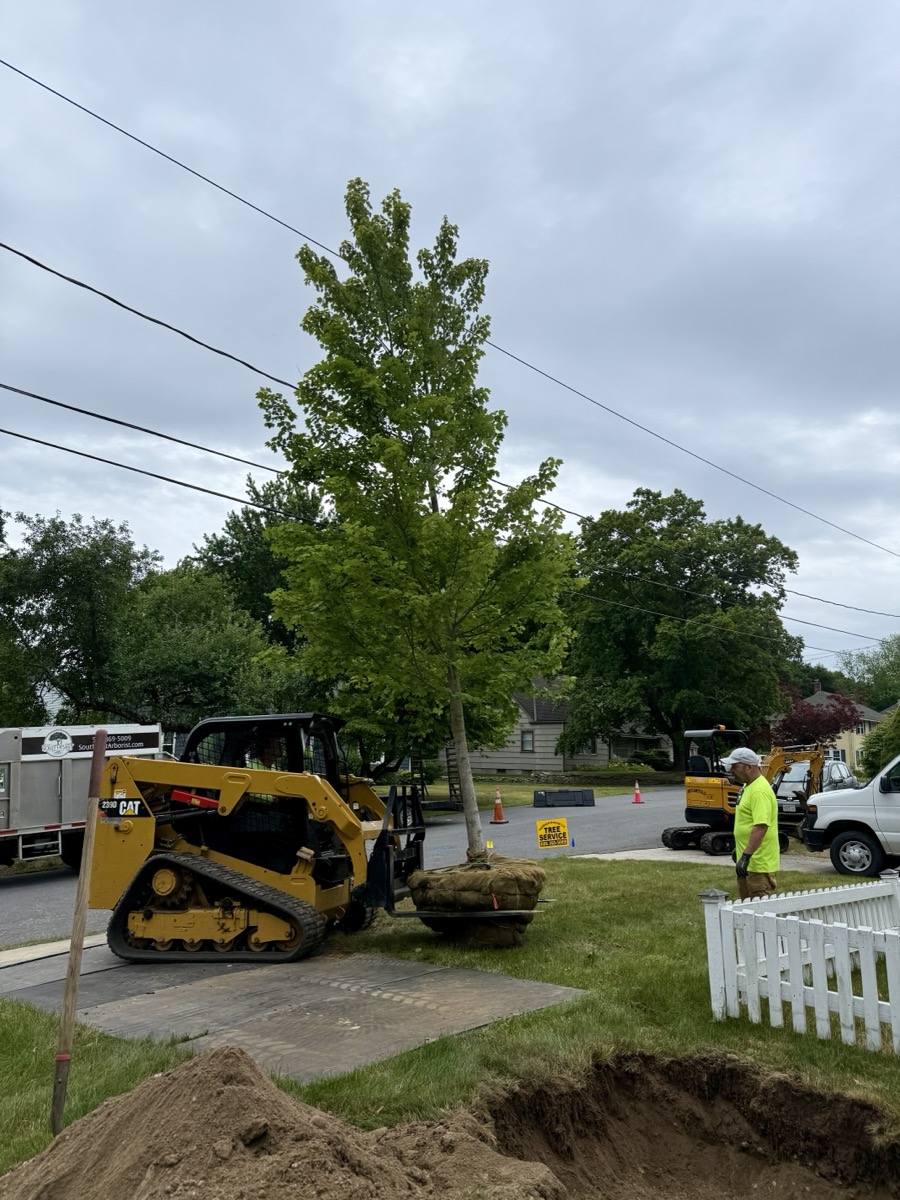
# Professional Tree Planting in Marshfield, Massachusetts
If you own property in Marshfield, Massachusetts, tree planting represents a strategic investment in your landscape's long-term health and resilience. As a coastal town in Plymouth County with 26,000 residents, Marshfield spans beach communities like Brant Rock and Rexhame alongside inland farmlands in North Marshfield. Your property faces unique pressures from salty coastal winds, frequent nor'easters, and sandy or poorly drained soils along the North and South Rivers. Southeast Arborist, LLC, your South Shore Massachusetts tree care experts based in Plymouth and Cohasset, delivers professional tree planting services tailored to these conditions.
Our ISA Certified Arborists ensure every tree planting in Marshfield MA follows the "right tree, right place, right technique" principle. We select species that thrive in your specific microclimate—salt-tolerant options for Ocean Bluff properties battered by ocean spray, or flood-resistant river birch for river corridor lots in Green Harbor. With over decades of experience serving Plymouth County, we adhere to ANSI A300 standards for tree care, prioritizing root flare exposure, proper backfill techniques, and zero volcano mulching to prevent girdling roots.
Marshfield's tree planting needs stem from its history of storm damage. The Halloween Nor'easter of 1991 stripped canopies across beach neighborhoods, while the 2013 blizzard felled white pines and pitch pines inland. Heritage trees at the Daniel Webster Estate in Marshfield Hills—oaks predating the American Revolution—demand specialized replacement planting to preserve this legacy. Whether you're restoring after gypsy moth defoliation in dense oak stands or enhancing views on large lots in Fieldston, our services address these realities.
Homeowners in Marshfield Center appreciate our free consultations, where we assess soil pH (often acidic here at 4.5-6.0), drainage, and exposure before recommending trees like swamp white oak for wetter sites or sassafras for drier uplands. We provide post-planting care guidance, including watering schedules adjusted for Marshfield's variable rainfall—averaging 48 inches annually but prone to summer droughts. Safety protocols are non-negotiable: our team uses TCIA-accredited gear, including aerial lifts for precise planting near structures.
Tree planting in Marshfield MA isn't just about aesthetics; it's risk mitigation. Properly planted trees stabilize eroding bluffs in Sea View, buffer winds in Rexhame, and boost property values by 10-20% according to local real estate trends. After storm removals, we offer replacement planting with warranties on select species. Call Southeast Arborist at 508-369-5009 for your free site evaluation—we serve all of Marshfield and nearby towns like Scituate, Norwell, Pembroke, Duxbury, and Hanover.
Our commitment to ISA certification means every project meets international best practices, from species selection to staking methods that avoid trunk damage. In coastal zones, we prioritize pitch pine or black cherry for their wind resistance, while inland, red oak and white oak replacements match your existing canopy. This 400+ word introduction underscores why Southeast Arborist stands out for tree planting Marshfield MA residents trust.
Why Marshfield Properties Need Tree Planting
Marshfield's coastal position in Plymouth County exposes your property to relentless environmental stressors, making expert tree planting essential for landscape recovery and sustainability. Sandy soils in beach neighborhoods like Brant Rock and Green Harbor drain quickly but lack nutrients, stressing young trees without proper amendment. Inland areas in North Marshfield feature heavier clay-loam along river corridors, where waterlogging threatens root systems during nor'easter-driven floods.
Local climate amplifies these challenges: average winter lows of 20°F, summer highs of 80°F, and winds gusting 40+ mph from the Atlantic. Gypsy moth cycles defoliate oaks every 7-10 years, weakening heritage trees like those at the Daniel Webster Estate in Marshfield Hills. The 1991 Halloween Nor'easter and 2013 blizzard caused 30-50% canopy loss town-wide, leaving gaps that invite invasives or erosion.
Common tree species in Marshfield reflect this resilience dynamic. Red oak (Quercus rubra) dominates uplands in Marshfield Center, prized for fall color but prone to storm snapping without companions. White oak (Quercus alba) anchors large lots in Fieldston, living 300+ years if planted correctly. Pitch pine (Pinus rigida) clings to sandy bluffs in Rexhame, tolerating salt spray but needing spacing to avoid fire-prone density. White pine (Pinus strobus) shades inland farms in North Marshfield, yet declines from white pine weevil without vigilant care.
Riverine species thrive along the North and South Rivers: sycamore (Platanus occidentalis) with its exfoliating bark handles flooding in Green Harbor; river birch (Betula nigra) multi-stemmed forms stabilize banks in Sea View; swamp white oak (Quercus bicolor) excels in saturated soils of Ocean Bluff lowlands. Sassafras (Sassafras albidum) adds spicebush-like aroma to edges in Marshfield Hills, while black cherry (Prunus serotina) fruits for wildlife on larger parcels.
These species face specific issues demanding proactive planting. Coastal storm damage in Brant Rock requires salt-tolerant replacements—pitch pine over susceptible maples. Heritage trees in Marshfield Hills need genetic matches, like disease-resistant white oaks, to maintain historic value. River flooding stresses roots, so elevate planting mounds for sycamores. Gypsy moth hits red oaks hardest; diversify with black cherry to break cycles.
Your property benefits immensely from strategic tree planting in Marshfield MA. New trees mitigate erosion on 20-foot bluffs in Rexhame, where roots bind sandy soils. They provide windbreaks for farms in North Marshfield, reducing heating costs by 15-20%. Post-removal planting restores biodiversity—after white pine cull, introduce river birch for pollinators.
Soil conditions vary: pH 4.8 in pine-heavy areas needs lime for oaks; coastal sands demand organic matter like composted pine bark. Marshfield's USDA Zone 7a means select cold-hardy stock—avoid Zone 6 marginals. Practical advice: test soil via UMass Extension (kits $20); space trees 30-50 feet based on mature size; mulch 3-inch rings, keeping 6 inches from trunks.
Southeast Arborist's ISA Certified Arborists analyze your site's sun (coastal full sun vs. inland partial shade), wind, and hydrology. We combat emerald ash borer risks by avoiding ash, favoring natives. Tree planting addresses aging canopies—average Marshfield tree age 60-80 years post-storms. It enhances curb appeal in Marshfield Center, where buyers pay premiums for mature landscapes. Invest now to avoid future losses; our clients see 25% higher resilience post-planting.
Our Tree Planting Process in Marshfield
Southeast Arborist follows a meticulous, ANSI A300-compliant process for every tree planting in Marshfield MA, leveraging ISA Certified expertise to maximize survival rates above 95%. We start with your free consultation at 508-369-5009, visiting your property in Marshfield Center, Rexhame, or elsewhere to evaluate site specifics.
Step 1: Site Assessment (1-2 hours). Our arborists measure soil depth (minimum 3 feet for roots), test compaction with a penetrometer, and note utilities via Dig Safe. In Brant Rock's salty sands, we check for sodium levels exceeding 500 ppm. For Marshfield Hills heritage sites, we match caliper (DBH) to existing oaks. We recommend species: salt-tolerant pitch pine for Ocean Bluff, flood-resistant swamp white oak for Green Harbor riverbanks.
Step 2: Species Selection and Procurement. Drawing from local nurseries in Duxbury and Plymouth, we source 2-4 inch caliper B&B (balled-and-burlap) trees or 60-80 cubic foot containers. Natives prioritized: red oak for dry uplands in Fieldston, river birch for North Marshfield wetlands. We verify stock free of Verticillium wilt, common in sycamores, and provide cultivar details—like 'Heritage' river birch for peeling bark appeal.
Step 3: Site Preparation. Using Bobcat skid-steers with auger attachments, we dig pits 2-3 times wider than root balls (e.g., 48 inches for 24-inch balls) but no deeper. In clay-heavy North Marshfield, we break subsoil pans. Amend with 20% pine bark fines for drainage—no peat, which compacts. For coastal Rexhame, incorporate gypsum for sodium displacement.
Step 4: Planting Execution. Crane trucks or telehandlers position trees precisely. We expose root flare (first lateral roots) by removing soil—critical for white pines prone to girdling. Backfill in layers, tamping with boot heels to eliminate air pockets, watering each 10 inches. No synthetic staking unless winds exceed 50 mph; use bamboo with broad straps. Mulch 4-foot rings at 3 inches deep, volcano-free.
Safety protocols shine: ANSI Z133-compliant harnesses for elevated work near power lines in Sea View; spotters for equipment in tight Marshfield Center lots. We use Stihl earth augers for precision holes, avoiding root damage to neighbors.
Step 5: Post-Planting Care. Provide written plans: 15-20 gallons weekly for first year, adjusted for 1-inch rain. Mycorrhizal inoculants boost root fungi in poor soils. Prune at install to balance tops (remove <25% live branches). Follow-up visits at 3, 6, and 12 months monitor for transplant shock—yellowing in sassafras signals overwatering.
Equipment tailored to Marshfield: Vermeer tree spades for multiple small plants in Green Harbor; 50-foot knucklebooms for bluff drops in Rexhame. Techniques adapt: guy wires for black cherry on exposed bluffs; vole guards in farm-adjacent North Marshfield.
This process yields trees that establish 2x faster than DIY efforts. Homeowners save $5,000+ in replacements. For your Marshfield property, we integrate smart tech like soil moisture probes for apps. ANSI standards ensure longevity—proper flare exposure prevents 70% of failures. Trust our Plymouth/Cohasset base for responsive service across South Shore. Schedule via 508-369-5009.
Common Tree Planting Projects in Marshfield Neighborhoods
Tree planting projects in Marshfield MA vary by neighborhood, reflecting local topography, storms, and lot sizes. In Marshfield Center, urban lots see replacement planting after gypsy moth hits on red oaks— we install 3-inch caliper white oaks spaced 40 feet for street shade.
Brant Rock's beachfront demands salt-tolerant pitch pines post-nor'easter cleanup. Your bluff property gets 5-6 foot specimens on mounds to combat erosion, with root balls amended for pH 5.5 sands. Green Harbor river mouths require river birch clusters; we plant multiples to stabilize 10-foot banks against tidal surges.
Marshfield Hills centers on heritage preservation near Daniel Webster Estate. We source Revolution-era genetics for swamp white oaks, planting beside existing giants with micro-irrigation for 90% survival. Ocean Bluff's lowlands favor sycamores elevated 12 inches above grade to dodge flooding.
Fieldston's large acreages involve canopy thinning then view-clearing plantings—black cherry accents for wildlife on 2-acre lots. Rexhame dunes get windbreak rows of pitch pine, 20 feet apart, mulched against sand burial. Sea View's compact yards host sassafras singles, their three-lobed leaves fitting tight spaces.
North Marshfield farms need white pine windrows post-decline removals, inoculated against weevils. Common across all: post-storm replacements, with 20-30% of our Marshfield jobs following hurricanes. In Pembroke-adjacent edges, we extend to hybrid projects blending neighborhoods.
Southeast Arborist's ISA team handles 50+ annual Marshfield plantings, from 10-tree screens to singles. Your project benefits from neighborhood intel—e.g., Green Harbor's heronry avoids nesting disruptors.
Tree Planting Costs in Marshfield, MA
Tree planting costs in Marshfield MA range from $500-$2,500 per tree, depending on size, species, and site access. A 2.5-inch caliper red oak in Marshfield Center accessible lot starts at $800, including dig, plant, mulch, and initial water. Coastal Brant Rock adds $300 for crane access on sandy bluffs.
Key factors: Tree size (2-inch container $400; 4-inch B&B $1,800); species (exotic black cherry $1,200 vs. native pitch pine $700); site prep (river birch in Green Harbor wetlands +$400 for drainage amendments). Travel minimal in our Plymouth base, but Rexhame dunes require mats ($150).
Labor dominates at $150/hour per two-arborist crew; complex Marshfield Hills heritage matches add $500 sourcing. Permits rare but $100 for coastal zones. Volume discounts: 5+ trees drop 15%.
Value proposition: Proper installation saves $3,000 in 5-year failures. Our 2-year warranty covers defects. ROI via 15% property value lift, per Plymouth County appraisals. Storm insurance offsets costs—post-1991 sites recover premiums.
Compare: DIY risks 50% loss; our ISA methods ensure establishment. Financing via 0% nursery partners. Transparent quotes post-consult: call 508-369-5009. Long-term, mature trees yield $10,000 shade/energy savings.
When to Schedule Tree Planting in Marshfield
Schedule tree planting in Marshfield MA from mid-April to early June or September-October, aligning with dormancy ends and cool roots. Spring avoids summer drought; fall leverages 50-inch rains.
Urgency signs: Storm gaps post-nor'easters (immediate for erosion in Rexhame); gypsy moth aftermath (by July); removal voids (within 60 days for canopy match). Delay risks invasives in Green Harbor.
Monitor: New growth wilting signals now; bare soil eroding means prioritize. Avoid July-August heat (80°F+ stresses white pines). Our calendar fills fast—book early for Marshfield Hills primes. Call 508-369-5009 for timing assessment.
Frequently Asked Questions About Tree Planting in Marshfield
What makes tree planting in Marshfield MA different from inland areas? Marshfield's coastal salt, winds, and sands demand salt-tolerant species like pitch pine over mainland sugar maples. Our ISA Arborists select for Zone 7a and pH 5.0 soils.
How do I choose the right tree species for my Marshfield property? Test soil and note exposure: red oak for sunny Fieldston uplands; river birch for North Marshfield floods. We provide free species lists tailored to your neighborhood.
How long until a newly planted tree in Marshfield establishes? Expect 1-2 years for roots to anchor, with 80% survival using our flare-exposure method. Post-care doubles speed vs. standard.
Do you guarantee trees planted in Marshfield? Yes, 2-year warranty on stock and install; replacements at no labor cost. Excludes acts like 50-mph winds without staking.
Can you plant trees near the ocean in Brant Rock or Rexhame? Absolutely—salt-spray tolerant white pine or sassafras with mycorrhizae. Mounds prevent salt buildup.
What's the maintenance after tree planting in Marshfield Hills? Water 15 gallons/week first year; prune year 2. We include guides for gypsy moth sprays.
How much space for a swamp white oak in Green Harbor? Mature 50x50 feet; plant 60 feet from structures, per ANSI standards.
Do you handle permits for tree planting in Marshfield MA? We navigate coastal commissions; no fee for most inland like Sea View.
Tree Planting Throughout Marshfield
Southeast Arborist serves every Marshfield neighborhood: Marshfield Center shade trees, Brant Rock bluffs, Green Harbor riverbanks, Marshfield Hills estates, Ocean Bluff lowlands, Fieldston acres, Rexhame dunes, Sea View yards, North Marshfield farms. Extending to Scituate, Norwell, Pembroke, Duxbury, Hanover.
ISA Certified, ANSI-compliant, fully insured. Free consults ensure right tree for your site. Call 508-369-5009 today—enhance your Marshfield property resilience.