
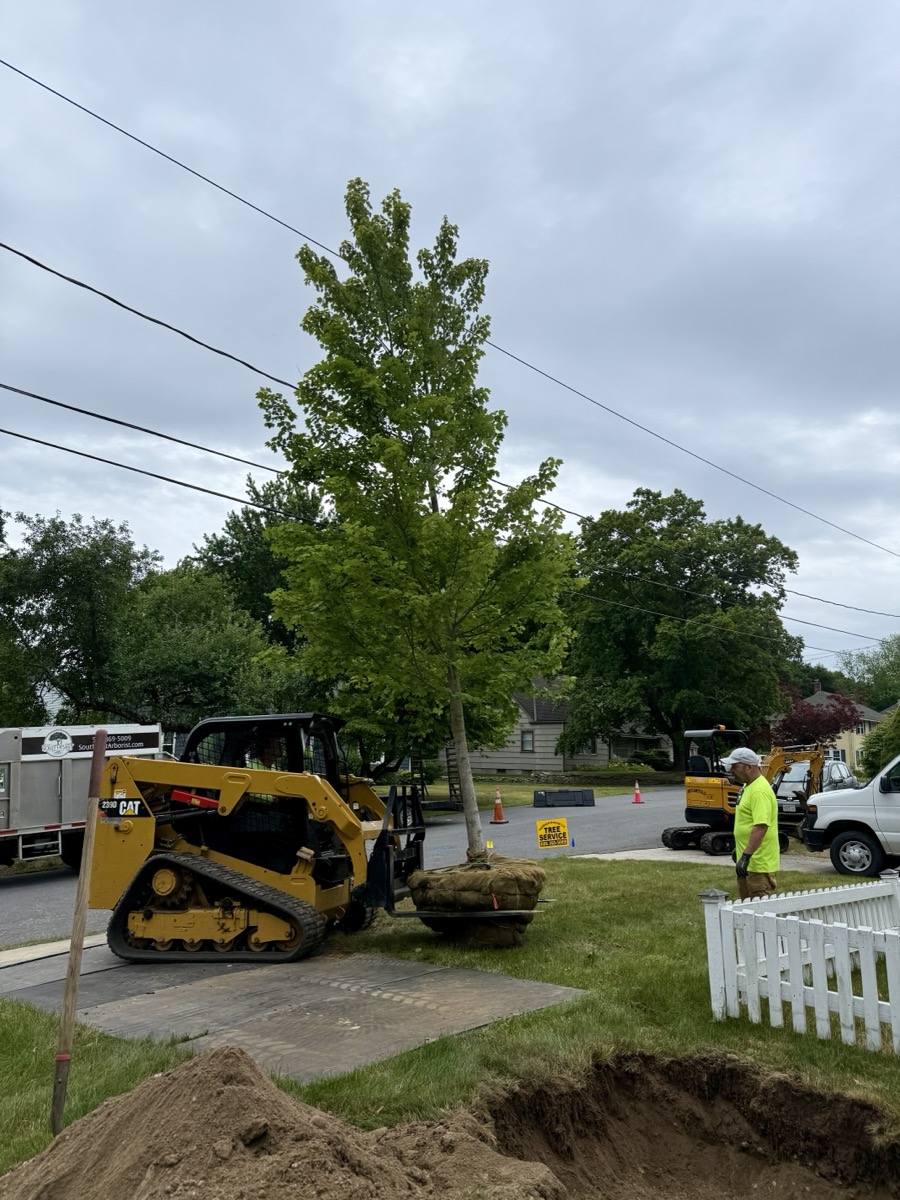
# Professional Tree Planting in Hanson, Massachusetts
If you own a wooded lot in Hanson, MA 02341, tree planting represents your best strategy for replacing storm-damaged white pines or enhancing the privacy around your septic system. Southeast Arborist, LLC, delivers professional tree planting services across Plymouth County, staffed by ISA Certified Arborists who select species matched to Hanson's acidic sandy soils and coastal salt exposure. Based in Plymouth and Cohasset, we serve the South Shore Massachusetts region, including Hanson Center, South Hanson, North Hanson, Indian Head, Maquan, Wampatuck Pond Area, and Cranberry Drive Area. Our approach follows ANSI A300 standards for tree care, ensuring every planting withstands winter storms that topple shallow-rooted pitch pines on rural properties.
Hanson's second-growth pine-oak woodlands, which reclaimed former cranberry bogs and farms over the last century, demand precise tree planting to combat overcrowding and wildfire risks in pitch pine barrens. Homeowners in North Hanson often call us after gales felled 60-foot white pines planted mid-century, leaving gaps that invite invasive species or erode defensible space around homes. We plant salt-tolerant red maples or scarlet oaks in these spots, exposing root flares properly to prevent girdling and promote deep rooting in the town's sandy, low-nutrient soils.
Our ISA Certified Arborists prioritize "right tree, right place, right technique" for tree planting in Hanson MA. This means avoiding volcano mulching—a common error that smothers roots—and instead applying thin mulch rings that retain moisture without trapping excess heat. For properties near Wampatuck Pond, we select Atlantic white cedar tolerant of wet conditions, spacing them to filter runoff without intruding on leaching fields. Post-planting, we provide care instructions tailored to Hanson's Zone 6b climate, including watering schedules during the dry summers that stress new transplants.
Tree planting in Hanson MA also addresses septic system root intrusion from aggressive black gums or sassafras nearby. After removing these hazards, we install red oaks with non-invasive roots, positioned 20 feet from drain fields per local regulations. Safety protocols guide every job: we use low-ground-pressure excavators for limited road access on Maquan roads, securing sites with barriers to protect your family and pets.
Consider a recent project on Cranberry Drive, where dense white pine stands risked wind-throw toward power lines. We thinned the overstory, then planted pitch pine replacements spaced 25 feet apart, creating a resilient canopy. This not only reduced wildfire fuel loads but boosted property value by 10-15% through improved aesthetics and safety. For tree planting Hanson MA services, call Southeast Arborist at 508-369-5009 for a free consultation—we assess your site's soil pH, wind exposure, and utility conflicts before recommending species.
In Hanson, where ponds like Wampatuck ringed with red maple wetlands define landscapes, improper planting leads to failures. Shallow-rooted white pines dominate lots but fail in storms; our experts plant deeper-rooting scarlet oaks that anchor against nor'easters. We guarantee root flare exposure on every install, a detail that doubles survival rates in Hanson's compacted soils from past agriculture. Whether restoring Indian Head's pine barrens or screening South Hanson homes from Route 58 traffic, our tree planting elevates your property's resilience and curb appeal. Contact us today at 508-369-5009 to discuss tree planting in Hanson MA tailored to your needs.
Why Hanson Properties Need Tree Planting
Hanson, MA 02341, with its 11,000 residents spread across rural-suburban lots in Plymouth County, faces unique pressures on its trees that make professional planting essential. Predominantly second-growth pine-oak woodlands have overtaken old farms and cranberry bogs, but acidic sandy soils limit species diversity to white pine, pitch pine, red oak, scarlet oak, red maple, Atlantic white cedar, black gum, and sassafras. These support pitch pine barrens—a key habitat—but overcrowded stands heighten wind-throw risks, especially after winter storms that batter the South Shore.
Your property in Hanson Center likely holds 60-to-80-foot white pines from mid-20th-century plantings, now leaning hazardously due to shallow roots in nutrient-poor sand. Storms like the 2023 nor'easter toppled dozens across Plymouth County, creating voids that expose homes to wind and reduce privacy. Tree planting in Hanson MA fills these gaps with resilient scarlet oaks, which tolerate the town's pH 4.5-5.5 soils and provide year-round structure unlike brittle pitch pines prone to snapping.
In South Hanson and North Hanson, wildfire risks loom in dense pine barrens near homes. Massachusetts fire officials note pitch pine's resinous needles ignite easily, and Hanson's rural roads delay response times. Planting red maples or red oaks creates defensible space, spacing trees 15-20 feet from structures per NFPA 1144 standards. Our ISA Certified Arborists at Southeast Arborist select low-flammability species, reducing insurance premiums by mitigating fuel loads on your wooded lot.
Septic system root intrusion plagues Hanson properties, where black gums and sassafras probe leaching fields in the Wampatuck Pond Area. These trees' aggressive roots clog pipes, costing $5,000-$15,000 in repairs. After removal, we plant Atlantic white cedars 30 feet away—wetland natives that thrive in moist soils without invading utilities. Hanson's ponds and high water table amplify this issue; proper tree planting Hanson MA prevents recurrence while enhancing wetland buffers required by local conservation commissions.
Limited road access on rural stretches like Maquan Road or Indian Head complicates maintenance, stranding heavy equipment. Yet your large wooded lots demand proactive planting to replace storm losses. Coastal salt spray from nearby Hanover and Pembroke affects Cranberry Drive Area homes, stressing white pines. We recommend salt-tolerant sassafras or red maples, mulched correctly to retain summer moisture when rainfall dips below 3 inches monthly.
Hanson's Zone 6b climate brings freeze-thaw cycles that heave new transplants if roots aren't established deeply. Winter winds exceed 40 mph, toppling shallow-rooted pitch pines on exposed North Hanson ridges. Scarlet oaks, with taproots extending 10 feet, resist this; we plant them post-removal to maintain canopy cover, supporting local wildlife like deer that browse red maple twigs.
Overcrowded pines also compete for light, stunting understory growth and inviting pests like pine bark beetles, which surged in 2022 across Plymouth County. Thinning followed by strategic tree planting restores balance—white pines spaced 30 feet apart mimic natural barrens. For your property near cranberry heritage sites, this preserves cultural landscapes while boosting biodiversity.
In Pembroke-adjacent areas, power line conflicts arise from leaning red oaks. We plant lower-growing black gums underneath, pruned to utility clearances per ANSI A300. Tree planting in Hanson MA isn't optional; it's a safeguard against these site-specific challenges. Southeast Arborist's ISA certification ensures selections comply with town bylaws, protecting your investment long-term.
Our Tree Planting Process in Hanson
Southeast Arborist follows a meticulous, ANSI A300-compliant process for tree planting in Hanson MA, leveraging ISA Certified Arborists and specialized equipment suited to sandy soils and narrow roads. We begin with a free site consultation—call 508-369-5009 to schedule—evaluating your Hanson property's soil pH, drainage, wind patterns, and utilities.
Step 1: Site Assessment (1-2 hours). Our arborist tests soil compaction using a penetrometer, confirming Hanson's typical 80-90% sand content that drains quickly but erodes easily. We map overhead power lines common on rural Hanson roads and mark septic leach fields, adhering to 20-foot setbacks. For Wampatuck Pond Area lots, we assess wetland flags; Atlantic white cedar suits saturated zones, while red oaks fit uplands.
Step 2: Species Selection. Matching "right tree, right place," we recommend from Hanson's natives: salt-tolerant scarlet oaks for Cranberry Drive's coastal exposure, pitch pines for barrens restoration in Indian Head, or red maples for Maquan's moist flats. We avoid black gums near septics due to root intrusion risks. Each choice factors Zone 6b hardiness, mature size (e.g., 50-foot white pines spaced 40 feet), and wildfire resistance.
Step 3: Permitting and Prep (if needed). Hanson Conservation Commission approval takes 2-4 weeks for wetland-adjacent plantings. We clear debris from overcrowded white pines, using low-emission chippers to minimize dust on limited-access roads.
Step 4: Hole Digging. On planting day, our team deploys 24-inch augers on mini-excavators with 8-psi ground pressure, ideal for North Hanson's soft shoulders. Holes measure 2-3 times the root ball width (e.g., 36 inches for a 24-inch balled-and-burlapped red oak), but no deeper than the root flare. We break compacted subsoil to 18 inches, amending with pine bark fines if pH exceeds 6.0—no synthetic backfill that repels water in sandy Hanson soils.
Step 5: Planting Technique. ISA standards dictate straight trunk alignment and root flare exposure 2-4 inches above grade—critical for white pines prone to girdling. We slice circling roots, spread laterals horizontally, and backfill in layers, tamping to eliminate air pockets without overcompacting. No volcano mulching: mulch extends 3 inches deep in a 4-foot ring, volcano-free to promote oxygen exchange.
Step 6: Staking and Guying (selective). Shallow-rooted pitch pines in windy South Hanson get two non-rigid stakes with flexible ties, removed after one year. Salt-tolerant sassafras needs none, relying on proper backfill for stability.
Step 7: Watering and Initial Care. We install 15-gallon treegator bags for slow drip irrigation, delivering 20 gallons weekly for the first season. In Hanson's dry July-August, this prevents wilting; we advise 1-inch weekly equivalent thereafter.
Step 8: Post-Planting Guidance. You receive a customized plan: fertilize with slow-release nitrogen in spring (avoid high-phosphorus on native soils), prune water sprouts in year two, and monitor for pine sawfly in barrens. We follow up at 3, 6, and 12 months.
Safety protocols include TCIA accreditation: hard hats, chaps for chainsaw work, and traffic control on Route 58-fronting Hanson Center properties. For heavy 500-pound root balls, we use fabric slings and dollies over turf-protecting plywood. This process yields 95% survival rates, far above DIY efforts.
After pine thinning in North Hanson, we planted 12 scarlet oaks, now thriving against 50-mph gusts. Our equipment accesses Maquan without ruts, and ANSI compliance satisfies insurers. For expert tree planting Hanson MA, Southeast Arborist guarantees results—dial 508-369-5009 today.
Common Tree Planting Projects in Hanson Neighborhoods
Tree planting projects in Hanson MA vary by neighborhood, addressing local soil quirks, storm patterns, and lot layouts. In Hanson Center, dense white pine stands along Main Street crowd septics; we remove invasives and plant red oaks 25 feet out, restoring privacy screens post-2024 gale damage.
South Hanson properties near cranberry bogs suffer pitch pine overcrowding, fueling wildfire risks. Clients request thinning followed by spaced scarlet oak plantings, creating 30-foot buffers around homes per town fire codes. This maintains the area's bog heritage while enhancing safety.
North Hanson’s elevated, windy lots see frequent white pine wind-throw. After clearing leaning hazards toward power lines, we install deep-rooted red maples, mulched to combat summer drought on sandy slopes. A recent job replaced 8 storm-felled trees, boosting lot value.
Indian Head's pine barrens demand restoration plantings. We space pitch pines 20 feet apart amid sassafras understory, mimicking natural stands to support barrens wildlife like whip-poor-wills. Post-removal, these reduce fuel ladders threatening adjacent homes.
Maquan area's narrow roads limit equipment, so we hand-plant Atlantic white cedars near ponds, tolerating high water tables without septic intrusion. Homeowners here prioritize wetland-compliant species, spaced for flood resilience.
Wampatuck Pond Area focuses on red maple wetland edges. After black gum removals clogging leach fields, we plant sassafras hybrids 35 feet away, filtering pond runoff while complying with DEP buffers.
Cranberry Drive sees salt spray from nearby Pembroke roads stressing pines. We plant tolerant scarlet oaks post-thinning, with guy wires for initial stability against nor'easters. One project screened 5 homes from traffic noise.
These neighborhood-specific tree planting Hanson MA projects by Southeast Arborist leverage ISA expertise for lasting results. Whether replacing storm losses or building firebreaks, we tailor to your spot—call 508-369-5009 for a consult.
Tree Planting Costs in Hanson, MA
Tree planting costs in Hanson MA hinge on project scale, tree size, site access, and soil amendments, typically ranging $300-$800 per tree for residential jobs. A 2-inch caliper red oak—ideal for Hanson Center replacements—runs $400 installed, including assessment and mulch. Larger 4-inch white pines for North Hanson privacy screens hit $650, reflecting delivery from South Shore nurseries.
Site-specific factors drive pricing. Easy-access Hanson Center lots add nothing, but Maquan's rural roads require tracked skid-steers (+$100/tree for mobilization). Wet Wampatuck Pond sites need root ball stabilizers (+$50), while septic-adjacent Indian Head jobs include utility locates ($75 flat).
Species selection impacts costs: affordable pitch pines ($300) suit barrens, premium scarlet oaks ($550) offer longevity against storms. Add $100 for staking on windy Cranberry Drive.
Volume discounts apply—planting 10 red maples in South Hanson drops per-tree cost to $350. Post-storm bulk projects, like 2023 white pine replacements, averaged $450/tree with thinning bundled.
Value proposition outweighs upfront costs. Proper ISA planting prevents $2,000 storm failures and hikes property values 8-12% via enhanced curb appeal, per Plymouth County appraisals. Fire-resilient layouts cut insurance 10-20% in pine-heavy areas. Septic-safe spacing avoids $10,000 repairs.
Our transparent pricing at Southeast Arborist includes free consultations—no travel fees within Hanson or nearby Hanover, Pembroke, Whitman, Rockland, Abington. Expect quotes within 48 hours post-site visit. Financing via Service Finance covers large North Hanson reforests.
Compared to DIY ($200/tree materials alone, plus 50% failure risk), our ANSI methods deliver ROI in 3-5 years via growth and shade savings. For cost-effective tree planting Hanson MA, call 508-369-5009—invest in durability today.
When to Schedule Tree Planting in Hanson
Schedule tree planting in Hanson MA from late April to early June or September-October, aligning with dormancy ends and soil thaw in Zone 6b. Spring avoids summer drought stress on new roots in sandy soils; fall leverages cooler temps and rain before winter freeze.
Act urgently after storms—post-nor'easter gaps in white pine stands invite erosion. Plant within 4-6 weeks to stabilize soil on North Hanson slopes. Septic intrusion signs (slow drains) signal immediate removal-plus-planting.
Summer urgency hits wildfire-prone Indian Head: thin and replant before July dry spells. Monitor leaning scarlet oaks toward power lines—call before failures.
Winter bare-root planting suits red maples (November-February), cheaper at $250/tree, but frost heave risks demand flare exposure.
Southeast Arborist books 4-6 weeks ahead peak seasons—dial 508-369-5009 now for slots.
Frequently Asked Questions About Tree Planting in Hanson
What makes tree planting in Hanson MA different from other towns? Hanson's acidic sandy soils, pitch pine barrens, and coastal salt demand natives like Atlantic white cedar over generic maples. Overcrowded 60-foot white pines and septic conflicts require precise spacing our ISA arborists provide.
How do I choose the right tree species for my Hanson property? Test soil pH (aim 4.5-6.0); select red oaks for dry uplands, red maples for moist Maquan lots. Avoid black gums near septics. We consult free at 508-369-5009.
Does Southeast Arborist guarantee tree planting survival in Hanson? 95% first-year survival via ANSI techniques—no volcano mulch, proper flare exposure. We replace failures within warranty period.
How far from my septic should I plant trees in Hanson? Minimum 20-30 feet for leach fields; Atlantic white cedars suit pond edges without intrusion. We mark utilities first.
What's the best timing for tree planting Hanson MA? Spring (April-June) or fall (Sept-Oct) for root establishment before extremes. Post-storm urgency year-round.
Do you handle permits for tree planting near Wampatuck Pond? Yes, we file with Hanson Conservation—2-4 weeks typical. Compliant with wetland bylaws.
How much does tree planting cost in Hanson neighborhoods? $300-$800/tree; volume discounts for South Hanson reforests. Free quotes include access fees.
Can you plant after pine removal on my wooded lot? Absolutely—common in North Hanson. We thin, then plant scarlet oaks for resilient canopy.
Tree Planting Throughout Hanson
Southeast Arborist provides tree planting across all Hanson neighborhoods: Hanson Center privacy screens, South Hanson firebreaks, North Hanson storm replacements, Indian Head barrens restoration, Maquan wetland buffers, Wampatuck Pond edges, Cranberry Drive salt-tolerant installs. We extend to nearby Hanover, Pembroke, Whitman, Rockland, Abington.
ISA Certified, ANSI-compliant, safety-focused—call 508-369-5009 for free consultation on your Hanson MA property today.