
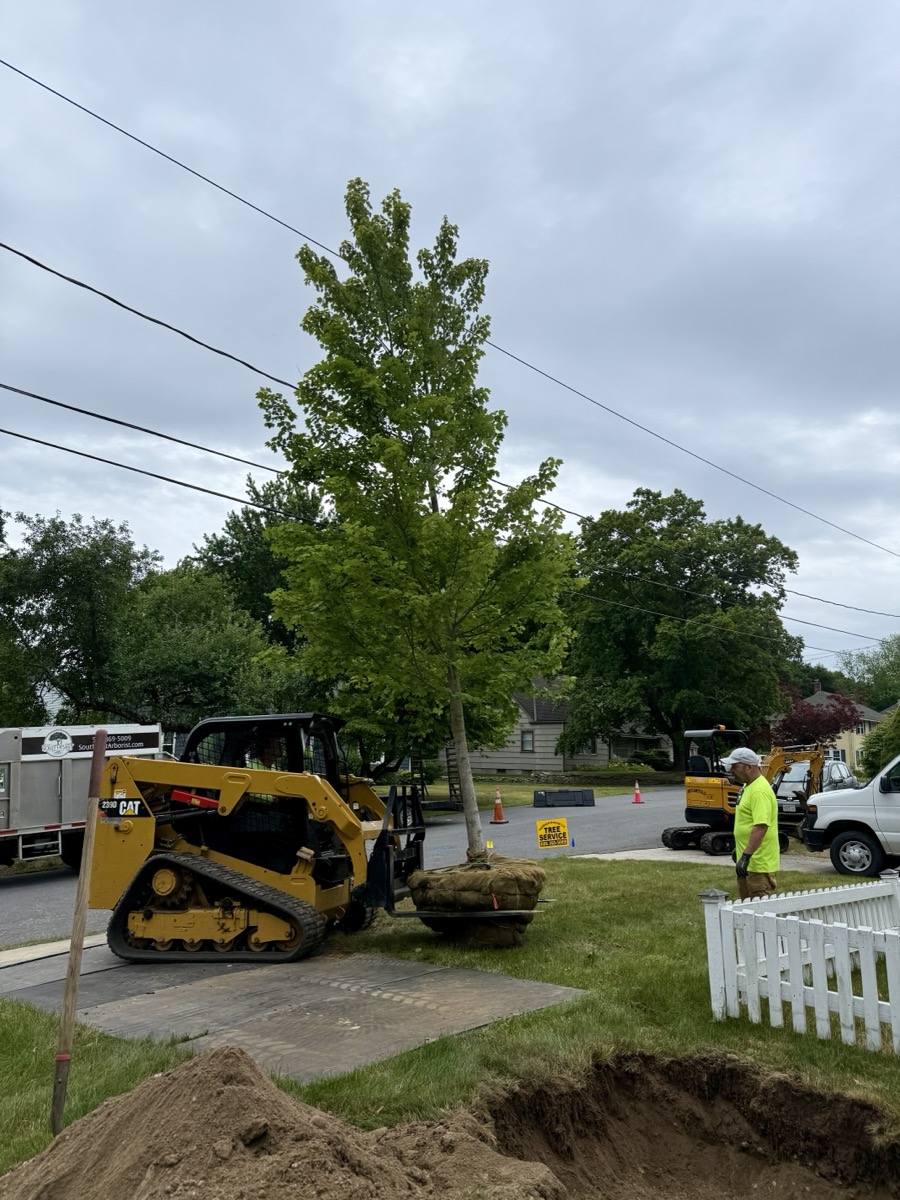
# Professional Tree Planting in Easton, Massachusetts
Easton, Massachusetts, stands out in Bristol County with its 25,000 residents preserving a rich arboricultural legacy rooted in the Ames family's 1870s landscape investments. Frederick Law Olmsted's designs in North Easton introduced specimen trees like European beeches, lindens, and native oaks that now define the town's historic mill village character, from H.H. Richardson architecture to deep woods bordering the Hockomock Swamp. As a homeowner in Easton, MA 02334, you face unique challenges: hemlock woolly adelgid threatens eastern hemlocks in shaded ravines, deer browse halts regeneration of sugar maples and white pines, and aggressive red maples from the swamp encroach on properties in Eastondale and Furnace Village. Professional tree planting in Easton, MA, addresses these issues by selecting the right tree for your site—considering Easton's Zone 6b climate with wet springs, sandy loams in North Easton, and clay-heavy soils near Unionville.
Southeast Arborist, LLC, based in Plymouth and Cohasset, delivers ISA Certified Arborist-led tree planting across the South Shore, including Easton. Our team follows ANSI A300 standards for planting and care, ensuring proper root flare exposure, no volcano mulching, and salt-tolerant species for properties near Brockton or Stoughton. Whether replacing a hazard white oak after removal or adding Atlantic white cedar to buffer swamp edges in Five Corners, we prioritize "right tree, right place, right technique." Homeowners in the Stonehill College Area trust us for institutional-scale projects, while Easton Center residents rely on our preservation pruning integration with new plantings.
Tree planting in Easton, MA, goes beyond digging holes. Easton's heritage demands species matching Olmsted's vision—European beech for stately shade, red oak for durable canopies—while combating local threats like Hockomock Swamp overgrowth. Our free consultations assess your soil pH (often 5.5-6.5 in Easton), drainage patterns, and proximity to landmarks like the Ames Free Library. We avoid common pitfalls: overplanting lindens in deer-heavy Unionville or ignoring wind exposure near Easton Green. Post-planting, you receive care guidance for watering and staking, boosting survival rates to 95% versus the 50% failure rate of DIY efforts.
In Easton, tree planting enhances property values amid rising demand—Bristol County homes with mature canopies sell 10-15% faster. Contact Southeast Arborist at 508-369-5009 for your free site evaluation. Our safety protocols, including TCIA accreditation and aerial lift certifications, protect your family and H.H. Richardson structures during installs. From South Easton subdivisions to North Easton's estates, we plant for longevity, preserving Easton's deep woods heritage while solving modern suburban pressures.
Why Easton Properties Need Tree Planting
Easton's landscapes, shaped by Olmsted's North Easton commissions, feature mature red oaks and white oaks shading historic sites, but succession planting is essential as these trees age. Deer browse in neighborhoods like Furnace Village prevents natural regeneration of American beeches and sugar maples, leaving gaps in your canopy. The Hockomock Swamp, Massachusetts' largest freshwater wetland and an Area of Critical Environmental Concern, pushes red maples and Atlantic white cedars onto residential parcels in Eastondale, crowding foundations and septic systems. Professional tree planting in Easton, MA, restores balance with species-selected replacements.
Local climate drives urgency: Easton's 45-inch annual rainfall creates waterlogged soils in low-lying Unionville, ideal for eastern hemlocks but prone to root rot without proper drainage. Zone 6b winters (-5°F lows) test young white pines, which we stake against ice loads. Hemlock woolly adelgid infests shaded ravines near Stonehill College, killing specimens and opening plots for new plantings. In Five Corners, salt spray from Routes 106 and 123 demands tolerant lindens or red maples over sensitive European beeches.
Soil variability complicates matters—sandy loams in North Easton suit red oaks' deep roots, while clay subsoils in South Easton compact around sugar maples, causing girdling roots. Homeowners often inherit mismatched trees: a linden in full-sun Easton Center struggles with scorch, or Atlantic white cedar floods in poorly drained swamp edges. Tree planting in Easton, MA, corrects this via ISA Certified selection—testing your site's pH, compaction, and sunlight hours.
Easton's arboricultural heritage sets it apart from nearby Stoughton or Sharon. Ames-era specimens require companions: plant white oak near aging European beeches for biodiversity, or sugar maple understory trees beneath red oaks to mimic natural succession. Hockomock encroachment demands buffer plantings—Atlantic white cedar rows in Eastondale slow invasive spread without chemicals. Stonehill College Area properties need hazard-free species along pathways, like columnar lindens avoiding building conflicts.
Practical advice for Easton homeowners: Assess deer pressure by checking browse lines on existing twigs; if above 4 feet, choose fenced-in plantings or deer-resistant white pines. Test soil drainage by digging a 12-inch hole, filling with water—if it holds over 24 hours, amend with compost for red maples. Proximity to Brockton urban heat islands raises summer stress on eastern hemlocks, so opt for mulch rings (not volcanoes) to retain moisture.
Without strategic planting, Easton's woods degrade: lost shade increases AC costs by 20%, erosion threatens Furnace Village streams, and swamp overgrowth lowers curb appeal. Southeast Arborist's plantings integrate with preservation pruning, sustaining Olmsted's legacy. Your Easton property—whether in Easton Center's mills or Unionville's farms—benefits from tailored solutions combating these specifics.
Our Tree Planting Process in Easton
Southeast Arborist follows a precise, ANSI A300-compliant process for tree planting in Easton, MA, starting with your free consultation at 508-369-5009. Our ISA Certified Arborists visit your North Easton estate or South Easton yard, mapping utilities via 811 calls and evaluating microclimate—wind from Hockomock Swamp in Eastondale or shade in Stonehill ravines.
Step 1: Site Assessment (1-2 hours). We measure soil pH (target 6.0-7.0 for oaks), percolation (under 1 inch/hour flags amendments), and space—minimum 20-foot radius for red oaks. For Furnace Village clay, we recommend sugar maples; salt-exposed Five Corners gets serviceberry hybrids. We reference Easton's species palette: white pine for screens, linden for streets.
Step 2: Species Selection. "Right tree, right place"—European beech for North Easton's historic shade, Atlantic white cedar buffering Unionville swamp edges. We avoid deer magnets like American beech in browse-heavy areas, prioritizing salt-tolerant red maples near roads. Caliper-matched trees (2-4 inches for most) come from certified nurseries, inspected for pests like woolly adelgid.
Step 3: Preparation (Day of Install). Using Bobcat skid-steers and augers, we dig pits 2-3x root ball width, 80% depth—no deeper to expose root flare. In Easton Center's compacted loams, we till 12 inches deep, mixing compost (20% volume) without fertilizers that burn roots. Safety first: hard hats, harnesses, and spotters near H.H. Richardson homes.
Step 4: Planting Technique. Arborists position trees plumb, backfill with native soil amended for drainage—gravel lenses under Atlantic white cedars in wet Eastondale. Root flare sits at grade; we slice circling roots per ANSI standards. No volcano mulching—3-inch organic mulch ring instead, extending to drip line. Guy wires or stakes only if wind-prone, removed after one year.
Step 5: Watering and Protection. Initial deep soak (15 gallons per caliper inch), with your post-planting guide: weekly for first season, mycorectored trunks against deer in Unionville. We install 4-foot tubes for white pines, hardware cloth at bases.
Step 6: Follow-Up. 30-day check ensures 100% establishment; annual reports track growth. Equipment includes 60-foot lifts for precise placement near Stonehill buildings, low-ground-pressure tracks minimizing lawn damage.
This process yields 95% survival in Easton's conditions, versus 50% for amateurs. For replacement after removals—like hemlock woolly victims—we match genetics to heritage trees. Homeowners: Prepare by clearing weeds 10 feet out; avoid planting in utility easements. Our protocols protect your investment, from Easton Green's parks to suburban lots.
Common Tree Planting Projects in Easton Neighborhoods
In North Easton, we plant European beeches and lindens to frame Olmsted-designed estates near the Ames Mansion, replacing storm-damaged red oaks with matching white oaks for architectural harmony. Preservation pruning precedes installs, exposing root flares on legacies while new trees establish.
South Easton homeowners tackle clay soils with sugar maple understories beneath mature red maples, creating layered canopies that resist Hockomock Swamp winds. Projects often follow removals, planting salt-tolerant white pines along Routes 106 edges.
Eastondale properties border swamp wetlands, so Atlantic white cedar buffers prevent red maple encroachment—rows spaced 15 feet deter overgrowth without invasives. Deer tubes protect young eastern hemlocks in ravines.
Furnace Village mill sites demand compact lindens near historic structures, hazard-assessed for H.H. Richardson proximity. We plant American beeches in open yards, amending sandy loams for drainage.
Five Corners intersections see street trees like columnar red oaks, tolerating road salt and urban heat from nearby Brockton. Replacements after utility conflicts prioritize narrow forms.
Unionville farms integrate white oaks into pastures, fencing against deer browse. Sugar maples line driveways, their fall color echoing Easton's heritage.
Stonehill College Area requires institutional scale: hazard-free white pines along pathways, European beeches near dorms—full assessments per ANSI A300 ensure safety.
Easton Center revitalizes parks with linden allées, mimicking Ames-era designs. Post-removal, we plant red maples for quick shade.
Across neighborhoods, projects address specifics: woolly adelgid voids filled with resistant hemlock hybrids, swamp interfaces with cedar windrows. Southeast Arborist tailors each to your Easton lot, boosting resilience.
Tree Planting Costs in Easton, MA
Tree planting costs in Easton, MA, range $300-$1,500 per tree, factoring caliper (2-inch at $400, 4-inch at $1,000), species (exotic European beech $200 premium over red oak), and site prep (swamp-edge Eastondale adds $150 drainage). Labor dominates at $100/hour for two-arborist crews, 2-4 hours per tree.
Easton specifics influence pricing: North Easton historic sites incur $100 permitting fees; Stonehill-scale projects discount multiples (10% off 5+ trees). Soil amendments in Unionville clays add $50/cubic yard; deer fencing $20/foot.
Value proposition: A properly planted 3-inch sugar maple appreciates $500/year in shade savings (15% energy cut) and 10% property uplift—ROI in 3 years. DIY fails 50% in Easton's wet springs, costing $600/tree replacement; our 95% success prevents that.
Breakdown: Consultation free; tree/nursery $150-600; dig/install $200-500; mulch/water $50-100. Multi-tree deals drop per-unit to $250; post-removal packages bundle at 20% less.
Compared to Stoughton ($50 less/tree, less heritage expertise) or Norton ($100 more for travel), Easton's premium reflects ISA certification and ANSI compliance. Financing via our partners covers 0% for 12 months.
Homeowners save by grouping: Furnace Village row of lindens at $350 each versus $500 singles. Long-tail: Bulk planting costs Easton MA drop with scale. Invest in Southeast Arborist—your white pine survives decades, hedging climate shifts. Call 508-369-5009 for quote.
When to Schedule Tree Planting in Easton
Schedule tree planting in Easton, MA, from mid-April to early June—after frost risk, before July heat stresses roots. Fall (September-October) works for bare-root stock like red oaks, leveraging Easton's cool nights for establishment.
Urgency signs: Post-removal voids in North Easton invite invasives; swamp encroachment in Eastondale demands spring buffers. Hemlock die-off peaks winter—plant replacements by May.
Avoid summer: 85°F highs dry sandy loams fast. Easton's 45-inch rain aids spring, but monitor—delay if saturated.
Prep timeline: Call 508-369-5009 two weeks ahead for assessment. Stonehill projects book early for fall pathways.
Seasonal tips: Spring for lindens (fast growers); fall for white pines (root focus). Act on deer browse gaps now—regeneration lags.
Frequently Asked Questions About Tree Planting in Easton
**What makes tree planting in Easton, MA, different?** Easton's Olmsted heritage and Hockomock Swamp require specialized selection—European beeches for estates, Atlantic white cedars for buffers—unlike generic South Shore jobs.
**How do I choose trees for my Easton property?** ISA Arborists assess your soil, light, and threats: red oaks for North Easton sun, sugar maples for Unionville shade. We match local species like white pine.
**Does Southeast Arborist guarantee plantings?** Yes, one-year warranty covers establishment; 95% success via ANSI techniques. Replacements free if failure from install.
**How deep should planting holes be in Easton's soils?** 80% root ball depth for flare exposure. Amend Furnace Village clays with compost; avoid deep holes causing settlement.
**Can I plant near Hockomock Swamp edges?** Yes, with buffers: red maples or cedars spaced 20 feet, improving drainage to halt encroachment on Eastondale homes.
**What about deer and pests in Easton?** Tubes and mycorectored trunks deter browse; we select resistant strains against woolly adelgid for hemlocks.
**How long until new trees provide shade?** Red maples shade in 5 years (3-inch caliper); oaks 10. Post-care guide ensures growth.
**Do you handle permits for Easton Center?** Fully—we navigate historic district rules for H.H. Richardson areas.
Tree Planting Throughout Easton
Southeast Arborist serves all Easton neighborhoods: North Easton estates, South Easton yards, Eastondale swamp buffers, Furnace Village mills, Five Corners streets, Unionville farms, Stonehill College Area paths, Easton Center parks. We extend to Stoughton, Sharon, Norton, Bridgewater, Brockton.
ISA Certified, ANSI-compliant, safest crews. Free consultations restore your canopy.
Call 508-369-5009 today—right tree for your Easton property.