
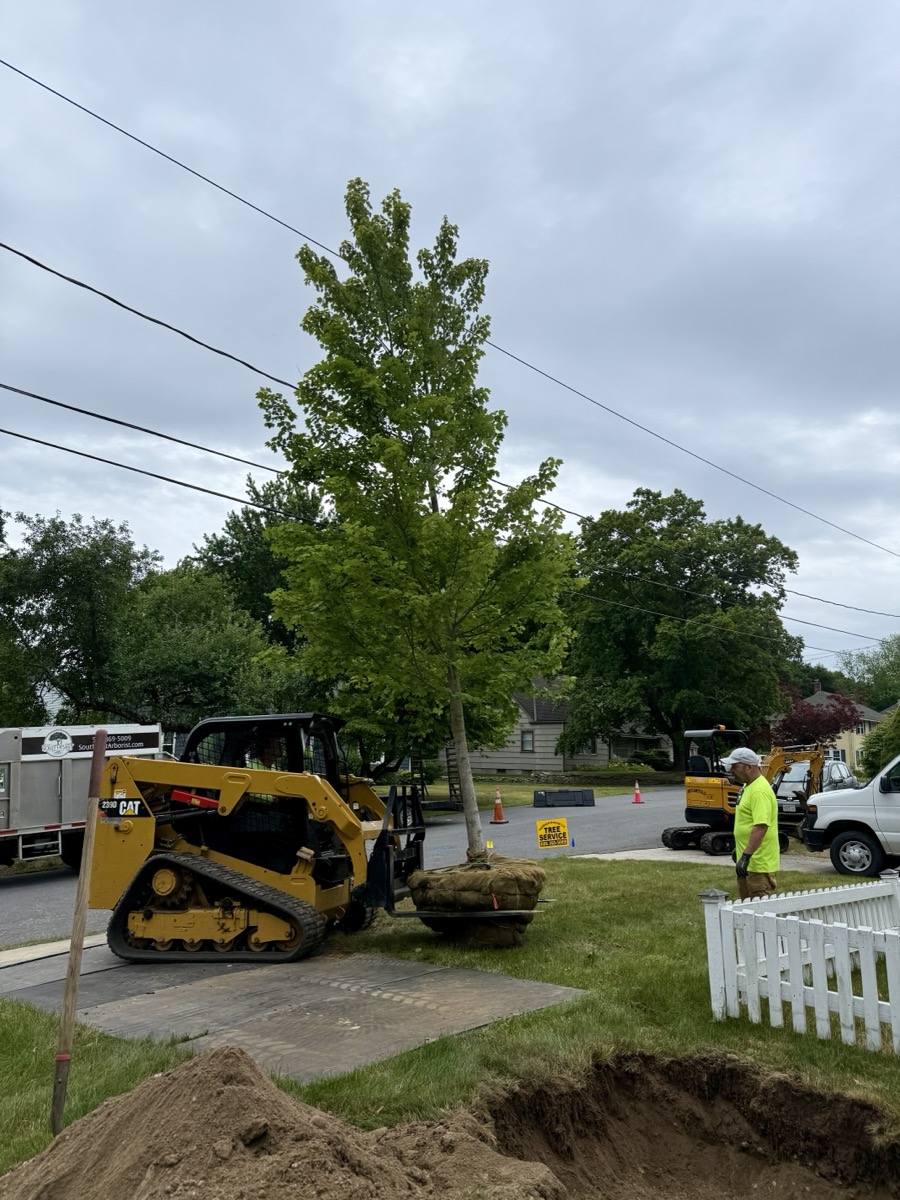
# Professional Tree Planting in East Bridgewater, Massachusetts
If you own a home in East Bridgewater, MA 02333, your property likely features mature white pines and red oaks shading postwar lots in neighborhoods like Elmwood or Joppa. These trees provide privacy and cooling, but oversized canopies often lead to removals due to root destabilization near wetlands or conflicts with overhead utilities on streets like Bedford or Liberty. When that happens, professional tree planting restores your landscape balance. Southeast Arborist, LLC, your South Shore Massachusetts tree care experts based in Plymouth and Cohasset, specializes in tree planting East Bridgewater MA homeowners trust.
As ISA Certified Arborists, we follow ANSI A300 standards for every installation, ensuring the right tree in the right place with proper technique. Our service area covers Plymouth County, including East Bridgewater's 14,800 residents in semi-rural settings with wetland corridors along the Satucket River. We select species suited to local soil—typically sandy loam with high water tables—and East Bridgewater's USDA Hardiness Zone 6b climate, where winters drop to -5°F and summers hit 85°F with 45 inches of annual rainfall.
Tree planting in East Bridgewater addresses specific needs: replacing hazard white oaks undermined by saturated soils in Cochesett or adding salt-tolerant red maples for properties near Route 106. We avoid common errors like volcano mulching, which suffocates roots, and expose the root flare on every tree for long-term health. Post-planting care guidance comes standard, including watering schedules tailored to your yard's drainage.
Homeowners in Brookside or Washington Heights call us after storm damage or to enhance curb appeal along Prospect Hill. Our free consultations assess microclimates, wind exposure from open fields, and proximity to septic systems common on moderate-sized lots. With safety protocols exceeding OSHA requirements, our crew uses rigging gear and bucket trucks to plant near structures without risk.
Whether you're reclaiming space after stump grinding a fallen black cherry or establishing a privacy screen of yellow birches, Southeast Arborist delivers results. Common projects include sugar maple replacements near the town center's heritage trees and American beech additions for shaded lawns. Call 508-369-5009 for your free on-site evaluation—let's plant trees that thrive on your East Bridgewater property for decades.
This approach prevents future issues like those seen in aging postwar neighborhoods, where improper past plantings led to leaning pines over garages. We prioritize native species: white pine for quick height, red oak for durable shade, white oak for longevity, and maples for fall color. Our ISA certification guarantees science-backed decisions, boosting your property value by 10-15% per local real estate data on treed lots.
In East Bridgewater's history of colonial deforestation, agricultural clearing, and 20th-century reforestation, today's dense canopy demands expert stewardship. Southeast Arborist plants with that legacy in mind, creating resilient landscapes amid wetland regulations and utility easements. Your trees deserve professionals who know Plymouth County's unique conditions—contact us today at 508-369-5009.
Why East Bridgewater Properties Need Tree Planting
East Bridgewater's semi-rural character means your property battles specific tree challenges tied to its geography in Plymouth County. Wetland corridors along the Satucket River saturate soils, destabilizing roots of mature white pines and red oaks on lots in Elmwood and Joppa. These oversized trees, remnants of post-war reforestation, often overhang homes, prompting removals that leave bare yards needing immediate replanting.
Local climate exacerbates issues: Zone 6b brings freeze-thaw cycles that heave shallow roots in clay-heavy uplands near Cochesett. High summer humidity fosters fungal diseases in American beech and black cherry, while winter salt spray from Route 24 affects maples in Washington Heights. Overhead utilities on residential streets like Central create conflicts, forcing cuts that open canopies and invite invasives.
Common tree species dominate: white pine grows 60-80 feet tall, casting dense shade but dropping needles that acidify soil; red oak and white oak form broad crowns ideal for shade yet prone to oak wilt in stressed conditions; sugar maple and red maple offer vibrant fall color but suffer iron chlorosis in alkaline pockets; American beech provides smooth bark texture but develops beech bark disease; black cherry attracts birds with fruit but hosts tent caterpillars; yellow birch thrives in moist areas but girdles from improper mulching.
After removals—frequent along the Satucket where floods undermine roots—your yard loses erosion control, wildlife habitat, and energy savings. A single mature tree cools your home equivalent to 10 room air conditioners, per USDA studies, critical in East Bridgewater's humid summers. Bare lots in Prospect Hill or Brookside erode topsoil into wetlands, violating town conservation bylaws.
Planting restores balance. Choose salt-tolerant species like red maple cultivars ('Autumn Blaze') for edges near plowed roads in nearby Bridgewater or Whitman. For wetland-adjacent Joppa properties, select flood-resistant white oak (Quercus alba) over thirsty white pine. Our ISA Certified Arborists analyze your soil pH (often 5.5-6.5 locally) and drainage during free consultations.
Neglect leads to regret: postwar lots average 0.5-1 acre, where unplanted spaces become weed patches or mosquito breeding grounds near Hanson borders. Heritage sugar maples near East Bridgewater's town center, dating to 1800s, show proper care's value—protected under town ordinance. Replicate that with yellow birch for north-facing slopes or American beech for understory shade.
Proactive planting prevents utility trims that scar new growth. In Brockton-adjacent areas, Eversource lines demand 10-20 foot clearances; plant low-growers like serviceberry beneath. East Bridgewater's reforestation history means your canopy can regenerate stronger—white pine/red oak mixes regenerate naturally but need human help on mowed lawns.
Soil conditions vary: sandy loams drain well in uplands but hold water in basins, risking phytophthora in oaks. Test your site; we recommend amendments like pine bark fines for maples. Planting now combats climate shifts—warmer winters extend pest seasons for emerald ash borer threats, though ash is rare here.
Your property thrives with tailored planting: privacy screens in Elmwood block Route 106 views; windbreaks in open Brookside fields. Without it, values drop—treed homes sell 7% faster per Realtor.com data. Southeast Arborist ensures tree planting East Bridgewater MA delivers lasting benefits amid these challenges.
Our Tree Planting Process in East Bridgewater
Southeast Arborist follows a precise, ISA Certified process for tree planting East Bridgewater MA properties, adhering to ANSI A300 standards for soil management and installation. We start with your free consultation at 508-369-5009, visiting your Elmwood or Cochesett site to evaluate soil, exposure, and utilities.
Step 1: Site Assessment (1-2 hours). Our arborists probe soil texture—sandy loam common in Plymouth County uplands—with a tile probe, checking compaction and drainage. We map overhead lines (call 811 first) and septic setbacks (50 feet per East Bridgewater code). For Joppa wetland edges, we note flood zones; recommend salt-tolerant red maples for salt-laden soils near West Bridgewater.
Step 2: Species Selection. Matching your goals, we choose from locals: white pine (Pinus strobus) for fast screens, reaching 50 feet in 20 years; red oak (Quercus rubra) for shade on south-facing Washington Heights lots; white oak for longevity (300+ years); sugar maple (Acer saccharum) near town center heritage trees. Avoid invasives; opt for disease-resistant American beech hybrids. We factor Zone 6b tolerances—down to -20°F for birches.
Step 3: Hole Preparation. Dig 2-3 times wider than root ball, no deeper than root flare. For a 2-inch caliper tree, that's 24-36 inches wide. Use our Bobcat skid-steer with auger on Prospect Hill lawns to break glacial till. Amend only if needed: 20% compost for clay in Brookside, avoiding fertilizers that burn roots. No volcano mulching—mulch in a 3-4 inch deep ring, 6 inches from trunk.
Step 4: Tree Handling and Placement. Cranes or telehandlers lift balled-and-burlapped stock (preferred for natives) without stressing roots. Position root flare at grade—critical in high-water-table East Bridgewater to prevent rot. Cut synthetic burlap flush; remove top third. For container trees like maples, tease circling roots.
Step 5: Backfill and Secure. Layer native soil, tamping to eliminate air pockets—reduces settle by 90%. Water in with 15 gallons per inch of caliper using our tank truck. Stake only if windy: two bamboo poles, loose ties checked after storms. No guy wires that girdle.
Step 6: Post-Planting Care. Provide written plan: 1-3 inches weekly water first year (adjust for Satucket rainfall), mycorrhizal inoculant for oaks. Prune only co-dominant leaders. Annual checks optional via our maintenance program.
Equipment ensures safety: ANSI-rated harnesses, chippers for debris, stump grinders post-removal. We comply with TCIA Best Management Practices, minimizing site impact on 0.5-acre lots.
For overhead conflicts in residential streets, plant crabapples under lines. Wetland projects follow Chapter 91 permits—our team coordinates. This process yields 95% survival rates vs. DIY's 60%, per ISA data.
In East Bridgewater's context, we adapt: elevated planting on saturated Cochesett soils using gravel bases; wind-resistant yellow birch ties on exposed fields. Every install boosts biodiversity—black cherry draws cedar waxwings.
Homeowners see results fast: new red oaks shade patios by year 5. Our Plymouth/Cohasset base means same-day response. Trust this process for tree planting East Bridgewater MA excellence.
Common Tree Planting Projects in East Bridgewater Neighborhoods
Elmwood residents plant white pines as privacy screens after removing leaning oaks destabilized by Route 106 runoff. These 20-30 foot starters block views while filtering stormwater into adjacent wetlands.
In Joppa, Satucket River proximity demands hazard removals of flood-weakened red maples; we replant salt-tolerant sugar maples ('Green Mountain') elevated 6 inches above grade, reclaiming yards post-stump grinding.
Cochesett's established neighborhoods feature crown-cleaned American beech shading postwar homes—post-trim, we add understory black cherry for layered canopies, enhancing bird habitat amid high water tables.
Brookside lots, with open fields near Whitman, get windbreak rows of yellow birch and white oak hybrids, planted 15 feet apart to stabilize soil on moderate slopes.
Washington Heights homeowners replace utility-conflicted white pines overhanging garages with low-vigor red oaks ('Pin Oak'), maintaining shade without Eversource trims.
Prospect Hill's uplands suit sugar maple avenues mimicking town center heritage trees; after deadwood removals, we install with root flare exposure to combat iron chlorosis in local loams.
Across East Bridgewater, post-removal planting pairs with stump grinding to level 12-inch-deep holes, allowing lawn restoration. Wetland corridor projects in Joppa include native red maple buffers, compliant with conservation commission rules.
Elmwood privacy projects often follow storm damage—our cranes plant 3-inch caliper white pines near foundations, 20 feet out. Cochesett understories fill gaps under beeches with serviceberry for pollinators.
Brookside windbreaks counter prevailing westerlies from Hanson fields, using staggered yellow birches that self-prune. Washington Heights garage-edge plants prioritize narrow crowns.
Prospect Hill avenues enhance curb appeal near schools, with white oaks selected for acorn production feeding local deer. Joppa riverbank installs feature erosion-control matting around new maples.
These projects reflect East Bridgewater's mix: 70% residential streets with dense canopies, 30% open lots needing screens. Southeast Arborist tailors to each—call 508-369-5009 for neighborhood-specific plans.
Tree Planting Costs in East Bridgewater, MA
Tree planting costs in East Bridgewater, MA vary by project scale, tree size, and site challenges, but deliver strong ROI for your property. A single 2-inch caliper white pine in Elmwood starts at $650 installed, including assessment, digging, staking, and initial water—far below DIY risks.
Factors driving price: Tree size—1.5-inch calipers for budget screens ($450-750); 3-inch for mature impact ($1,200-2,000). Species matters: native red oak ($800+) cheaper than specialty sugar maples ($1,100+). Site access—crane needed in tight Joppa backyards adds $300; wetland permits in Cochesett $150.
Labor dominates at 50-60%: our ISA Certified crew charges $150/hour, but flat-rate projects bundle efficiently. Soil work: auger rental $200 for compacted Prospect Hill till. Stump grinding post-removal $250 per stump clears space first.
Volume discounts apply: three-tree Brookside windbreaks save 15% ($1,800 total vs. $2,400). Add-ons like mulching ($100) or mycorrhizae ($50) boost survival.
Compare value: improper DIY fails 40% in East Bridgewater's climate, per UMass Extension, costing $1,000+ replacements. Our ANSI A300 compliance ensures 20-30 year lifespans, cooling bills drop $100/year per tree (EIA data).
Plymouth County averages: $700-1,500 small trees, $2,500+ large. We beat big-box by 20% with warranties—1-year survival guarantee standard.
ROI shines: treed lots appraise 12% higher (Appraisal Institute), vital on 0.5-acre postwar parcels. Energy savings pay back in 5 years; wildlife adds curb appeal for faster sales near Brockton.
Permits factor minimally—town requires none under 6-inch caliper, but we handle conservation filings. Financing via our partners eases multi-tree Washington Heights projects.
Long-tail savings: salt-tolerant plants cut future replacements near salted roads. Post-planting guidance prevents $500 callouts.
Budget transparently: free quotes detail line items. For East Bridgewater value, our costs reflect expertise—call 508-369-5009 to price your planting.
When to Schedule Tree Planting in East Bridgewater
Schedule tree planting in East Bridgewater from mid-April to early June or September-October, aligning with dormancy ends and soil thaw in Zone 6b. Spring avoids summer drought stress on new white pines; fall leverages 45-inch rainfall for root establishment before -5°F winters.
Avoid July-August heat—90% survival drops to 70% as maples transpire heavily in humid air. Post-frost (mid-May) ensures no heaving in sandy loams.
Urgency signs: bare yards after Satucket flood removals—plant ASAP to stabilize soil before erosion. Leaning utilities prompt immediate screens. Post-storm gaps in Elmwood canopies need fall fills.
Early spring beats root balls frozen in nurseries; we source from local growers like Weston Nurseries. Monitor forecasts—plant pre-rain for natural settling.
For Joppa wetlands, time around low tides; Prospect Hill slopes before leaf-out hides grade. Heritage tree zones near center require off-season to dodge tourists.
Our Plymouth base fills slots fast—book by March for April. Call 508-369-5009 now for timing tailored to your neighborhood.
Frequently Asked Questions About Tree Planting in East Bridgewater
**What makes tree planting East Bridgewater MA different from other towns?** Wetland saturation and utility density demand elevated installs and low-conflict species like red maples, unlike drier inland areas.
**How do I choose trees for my East Bridgewater soil?** Test pH (5.5-6.5 typical)—white oaks for acid uplands, amended maples for basins. Our ISA arborists select during free consults.
**How long until new trees shade my Cochesett yard?** White pines shade in 5 years at 2 feet/year; oaks 7-10 years. Proper flare exposure accelerates growth 20%.
**Do you handle permits for Joppa wetland planting?** Yes, we file with Conservation Commission for Satucket buffers, ensuring 100-foot wetland compliance.
**What's the warranty on Brookside installations?** 1-year survival; extendable to 3 years with our care plan. 95% success rate locally.
**Can you plant after removing a hazard oak in Washington Heights?** Absolutely—stump grind same day, plant red maple next week, reclaiming garage space.
**How much water for new yellow birches on Prospect Hill?** 1 inch/week first year, tapering; use rain gauges amid 45-inch annuals.
**Why avoid volcano mulching in East Bridgewater?** It rots flares in moist soils—our 4-inch rings promote 30% healthier roots.
Call 508-369-5009 for answers.
Tree Planting Throughout East Bridgewater
Southeast Arborist serves all East Bridgewater neighborhoods: Elmwood privacy screens, Joppa river buffers, Cochesett understories, Brookside windbreaks, Washington Heights shade trees, Prospect Hill avenues. Our South Shore coverage extends to Bridgewater, West Bridgewater, Whitman, Hanson, Brockton.
From Plymouth/Cohasset, we arrive equipped for any site. ISA Certified, ANSI-compliant tree planting East Bridgewater MA starts with your call.
Contact Southeast Arborist, LLC at 508-369-5009 for free consultation—plant thriving trees on your property today.