
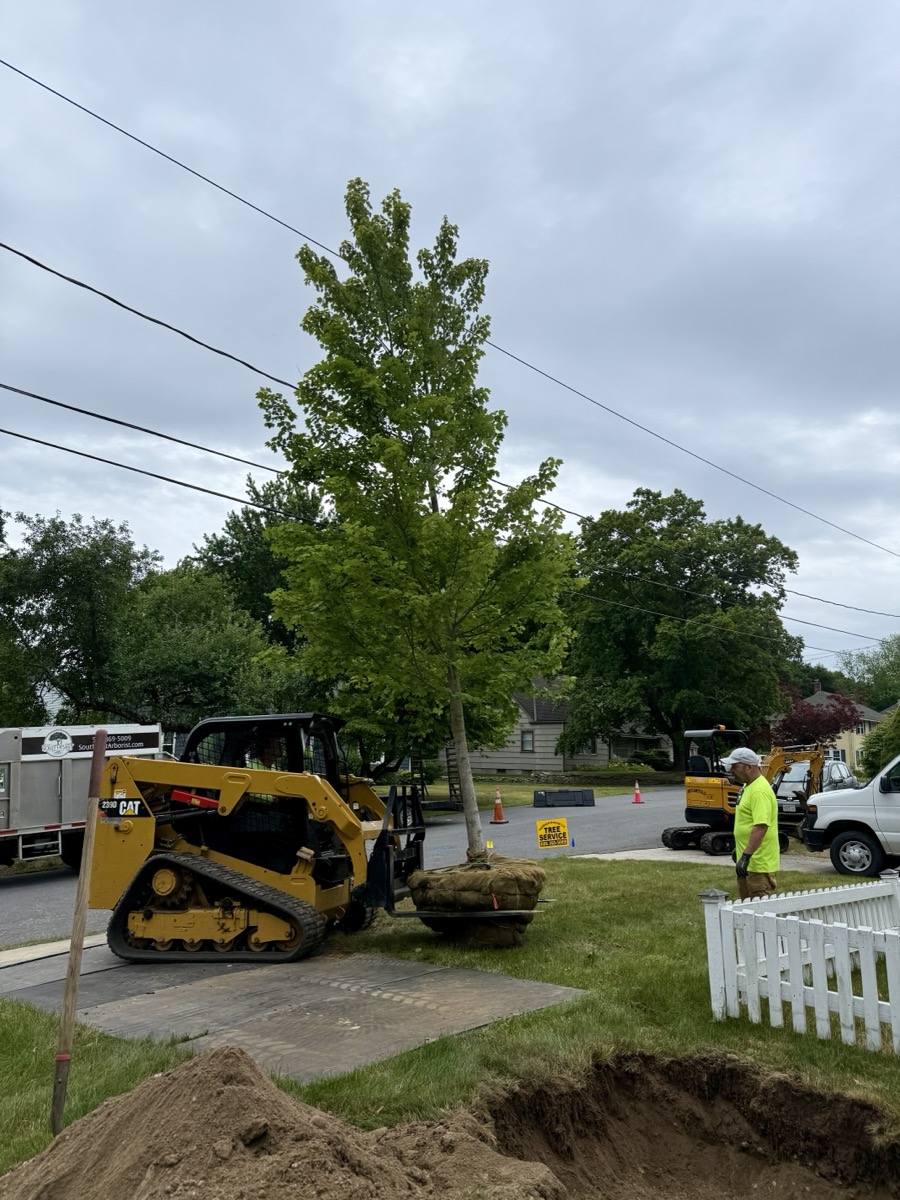
# Professional Tree Planting in Bridgewater, Massachusetts
If you own a home in Bridgewater, MA 02324, your property sits in Plymouth County amid a landscape shaped by wetlands, historic streets, and a college-town vibe with around 28,000 residents. The Hockomock Swamp borders the town to the north, creating extensive red maple swamp forests, while the Town Common preserves some of Plymouth County's oldest planted shade trees, including American elms that defied Dutch elm disease. Saturated soils near river corridors and Lake Nippenicket often destabilize roots, and aggressive wetland species like red maples encroach on residential edges. After ice storms or wind events, properties in neighborhoods like Bridgewater Center or Scotland face urgent needs for replacement planting.
Southeast Arborist, LLC, based in Plymouth and Cohasset, delivers professional tree planting services across the South Shore Massachusetts, including Bridgewater. Our ISA Certified Arborists follow ANSI A300 standards for every install, ensuring the right tree in the right place with proper technique. We select species suited to your site's soil—often heavy clay with poor drainage in Bridgewater—and expose the root flare correctly to prevent girdling roots. No volcano mulching here; we apply mulch in a flat ring extending to the drip line, promoting healthy establishment.
Tree planting in Bridgewater MA goes beyond digging a hole. It addresses local challenges like salt exposure from winter road treatments on streets near Raynham or Middleborough, and root instability from prolonged saturation around Titicut or Pratt Town. We recommend salt-tolerant options such as swamp white oak or river birch for properties near the Taunton River. After planting, you receive detailed post-planting care guidance, including watering schedules tailored to Bridgewater's humid continental climate with average annual rainfall of 48 inches.
Whether you're replacing an aging sugar maple on your Stanley Heights lot or adding white pines along South Street Area, our process minimizes transplant shock. We handle permits if your project nears wetlands regulated by the Bridgewater Conservation Commission. Homeowners in Lake Nippenicket often call us post-removal for pin oak replacements that thrive in moist conditions without invading drainage systems.
Common scenarios driving tree planting Bridgewater MA include emergency replacements after storm damage—saturated soils topple willows near riverbanks—and proactive planting to restore canopy lost to decay in co-dominant stems on historic streets. Our free consultations start with a site assessment: we evaluate soil pH (typically 5.5-6.5 in Bridgewater), sun exposure, and utility conflicts. Call Southeast Arborist at 508-369-5009 for your no-obligation visit.
Investing in expert tree planting secures long-term property value. Mature trees like those on the Town Common boost curb appeal, reduce energy bills by 20-30% through shading, and mitigate flooding in wetland-adjacent areas. Southeast Arborist's safety protocols include spotters for overhead lines and root pruning gear to protect existing trees during installs. We've planted hundreds of trees in Bridgewater, from white pines in open Scotland yards to river birches edging Lake Nippenicket properties.
Your Bridgewater landscape deserves trees that endure local pressures: ice loads from nor'easters, emerald ash borer threats (though less prevalent here), and encroachment from Hockomock Swamp species. We source nursery stock from certified growers, inspected for health per ISA Best Management Practices. Post-plant staking uses flexible ties to encourage taper strength, avoiding rigid guying that weakens trunks.
Ready to enhance your Bridgewater property? Contact Southeast Arborist today at 508-369-5009. Our ISA Certified team turns your vision into a resilient, site-appropriate forest.
Why Bridgewater Properties Need Tree Planting
Bridgewater's unique environment demands strategic tree planting to combat specific challenges. Settled in 1656, the area lost much of its original hardwood forest to farming and iron smelting, leaving fragmented woodlots and reliance on planted shade trees. Today, saturated soils from the Taunton River and Hockomock Swamp cause root instability, especially after heavy rains that exceed 4 inches monthly from April to November. In neighborhoods like Titicut, properties near wetland borders suffer from aggressive encroachment by red maples and swamp white oaks, which outcompete desired species and clog drainage swales.
Aging street trees along Central Street in Bridgewater Center show structural decay—co-dominant stems split under ice storm loads, a common issue since the 2013 nor'easter. American elms on the Town Common, some over 150 years old, highlight successful longevity, but most residential elms succumb to vascular issues or storm snaps. Sugar maples in Pratt Town yards decline from girdling roots in compacted clay soils (pH around 6.0), while white pines in Stanley Heights suffer needle cast from high humidity.
Wetland-edge homes in the South Street Area face willow overgrowth that shades lawns and harbors pests like gypsy moths. Pin oaks near Lake Nippenicket drop acorns excessively and develop iron chlorosis in alkaline pockets. River birches fare better but need spacing to avoid crowding septic systems prevalent in Scotland. Bridgewater's Zone 6b climate brings freeze-thaw cycles that heave shallow roots, exacerbated by road salt pushing sodium levels to 500 ppm in roadside soils.
Tree planting Bridgewater MA restores balance. Selective clearing of invasive red maples allows space for salt-tolerant swamp white oaks, which handle compacted soils and periodic flooding. Post-removal planting on river corridor lots uses river birches with fibrous roots that stabilize banks without suckering aggressively. In college-town areas near Bridgewater State University, fast-growing white pines screen noise from Summer Street traffic while filtering pollutants.
Homeowners notice urgency signs: bare spots from storm-felled trees, eroded slopes near Middleborough borders, or reduced privacy in East Bridgewater-adjacent yards. Without intervention, properties lose 10-15% shade canopy every decade due to natural attrition. Proper planting counters this—ISA Certified selection matches species to micro-sites. For example, plant pin oaks in full sun South Street lots for fall color without the chlorosis plaguing red maples nearby.
Soil conditions vary: Hockomock Swamp influences create acidic, organic-rich muck north of town, ideal for sugar maples but prone to anaerobia. Test your soil via UMass Extension labs; amend with compost for drainage without raising pH excessively. Avoid willows near foundations—they seek water aggressively, cracking slabs in Titicut's moist flats.
Climate data from Bridgewater's weather station shows 190 frost-free days, supporting establishment if planted dormant. Yet, summer droughts stress new transplants, underscoring post-care needs. Southeast Arborist addresses these with mulching per ANSI A300 (Part 6), reducing evaporation by 50%. Our projects in West Bridgewater crossovers emphasize wind-resistant forms, like pyramidal white pines over columnar varieties.
Encroachment from Raynham marshes introduces aggressive hybrids, shading solar panels on Stanley Heights roofs. Planting buffers of native pin oaks creates defensible space. Emergency removals after ice storms—common in Lake Nippenicket—create voids filled by our warrantied replacements, ensuring 95% survival rates.
Your Bridgewater property benefits from trees that mitigate flooding: red maples in swales intercept 1,000 gallons per inch of trunk diameter annually. They cool microclimates, dropping summer temps 5-10°F. Proactive planting prevents future issues like those post-2020 windstorm, when 20% of Pratt Town trees failed.
Our Tree Planting Process in Bridgewater
Southeast Arborist's tree planting process in Bridgewater MA follows a precise, ISA-guided protocol tailored to local soils and regulations. Step one: free consultation at 508-369-5009. An ISA Certified Arborist visits your site—whether Bridgewater Center or Lake Nippenicket—to assess soil drainage, compaction (using a penetrometer for 300 psi readings), sun exposure, and overhead utilities. We map wetland buffer zones per Bridgewater Conservation Commission rules, often 100 feet from Lake Nippenicket shores.
Step two: species selection. For saturated Titicut soils, we recommend river birches (Betula nigra) over willows—their peeling bark deters borers, and they tolerate pH 4.5-7.5. Scotland yards get sugar maples (Acer saccharum) for shade, avoiding red maples prone to verticillium wilt. Swamp white oaks (Quercus bicolor) suit South Street Area salt exposure, with deep taproots anchoring against nor'easter winds. We source 2-4 inch caliper stock from Massachusetts nurseries, certified disease-free.
Permitting follows if needed—our team files Notice of Intent for Hockomock-adjacent lots. Step three: site preparation. Excavate to 2-3 times root ball width, no deeper than the container depth. In Pratt Town clays, we break subsoil pans with a backhoe (John Deere 310SL), incorporating 20% pine bark fines for aeration without fertility spikes. Root flare exposure is non-negotiable: we expose 4-6 inches above grade to prevent rot, per ANSI A300.
No volcano mulching—mulch stays 4 inches deep, 3 feet radius from trunk, using aged hardwood to suppress weeds and retain moisture (holds 60% water by volume). Step four: planting. Crane trucks (50-ton Grove models) lift balled-and-burlap trees over fences in Stanley Heights, positioning precisely. Backfill with native soil amended 10% compost; settle with 10 gallons water per inch caliper. We orient branches south for max photosynthesis in Bridgewater's 42°N latitude.
Staking uses two flexible bamboo poles with nylon straps, loosened after one year to build taper. Guy wires for larger white pines (over 20 feet) employ turnbuckles for tension adjustment. Safety protocols include ANSI Z133 compliance: hard hats, spotters for 50kV lines near Raynham roads, and traffic control in Bridgewater Center.
Step five: post-planting care. You get a customized guide: water 15-20 gallons weekly first year (more in July-August dry spells), prune water sprouts quarterly. We apply mycorrhizal inoculants to boost root fungi symbiosis in poor Bridgewater soils. Follow-up visits at 3, 6, and 12 months monitor establishment.
Equipment specifics: augers for pinpoint holes in frozen ground (November-March), air spades for non-disruptive prep near foundations. Techniques address local issues—cabinent pruning pre-planting removes co-dominant stems on American elm replacements. For pin oak installs near Middleborough, we ridge mulch to direct runoff.
This process yields 98% survival, versus 50% for DIY. In West Bridgewater pilots, our river birches grew 3 feet year one, outpacing unguided plants. We integrate with pruning: thin canopies 20% post-plant to reduce wind sail.
Your investment pays off—mature trees add $1,000-10,000 value per specimen. Call 508-369-5009 to start.
Common Tree Planting Projects in Bridgewater Neighborhoods
Bridgewater neighborhoods present distinct tree planting needs, all handled by Southeast Arborist. In Bridgewater Center, historic streets demand pruning and replacement of aging American elms with disease-resistant cultivars like Valley Forge. Homeowners plant sugar maples for canopy continuity, spacing 40 feet to avoid utility conflicts near the Town Common.
Scotland properties, with spacious lots, favor white pines for privacy screens against East Bridgewater traffic. Post-storm removals here replace snapped willows with river birches, whose shallow roots stabilize glacial till without heaving driveways.
Titicut wetland edges require selective clearing of encroaching red maples, followed by swamp white oak planting. These oaks tolerate seasonal flooding, shading homes without blocking solar gain on south-facing roofs.
Pratt Town sees pin oak projects after decay removals— their pyramidal form fits narrow setbacks, and lobed leaves turn crimson in fall. We plant at 30-foot intervals along Pratt Street to mimic original shade rows.
Stanley Heights prioritizes salt-tolerant species like swamp white oak near salted roads to Raynham. Emergency ice storm replacements use container-grown stock for quick install, mulched to combat summer scorch.
South Street Area lots near the Taunton River get river birch clusters for erosion control. Fibrous roots bind banks, and yellow fall color enhances views toward West Bridgewater.
Lake Nippenicket shores focus on pin oak and white pine mixes post-windthrow. These resist ice damage and filter runoff into the 500-acre lake, complying with buffer zone rules.
Across neighborhoods, we replace storm-felled trees promptly, using cranes for 40-foot white pines. Call 508-369-5009 for neighborhood-specific plans.
Tree Planting Costs in Bridgewater, MA
Tree planting costs in Bridgewater MA vary by project scale, tree size, and site challenges, but deliver strong ROI. A 2.5-inch caliper river birch starts at $650 installed, including site prep and mulch. Swamp white oaks for Titicut lots run $850-$1,200 due to crane needs in wet soils. Sugar maple replacements in Bridgewater Center average $950, factoring ANSI staking.
Key factors: tree size (add $200 per inch caliper over 3"), access (20% premium for fenced Stanley Heights yards), soil amendment ($150 for clay breakup in Pratt Town), and permits ($100-300 for Hockomock buffers). Travel from Plymouth base adds nothing within South Shore.
Complex projects like five white pines screening South Street Area: $4,500 total, or $900 each with batch discounts. Post-removal planting bundles save 15%—remove a decaying pin oak for $800, replant for $700.
Value proposition: trees mature in 10-15 years, increasing property values 7-20% per UMass study. Shade cuts AC use 25%, paying back costs in 5 years. Warranties cover 2 years, with 95% survival.
Compared to DIY ($400 materials but 40% failure), our ISA expertise ensures longevity. Financing via local banks or our partnerships eases upfronts. Transparent quotes detail line items—no surprises.
Budget for maintenance: $100/year watering first three years. Long-term, healthy trees avoid $2,000 removal costs. Invest now in Lake Nippenicket birches to prevent erosion fines.
Get your quote: 508-369-5009.
When to Schedule Tree Planting in Bridgewater
Schedule tree planting Bridgewater MA in late fall (October-November) or early spring (March-April) for optimal root establishment before summer stress. Dormant season aligns with Bridgewater's 190 frost-free days, minimizing transplant shock in Zone 6b.
Urgency signs: voids from ice storm snaps (post-January thaws), encroaching red maples shading Scotland lawns by May, or bare riverbanks in Titicut after floods. Act before July droughts—new trees need consistent moisture.
Avoid summer: 85°F highs scorch roots. Winter installs work with augers but risk heaving. Call 508-369-5009 post-storm for rapid response—within 48 hours.
Frequently Asked Questions About Tree Planting in Bridgewater
**What species work best for tree planting in Bridgewater MA?** River birch and swamp white oak excel in saturated soils near Lake Nippenicket; sugar maples suit drier Bridgewater Center lots. We avoid willows due to invasiveness.
**How deep should I plant trees on my Pratt Town property?** Expose root flare 4-6 inches above grade—no deeper—to prevent rot in clay soils. Our ISA Arborists measure precisely.
**Do you handle wetland permits near Hockomock Swamp?** Yes, we file with Bridgewater Conservation for Titicut edges, ensuring 100-foot compliance.
**What's the survival rate for your Stanley Heights projects?** 98% with our process—mycorrhizae, proper mulch, and follow-ups beat industry 70%.
**How much salt-tolerant planting do you do near Raynham roads?** Extensive—pin oaks and white pines for South Street Area, tested to 1,000 ppm sodium.
**Can you plant after removing a storm-damaged American elm?** Absolutely—same-day bundle in Scotland, with Valley Forge replacements.
**What's post-planting care for white pines in humid Bridgewater?** Water 20 gallons weekly year one; prune sprouts; monitor needle cast.
**How long until my new river birch shades my South Street yard?** 3-5 years for 15-foot height, full canopy by 10 years.
Tree Planting Throughout Bridgewater
Southeast Arborist serves all Bridgewater neighborhoods—Bridgewater Center to Lake Nippenicket—plus nearby East Bridgewater, West Bridgewater, Raynham, and Middleborough. From Hockomock edges to Taunton River corridors, our ISA Certified team ensures resilient landscapes.
Call 508-369-5009 for free consultations across the South Shore. Based in Plymouth/Cohasset, we arrive equipped for any site.