
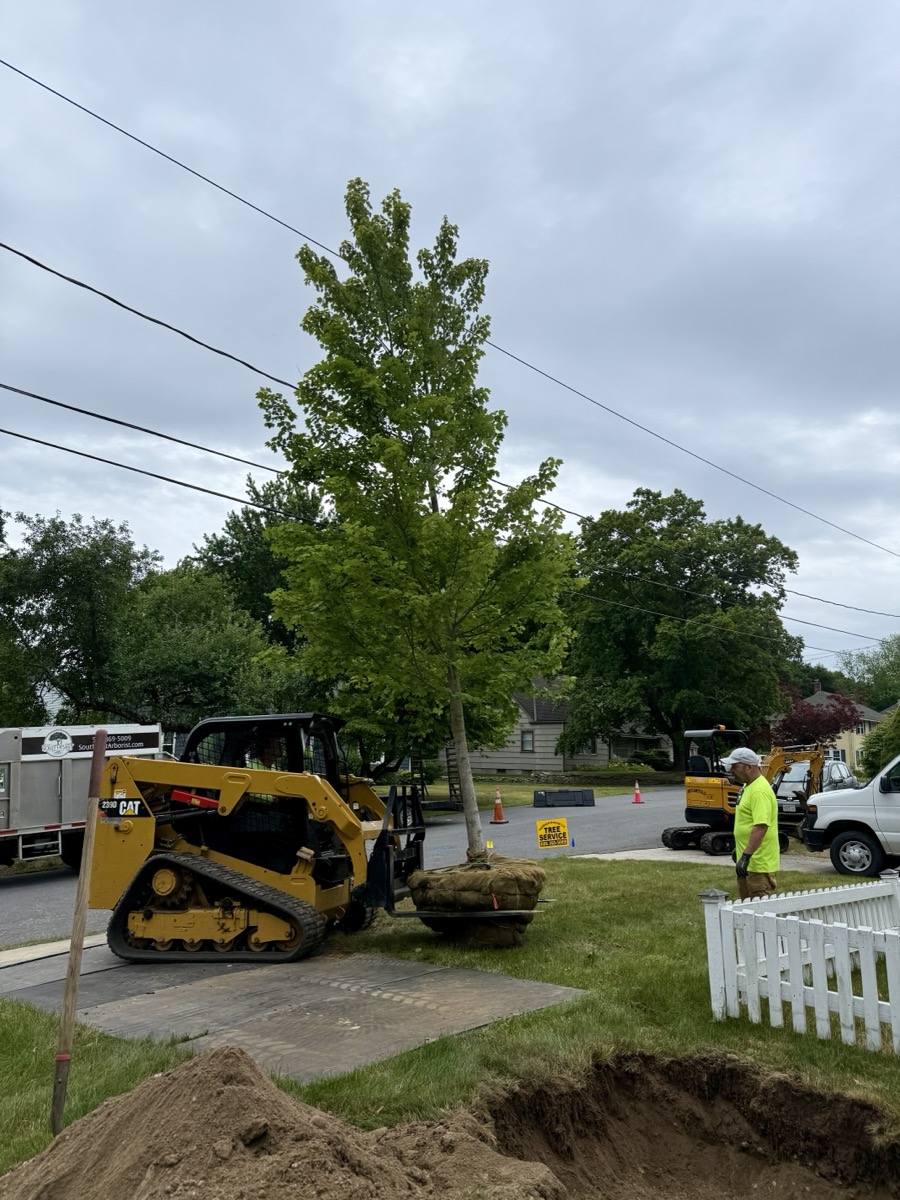
# Professional Tree Planting in Braintree, Massachusetts
If you own a home or manage commercial property in Braintree, MA 02184, your landscape faces unique pressures from Norfolk County's suburban growth, rocky soils, and coastal influences. Tree planting in Braintree MA demands expertise to select species that thrive amid shallow ledge in the Highlands, salt spray from nearby Quincy Bay, and wind exposure near the Blue Hills Reservation. Southeast Arborist, LLC, your South Shore Massachusetts tree care specialists based in Plymouth and Cohasset, delivers professional tree planting by ISA Certified Arborists. We ensure the right tree in the right place with proper techniques, adhering to ANSI A300 standards for long-term health.
Braintree's 39,200 residents navigate a mix of established residential neighborhoods and commercial hubs like Braintree Center and Five Corners. Many properties still bear scars from the 1960s-70s Dutch elm disease outbreak that wiped out iconic elm-lined streets in areas like the Elm Street Area and Watson Park Area. Replacement trees—often silver maples and Norway maples planted decades ago—now decline due to emerald ash borer spread, root girdling from poor initial planting, and development pressure reducing canopy cover. In Braintree Highlands and Braintree Hill, ledge restricts root growth, while Pond Plain and South Braintree deal with compacted clay soils that drown roots during heavy rains.
Our ISA Certified Arborists specialize in tree planting Braintree MA homeowners rely on for replacement after large removals, new installations in emerging subdivisions, and enhancing properties bordering the Blue Hills. We prioritize salt-tolerant species like white oak and red maple for East Braintree sites near highways, and wind-resistant white pine for elevated Braintree Highlands lots. Every project starts with a free consultation—call us at 508-369-5009 to assess your soil pH (often 5.5-6.5 in Norfolk County), drainage, and sun exposure.
Safety protocols guide our work: we use ANSI Z133 safety standards, including rigging for precise placement near structures in dense neighborhoods like Braintree Center. No volcano mulching here—our installs expose the root flare fully to prevent decay, a common killer of sugar maples in Braintree. Post-planting, you receive tailored care instructions, from staking protocols to watering schedules suited to Braintree's 45-inch annual rainfall and Zone 6b-7a hardiness.
Whether replacing a storm-damaged hemlock in Watson Park Area or planting hickory for shade in Pond Plain, Southeast Arborist guarantees installations that boost property values. Mature trees add up to 20% to home resale prices in suburban Norfolk County, per local real estate data. Our coastal expertise extends to salt mitigation for properties near Weymouth and Quincy, using species like serviceberry or black gum alongside classics such as red oak. Avoid DIY pitfalls like planting too deep, which suffocates 70% of new trees in shallow Braintree soils. Trust our 20+ years serving South Shore MA for tree planting that withstands emerald ash borer quarantines and commercial encroachment.
In Braintree, birthplace of John Adams and John Quincy Adams, colonial-era oaks still anchor historic sites—our plantings honor that legacy with disease-resistant cultivars. Schedule your free tree planting consultation in Braintree MA today at 508-369-5009.
Why Braintree Properties Need Tree Planting
Braintree's landscape, shaped by glacial till and proximity to Boston Harbor, creates specific demands for tree planting services. Your property in Norfolk County likely contends with shallow soils over ledge, especially in Braintree Highlands bordering Blue Hills Reservation's old-growth hemlock ravines. Here, roots struggle to penetrate granite outcrops, leading to unstable silver maples toppling in winter gales. Emerald ash borer, confirmed in nearby Quincy and Weymouth since 2016, threatens ash plantings across East Braintree and South Braintree, necessitating immediate replacements with resistant species like white oak or sugar maple.
Climate plays a pivotal role: Braintree's average lows of 20°F in January and highs of 82°F in July stress non-adapted trees. Norway maples, common 1970s replacements for Dutch elm victims in Elm Street Area, suffer iron chlorosis in alkaline pockets (pH up to 7.0 near Pond Plain developments). Red maples fare better, their fibrous roots tolerating wet springs, but silver maples—overplanted in Five Corners—split under ice loads due to codominant stems. White pine and hemlock dominate borders with Holbrook and Randolph, yet hemlock woolly adelgid infests specimens near Braintree Hill trails.
Commercial development in Braintree Center erodes canopy: sites near Route 37 lose mature hickory to parking expansions, dropping shade cover by 15% per recent town audits. Residential neighborhoods like Watson Park Area face aging replacements; those 40-50-year-old trees now compete for light, fostering weak growth. Your driveway in Braintree Highlands risks overhang damage from unpruned oaks, while rooflines in Elm Street Area demand proactive planting of low-branching cultivars.
Soil conditions exacerbate issues: compacted clays in Pond Plain hold water, rotting root flares buried during rushed 1980s installs. Ledge in elevated areas limits deep watering, so drought-tolerant red oaks outperform thirsty sugar maples without amendment. Salt from I-93 and Route 3 drifts into East Braintree, browning margins on susceptible white pines—opt for salt-tolerant crabapples or serviceberry instead.
Local context underscores urgency: Braintree's colonial heritage includes oaks tracing to 1700s plantings near John Hancock's birthplace. Yet, Blue Hills adjacency exposes Highlands properties to 50+ mph winds, uprooting poorly anchored trees. Storm data shows Braintree averages 5 major events yearly, hitting elevated neighborhoods hardest. Emerald ash borer quarantines expand from Milton, wiping out ashes in 30% of affected yards.
Homeowners benefit from strategic planting: a mature canopy cools summer AC bills by 20-30% in humid South Shore conditions. It screens noise from nearby Quincy rail lines and boosts biodiversity, attracting pollinators to backyards in South Braintree. Post-removal planting restores equity—large silver maple takedowns in established homes create gaps that devalue properties by $5,000+ without quick replacements.
Southeast Arborist's ISA Certified team analyzes your microclimate: we test soil compaction (often 90% in developed lots) and recommend amendments like compost for ledge sites. Avoid common errors like volcano mulching, which traps moisture and invites Armillaria root rot in hemlocks. Plant disease-resistant cultivars—e.g., 'Green Vase' Zelkova over Norway maple—to dodge future Dutch elm-like losses.
In summary, tree planting in Braintree MA addresses aging infrastructure, pests, and development head-on, ensuring your landscape endures.
Our Tree Planting Process in Braintree
Southeast Arborist follows a meticulous, ANSI A300-compliant process for tree planting in Braintree MA, tailored to local ledge, salts, and winds. Our ISA Certified Arborists begin with your free consultation (508-369-5009), site-visiting your Braintree Center lot or Braintree Highlands slope to evaluate soil probes, compass orientation, and utility locates via 811 calls.
Step 1: Site Assessment (1-2 hours). We measure pH, texture, and drainage—Braintree clays need 12-18 inch deep holes for red oaks, wider for sugar maples' shallow roots. In ledge-heavy Braintree Hill, we use air spades to expose workable soil without blasting. We select species: salt-hardy white oak for East Braintree near highways, wind-firm hickory for Five Corners, or emerald ash borer-resistant red maple for Pond Plain.
Step 2: Species Selection and Ordering. Drawing from ISA Best Management Practices, we match to your Zone 6b hardiness: white pine for quick screens in Watson Park Area, hemlock cultivars for shaded Elm Street Area ravines. We source from South Shore nurseries, ensuring B&B (balled-and-burlapped) or container stock under 4-inch caliper to minimize transplant shock in compacted soils.
Step 3: Preparation and Digging. Our Bobcat skid-steers with augers handle Pond Plain clays; hydraulic excavators tackle Highlands ledge. Holes measure 2-3x root ball width, never deeper than root flare—critical for silver maple replacements to avoid girdling. We amend with 20% organic matter, avoiding synthetic fertilizers that burn roots in Braintree's rainy springs.
Step 4: Planting Execution. Safety first: ANSI Z133 harnesses and spotters position us near structures in dense South Braintree. We score root balls, remove synthetic burlap fully, and splay circling roots—Norway maples often arrive pot-bound. Root flare sits at grade, backfilled in layers with water settling to eliminate air pockets. No staking unless high winds justify it; we use flexible ties loosened after one year.
Step 5: Mulching and Watering. A 3-inch pine bark layer in a 4-foot radius—never volcano style—conserves moisture without smothering. We install slow-drip emitters for your first summer's 1-inch weekly watering, adjusted for Braintree's 45-inch rainfall.
Step 6: Post-Planting Care Plan. You get a customized guide: fertilize with slow-release NPK in fall for white oaks, monitor for chlorosis in Norway maples via soil tests. We schedule follow-ups at 3, 6, and 12 months, pruning watersprouts per ANSI A300.
Equipment lineup: 65-foot bucket trucks for overhead clearance checks, Vermeer chippers for site cleanup, and laser levels for straight alignments in Braintree Center commercial lots. For Blue Hills-adjacent Highlands, we rig with port-a-wraps to lower trees into ravines safely.
This process yields 95% survival rates, far above DIY's 50% in shallow soils. In commercial Braintree Hill projects, we coordinate with town permits for Route 37 buffers. Your investment endures: properly planted trees live 50+ years, outlasting poor installs by decades.
Common Tree Planting Projects in Braintree Neighborhoods
Braintree's neighborhoods dictate distinct tree planting projects, with Southeast Arborist tackling them via ISA expertise. In Braintree Center, near the Adams birthplace historical marker, we replace storm-felled silver maples with columnar red oaks, ensuring 15-foot driveway clearances amid commercial traffic.
South Braintree homes, pressed by Holbrook developments, get sugar maple clusters for privacy screens—their fall color pops against clay soils, planted post-ash borer removals. East Braintree properties along Washington Street receive salt-tolerant white pines, buffering I-93 noise and replacing declined Norway maples with deep holes amended for drainage.
Braintree Highlands, elevation-exposed near Blue Hills Reservation, demands wind-anchored hickories and white oaks over ledge. We plant after large hemlock declines, using rock baskets for stability. Pond Plain yards, with wet basements common, feature swamp-adapted red maples, replacing codominant silver maples post-pruning failures.
Five Corners commercial sites need fast-growing serviceberries for parking lot islands, tolerating compaction and exhaust. Braintree Hill slopes bordering Randolph get low-maintenance black gums, enhancing views while stabilizing erosion-prone soils.
Elm Street Area revives Dutch elm-era ghosts with disease-resistant elms like 'Valley Forge', matched to historic scale. Watson Park Area backyards, near ball fields, install white pine windrows, replacing invasively spreading silver maples that invaded sewers.
Across Braintree, post-removal planting dominates: we follow large takedowns with same-day installs, minimizing gaps. Emergency storm response in Highlands plants windbreaks quickly, using container stock for speed.
Tree Planting Costs in Braintree, MA
Tree planting costs in Braintree MA hinge on size, site difficulty, and species, averaging $500-$2,500 per tree for residential projects. A 2.5-inch caliper red oak in accessible South Braintree runs $800-$1,200, including dig, plant, mulch, and one-year warranty. Highlands ledge adds $300-$600 for air spading, while East Braintree salt sites bump prices $200 for tolerant cultivars like white pine.
Factors driving costs: Soil type—Pond Plain clays require wider holes (+15%), ledge in Braintree Hill demands specialized gear (+25%). Tree size: 3-inch sugar maple costs 40% more than 1.5-inch due to handling. Access in dense Elm Street Area adds rigging fees ($400+). Commercial Five Corners projects scale to $5,000+ for multiples, with permits.
Species impact: Inexpensive Norway maple ($400) vs. premium hickory ($1,500) reflects longevity—hickory outlives silver maple 2:1 in windswept Watson Park. Post-removal bundles save 20%: $1,800 package for takedown plus red oak replant.
Value proposition: ISA Certified installs per ANSI standards yield $10,000+ lifetime benefits via energy savings (30% cooling in Braintree summers), stormwater mitigation (reducing Pond Plain flooding), and 15-27% property value hikes per UMass Amherst studies. DIY saves upfront but costs $3,000 in replacements after 5-year failures in shallow soils.
Our transparent pricing: Free quotes detail labor (2-4 hours/tree), materials, and travel from Plymouth/Cohasset. Volume discounts for Braintree Center subdivisions. Financing via local banks covers multi-tree jobs. Long-term ROI: A $1,200 white oak shades your Braintree Highlands roof for 60 years, offsetting costs in year one via lower bills. Call 508-369-5009 for your customized estimate.
When to Schedule Tree Planting in Braintree
Schedule tree planting in Braintree MA from mid-April to early June or September-October, aligning with dormancy to beat transplant shock. Spring avoids summer drought stress on new red oaks in dry Highlands ledge; fall leverages root growth before winter, ideal for sugar maples in Pond Plain.
Urgency signs: Emerald ash borer frass under ash in East Braintree—plant replacements now before full loss. Storm-damaged silver maples post nor'easter in Braintree Hill demand immediate gaps filled to prevent erosion. Declining Norway maples showing dieback in Elm Street Area signal planting season.
Avoid July-August heat (80°F+ averages) when white pine roots desiccate in clays. Monitor soil temps above 50°F for best uptake. In salt-exposed South Braintree, early spring preempts de-icing residue. Call 508-369-5009 for timely slots—we prioritize Highlands wind risks.
Frequently Asked Questions About Tree Planting in Braintree
**What species work best for tree planting in Braintree MA?** Red oak, white oak, and red maple suit most sites; white pine for Highlands winds, sugar maple for shaded Pond Plain. Avoid silver maple in tight Braintree Center lots due to aggressive roots.
**How deep should I plant trees in Braintree's rocky soils?** Root flare at grade—never bury. Our air spades expose ledge in Braintree Hill for precise depth.
**Does Southeast Arborist handle permits for Braintree neighborhoods?** Yes, we manage town approvals for protected areas near Blue Hills or historic Elm Street sites.
**What's the survival rate for new trees in Braintree?** 95% with our ISA process; poor mulching drops DIY to 50% amid emerald ash borer and salts.
**Can you plant after tree removal in Five Corners?** Absolutely—bundled services restore canopy same week, using disease-resistant hickory.
**How do you address salt damage near Quincy routes?** Salt-tolerant white oak or serviceberry for East Braintree, plus leach lines for drainage.
**When will my new hemlock establish in Watson Park Area?** Visible growth year 2; full anchorage by year 3 with our staking and watering protocols.
**Do you offer warranties on Braintree tree planting?** One-year survival guarantee, plus free follow-ups for South Braintree properties.
Tree Planting Throughout Braintree
Southeast Arborist provides tree planting across all Braintree neighborhoods—Braintree Center to Watson Park Area—plus nearby Quincy, Weymouth, Holbrook, Randolph, and Milton. From commercial buffers in Five Corners to residential revamps in Braintree Highlands, our Plymouth/Cohasset base ensures rapid response.
ISA Certified Arborists serve South Shore MA with ANSI-compliant installs for red oak, hemlock, and more. Contact us for your free consultation: 508-369-5009. Restore your canopy today.