
# Professional Tree Cabling in Rehoboth, Massachusetts
If you own property in Rehoboth, Massachusetts, your trees face unique pressures from the town's rural landscape, dense forests, and variable weather. Rehoboth's 12,000 residents maintain large lots bordered by stone walls and mature woodlands, where red oaks, white oaks, and sugar maples dominate. These trees, some growing from boundaries cleared in the 1600s, often develop weak crotches or codominant stems due to overcrowding and past spongy moth outbreaks. Tree cabling in Rehoboth MA provides the structural reinforcement needed to prevent failure, saving you the expense and loss of heritage specimens.
Southeast Arborist, LLC, based in Plymouth and Cohasset, delivers ANSI A300-compliant tree cabling across Bristol County, including Rehoboth 02769. Our ISA Certified Arborists assess your white pines along Hornbine roadsides or American beeches in Palmer River bottomlands, installing high-strength cables to support weak attachments. This service preserves trees that enhance your property's value while mitigating risks from ice storms, a frequent threat in Rehoboth's inland position.
Consider a shagbark hickory on your Anawan lot with split limbs from emerald ash borer stress nearby—cabling stabilizes it without removal. Homeowners in North Rehoboth report overhanging black birches endangering narrow roads; our cabling reduces that hazard. Unlike bracing rods, cabling allows natural movement, preventing bark girdling on species like eastern hemlock or tulip trees.
Rehoboth's agricultural-forest interface demands proactive care. Farms along Route 44 need cabling for red maples near fence lines, maintaining defensible space. Our annual inspection program tracks cable tension on your oaks, adjusting for growth. This approach complies with town bylaws and insurance requirements, lowering liability.
Tree cabling Rehoboth MA costs less than full removal—often 40-60% cheaper for mature trees—while boosting curb appeal in Rehoboth Village. Spongy moth damage has left widespread hazard trees; cabling lets you retain canopy shade for livestock pastures. Call Southeast Arborist at 508-369-5009 for a free assessment. Our South Shore team arrives equipped for your soil's rocky, well-drained profile, which stresses roots and prompts leaning trunks.
In Rehoboth's oldest continuously wooded areas, cabling extends tree life by decades. White oaks framing stone walls in South Rehoboth withstand wind better post-cabling. We prioritize safety with TCIA accreditation and use only EIP-rated hardware. Schedule tree cabling services in Rehoboth MA today to protect your investment amid ice events and rural road demands.
Why Rehoboth Properties Need Tree Cabling
Rehoboth's rural farming heritage shapes its tree challenges. Settled in 1643, the town preserves Bristol County's oldest wooded lands, with stone-wall-lined roads flanked by mature forests. Your property likely features red oak and white oak canopies over former pastures, now overcrowded from natural succession. These species develop V-shaped crotches prone to splitting under ice loads, common in Rehoboth's inland climate with 45-50 inches annual precipitation.
Spongy moth damage exacerbates issues. Outbreaks since 2021 have defoliated sugar maples and American beeches in Hornbine and North Rehoboth, weakening limbs and creating hazard trees. Cabling supports these declining specimens, allowing recovery without removal. Emerald ash borer threatens nearby ash, stressing adjacent black birches and shagbark hickories through competition.
Ice storms hit hard due to Rehoboth's dense canopy. Eastern hemlocks and white pines in Palmer River valleys accumulate 1-2 inches of ice, snapping unsupported branches. Red maples, with brittle wood, lean over winding roads like those in South Rehoboth. Tree cabling Rehoboth MA addresses this by linking codominant stems, distributing weight.
Soil conditions amplify vulnerabilities. Rehoboth's glacial till—sandy loam over bedrock—limits root depth, causing windthrow in tulip trees during nor'easters. Agricultural-forest interfaces near Swansea and Seekonk borders require cabling for fence-line red oaks, preventing encroachment on pastures.
Road safety demands attention. Narrow lanes in Anawan and Rehoboth Village carry farm traffic; overhanging white pines risk downing power lines. Our ISA Certified Arborists identify defects via visual tree risk assessments (VTA), cabling high-value trees per ANSI A300 standards.
Large-lot woodland management prevails. In Palmer River areas, riparian hardwoods like beeches need cabling to resist flooding while maintaining wildlife corridors. Ice-vulnerable sugar maples in North Rehoboth benefit from dynamic cabling, which flexes with sway.
Storm history underscores urgency. The 2011 Halloween nor'easter felled uncabled oaks across Bristol County; Rehoboth's position spared coastal winds but not ice. Recent spongy moth cycles mirror 1980s events, leaving hickories with deadwood overhangs.
Practical advice for your property: Inspect red oaks for included bark at crotches—smooth unions fail first. Test white pines by pushing branches; excessive sway signals cabling needs. In farm settings, prioritize tulip trees near barns for defensible space.
Cabling outperforms removal for heritage trees. A cabled black birch in Hornbine withstands 50 mph gusts, preserving soil stabilization on slopes. Southeast Arborist's protocols include load calculations for Rehoboth's 20-30 foot mature trees, ensuring longevity.
Nearby towns like Attleboro face similar issues, but Rehoboth's rural density heightens needs. Cabling your hemlocks prevents debris on Palmer River trails, enhancing community safety.
Our Tree Cabling Process in Rehoboth
Southeast Arborist follows a precise, ANSI A300-compliant process for tree cabling in Rehoboth MA, tailored to local species and terrain. We start with a site visit to your Rehoboth Village property, where our ISA Certified Arborists conduct a level 2 VTA. This examines red oaks for codominant leaders, measuring crotch angles under 90 degrees as high-risk.
Step 1: Risk Assessment (1-2 hours). Using resistograph tools, we probe white pine wood strength, detecting spongy moth decay. For sugar maples in Anawan, we level your tree with a clinometer, calculating lean toward stone walls. Soil probes check root plate stability in rocky Rehoboth loam.
Step 2: Cable Design. We model load paths with software like Tree Risk Assessment Qualification (TRAQ), specifying cable count and placement. A shagbark hickory in Hornbine might need two dynamic cables at 40% canopy height, using 1/4-inch 316 stainless steel for rust resistance in humid Palmer River air.
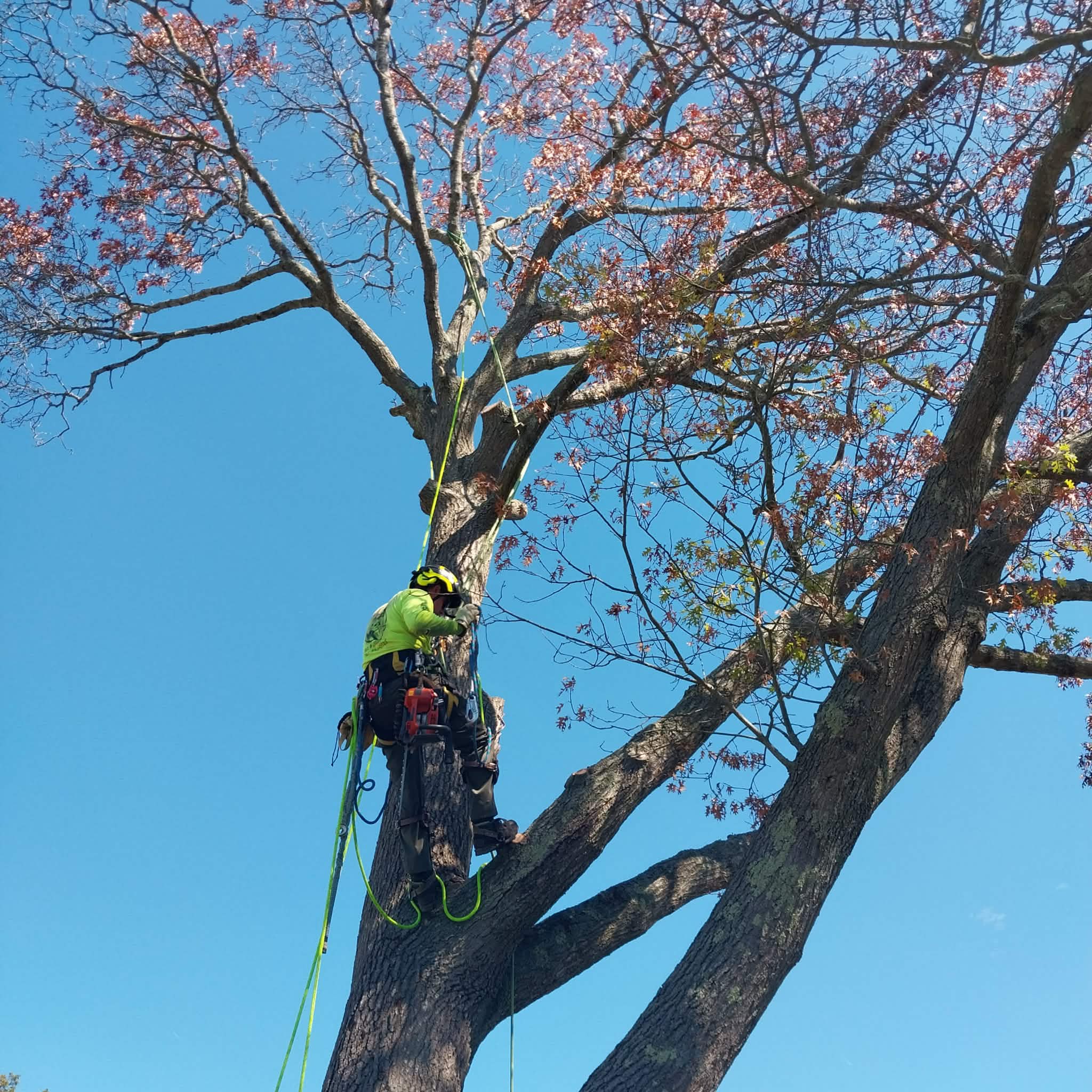
Step 3: Preparation. Climbers ascend with certified gear, pruning minor defects per ANSI A300 pruning standards. We remove included bark from American beech crotches, applying wound paint only if decay is active.
Step 4: Installation. Drilling minimal 1-inch holes, we thread EIP-rated cables through branches, tensioning to 10-20% of breaking strength. For black birches in North Rehoboth, we install loop systems around the trunk to avoid girdling. Eastern hemlocks get slack cables for sway tolerance.
Equipment includes Buckingham harnesses, Ascenders for white pine heights up to 80 feet, and CMI pulleys. Our aerial lift accesses tulip trees near South Rehoboth farms without spikes, preserving cambium.
Step 5: Hardware Selection. Rehoboth's ice demands UV-resistant polyester-sleeved cables. Red maples receive turnbuckles for annual adjustments, preventing over-tightening.
Step 6: Testing and Documentation. Post-install, we shake-test the tree, verifying 30% movement reduction. You receive a report with photos, specs, and inspection schedule, compliant with town permitting.
Annual inspections check elongation on your oaks—cables stretch 5-7% yearly. We retension using torque wrenches, replacing every 10-15 years.
Safety protocols shine: All crew wear PFAS-rated PPE, with spotters for road-adjacent work in Rehoboth Village. We secure permits from Bristol County conservation if near Palmer River.
For large-lot projects, we thin overcrowded stands first, cabling select red oaks. This manages agricultural interfaces, clearing 10-20 feet from fences.
Real Rehoboth example: A 60-foot white oak in South Rehoboth with split crotch—cabled in 2022, it survived the 2023 ice storm intact.
Our process minimizes disruption; installs finish in 4-8 hours per tree. Call 508-369-5009 to start.
Common Tree Cabling Projects in Rehoboth Neighborhoods
Rehoboth neighborhoods present distinct cabling needs due to topography and history.
In Rehoboth Village, central farms feature red oaks and sugar maples over stone walls. Homeowners cable codominant stems leaning toward Route 44, preventing road hazards. A typical project stabilizes two 50-foot oaks near the village green, preserving shade for community events.
Anawan properties, with rolling fields, deal with white pines damaged by spongy moths. Cabling supports tops heavy from regrowth, reducing ice snap risk. We often combine with fence-line clearing for pastures bordering Seekonk.
Hornbine's wooded hills host American beeches and shagbark hickories. Narrow roads demand cabling for overhanging branches; a recent job reinforced three beeches after emerald ash borer stress weakened neighbors.
North Rehoboth's rural expanses have black birches and eastern hemlocks along winding lanes. Cabling addresses wind sway on slopes, vital for properties near Attleboro lines. Ice-vulnerable hemlocks get multi-level cables.
South Rehoboth farms battle red maple inclusions from wet soils. Projects focus on trees near barns, creating defensible space while retaining windbreaks.
Palmer River Area shines with bottomland hardwoods—towering tulip trees and oaks. Riparian cabling manages flood-prone leans, complying with wetland bylaws. We cable valley oaks to protect trails.
Across neighborhoods, spongy moth projects dominate: Thinning then cabling declining white pines. Roadside removals pair with cabling survivors along Hornbine Road.
Your practical step: Map trees within 30 feet of structures, noting species like hickories for priority.
Southeast Arborist's ISA team serves all areas from our Plymouth base, arriving same-week.
Tree Cabling Costs in Rehoboth, MA
Tree cabling costs in Rehoboth MA vary by tree size, condition, and access. Expect $500-$1,200 for a 40-60 foot red oak—far below $2,500+ removal. Factors include:
Tree diameter: 24-inch white oak crotches need two cables ($800 base), versus 36-inch ($1,200).
Height and species: Sugar maple at 70 feet adds $300 for climb time; brittle American beech requires extra hardware.
Site access: Stone-wall-lined Anawan lots with no truck parking increase costs 20% via rigging.
Condition: Spongy moth decay in black birches demands resistograph testing (+$150).
Number of trees: Multi-tree discounts—five Hornbine white pines drop per-tree from $900 to $650.
Annual inspections: $150/tree, preventing $1,000 retensions.
Rehoboth value proposition: Cabling preserves mature canopy, stabilizing soil on rural slopes. A cabled shagbark hickory in Palmer River saves $3,000 removal while filtering floodwater.
Compared to nearby Taunton ($100 more/tree due to urban access), Rehoboth's open lots lower bids. Insurance discounts of 5-10% follow our documented installs.
ROI example: North Rehoboth red maple cabling ($750) averts $5,000 property damage from limb drop.
Get your quote: Free assessments factor local soil, climate. Call 508-369-5009—transparent pricing, no surprises.
When to Schedule Tree Cabling in Rehoboth
Schedule tree cabling in Rehoboth MA during late fall (October-November) or early spring (March-April). Dry ground aids equipment on rocky soils; avoid summer growth peaks when sugar maples bleed sap.
Urgency signs: Cracks at red oak crotches, leaning white pines post-wind, spongy moth dieback on beeches. Act if branches overhang roads in South Rehoboth—town notifies fast.
Ice season (December-February) demands preemptive cabling; post-storm assessments fix hemlock snaps.
Practical tip: Annual walkabouts post-leaf-drop reveal black birch defects. Call us at 508-369-5009 for urgent spots.
Frequently Asked Questions About Tree Cabling in Rehoboth
**What is tree cabling, and does it work for Rehoboth trees?** Tree cabling installs flexible steel cables in canopies to support weak crotches, per ANSI A300. It excels for Rehoboth's red oaks and white pines, reducing split risk by 70% in ice storms.
**How long do cables last on my Palmer River tulip tree?** 10-15 years with annual checks; stainless steel resists humid valley air. Southeast Arborist schedules Rehoboth inspections.
**Is cabling cheaper than removal in Hornbine?** Yes, 40-60% less—$800 vs. $2,000 for a 50-foot sugar maple. Preserves heritage value.
**Will cabling damage my Anawan shagbark hickory?** No—minimal drilling, no spikes. ISA Certified installs prevent girdling.
**How do I know if my North Rehoboth beech needs cabling?** Look for V-crotches under 60 degrees, decay, or sway. Free VTA confirms.
**Does town require permits for South Rehoboth roadside cabling?** Often yes near roads; we handle Bristol County filings.
**Can cabling prevent spongy moth hazards?** Supports weakened limbs on black birches, buying recovery time.
**What's the difference from bracing?** Cabling allows flex for eastern hemlocks; bracing is rigid rods for trunks.
Tree Cabling Throughout Rehoboth
Southeast Arborist provides tree cabling services across Rehoboth neighborhoods—Rehoboth Village to Palmer River Area—and nearby Attleboro, Seekonk, Swansea, Taunton, Somerset. From Plymouth/Cohasset, we reach your property in under 45 minutes.
Large-lot owners in Hornbine and North Rehoboth trust our woodland management. South Rehoboth farms get fence-line cabling.
Contact ISA Certified experts at 508-369-5009 for Rehoboth MA tree cabling. Free quotes, ANSI A300 guaranteed.