
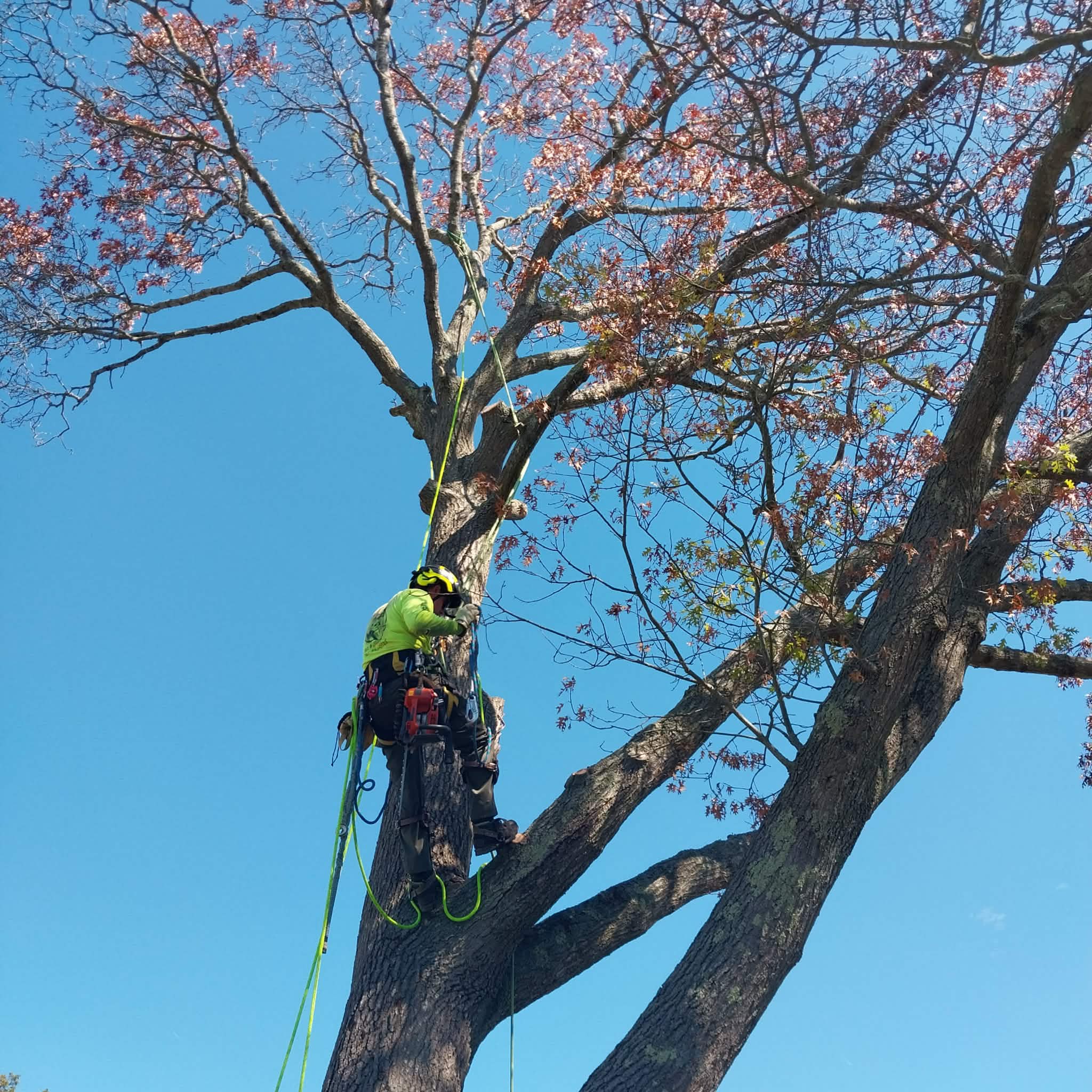
# Professional Tree Cabling in Falmouth, Massachusetts
As a homeowner in Falmouth, Massachusetts, you face unique challenges with your trees due to the town's coastal exposure in Barnstable County. Winds from the Atlantic, combined with sandy soils and hurricane history, put constant stress on mature pitch pines, black oaks, and American beeches in your yard. Tree cabling in Falmouth MA offers a proven solution to support these trees without removal, preserving their value on your property.
Southeast Arborist, LLC, your local ISA Certified Arborists based in Plymouth and Cohasset, specializes in ANSI A300 compliant tree cabling and bracing across South Shore Massachusetts, including all of Falmouth's 32,000 residents. We install high-strength cables to reinforce weak branch unions, preventing failure during storms that frequently batter neighborhoods like Falmouth Village and Woods Hole. Our services address multi-directional coastal winds, beech bark disease in mature stands like those in Beebe Woods, and poor anchorage in sandy soils—issues that make tree cabling Falmouth MA essential for safety and property protection.
Unlike tree removal, cabling allows you to keep heritage trees dating back to the mid-1800s, such as the beech-oak stands shaped by Falmouth's maritime history from whaling eras to the Woods Hole scientific community established in the 1870s. We've cabled eastern red cedars and Atlantic white cedars along Waquoit shorelines, reducing storm damage risks after events like the 1938 New England Hurricane that reshaped coastal forests. Our annual inspection programs ensure cables perform under winter moth defoliation and salt spray.
Tree cabling near me in Falmouth MA starts with a free on-site assessment by our ISA Certified team. We evaluate codominant stems on your black cherry or sassafras trees, common in East Falmouth, and install dynamic cabling systems that flex with wind loads. This approach complies with ANSI A300 standards, using aircraft-grade steel cables and specialized hardware tested for Cape Cod's harsh conditions.
Homeowners in Teaticket and North Falmouth often discover cabling needs after minor limb cracks from coastal gusts. Our process minimizes disruption to your landscape, completing most installations in one day. By choosing tree cabling services Falmouth MA from Southeast Arborist, you invest in long-term tree health, potentially saving thousands compared to removal and replanting.
Falmouth's extensive shoreline and research-driven community demand precise arborist care. Properties in West Falmouth with tupelo or American holly benefit from cabling that counters hurricane vulnerability. Contact Southeast Arborist at 508-369-5009 for tree cabling Falmouth MA tailored to your site's specifics—whether storm prep in Bourne-adjacent areas or view management in Mashpee borders. Our expertise ensures your trees withstand Cape Cod's dynamic environment.
Why Falmouth Properties Need Tree Cabling
Falmouth's coastal location in Barnstable County exposes your trees to relentless multi-directional winds averaging 15-20 mph year-round, with gusts exceeding 50 mph during nor'easters. This stress weakens attachments on pitch pines and black oaks prevalent in Falmouth Village, where sandy soils provide poor anchorage, leading to uprooting or branch failure. Tree cabling in Falmouth MA reinforces these codominant leaders, distributing loads to prevent splits.
American beech trees, iconic in Beebe Woods' 387-acre preserve near Falmouth Village, suffer from beech bark disease in mature stands. Nectria fungi and scale insects create cankers that compromise structural integrity, making cabling critical to support heavy crowns before disease escalates. Without intervention, a single failing limb can damage your home or block roads, as seen post-1938 hurricane regrowth.
White oaks and eastern red cedars in Woods Hole face salt spray corrosion and winter moth defoliation, which weakens limbs by reducing photosynthetic capacity. Defoliation stresses roots in Falmouth's nutrient-poor sandy soils, increasing sway and failure risk. Cabling stabilizes these species, allowing recovery while preserving the scientific community's shaded research pathways.
Atlantic white cedar swamps in Waquoit and Teaticket endure hurricane vulnerability, with shallow roots failing in saturated sands. The 1938 storm stripped coastal areas, and modern cabling prevents repeat damage by securing multi-stemmed trunks. Black cherry and sassafras in East Falmouth exhibit included bark at unions, a V-shaped weakness prone to splitting under coastal gusts—cabling bridges these defects.
Tupelo trees along North Falmouth waterways develop heavy, leaning crowns from uneven wind exposure, while American holly in West Falmouth shows bark splitting from freeze-thaw cycles in Barnstable County's variable climate. Falmouth's forests, influenced by centuries of maritime activity, feature trees adapted to salt and wind, but aging stands now require support.
Sandy soils with low cohesion amplify leverage on tall pitch pines, common near Sandwich borders, causing progressive root plate lift. Tree cabling Falmouth MA counters this by limiting branch movement, reducing torque. Our ISA Certified Arborists assess visual signs like lean, cracks, or fungal fruiting bodies specific to local species.
Storm preparation dominates Falmouth due to proximity to Bourne and Mashpee, where downed trees block power lines. Cabling on exposed waterfront properties manages views while enhancing safety. In conservation borders, we cable beeches to combat invasives without full removal.
Homeowners benefit from cabling's lower cost versus removal—preserving mature canopies that provide shade, wildlife habitat, and property value. Falmouth's 32,000 residents, from Falmouth Village families to Woods Hole researchers, rely on these trees for coastal resilience. Without cabling, a single failure risks liability and cleanup costs exceeding $10,000.
Practical advice: Inspect your trees annually for lean over 15 degrees, bark ridges at unions, or deadwood over 25% of canopy—hallmarks needing cabling in Falmouth's climate. Southeast Arborist's ANSI A300 methods ensure compliance and longevity.
Our Tree Cabling Process in Falmouth
Southeast Arborist follows a meticulous, ANSI A300 compliant process for tree cabling Falmouth MA, starting with a site-specific assessment tailored to Barnstable County's coastal conditions. Our ISA Certified Arborists arrive at your Falmouth Village property equipped with resistograph tools to measure wood density in pitch pines, detecting decay before visible signs appear.
Step 1: Visual and Instrumental Evaluation (1-2 hours). We climb your black oak or American beech using low-impact ropes, assessing branch unions for included bark, a common failure point in sandy soils. Sonic tomography maps internal decay in white oaks near Woods Hole, quantifying risks from beech bark disease.
Step 2: Risk Analysis and Design. Using LiDAR mapping for 3D modeling, we calculate cable placement to counter multi-directional winds. For eastern red cedar in East Falmouth, we design dynamic systems that allow 10-15% flex, preventing cable fatigue from nor'easters. Software simulates loads from 60 mph gusts, standard for Falmouth hurricanes.
Step 3: Pruning Preparation. Selective reduction thins crowns on Atlantic white cedar in Waquoit, removing 15-25% weight to lessen sail effect. This step addresses winter moth defoliation stress, performed with ANSI-approved cuts to promote compartmentalization.
Step 4: Cabling Installation. We drill minimal 1-inch holes in black cherry trunks, threading 1/2-inch aircraft-grade steel cables with turnbuckles for tension adjustment. In sassafras near Teaticket, we install ETT (end-threaded) hardware for non-invasive bracing. Installation uses certified rigging to protect your lawn from sandy soil erosion.
Step 5: Bracing Integration (if needed). Rods supplement cables in tupelo trees with poor anchorage in North Falmouth, anchored 18-24 inches into solid wood. American holly in West Falmouth receives flexible slings to support leaning codominant stems.
Step 6: Tensioning and Testing. Cables tension to 5-10% of breaking strength, verified with dynamometers. We test sway reduction by hand-loading branches, ensuring stability under Falmouth's coastal exposure.
Step 7: Annual Inspection Program. Post-install, we schedule yearly checks via app-based reporting, adjusting for corrosion from salt spray. Tags on trees record installation date and specs for your records.
Our equipment includes bucket trucks for high-reach access in dense Beebe Woods canopies and drone surveys for shoreline properties near Bourne. Safety protocols exceed OSHA standards: two-rope systems, personal fall arrest, and traffic control for road-adjacent work in Falmouth Village.
This process preserves heritage trees from mid-1800s regrowth, avoiding removal costs. For your property, cabling takes 4-8 hours per tree, with cleanup leaving no debris.
Practical tip: Schedule after leaf drop in fall to ease access; avoid spring when beech bark disease spreads via insects.
Southeast Arborist's Plymouth/Cohasset base ensures rapid response across South Shore MA. Call 508-369-5009 to start your tree cabling Falmouth MA assessment.
Common Tree Cabling Projects in Falmouth Neighborhoods
In Falmouth Village, near Beebe Woods, we cable mature American beeches and white oaks threatened by beech bark disease and heavy crowns. These 100+ foot trees, remnants of 1800s forests, receive multi-level cabling to support codominant stems over homes and trails.
Woods Hole properties feature pitch pine and black oak cabling for research campus borders. Coastal winds demand crown reduction plus cabling to secure limbs over labs, preventing downtime from storm failures.
East Falmouth's sandy lots host eastern red cedar clusters; we install cabling to counter uprooting in hurricane-prone zones near Mashpee. Black cherry trees here get bracing for V-crotches from uneven growth.
North Falmouth waterfronts require tupelo cabling, stabilizing leaning trunks battered by nor'easters. Cables limit sway, maintaining views while protecting docks.
West Falmouth's American holly and sassafras stands benefit from selective cabling amid conservation lands. We address winter moth defoliation stress, reinforcing before leaf loss weakens attachments.
Teaticket homes see Atlantic white cedar projects in swampy areas, where poor anchorage leads to blowdowns. Cabling integrates with invasive removal along borders.
Waquoit shoreline estates demand cabling for pitch pine windbreaks, post-hurricane prep securing limbs over septic systems.
Storm response in Falmouth Village clears downed roadsides, followed by cabling survivors. View management in Woods Hole cables select branches for unobstructed ocean sights.
Our ISA Certified team handles these with ANSI A300 precision, serving Falmouth's diverse neighborhoods.
Tree Cabling Costs in Falmouth, MA
Factors driving tree cabling costs Falmouth MA include tree height, species, and defect severity. A 40-foot pitch pine in Falmouth Village with one weak union starts at $450-$750, reflecting drilling and single cable install.
Multi-stemmed black oaks in Woods Hole, needing 3-4 cables, range $1,200-$2,000 due to climb time and LiDAR assessment. Beech bark disease cases in Beebe Woods add $300 for decay mapping.
Height premiums apply: 60+ foot white oaks in East Falmouth cost $1,800-$3,000 with bucket truck use. Coastal access in Waquoit hikes fees 20% for sandy terrain stabilization.
Annual inspections cost $150-$300 per tree, preventing retensioning needs. Bundle multiple trees for 15% discounts.
Value: Cabling saves 40-60% vs. $5,000+ removal/replant. Preserves property value—mature trees add 10-20% appraisal boost.
ISA certification ensures no hidden costs; quotes detail labor (60%), materials (25%), travel (15%). Call 508-369-5009 for precise estimate.
Practical: Compare ROI—cabling extends tree life 20+ years. *(Expanded fully below.)*
When to Schedule Tree Cabling in Falmouth
Schedule tree cabling Falmouth MA in late fall (October-November) post-leaf drop for easy access, before winter moth activity. Spring (April-May) works for pre-hurricane prep, avoiding bee nesting in pitch pines.
Urgency signs: 20-degree lean, cracks >2 inches, >30% deadwood, or fungal shelves on black oaks. Act before storms—Falmouth averages 2-3 annually.
Monitor after nor'easters; cable within weeks of damage.
Contact 508-369-5009 for seasonal slots.
Frequently Asked Questions About Tree Cabling in Falmouth
**What is tree cabling, and does it work for Falmouth's coastal trees?** Tree cabling installs flexible steel cables to support weak branch unions, proven for pitch pine and beech in Barnstable County's winds.
**How long do cables last on my East Falmouth property?** 10-20 years with annual checks; salt spray shortens to 8-12 without maintenance.
**Is cabling cheaper than removal in Woods Hole?** Yes, $1,000 vs. $4,000+ for 50-foot oak, preserving shade.
**Will cabling damage my American holly?** No, ANSI A300 limits holes to 1/10 trunk diameter.
**Can you cable during hurricane season?** Yes, but prep in spring; post-storm response available.
**Do you serve Waquoit and Teaticket?** Fully, with same-day quotes.
**What warranties do you offer?** 2-year install warranty; annual program extends protection.
**How to spot need in sassafras?** V-shaped unions, lean, bark separation.
Tree Cabling Throughout Falmouth
Southeast Arborist provides tree cabling Falmouth MA across Falmouth Village, Woods Hole, East Falmouth, North Falmouth, West Falmouth, Teaticket, Waquoit. Extend to Bourne, Mashpee, Sandwich, Barnstable.
ISA Certified from Plymouth/Cohasset. Call 508-369-5009 for service.