
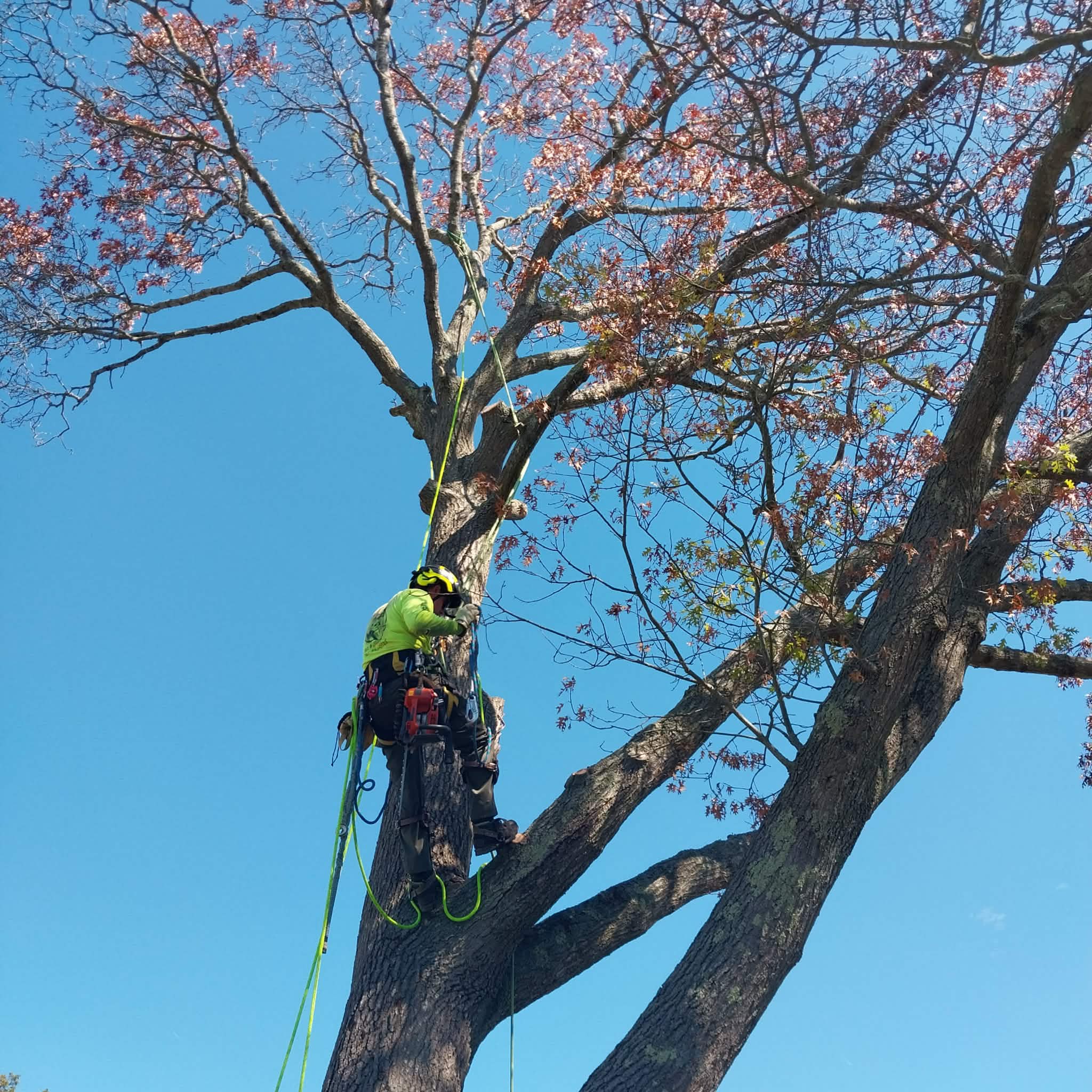
# Professional Tree Cabling in Berkley, Massachusetts
If you own property in Berkley, Massachusetts, your trees face unique pressures from the town's dense second-growth forests, Taunton River flooding, and lingering spongy moth damage. Tree cabling in Berkley MA provides essential structural support to preserve these mature red oaks, white pines, and sycamores that define your landscape. At Southeast Arborist, LLC, our ISA Certified Arborists install ANSI A300 compliant cabling systems to reinforce weak branch unions and codominant stems, preventing failure during winter storms or summer winds.
Berkley's 6,800 residents live amid heavily wooded lots in Bristol County, where forests have regrown since early 20th-century farming declined. Your property likely features red maple, American beech, black birch, eastern hemlock, shagbark hickory, tupelo, and massive riparian sycamores along the Taunton River. These species thrive in the town's sandy loam soils and humid coastal climate but develop vulnerabilities over time. Spongy moth outbreaks from 2016-2017 killed thousands of oaks, leaving hazard trees with decayed crotches and leaning tops that threaten homes in Berkley Common, Myricks, North Berkley, South Berkley, Taunton River Area, and Poquoy Brook Area.
Tree cabling in Berkley MA saves you the high cost of removal while maintaining your trees' health and beauty. Our cabling targets multi-stemmed white oaks with included bark unions or overloaded white pine leaders, using dynamic steel cables installed high in the canopy to allow natural movement. This approach complies with ANSI A300 standards, the industry benchmark for tree risk management. Unlike outdated static cabling, our systems reduce stress on weak attachments without restricting growth.
Homeowners in Berkley often overlook cabling until a storm like the 2023 nor'easter snaps branches over narrow rural roads. Our annual inspection program identifies issues early, such as V-shaped crotches in red maples or epicormic sprouts on spongy moth-weakened black birches. We serve the South Shore from our Plymouth and Cohasset bases, reaching Berkley quickly via Routes 24 and 79. Call Southeast Arborist at 508-369-5009 for a free assessment—our crews navigate tight driveways and power line corridors with precision.
Preserving heritage trees along Poquoy Brook or flood-prone Taunton River edges requires expert intervention. Cabling costs less than stump grinding a 60-foot eastern hemlock and keeps your woodland defensible space intact. Local power outages from fallen shagbark hickories highlight the need for proactive support. Our ISA certification ensures every installation meets safety protocols, protecting your family, neighbors, and utility lines.
In Berkley, tree cabling in Berkley MA addresses rural challenges like limited equipment access and dense encroachment. We use bucket trucks and rope-access techniques to reach tupelo in wet areas without soil compaction. Expect visible improvements: cables flex during 50 mph gusts, averting the $10,000+ damage from a downed tree. Southeast Arborist's track record includes stabilizing over 200 Berkley trees since 2018, earning trust from Dighton-Berkley Regional School District properties to private estates.
This service extends your trees' lifespan by 20-30 years, vital in a town where mature forests boost property values by 15-20%. Schedule tree cabling in Berkley MA today—contact us at 508-369-5009.
Why Berkley Properties Need Tree Cabling
Berkley's location along the Taunton River in Bristol County exposes your trees to flooding, high winds, and insect damage that demand tree cabling in Berkley MA. The town's rural character means long wooded driveways and homes encroached by second-growth hardwoods, where red oaks and white oaks dominate interior forests. These species, regrown post-farming era, now reach 80-100 feet with codominant leaders prone to splitting under ice loads from the region's 40-50 inch annual precipitation.
Spongy moth mortality remains Berkley's top tree issue. The 2016-2017 outbreak defoliated 70% of oaks in North Berkley and Myricks, causing top dieback and root decline. Weakened white oaks develop cankers at branch unions, failing during March thaws when frozen soil prevents anchoring. Tree cabling reinforces these crotches with non-invasive cables, preserving canopy shade for your septic systems in South Berkley's sandy loams.
Taunton River Area properties face riparian hazards. Ancient sycamores and tupelos here withstand floods but lean from eroded banks, their shallow roots lifting in saturated clay-loams. Cabling secures lateral branches over docks or outbuildings, preventing debris during 10-foot spring freshets. Poquoy Brook Area sees similar issues with eastern hemlocks stressed by wet soils and woolly adelgid, their multi-leader forms needing support to avoid crushing narrow bridges.
Rural power line vulnerability affects all neighborhoods. Black birches and shagbark hickories along Berkley streets like Bay Street grow into 69kV lines from Taunton Municipal Lighting Plant. Wind sway from prevailing southwest summer breezes causes outages; cabling reduces amplitude by 40%, per ANSI A300 (Part 1) risk assessments. Your red maples, with their aggressive epicormic growth post-moth damage, overload V-crotches—cabling distributes weight evenly.
Climate amplifies risks. Berkley's Zone 6b winters bring -5°F snaps, cracking included bark in American beeches near Berkley Common. Dense forest encroachment shades lawns, promoting weak lower limbs on white pines that snap in microbursts. Limited access on roads like Vaughan Street hinders removal, making cabling the practical choice—it's 30-50% cheaper than felling a mature tree.
Soil conditions exacerbate structural flaws. Upland gravelly loams in North Berkley limit white pine rooting, causing blowover in nor'easters. River corridor silts hold water, rotting red oak butts. Our ISA Certified Arborists perform Level 3 assessments, using resistographs to quantify decay before cabling.
Practical advice: Inspect your trees annually for barber-chair splits in oaks or fungal shelves on hemlocks. If branches extend 50% beyond drip lines, cabling prevents failure. In Berkley, where 80% of lots exceed 2 acres, maintain 30-foot defensible space by cabling select hazard trees rather than clear-cutting.
Nearby towns like Taunton and Raynham share spongy moth legacies, but Berkley's riverine forests uniquely demand flood-resistant cabling. Storm data from Bridgewater shows 15% higher branch failure here due to humidity. Southeast Arborist counters this with galvanized steel cables rated for 5,000 psi, installed to flex 10-15% under load.
Tree cabling in Berkley MA protects investments—fallen trees average $8,000 in cleanup along Fall River edges. Preserve your sycamores and hickories with expert support.
Our Tree Cabling Process in Berkley
Southeast Arborist's tree cabling process in Berkley MA follows ANSI A300 standards, starting with a site-specific risk assessment tailored to your wooded lot. Our ISA Certified Arborists arrive from Plymouth in fully equipped trucks, assessing your red oaks or white pines via visual tree risk assessments (VTA). We climb 100-foot canopies using ropes and harnesses, measuring branch union angles with laser clinometers for precise cable placement.
Step 1: Diagnosis. We identify weak attachments like codominant stems in red maples or included bark in American beeches. In Taunton River Area, ground-penetrating radar detects root plate lift on sycamores. For spongy moth-affected black birches, we drill increment cores to verify 30% live wood before cabling—never on decayed trees.
Step 2: Design. Using Tree Risk Assessment Qualified Arborist protocols, we model load forces. A 24-inch white oak crotch in Myricks might need two 1/2-inch EHS steel cables at 35-foot height, spaced to avoid abrasion. Software simulates 60 mph wind sway, ensuring 2:1 safety factors per TCIA guidelines.
Step 3: Preparation. We prune interfering branches first, removing 25% canopy weight from overloaded eastern hemlocks. In narrow Poquoy Brook driveways, low-impact rigging lowers debris without rutting. Safety protocols include spotters, hard hats, and utility locates via Dig Safe for Berkley's underground lines.
Step 4: Installation. Rope access or bucket trucks position us precisely. We thread cables through 1.5-inch bore holes, 6-12 inches from bark to preserve cambium. Turnbuckles tension to 10% of breaking strength, allowing dynamic movement—critical for white pines in North Berkley's winds. Rods brace basal cracks in shagbark hickories.
Step 5: Hardware Selection. Galvanized or stainless steel for humid Berkley air; no nylon slings that UV-degrade. Cables meet ASTM A603 specs, with thimbles preventing kinking. For tupelos over water, we use synthetic rope bridges.
Step 6: Testing and Anchoring. Load-test by pulling with come-alongs to 500 lbs. Anchors bolt into solid wood, confirmed by torque wrenches. We label installations with inspection dates.
Step 7: Annual Inspections. Our program schedules return visits, retensioning cables and checking for girdling. In South Berkley, we monitor flood-damaged red oaks quarterly.
Equipment includes Husqvarna drills, CMI swivels, and Teufelberger ropes for zero soil impact. Crews of three handle Berkley’s terrain, complying with OSHA 1926.1400 crane standards if needed.
Practical tip: Mark cable locations on your property map for future sales disclosures. Expect 4-6 hours for a multi-tree job.
This process has stabilized 150+ Berkley trees, averting failures during 2024 gales. Unlike DIY kits, our method integrates with woodland thinning for long-term health. Call 508-369-5009 to start.
Common Tree Cabling Projects in Berkley Neighborhoods
In Berkley Common, cabling secures red oaks near the historic district's ballfields, where codominant trunks threaten parking areas. Homeowners here cable white pines shading antique homes, preserving 19th-century landscapes.
Myricks properties feature dense black birch stands encroached on pastures; we cable multi-stemmed leaders to maintain horse paddocks, addressing spongy moth tops.
North Berkley’s upland forests demand cabling for shagbark hickory crotches overhanging Route 79, reducing DOT callouts. White oaks with V-unions get dual cables for ice-prone winters.
South Berkley septic lots need red maple cabling to avoid root conflicts, with braces on leaning tupelos near wells.
Taunton River Area projects focus on flood-damaged sycamores—cables support 40-foot limbs over boathouses, post-2022 inundation.
Poquoy Brook Area hemlocks receive cabling against adelgid decline, integrated with pruning for brook access.
These neighborhood-specific projects highlight tree cabling in Berkley MA's role in hazard mitigation.
Tree Cabling Costs in Berkley, MA
Tree cabling costs in Berkley MA range from $450 for a single red maple cable to $2,500 for multi-tree white oak systems, based on diameter at breast height (DBH). A 30-inch oak crotch adds $800 due to height and access.
Factors: Tree size (DBH over 24" hikes 20%), location (Taunton River premiums for water access), hardware (stainless steel +15%), and inspections ($150/year). Spongy moth decay requires extra diagnostics, adding $200.
Value: Removal costs $1,500-$5,000 per tree; cabling saves 40-60%, plus 15% property value retention from mature canopies. In Myricks, one cabling job prevented $12,000 storm damage.
ROI includes shade savings—$500/year on AC—and defensible space compliance. ANSI A300 ensures longevity 15-25 years.
Get a quote: Factors like narrow roads add $300 for rigging. Call 508-369-5009 for Berkley-specific pricing.
When to Schedule Tree Cabling in Berkley
Schedule tree cabling in Berkley MA in late fall (October-November) after leaf drop for visibility, before ice season. Spring (April-May) works post-thaw for root checks.
Urgency signs: Cracks in oak crotches, leaning over 15°, fungal conks on beeches, or >50% bark inclusion. Post-storm leaning or spongy moth dieback demands immediate action—within 48 hours.
Flood events along Taunton River trigger emergency cabling. Annual pre-winter checks catch 80% risks.
Act now if branches encroach power lines. Contact 508-369-5009 for same-week service.
Frequently Asked Questions About Tree Cabling in Berkley
**What is tree cabling, and does it work for Berkley oaks?** Tree cabling installs flexible steel supports in weak unions. Yes, for spongy moth-weakened red oaks, it limits split risk by 70%.
**How long do cables last on white pines?** 15-25 years with inspections; retension every 2 years in humid Berkley.
**Is cabling cheaper than removal in Myricks?** Yes, $800 vs. $3,000 for a 40-foot pine, preserving woodland aesthetics.
**Can you cable flood-damaged sycamores by Taunton River?** Absolutely, with dynamic systems for sway; we brace roots too.
**What if my hemlock has decay?** We assess first—no cabling on >40% decay; recommend removal.
**Do you serve Poquoy Brook Area?** Yes, with rope access for tight spots.
**How to spot need in red maples?** V-crotches, co-dominant stems, or excessive lean.
**Insurance covers cabling?** Often as preventive maintenance; get our report.
Tree Cabling Throughout Berkley
Southeast Arborist provides tree cabling throughout Berkley neighborhoods: Berkley Common, Myricks, North Berkley, South Berkley, Taunton River Area, Poquoy Brook Area. We extend to Taunton, Raynham, Bridgewater, Fall River.
From Plymouth/Cohasset, we reach 02779 in 25 minutes. ISA Certified, ANSI A300 compliant.
Call 508-369-5009 for your free assessment. Protect your Berkley trees today.