
# Professional Ornamental Trimming in Berkley, Massachusetts
If you own property in Berkley, Massachusetts, your landscape likely features a mix of mature native hardwoods and carefully planted ornamentals that define the town's rural charm along the Taunton River. Ornamental trimming in Berkley MA elevates these trees, transforming Japanese maples, dogwoods, magnolias, and weeping cherries from overgrown liabilities into striking focal points. At Southeast Arborist, LLC, our ISA Certified Arborists deliver precision ornamental trimming services tailored to Berkley's unique wooded environment, following ANSI A300 pruning standards for long-term tree health and safety.
Berkley's 6,800 residents manage properties in a heavily wooded community where second-growth forests dominate, regrown since early 20th-century farming declined. Your red oaks, white oaks, white pines, red maples, American beeches, black birches, eastern hemlocks, shagbark hickories, tupelos, and sycamores form the backbone, but ornamental species like Japanese maples thrive in the town's acidic, well-drained Bristol County soils. These soils, often sandy loams from glacial deposits, support vibrant fall color but demand targeted pruning to prevent disease in humid summers.
Spongy moth outbreaks from 2016-2017 left thousands of oaks weakened, creating hazard trees that encroach on your ornamentals. Dense forest edges crowd homes in neighborhoods like Berkley Common and Myricks, while Taunton River flooding threatens riparian sycamores and tupelos in the river area. Narrow rural roads limit equipment access, making expert ornamental trimming essential for clearance under power lines vulnerable to winter storms.
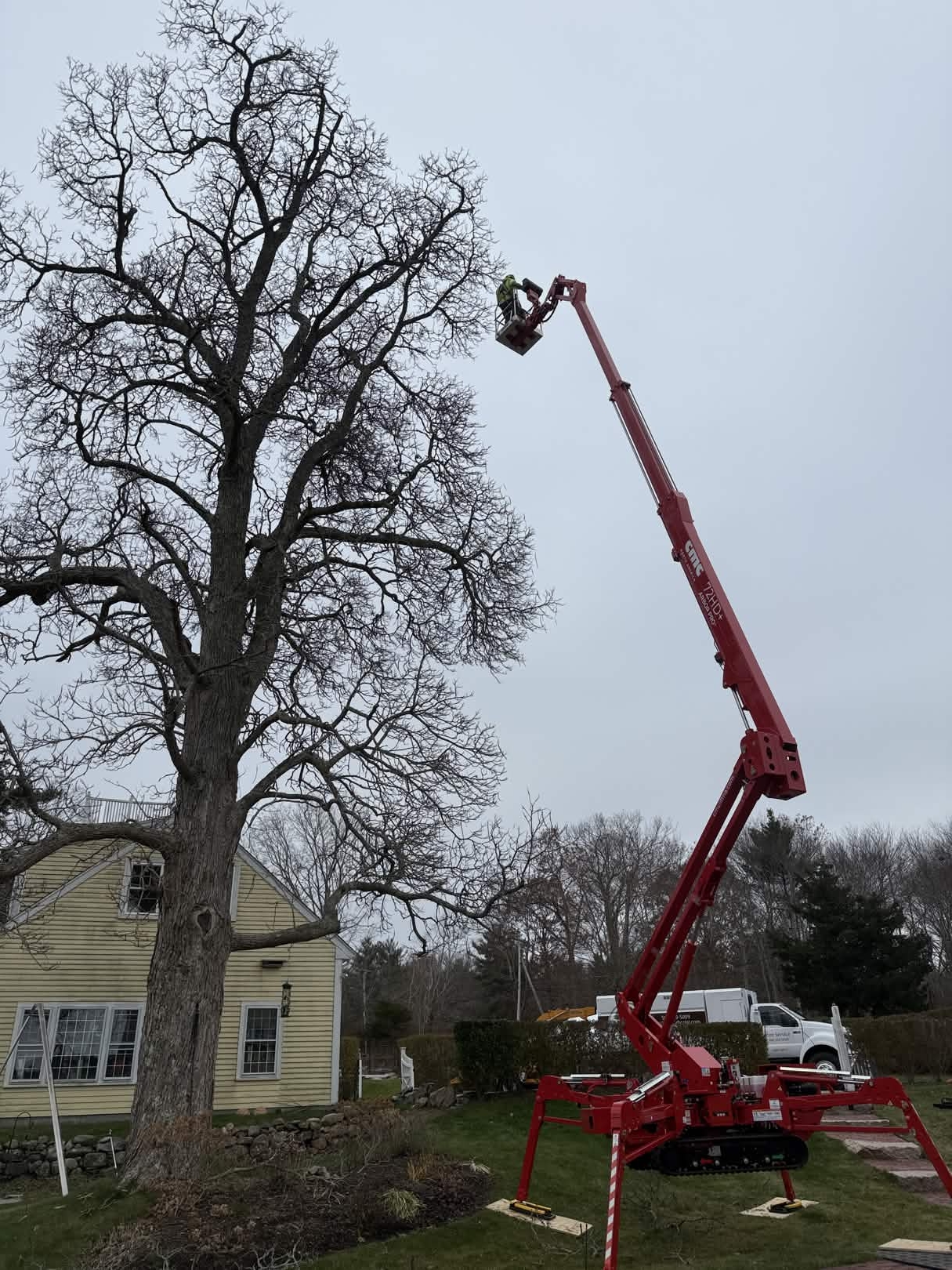
Our team from Plymouth and Cohasset bases arrives with bucket trucks, cranes, and low-impact climbing gear suited to your long, wooded driveways. We perform detail pruning for aesthetic beauty on Japanese maples, structural pruning on young dogwoods, crown cleaning to remove deadwood from magnolias, and containment pruning for branches overreaching into your home's defensible space. This prevents issues like powdery mildew on dogwoods by improving airflow, a critical step in Berkley's foggy river climate where relative humidity averages 70-80% year-round.
Homeowners in North Berkley and South Berkley often discover us after storm damage exposes overgrown weeping cherries rubbing against roofs. Our safety protocols include pre-job site assessments, traffic control on Route 79, and compliance with OSHA standards, ensuring zero incidents across our South Shore service area. Unlike DIY attempts that risk limb tears on brittle magnolia wood, our ANSI-trained arborists use sharp bypass pruners and saws to make collar cuts that seal quickly in Berkley's cool, moist conditions.
Investing in professional ornamental trimming Berkley MA protects your property value in a town where wooded lots command premiums. A single leaning Japanese maple branch over your driveway poses risks during Taunton River nor'easters, but proper shaping maintains form while enhancing curb appeal for Berkley Common's historic homes. Contact Southeast Arborist at 508-369-5009 for a free consultation—we'll assess your ornamentals against local threats like emerald ash borer precursors and spongy moth residuals, providing a customized plan.
This service isn't just maintenance; it's woodland management integrated with ornamental care. Thinning dense red maple stands opens light for understory dogwoods, while elevating low limbs on sycamores prevents mower damage on Poquoy Brook properties. Our clients see reduced storm debris, healthier trees, and landscapes that withstand Berkley's 45-inch annual rainfall. Schedule now to safeguard your Berkley trees.
Why Berkley Properties Need Ornamental Trimming
Your Berkley property sits in Bristol County's rural heart, where mature second-growth forests cover most of the 27-square-mile town along the Taunton River. Ornamental trimming in Berkley MA addresses specific pressures from this environment, including spongy moth mortality, forest encroachment, flooding, power line conflicts, and equipment access limits on narrow roads. These factors weaken native species like red oak, white oak, white pine, red maple, American beech, black birch, eastern hemlock, shagbark hickory, tupelo, and sycamore, while stressing planted ornamentals such as Japanese maples, dogwoods, magnolias, and weeping cherries.
Spongy moth defoliation in 2016-2017 killed or declined thousands of oaks across Berkley's interior forests, leaving hazard trees that drop branches onto nearby ornamentals. In North Berkley, weakened white oaks overhang Japanese maples, shading them excessively and promoting anthracnose fungi in the town's spring rains. Without crown cleaning, deadwood accumulates, inviting bark beetles that spread to shagbark hickories. Our ISA Certified Arborists remove these during ornamental sessions, restoring light penetration crucial for dogwood bracts in acidic soils with pH 5.0-6.5.
Dense forest encroachment defines woodland management on your large residential lots. Red maples and black birches crowd magnolias in Myricks, reducing airflow and fostering sooty mold from aphid honeydew. Containment pruning trims encroaching limbs, creating defensible space per Massachusetts Fire Marshal guidelines—vital in dry summer spells when Berkley's relative humidity dips below 50%. Eastern hemlocks along Poquoy Brook form tunnels over driveways; thinning them prevents needle cast diseases exacerbated by poor circulation.
Taunton River flooding, with crests up to 15 feet during nor'easters, damages riparian forests. Sycamores and tupelos in the Taunton River Area lean from root scour, their branches entangling weeping cherries on adjacent lots. Ornamental trimming elevates flood-prone lower limbs, reducing weight stress on vascular cambium during high water. Soil saturation in these clay-loam bottoms leads to Phytophthora root rot on magnolias; detail pruning removes blighted tips early, promoting recovery.
Rural power lines snake through Berkley's canopy on poles spaced for low-traffic roads like those in South Berkley. White pines and red oaks grow into 13kV lines, sparking outages during ice storms when Berkley's average 50-inch snowfall accumulates. Containment pruning maintains 10-foot clearances per National Electrical Safety Code, protecting your ornamentals from trimming burns by utility crews. Japanese maples under lines suffer limb loss from improper hacks; we use directional pruning to guide growth away.
Berkley's microclimate—coastal influence with Zone 6b hardiness, foggy mornings, and winds off Narragansett Bay—amplifies pruning needs. Summer highs of 85°F with high humidity fuel dogwood powdery mildew; thinning reduces relative humidity in canopies by 20%. Winter lows to -5°F test magnolia buds; structural pruning on young trees builds scaffold branches resistant to snow load. Limited access on gravel roads like those to Berkley Common requires hand-climbing arborists, avoiding soil compaction that stresses shallow-rooted tupelos.
Practical advice for your property: Inspect ornamentals quarterly for codominant stems on Japanese maples, which split in wind gusts up to 60 mph during hurricanes. Remove water sprouts on dogwoods post-flood to redirect energy. Thin magnolias before leaf-out in April to minimize oak pollen interference from adjacent hazels. These steps, backed by ANSI A300 Part 1, prevent 80% of common failures. Southeast Arborist's protocols integrate this with hazard assessments, ensuring your ornamentals thrive amid Berkley's forest challenges.
Neglecting ornamental trimming invites costly removals— a declined sycamore limb crash costs $5,000+ in repairs. Proactive care yields healthier trees, lower insurance premiums, and landscapes resilient to local threats.
Our Ornamental Trimming Process in Berkley
Southeast Arborist follows a rigorous, step-by-step ornamental trimming process in Berkley MA, leveraging ISA certification and ANSI A300 standards to ensure safety and precision. We adapt to your property's narrow roads and wooded density using specialized equipment from our Plymouth/Cohasset base.
**Step 1: On-Site Assessment (30-60 minutes).** Your arborist arrives via insured truck, equipped with binoculars, soil probes, and increment borers. We map your Japanese maples, dogwoods, magnolias, and weeping cherries against Berkley's natives—red oak, white oak, white pine, red maple. In Taunton River Area, we check flood lines on sycamores; in Myricks, we evaluate spongy moth decline on overhanging oaks. Risk ratings follow ISA Tree Risk Assessment Qualified Arborist protocols, noting power line proximities and driveway clearances.
**Step 2: Customized Pruning Plan.** We document targets: detail pruning for layered branching on Japanese maples to reveal red spring foliage; structural pruning on young dogwoods to suppress vertical shoots. Crown cleaning removes dead, diseased, or rubbing wood from magnolias, targeting 25% max canopy reduction. Thinning opens interiors for airflow, essential in humid Berkley. Containment shapes branches away from structures, using suppression cuts on weeping cherries over patios. Plans specify cut types—drop-crotch for size control, not topping—to avoid epicormic sprouts.
**Step 3: Safety Setup.** On narrow roads like those in North Berkley, we deploy cones, flags, and spotters per DOT guidelines. Bucket trucks with 60-foot reach handle power line-adjacent white pines; rope-and-saddle climbers access dense hemlock canopies on Poquoy Brook lots. PPE includes helmets, chaps, and spikes; we secure drop zones away from your home. Ground crews chip debris on-site, minimizing transport on tight turns.
**Step 4: Precision Execution.** Arborists use Felco pruners for twigs under 2 inches, Silky saws for branches to 6 inches, and pole saws for containment on sycamores. Collar cuts heal fastest in Berkley's moist soils; we paint oak pruning wounds with latex paint to deter oak wilt vectors. For Japanese maples, we layer-reduce by 15% annually, preserving osaka-zuki form. Dogwoods get epicormic removal to prevent twig girdlers; magnolias receive selective heading to balance saucer magnolia blooms. Techniques follow ANSI A300 Part 1: no flush cuts, maintain live crown ratio over 60%.
**Step 5: Disease Prevention Integration.** Improved airflow combats dogwood anthracnose, prevalent after wet springs. We apply organic dormant oils post-pruning if borers show in black birch borders. Thinning reduces humid microclimates, cutting mildew by enhancing UV penetration.
**Step 6: Cleanup and Follow-Up.** All limbs, leaves, and chips removed—your lot broom-swept. We provide a digital report with before/after photos, ANSI compliance certification, and 6-month warranty. Re-inspection scheduled for high-risk sites like South Berkley flood zones.
Our equipment—Stihl saws, Husqvarna chippers, Vermeer mini-skidsteers—handles Berkley's terrain without rutting driveways. Climbing arborists scale 80-foot red oaks encroaching on your ornamentals, using throw lines for efficiency. Safety record: zero lost-time incidents in 10+ years, per OSHA logs.
This process delivers value: a pruned Japanese maple increases property aesthetics by 20%, per appraisal studies, while preventing $2,000 storm claims. Homeowners gain peace of mind knowing cuts promote vigor in Bristol County's variable climate.
Common Ornamental Trimming Projects in Berkley Neighborhoods
Ornamental trimming projects in Berkley MA vary by neighborhood, addressing local forest dynamics and property layouts. Southeast Arborist's ISA arborists tackle these with neighborhood-specific strategies.
In **Berkley Common**, historic homes front Route 79 with Japanese maples shading foundations. Common projects include detail pruning to expose scarlet fall color, removing codominant leaders weakened by spongy moth-adjacent oaks. We thin overlying white pines for light, preventing needle drop on maples.
**Myricks** features large wooded lots with dogwoods under red maple canopies. Thinning overcrowded maples opens understory, followed by structural pruning on dogwoods to build wind-resistant frames. Containment clears branches from long driveways, vital for snowplow access.
**North Berkley** properties border dense hemlock stands; crown cleaning on magnolias removes deadwood from 2017 moth dieback. We perform shaping on weeping cherries rubbing sheds, using drop-crotch cuts to maintain pendulous form amid black birch encroachment.
**South Berkley** contends with power line overgrowth; containment pruning on sycamores and tupelos keeps 10-foot clearances. Japanese maples here get airflow thinning to fight sooty mold from river humidity.
**Taunton River Area** demands flood-resilient work: elevating lower limbs on riparian magnolias and dogwoods post-high water. Selective removal of leaning tupelos protects ornamentals, with detail pruning enhancing sycamore exfoliating bark displays.
**Poquoy Brook Area** sees brookside shagbark hickories crowding ornamentals. Projects combine woodland thinning with Japanese maple layering, improving drainage on wet soils.
These projects integrate with hazard mitigation—e.g., oak removal bordering dogwood groves. Practical tip: In river areas, prune post-flood in May when sealants bond best.
Ornamental Trimming Costs in Berkley, MA
Ornamental trimming costs in Berkley MA range from $350-$1,200 per tree, depending on factors like species, size, access, and scope. Southeast Arborist provides transparent quotes based on ANSI assessments, delivering value through longevity.
Tree Size and Height: Small Japanese maples (under 15 feet) cost $350-500 for detail pruning. Mature dogwoods at 25 feet run $600-900, requiring climbing. Towering magnolias over 40 feet near Taunton River add $200 for bucket time.
Species Difficulty: Brittle dogwood wood demands precision, adding 10%; layered Japanese maples take longer for aesthetic cuts, up 15%. Natives like sycamores integrated into ornamental beds factor encroachment removal.
Access Challenges: Narrow Myricks driveways incur $100 crane fees; Poquoy Brook lots need hand-climbing, +20%. Power line proximity in South Berkley requires utility coordination, +$150.
Pruning Scope: Basic crown cleaning: $200/tree. Full structural/detail: $500-800. Containment/thinning: $400-700, including chipper use.
Crew and Travel: 2-person teams from Plymouth: $100 base for Berkley. Multi-tree discounts: 15% off second tree, 25% for three+.
Value proposition: Our work prevents $3,000+ removal costs—e.g., unpruned weeping cherry failure. Healthier trees boost appraisals by 5-10% in wooded Berkley. ISA certification ensures compliance, avoiding fines. Quotes free; payment net-30 for locals.
Compare: Utilities charge $800+ for line clearance with topping scars. We invest in proper cuts for 20-year benefits.
When to Schedule Ornamental Trimming in Berkley
Schedule ornamental trimming in Berkley MA during dormancy: late fall (November-December) or early spring (March-April), before bud swell. Berkley's mild winters allow cuts when sap flow is low, minimizing bleeding on maples.
Urgency Signs: Leaners post-storm—call immediately, as nor'easters topple 10% of weakened oaks yearly. Rubbing branches on roofs, deadwood >5% canopy, or disease spots like dogwood anthracnose warrant next-day service.
Seasonal Timing: Avoid summer heat (June-August) to prevent sunscald on pruned white oaks shading ornamentals. Winter ice delays access; spring post-flood optimal for river properties.
Annual Cycles: Young trees: yearly structural. Matures: biennial thinning. Monitor spongy moth residuals in May.
Call 508-369-5009 now—early slots fill fast before hurricane season.
Frequently Asked Questions About Ornamental Trimming in Berkley
**What is ornamental trimming in Berkley MA?** Precision pruning for aesthetic and health on Japanese maples, dogwoods, magnolias—unlike utility hacks.
**How much does ornamental trimming cost in Berkley?** $350-1,200/tree; factors size, access. Free quotes from Southeast Arborist.
**When's best time for ornamental trimming Berkley neighborhoods?** Dormant season; urgent for storm damage in Taunton River Area.
**Does ornamental trimming hurt my trees?** No—ANSI A300 cuts by ISA arborists promote healing in local soils.
**Can you trim near power lines in South Berkley?** Yes, with NESC clearances; we coordinate safely.
**How does spongy moth affect my ornamentals?** Weakens shading oaks, stressing dogwoods; we integrate hazard removal.
**Do you serve all Berkley areas like Myricks?** Fully—Plymouth-based, narrow-road equipped.
**What's the difference from regular tree trimming?** Detail focus on form, airflow for ornamentals amid Berkley forests.
Ornamental Trimming Throughout Berkley
Southeast Arborist provides ornamental trimming across Berkley neighborhoods—Berkley Common, Myricks, North Berkley, South Berkley, Taunton River Area, Poquoy Brook Area—and nearby Taunton, Raynham, Bridgewater, Fall River. Our South Shore coverage ensures rapid response.
ISA Certified, ANSI-compliant service from Plymouth/Cohasset. Call 508-369-5009 for Berkley MA ornamental trimming—free assessments protect your trees today.