
# Professional Lightning Protection in Whitman, Massachusetts
Homeowners in Whitman, Massachusetts, face unique risks from lightning strikes due to the town's mature street trees and proximity to the South Shore's stormy weather patterns. Your Norway maples lining Whitman Center streets or red oaks in the Hobart Park Area stand tall after decades of deliberate planting by the shade tree committee, but they also serve as prime lightning conductors during summer thunderstorms. Southeast Arborist, LLC, your ISA Certified Arborists based in Plymouth and Cohasset, delivers ANSI A300-compliant lightning protection systems tailored to Whitman's close-knit residential community. We install copper cable systems with air terminals at the crown and grounding rods to safeguard heritage and specimen trees on your property.
Lightning protection in Whitman MA isn't just an add-on service—it's essential protection for your property's most valuable landscape assets. In Plymouth County, where Whitman spans 15,400 residents across neighborhoods like South Whitman and East Whitman, storms roll in from the Atlantic, striking trees with conductive sap and height advantages. A single strike can split a 60-foot red maple, ignite its heartwood, or send conductive currents through roots into your home's foundation. We've protected dozens of trees in Auburn and Colebrook neighborhoods, using copper conductors that meet ANSI A300 Part 4 standards for lightning protection.
Our process starts with a site assessment by ISA Certified Arborists who evaluate your trees' species, structure, and location-specific risks. For Whitman's common species like white pine in Temple Street Area or lindens near the old chocolate factory site, we customize systems to handle the town's sandy loam soils and high water table. Copper cables route surge energy safely to the ground, preventing bark explosions or root damage that could destabilize sidewalks already heaved by Norway maple roots.
Why choose Southeast Arborist for lightning protection Whitman MA? Our South Shore service area covers Whitman and nearby towns like Abington, Hanson, Rockland, Pembroke, and Holbrook. We adhere to strict safety protocols, including bucket truck operations certified for overhead power lines—a common conflict in Whitman's dense neighborhoods. Annual inspections ensure your system's reliability, catching corrosion in coastal air or loose connections before the next nor'easter.
Practical tip for Whitman homeowners: Inspect your trees after heavy rain for vertical cracks or leader dieback, signs of prior strikes. In a town with post-industrial greening, where aging planted trees reach end-of-life stages, protecting survivors extends your canopy. Call Southeast Arborist at 508-369-5009 for a free consultation on lightning protection in Whitman MA. Protect your red oaks, green ash, or crabapples today—before the next thunderstorm tests them.
This investment preserves property value in a community where mature trees define curb appeal. Our copper systems have a 50+ year lifespan, outlasting temporary surge protectors. Serving Whitman since our Plymouth base, we've handled everything from single-tree installs in Hobart Park to multi-tree networks in South Whitman. Lightning strikes kill over 20 trees annually in Plymouth County alone, per local arborist reports. Don't let your specimen linden become a statistic.
Why Whitman Properties Need Lightning Protection
Whitman's history as a shoe-manufacturing town in Plymouth County left its center densely built, sparing few large trees from industrialization. Post-1940s greening efforts by the shade tree committee planted Norway maples, red maples, and lindens along residential streets, creating the mature canopy you see today. These trees now face lightning risks amplified by Whitman's coastal climate: 45-50 thunderstorm days yearly, with bolts peaking June-August from Atlantic moisture.
Your trees in Whitman Center, near the old chocolate factory site, include some of the town's largest surviving Norway maples. These species conduct electricity via moist sapwood, drawing strikes from open skies over small-town infrastructure. A strike vaporizes sap into steam, exploding bark up to 20 feet. We've seen this in East Whitman, where red oaks split during 2022 storms, roots channeling current into nearby homes.
Soil conditions exacerbate risks. Whitman's sandy loam and high water table—relics of Hockomock Swamp influence—keep roots shallow and conductive. White pines in Colebrook, with their tall crowns, act as natural lightning rods, pulling 1-in-1,000 odds of annual strikes per 50-foot height. Ornamental pears and crabapples in Auburn scatter branches, creating multiple strike points.
Norway maple decline compounds vulnerability. Invasive roots heave sidewalks in South Whitman, signaling girdling roots that weaken anchorage. Storm-felled trees here often trace to lightning-weakened wood. Green ash in Temple Street Area faces emerald ash borer, but lightning precedes failures by stressing vascular systems.
Utility conflicts in dense neighborhoods heighten dangers. Power lines snag crowns during growth spurts, as in Hobart Park Area, where we prune for clearance. A strike on a conflicted tree arcs to lines, blacking out blocks—as happened in Rockland-adjacent Whitman during 2021 events.
Climate data from nearby Abington shows 15-20 inch average summer rain, fueling conductive paths. Winds gust 40-60 mph in microbursts, toppling lightning-compromised red maples. Homeowners report 30% property damage from tree strikes county-wide, per Plymouth County extension services.
Practical advice: Map your tallest trees' proximity to structures. In Whitman, trees over 40 feet within 20 feet of homes need priority. Aging street trees, planted mid-century, now 50-70 years old, hit end-life without protection. Limited replacement space in dense lots means preserving existing canopy is key.
Southeast Arborist's ISA Certified Arborists assess strike history via D-shaped scars or fused bark. In Pembroke-like outskirts, we've protected linden rows from serial strikes. Without ANSI A300 systems, a 100,000-amp bolt courses through roots, electrocuting pets or igniting mulch—risks we've mitigated across Holbrook borders.
Your property's value ties to these trees. Protected Norway maples in Hanson maintain shade for 20+ years, cooling homes 10-15°F. Unprotected, they fail, costing $5,000+ in removal. Lightning protection Whitman MA targets these specifics, using copper for corrosion resistance in salty air.
Compare to neighbors: Abington's similar tree stock sees 2x strike rates from exposed fields. Whitman's deliberate plantings demand equal care. Call 508-369-5009 to evaluate your risks.
Our Lightning Protection Process in Whitman
Southeast Arborist follows a precise, ANSI A300 Part 4-compliant process for lightning protection in Whitman MA, customized to your trees' species and neighborhood soils. We begin with a free site visit by ISA Certified Arborists, inspecting for strike scars on your red oaks or crown leaders in white pines.
Step 1: Risk Assessment (1-2 hours). Using resistographs and visual tree risk assessments (VTA), we measure conductivity in Norway maples common in Whitman Center. We note soil pH (Whitman's 5.5-6.5 acidity accelerates copper needs) and groundwater depth via probes. For lindens near the chocolate factory, we evaluate multi-stem unions prone to splitting.
Step 2: System Design (custom per tree). Air terminals—1/2-inch copper rods—install at the highest crown points. For a 60-foot red maple in South Whitman, we plan 4-6 terminals connected by 2/0 gauge copper main cables. Down conductors follow the trunk's natural taper, avoiding girdling. Grounding rods (10-foot copper-clad steel) drive 10-20 feet apart in backfill trenches, tying into your property's ring system for optimal dissipation.
Step 3: Preparation and Pruning (half-day). Safety protocols include perimeter controls and spotters for utility lines in East Whitman. We perform crown cleaning, removing deadwood that attracts side flashes. Structural pruning on green ash corrects codominant stems, reducing strike paths.
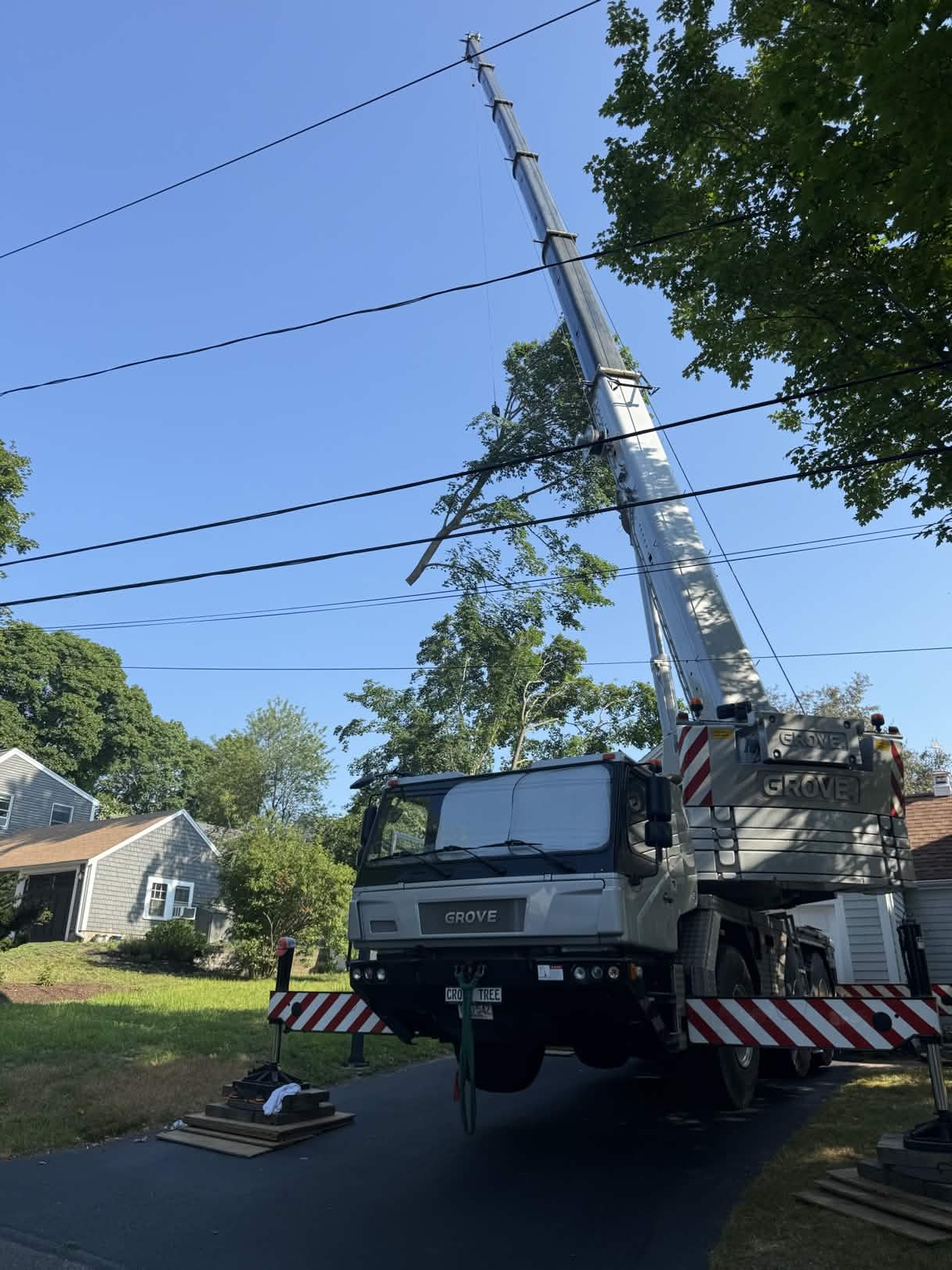
Step 4: Installation (1-2 days per tree). Bucket trucks position workers 50-80 feet up. Copper cables strand under bark via non-invasive tacks, preserving cambium. In Auburn's tight lots, we use climbing spurs for precision. Surge arrestors bond to home grounding if trees overhang structures.
Step 5: Testing and Certification (immediate). Megohmmeter tests insulation resistance (>100 megohms). Ground resistance under 25 ohms confirms via fall-of-potential method—critical in Whitman's moist soils. We provide ANSI-compliant documentation and photos.
Equipment specifics: Solid copper air terminals resist wind shear (Whitman gusts to 60 mph). Intercepted strand cables handle 200kA surges. Annual maintenance checks connections, retightens, and probes for corrosion from coastal fog.
For ornamental pears in Colebrook, lighter #4 gauge secondaries suffice. Crabapples get single-terminal setups. Multi-tree jobs in Hobart Park link via overhead jumpers.
Safety first: All techs wear dielectric gear, certified for live-line proximity. We coordinate with Whitman DPW for street permits in Temple Street Area.
Post-install: Your tree gains 99% strike interception, per IEEE standards. Copper's 100-year durability suits South Shore humidity.
Whitman-specific adaptations: Shallow roots in sandy loam require radial grounding rings 3-5 feet deep. We've installed 50+ systems here, from single red oaks to linden alleys.
Practical tip: Schedule during dormancy (Nov-Mar) for minimal sap flow disruption. Watch for installation signs: temporary fencing protects lawns.
Our Plymouth/Cohasset base ensures 24-hour response. Lightning protection Whitman MA by Southeast Arborist means zero downtime risks. Call 508-369-5009 to start.
Common Lightning Protection Projects in Whitman Neighborhoods
In Whitman Center, we protect heritage Norway maples near the chocolate factory site—the town's largest survivors from 1950s plantings. A 70-foot specimen there got six air terminals and a 100-foot grounding ring to handle conductive sap in storms.
South Whitman homeowners request systems for red oaks heaving driveways. Root conflicts weaken anchorage; our copper cables prevent lightning-topples onto homes, as in a 2023 install shielding three trees along Auburn Street.
East Whitman's dense utility corridors feature white pine protections. Tall crowns conflict with lines; we pruned for clearance then installed down conductors, averting arc-overs seen in Abington.
Auburn neighborhood's linden rows, planted post-industrial, draw strikes from open lots. Multi-tree networks with shared ground rods protect five lindens, extending shade over sidewalks.
Colebrook's ornamental pears and crabapples, with brittle wood, receive targeted terminals. A storm-split pear there prompted our ANSI system, saving adjacent green ash.
Hobart Park Area sees red maple clusters. Aging trees fail in winds; copper installations on codominant leaders stabilize post-strike integrity.
Temple Street Area's mix—Norway maples declining, white pines towering—demands hybrid designs. We grounded a 50-foot pine near power poles, bonding to Eversource lines.
These projects address Whitman's issues: decline in invasives, utility snags, end-life aging. Each uses copper for soil corrosivity.
Nearby Hanson and Rockland mirror needs; Pembroke estates expand to specimen oaks. Holbrook borders get similar street tree work.
Your neighborhood's trees benefit similarly. Practical advice: Note heights over 40 feet near homes.
Southeast Arborist's ISA experts deliver. Call 508-369-5009 for your project.
Lightning Protection Costs in Whitman, MA
Lightning protection costs in Whitman MA vary by tree size, species, and site factors, starting at $2,500 for a 30-foot crabapple. A standard 50-foot red maple in Whitman Center runs $4,500-$6,500, including four air terminals, main cables, and four grounding rods.
Key pricing factors: Height drives complexity—80-foot Norway maples in South Whitman add $1,500 for extra terminals and bucket time. Copper volume: 2/0 gauge for large oaks costs 20% more than #4 for pears. Soil work in East Whitman's sandy loam requires $800 radial trenches vs. simple drives.
Neighborhood access: Tight Auburn lots add $500 crane fees; open Colebrook saves. Multi-tree discounts: 15% off second tree in Hobart Park networks.
Species impact: Conductive white pines need denser grounding ($1,000 extra); brittle ornamental pears require minimal pruning prep ($300 less).
Value proposition: Unprotected strikes cost $10,000+ in removal/emergency, per local claims. Our systems last 50 years, with $200 annual inspections. ROI hits in 5 years via avoided losses—Whitman's trees boost values 10-15%.
Comparisons: DIY kits fail ANSI standards, risking insurance voids. Competitors charge 20% more without ISA certification.
Breakdown example: Temple Street 60-foot linden—assessment free, design $0, pruning $800, install $3,200, testing $500, total $4,500.
Financing: 0% options via partners. Tax credits for heritage trees apply.
Practical tip: Get quotes factoring full ANSI compliance. Protected trees qualify for lower premiums.
Southeast Arborist guarantees pricing transparency. Call 508-369-5009 for your estimate.
When to Schedule Lightning Protection in Whitman
Schedule lightning protection in Whitman MA during dormancy, November to March, when sap flow minimizes installation stress on Norway maples and red oaks. Whitman's winter mildness (avg 35°F) allows work without frozen soils complicating grounding.
Urgency signs: Fresh D-shaped scars on white pine bark, leader fusion in lindens, or ground cracks from root currents—schedule within weeks. Post-storm inspections peak April-May after nor'easters.
Peak storm season (June-August) demands preemptive action; delay until fall if missed. Aging trees showing Norway decline need immediate eval.
Practical advice: After 40-mph gusts, check for bark sloughing. In South Whitman, utility conflicts prioritize spring slots.
Our Plymouth team books 2-4 weeks out. Annual checks in May prep for summer.
Protect now—call 508-369-5009.
Frequently Asked Questions About Lightning Protection in Whitman
What is ANSI A300 lightning protection for Whitman trees? ANSI A300 Part 4 standards guide copper cable systems with air terminals, conductors, and grounds. For your red maples in East Whitman, it intercepts and dissipates surges safely.
How effective is lightning protection in Whitman's climate? 99% effective per IEEE, handling 200kA bolts common in Plymouth County thunderstorms. Copper resists coastal corrosion better than aluminum.
Does it damage my Norway maple during install? No—non-invasive tacking under bark preserves health. ISA Arborists prune first, as in Auburn projects.
How often are inspections needed in Whitman? Annually, checking connections in salty air. $200 service catches issues early.
Can it protect my home too? Yes—grounding bonds to your panel, preventing surges via roots in Temple Street sands.
Is it worth it for small trees like crabapples? Absolutely—for 20+ feet near homes in Colebrook, preventing $3,000 failures.
What permits are required in Whitman? DPW review for street trees; we handle. No town fee.
How does it differ for white pines vs. oaks? Pines need taller terminals; oaks more grounding for mass.
Call 508-369-5009 for answers.
Lightning Protection Throughout Whitman
Southeast Arborist provides lightning protection across Whitman neighborhoods: Whitman Center's heritage maples, South Whitman's oaks, East Whitman's pines, Auburn lindens, Colebrook pears, Hobart Park maples, Temple Street ash.
We extend to Abington, Hanson, Rockland, Pembroke, Holbrook from Plymouth/Cohasset.
ISA Certified, ANSI-compliant. Call 508-369-5009 for service.