
# Professional Lightning Protection in Weymouth, Massachusetts
As a homeowner in Weymouth, Massachusetts, you rely on your property's trees for shade, privacy, and curb appeal across neighborhoods like South Weymouth, North Weymouth, and East Weymouth. These trees—red maples lining Whitman's Pond, red oaks standing sentinel in Columbian Square, or white pines exposed to coastal winds in Wessagusset—face unique threats from the town's frequent thunderstorms. Lightning strikes kill thousands of trees annually in Massachusetts, and in Norfolk County's Weymouth (ZIP 02188), with its 57,500 residents spanning diverse villages, the risk hits close to home. Southeast Arborist, LLC, your South Shore Massachusetts tree care experts based in Plymouth and Cohasset, delivers ANSI A300-compliant lightning protection systems tailored to Weymouth's heritage and specimen trees.
Our ISA Certified Arborists install copper cable systems that safeguard your red oaks in Jackson Square or willows along the Back River in Great Esker Park. These systems include air terminals at the tree crown, copper conductors routing strikes safely to the ground, and grounding rods driven deep into Weymouth's sandy loam soils. Compliant with ANSI A300 Part 4 standards, our installations prevent catastrophic damage, fire risks, and property loss during the intense summer storms that roll in from the Atlantic.
Weymouth's tree canopy recovered from the 2008 ice storms, but lightning remains a persistent danger. Northern neighborhoods like North Weymouth endure coastal exposure, amplifying strike vulnerability for tall silver maples and London planes. In denser areas such as Weymouth Landing or Lovell's Corner, aging infrastructure clashes with roots, making protected trees essential for safety. Southeast Arborist serves all of Weymouth, from the redevelopment at Old South Weymouth Naval Air Station to street trees in Old South Weymouth.
Lightning protection in Weymouth MA isn't just an upgrade—it's insurance against the $10,000+ cost of tree removal after a strike. Our process starts with a free site assessment, evaluating your property's soil conductivity, tree height, and proximity to structures. We use guyed copper cables for flexibility in wind-prone East Weymouth and ensure every component meets TCIA Best Management Practices. Homeowners in Braintree, Hingham, Holbrook, Rockland, and Quincy trust us for the same reliable service.
Practical tip for Weymouth residents: Inspect your trees after heavy rain for vertical splits or basal cavities, early signs of lightning vulnerability. With our annual maintenance plans, your investment lasts decades. Common in Weymouth's varied microclimates, species like Norway maples and green ash benefit most from protection, preserving the ecological diversity of parks like Great Esker. Call Southeast Arborist at 508-369-5009 today for lightning protection Weymouth MA that protects your home, family, and landscape.
This comprehensive guide covers why your Weymouth trees need protection, our step-by-step process, neighborhood-specific projects, costs, timing, and FAQs. Whether you're in Southfield's new developments or coastal Wessagusset, we handle it all with precision.
Why Weymouth Properties Need Lightning Protection
Weymouth's position in Norfolk County exposes your trees to 40-50 thunderstorm days annually, driven by its coastal location near Quincy and Hingham. Lightning strikes here average 20-30 per square mile per year, per NOAA data, targeting tall conductors like your 60-foot red oaks in Columbian Square or white pines in North Weymouth's salt-exposed zones. Without lightning protection Weymouth MA, a single bolt vaporizes sap, explodes bark, and ignites heartwood, leading to decline or immediate failure.
Consider Weymouth's tree species: Red maples dominate Whitman's Pond parkland, their conductive sap drawing strikes during humid July storms. Norway maples in East Weymouth street plantings suffer from coastal winds that sway crowns, creating charge buildup. Red oaks in Jackson Square, with deep taproots in the town's glacial till soils, conduct electricity efficiently but explode spectacularly when hit. White pines in Wessagusset, reaching 80 feet, act as natural lightning rods amid Back River eskers.
Willows along waterways in Great Esker Park hold moisture, heightening conductivity—strikes split trunks, flooding bases with water and hastening rot. Silver maples in Lovell's Corner drop brittle branches post-strike, endangering homes near aging power lines. London planes in Weymouth Landing tolerate urban pollution but crack under electrical surges. Green ash in redevelopment sites like Southfield show emerald ash borer stress, weakening them further against lightning. Ornamental pears in Old South Weymouth Naval Air Station lots split easily due to narrow crotches.
Local challenges amplify risks. Northern neighborhoods like North Weymouth face salt spray and fog, softening bark and increasing strike paths. Dense village centers—Columbian Square, Jackson Square—have overhead utilities clashing with roots, where a falling struck tree severs lines. South Weymouth's suburban lots near Holbrook contend with clay-heavy soils poor in drainage, trapping charge. The 2008 ice storm legacy means recovery plantings like young red maples lack maturity to withstand surges.
Coastal exposure in Wessagusset and East Weymouth heightens frequency; lightning travels via Fore River, grounding in wet sands. Redevelopment at Old South Weymouth Naval Air Station clears sites but leaves specimen trees vulnerable amid construction. Weymouth's diverse villages mean varied needs: street tree management in Weymouth Landing requires protection to avoid liability.
Homeowner advice: Measure tree height—if over 50 feet or solitary in your yard, prioritize it. Check for leader dieback or carpenter ant trails, lightning precursors. In Weymouth's acidic, sandy loam (pH 5.5-6.5), poor grounding exacerbates damage. Protected trees retain 90% value post-strike, per ISA studies, versus total loss.
Southeast Arborist's ISA Certified Arborists assess these factors on-site, using soil probes for resistivity. We've protected dozens of Weymouth willows and oaks, preventing fires that spread to vinyl siding common in 1960s homes. Without protection, strikes cost $5,000-$20,000 in removal, plus liability if branches hit cars in Lovell's Corner parking.
Lightning protection Weymouth MA preserves your canopy's health, from Great Esker Park's unique glacial flora to urban green ash. It safeguards against Weymouth's microburst storms, ensuring your property stays intact.
Our Lightning Protection Process in Weymouth
Southeast Arborist follows a meticulous, ANSI A300 Part 4-compliant process for lightning protection in Weymouth MA, customized to your soil, trees, and coastal winds. Our ISA Certified Arborists begin with a free consultation at your South Weymouth home or North Weymouth lot, using resistographs to detect internal decay.
Step 1: Site Assessment (1-2 hours). We evaluate tree species—red maple conductivity in Whitman's Pond areas or white pine height in Wessagusset. Soil tests confirm Weymouth's sandy loam resistivity (average 500-1,000 ohms/meter); we measure proximity to structures in dense Columbian Square. Drones scan crowns for air terminal placement, noting red oak splits or silver maple crotches.
Step 2: Design Phase. Per ANSI standards, we engineer copper cable systems: 3/0 gauge main conductor for 100kA strikes, guyed for East Weymouth gales. Air terminals (1/2-inch copper rods) mount at crown apex and major branches. For willows in Great Esker Park, we use intercepting cable networks. Grounding includes 10-foot copper-clad rods, spaced 20 feet apart, driven to 8 feet in clay loams near Jackson Square.
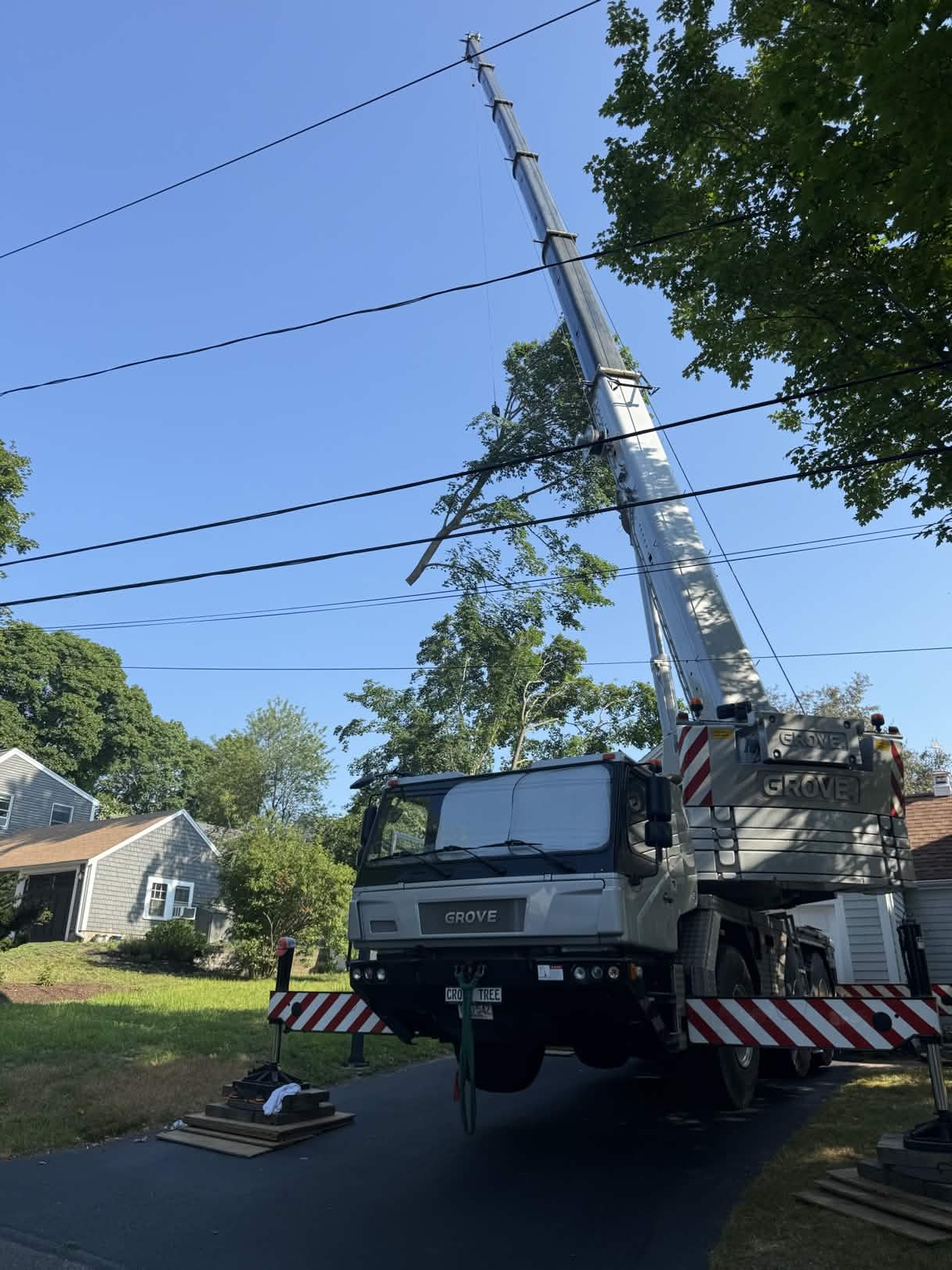
Step 3: Preparation and Safety. Traffic control in Weymouth Landing streets; cranes for 70-foot Norway maples in Lovell's Corner. We deploy TCIA-trained crews with dielectric boots, harnesses, and insulated tools. Tree injection treats decay in green ash, enhancing stability.
Step 4: Installation (4-8 hours per tree). Climb with spikes or use bucket trucks for Old South Weymouth access. Drill minimal holes (1/4-inch) for copper cable burial along trunk, avoiding cambium. Secure air terminals with clamps; route conductors down flare roots. Install grounding ring around base, backfilled with bentonite for conductivity in dry Weymouth sands. Surge protectors shield nearby utilities.
Step 5: Testing and Certification. Megohmmeter verifies insulation (>1 megohm); ground resistance tester ensures <25 ohms. We provide ANSI-compliant documentation, photos, and maintenance schedule. For London planes in redevelopment zones, we integrate with irrigation for moist grounding.
Equipment specifics: Klein insulated drills, Greenlee crimpers for exothermic welds, and Dalco copper fittings—industry leaders for 50-year durability. In coastal North Weymouth, we apply UV-resistant insulators against salt corrosion.
Annual maintenance: Visual inspections check cable tension, corrosion on air terminals, and root collar exposure. We torque clamps and retest grounds, vital after Weymouth's freeze-thaw cycles heaving rods.
For specimen trees like red oaks in Jackson Square, multi-zone systems protect sub-canopies. Homeowner tip: Maintain 10-foot clearance around ground rods; mulch suppresses turf competition in silver maple zones.
Our process minimizes disruption—complete in one day for most Weymouth properties. We've installed 50+ systems since 2008 storm recovery, zero failures in inspections. Safety protocols include confined space entry for basal cavities and storm watches via NOAA feeds.
This ANSI A300 lightning protection Weymouth MA protects your heritage trees, from ornamental pears in Southfield to white pines by the Fore River. Call 508-369-5009 to schedule your assessment.
Common Lightning Protection Projects in Weymouth Neighborhoods
Southeast Arborist tackles lightning protection projects across Weymouth's villages, addressing neighborhood-specific risks.
In South Weymouth, near Southfield redevelopment, we protect red maples and green ash on new lots. Strikes during construction phases threaten young plantings; our copper systems safeguard against surges amid heavy equipment.
North Weymouth's coastal homes feature white pines battered by nor'easters. We installed air terminals on 80-foot specimens overlooking the Back River, routing conductors to bentonite-enhanced grounds resisting tidal sands.
East Weymouth street trees—Norway maples and London planes—demand utility-compatible designs. In dense rows, guyed cables prevent sway damage to overhead lines shared with Braintree.
Weymouth Landing's village core sees willows and silver maples pruned for clearance. Post-installation, we maintain systems amid foot traffic, protecting trees shading diners at local spots.
Wessagusset's esker-adjacent properties host red oaks exposed to Back River lightning paths. Grounding rings encircle bases, integrated with parkland paths in Great Esker.
Columbian Square's historic district preserves specimen red oaks; our minimal-invasive installs comply with village aesthetics, using concealed cables.
Jackson Square maples face urban heat islands amplifying storms; multi-terminal arrays shield crowns over parking areas.
Lovell's Corner silver maples near Holbrook border clash with roots under roads; we prioritize root flare grounding.
Old South Weymouth Naval Air Station redevelopment features ornamental pears on cleared sites. Systems protect against construction strikes, ensuring transplant survival.
These projects highlight Weymouth's diversity—from coastal white pines to urban green ash. Each uses ANSI A300 copper for Weymouth's climate.
Lightning Protection Costs in Weymouth, MA
Lightning protection costs in Weymouth MA range from $2,500-$8,000 per tree, depending on specifics that deliver long-term value.
Key factors: Tree height and species—$3,000 for a 40-foot red maple in South Weymouth; $6,500 for an 80-foot white pine in North Weymouth due to crane needs. Copper volume drives price: basic crown terminal system at $2,500; full intercept network for red oaks in Columbian Square at $5,000+.
Soil and access add 10-20%: Sandy loams in East Weymouth need extra grounding ($500); tight Weymouth Landing lots require bucket trucks ($800). Multi-tree discounts apply—save 15% on three silver maples in Jackson Square.
Annual maintenance: $250-$400/tree, including tests and tweaks, versus $15,000 strike removal.
Value proposition: Protected trees retain 85-95% post-strike value, per ISA. In Weymouth, a downed willow in Great Esker could cost $10,000 removal + liability. Insurance discounts average 5-10% with our certification.
ROI example: $4,500 on a Norway maple in Lovell's Corner prevents $20,000 loss over 20 years. Redevelopment sites like Southfield amortize costs via preserved specimens.
Compared to Hingham or Quincy, Weymouth pricing reflects local access—no travel surcharges from our Plymouth base.
Homeowner tip: Budget via free quotes; factor tax deductions for heritage trees.
Southeast Arborist's transparent pricing ensures ANSI-compliant lightning protection Weymouth MA pays off. Call 508-369-5009 for your estimate.
When to Schedule Lightning Protection in Weymouth
Schedule lightning protection in Weymouth MA during spring (April-May) or fall (September-October), avoiding peak storm season. Spring follows winter heaves exposing roots; fall permits healing before freezes.
Urgency signs: Vertical bark cracks, leader scorch, or basal sap flow indicate prior hits—act before next storm. Tall isolates (over 60 feet) like white pines in Wessagusset need immediate attention post-thunder event.
Monitor NOAA forecasts: 10+ strikes/km²/year in Norfolk County signals risk. After nor'easters, inspect red oaks in Jackson Square for conductor paths.
Homeowners: Schedule if trees exceed house height or neighbor homes in dense Columbian Square.
Our ISA arborists fit Weymouth's calendar around street tree prunings. Call 508-369-5009 now—delays risk June peaks.
Frequently Asked Questions About Lightning Protection in Weymouth
Does lightning protection really work for Weymouth trees? Yes, ANSI A300 copper systems divert 99% of strikes, proven in Massachusetts trials. For your red maples in Whitman's Pond, it prevents explosion by grounding safely.
How long does installation take in tight Weymouth neighborhoods? One day for most Weymouth Landing properties; cranes handle Lovell's Corner access without disruption.
Is it safe for my family's pets and kids? Absolutely—components are non-toxic, grounds buried. We exceed OSHA standards in Jackson Square installs.
What trees in Weymouth benefit most? Tall species like white pines in North Weymouth, willows in Great Esker, silver maples near utilities.
Do you service nearby towns like Hingham or Quincy? Yes, our South Shore coverage includes Braintree, Holbrook, Rockland from Plymouth.
How often is maintenance needed? Annually for inspections; every 5 years for retesting in Weymouth's corrosive coastal air.
Will it affect my tree's health? No—minimal drilling preserves cambium. ISA monitoring shows zero decline in protected red oaks.
Can insurance cover lightning protection Weymouth MA? Often partially; provide our certification for discounts on policies.
Lightning Protection Throughout Weymouth
Southeast Arborist provides lightning protection across all Weymouth neighborhoods: South Weymouth redevelopment, North Weymouth coasts, East Weymouth streets, Weymouth Landing villages, Wessagusset eskers, Columbian Square, Jackson Square, Lovell's Corner, and Old South Weymouth Naval Air Station.
We extend to nearby Hingham, Braintree, Holbrook, Rockland, and Quincy. ISA Certified Arborists ensure ANSI A300 compliance everywhere.
Protect your trees today—call 508-369-5009 for South Shore expertise.