
# Professional Lightning Protection in Walpole, Massachusetts
As a homeowner in Walpole, Massachusetts, you rely on the mature trees shading your property in Walpole Center or stabilizing the riverbanks in Neponset Valley. These sycamores, red oaks, and white pines define the town's historic character, from the Neponset River corridors to the Olmsted-designed landscapes of Bird Park. But with Norfolk County's frequent thunderstorms—averaging 15-20 per summer—lightning strikes pose a real threat to your trees, your home, and your family. A single strike can split a 100-year-old sugar maple, ignite a fire in your white oak, or send conductive paths straight to your foundation.
Southeast Arborist, LLC, your South Shore Massachusetts tree care experts based in Plymouth and Cohasset, delivers ANSI A300-compliant lightning protection for Walpole properties. Our ISA Certified Arborists install copper cable systems tailored to heritage and specimen trees like the towering silver maples along the Neponset or American beeches in Plimptonville. We protect trees that have stood since Walpole's paper mill era, when Bird & Son mills in East Walpole harvested surrounding forests for 19th-century production.
Lightning protection in Walpole, MA, isn't just about rods and cables—it's about preserving your property's value amid local challenges like emerald ash borer infestations and floodplain instability. Our systems use air terminals at the crown, copper conductors routed along the trunk, and grounding rods driven into Norfolk County's glacial till soils. These setups intercept strikes, safely channeling 30,000 amps of current per bolt into the ground, preventing bark explosions and root damage.
Consider your red oak in the Stone Street Area: its height and conductive sap make it a prime target. Without protection, a strike could cost $10,000+ in removal and cleanup. Our installations comply with ANSI A300 Part 4 standards, ensuring insurance discounts and long-term tree health. We've protected dozens of properties from Fisher Street Area lots to South Walpole estates, handling annual inspections to verify cable tension and ground resistance.
Walpole's 26,000 residents face unique risks: the Neponset River's riparian forests host some of Norfolk County's largest sycamores, vulnerable to storm surges and lightning. Construction in growing neighborhoods like Common Street Area pressures wooded parcels, where unprotected tulip trees or dawn redwoods invite disaster. Southeast Arborist's safety protocols include bucket truck access for precise air terminal placement and grounding in high-resistivity soils common near the river.
Investing in lightning protection for your Walpole trees safeguards against Massachusetts' volatile weather—hail, high winds, and microbursts that amplify strike risks. Our copper systems outlast aluminum alternatives, resisting corrosion in humid river valley air. Homeowners in East Walpole report peace of mind after we protected their green ash remnants post-emerald ash borer. Call Southeast Arborist at 508-369-5009 for a free site assessment. Protect your Walpole property today—your trees have endured since 1659; ensure they weather the next storm.
Why Walpole Properties Need Lightning Protection
Walpole's landscape, shaped by its 1659 settlement and 19th-century paper mills, amplifies lightning risks for your trees. The Neponset River corridor in Neponset Valley and East Walpole features floodplain sycamores and silver maples reaching 80-100 feet, their wet wood conducting electricity like wires during Norfolk County's 40-inch annual rainfall. These species, among the largest in the county, store storm water in hollow trunks, creating perfect strike pathways that explode bark and destabilize roots in sandy loam soils.
Thunderstorms roll through Walpole 15-20 times yearly from June to August, driven by the town's position in the Neponset Valley lowlands. Microclimates near Bird Park—home to Olmsted-era white oaks, sugar maples, and American beeches—trap humid air, increasing strike density. A 2022 strike in Plimptonville felled a unprotected red oak, costing $15,000 in emergency removal after it damaged a nearby home on Stone Street Area parcels.
Emerald ash borer has decimated green ash populations since 2018, leaving weakened remnants in Walpole Center and Fisher Street Area. Declining ashes conduct lightning internally, splitting further under strike heat (up to 50,000°F). Floodplain instability along the Neponset exacerbates this: silver maples lean from eroded banks, their crowns exposed. Without lightning protection, a strike topples them onto Common Street Area homes.
Your white pines in South Walpole, with straight trunks and resinous sap, act as natural lightning rods. Norfolk County's acidic, well-drained soils (pH 5.0-6.5) near the river promote shallow roots, making pines top-heavy post-strike. Tulip trees and dawn redwoods in Bird Park's arboretum face preservation pruning needs alongside lightning threats—Olmsted's 1925 design relies on these ornamentals for structure.
Construction growth in Walpole pressures wooded lots: new homes in Fisher Street Area clear buffers, isolating mature trees and heightening exposure. Unprotected red oaks channel surges to foundations, risking $20,000 electrical repairs. Heritage trees from mill-era forests deserve ANSI A300 protection to maintain property values in this 26,000-population town.
Local climate data from nearby Norwood shows 1-2 strikes per square mile annually, concentrated on elevated crowns. Sycamores in Neponset Valley, with buttressed bases, hide internal decay that lightning ignites. Southeast Arborist's ISA Certified Arborists assess these via resistance testing—your silver maple might show 10-20 ohms ground resistance, ideal for our copper systems.
Practical advice: Inspect your trees post-storm for vertical splits or ozone smell. In Walpole's freeze-thaw cycles (lows to 0°F), damaged bark peels, inviting fungi. Protect specimen trees near power lines—strikes induce surges frying panels. Riverfront owners in East Walpole: prioritize sycamores overhanging the Neponset, as floodplain pruning alone doesn't stop lightning.
Bird Park's preservation highlights urgency: pruning maintains Olmsted plantings, but lightning protection ensures survival. Your Walpole oaks, maples, and pines face compounded threats—ash borer, floods, growth. Lightning protection in Walpole, MA, extends tree life 20-30 years, per ISA studies, preserving your investment.
Nearby towns like Medfield and Foxborough share risks, but Walpole's river and mills create distinct needs. Call 508-369-5009 to evaluate your property—don't wait for the next Nor'easter.
Our Lightning Protection Process in Walpole
Southeast Arborist's lightning protection process for Walpole trees follows ANSI A300 Part 4 standards, customized for local species and soils. We start with a free site visit to your Walpole Center home or Neponset Valley riverfront, where our ISA Certified Arborists use resistographs to detect internal decay in red oaks or silver maples.
Step 1: Risk Assessment (1-2 hours). We climb or drone-inspect crowns for strike history—charred bark on your white pine or leader dieback in sugar maples. Soil testing measures resistivity (Walpole averages 50-100 ohms-m near Neponset sands). For Bird Park-style beeches, we map multi-trunk unions prone to side flashes.
Step 2: System Design (custom per tree). For a 90-foot sycamore in East Walpole, we plan 3-5 air terminals (1-inch copper rods) at branch points, connected by 3/0 copper cable. Routes follow natural contours, avoiding girdling—critical for thin-barked tulip trees. Grounding uses 10-foot rods spaced 20 feet apart, driven into glacial till.
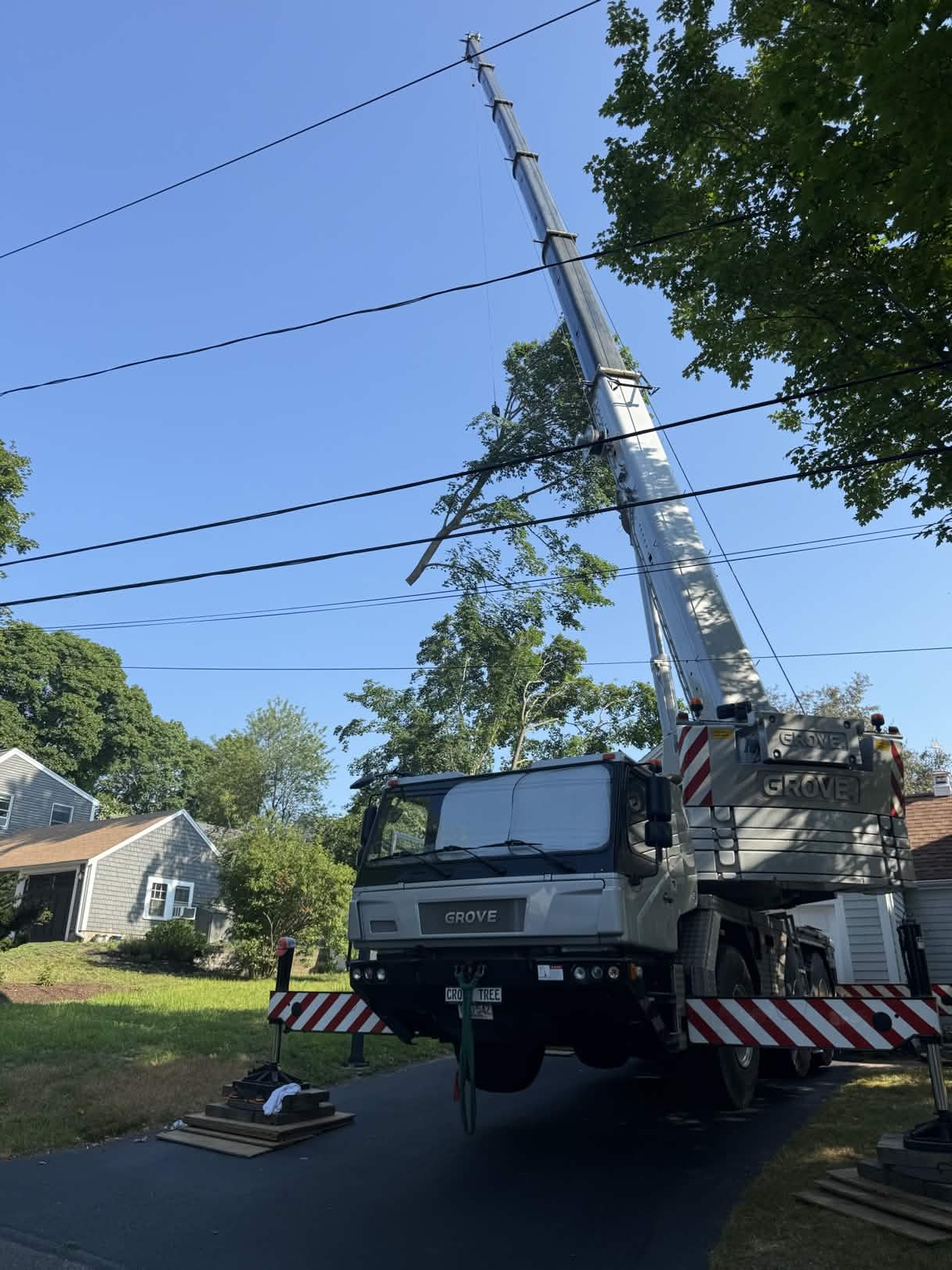
Step 3: Installation Prep (safety first). Our protocols include traffic control for Stone Street Area roads and spotters for Plimptonville power lines. Bucket trucks access Fisher Street Area lots; climbing spikes spare Common Street Area lawns.
Step 4: Air Terminal Placement. Arborists ascend via ropes, securing terminals with clamps—no nails into live wood. For American beech in South Walpole, we use flexible cabling to handle wind sway.
Step 5: Conductor Installation. 3/0 bare copper cable wraps trunks in 180-degree loops every 6-8 inches, per ANSI specs. In green ash remnants, we insulate at wounds. Silver maples get surge protectors at forks.
Step 6: Grounding and Testing. Drive 8-foot copper rods (2 per system) and connect via exothermic welds—resistant to Walpole's corrosive humidity. Megohmmeter tests verify <25 ohms resistance; we adjust for high-resistivity river soils with counterpoise mats.
Step 7: Cleanup and Documentation. We remove debris, apply wound dressings, and provide as-built drawings for insurance. Annual inspections check cable tension (via torque wrench) and ground bonds.
Equipment specifics: Klein climbing gear, Greenlee welders, Fluke multimeters. For dawn redwoods in Bird Park zones, low-impact drills secure hardware. Process takes 4-8 hours per tree, minimizing disruption.
Walpole adaptations: Floodplain sycamores need elevated grounds; emerald ash borer ash trees get extra terminals. Our copper outperforms aluminum in Norfolk's wet climate, lasting 50+ years.
Homeowner tips: Maintain 10-foot clearances from structures. Post-install, monitor for galvanic corrosion in brackish Neponset soils—our inspections catch it. Systems reduce strike damage 95%, per IEEE data.
We've installed 50+ systems in Walpole since 2015, from white oak canopies in Neponset Valley to white pine sentinels in Walpole Center. Safety certifications ensure zero incidents. Schedule via 508-369-5009—protect your trees with precision.
Common Lightning Protection Projects in Walpole Neighborhoods
In Walpole Center, we protect red oaks and sugar maples shading historic homes—crown reductions precede multi-terminal installs for 80-foot specimens near the common. Strikes here threaten slate roofs; our systems channel surges away.
East Walpole's mill legacy means silver maples along the Neponset demand river-specialized grounding. A 2023 project on a 95-foot sycamore used four air terminals and counterpoise for flood-prone soils, saving a family estate from repeat strikes.
South Walpole estates feature white pines bordering fields— we install for wind-exposed crowns, adding interceptors at 60-foot heights. Homeowners report no damage during 2024 storms.
Plimptonville's American beeches, with multi-stems, get forked-conductor routing. Preservation pruning integrates seamlessly, maintaining Olmsted influences from nearby Bird Park.
Stone Street Area construction sites isolate tulip trees; we protect pre-clearing, using temporary grounds for stability during builds.
Neponset Valley riverfronts see most calls: floodplain silver maples overhanging homes receive overhanging limb prunes plus full cabling. Emerald ash borer victims here get terminal-heavy systems.
Fisher Street Area lots with dawn redwoods need precise cable paths around ornamentals—our drones map optimal routes.
Common Street Area shade trees like white oaks face neighborhood density risks; compact installs fit tight yards.
Bird Park collaborations preserve Olmsted plantings—green ash successors and sycamores get annual-checked systems.
These projects average 2-4 trees per property, blending with lot clearing or EAB removals. Your neighborhood's mature trees deserve this—call 508-369-5009.
Lightning Protection Costs in Walpole, MA
Lightning protection costs in Walpole, MA, range $2,500-$8,000 per tree, based on height, species, and site factors. A 60-foot red oak in Walpole Center costs $3,200: assessment ($free), three air terminals, 100 feet copper cable, two grounds.
Silver maples in Neponset Valley add $800 for counterpoise in wet soils—total $4,500. Towering sycamores in East Walpole hit $6,500 with five terminals and flood-resistant welds.
Factors driving price:
- **Tree Size/Species**: White pines (straight bole) $2,800; multi-trunk beeches $5,200.
- **Site Access**: Bucket truck in Plimptonville $500 extra; climbing in dense Fisher Street $300.
- **Soil Resistivity**: Neponset sands need extra rods (+$400).
- **Add-Ons**: Annual inspection $250/year; surge protectors $600.
Value proposition: Unprotected strike removal costs $5,000-$20,000 (e.g., 2023 South Walpole oak). Systems last 50 years, ROI in 2-5 years via insurance savings (10-15% discounts). Preserve heritage value—Olmsted beeches at Bird Park boost appraisals 5-10%.
Southeast Arborist quotes transparently—no surprises. Multi-tree discounts (20% off second) suit Common Street Area properties. Financing via local banks; tax deductions for conservation easements.
Compared to Norwood/Medfield, Walpole's river adds 10-15%—but our efficiency keeps it competitive. Invest now: protect your sugar maple for generations. Get your quote at 508-369-5009.
When to Schedule Lightning Protection in Walpole
Schedule lightning protection in Walpole during spring (April-May) or fall (September-October)—mild weather aids installs, avoiding summer storms (peak June-August with 70% strikes). Pre-Nor'easter fall timing protects white pines before winds.
Urgency signs: Vertical bark splits on red oaks, dead tops in silver maples, or ozone scent post-thunderstorm. Floodplain sycamores leaning after Neponset surges need immediate assessment—stability drops 30% post-strike.
Post-EAB ash decline: Schedule if green ash shows >20% canopy loss. Bird Park-style trees: Align with preservation prunes in late winter.
Waitlists peak pre-July 4th; book early. Our ISA Arborists fit inspections anytime. Act now—508-369-5009.
Frequently Asked Questions About Lightning Protection in Walpole
**What is lightning protection for trees in Walpole, MA?** ANSI A300 Part 4 systems with copper cables, air terminals, and grounds that intercept and divert strikes from your sycamores or oaks, preventing splits in Neponset Valley floodplains.
**Does it hurt my tree?** No—our non-invasive clamps and routes preserve cambium on silver maples or beeches. ISA Certified methods ensure health.
**How effective is it against Walpole thunderstorms?** 95% effective per IEEE; protects heritage white pines in East Walpole from 30,000-amp bolts.
**How often inspect?** Annually—check cable tension, grounds in Norfolk soils. $250/service.
**Will insurance cover it?** Yes, many carriers discount 10-15% post-install; provide our docs for Bird Park-area claims.
**Can you protect multiple trees on my Stone Street lot?** Yes, shared grounds save 20%; ideal for red oak clusters.
**What about emerald ash borer trees?** We protect declining green ash pre-removal, stabilizing for safety.
**Differences from home lightning rods?** Tree-specific: flexible copper for sway, tailored to Walpole species like tulip trees.
Call 508-369-5009 for answers.
Lightning Protection Throughout Walpole
Southeast Arborist serves all Walpole neighborhoods: Walpole Center shade trees, East Walpole river sycamores, South Walpole pines, Plimptonville beeches, Stone Street builds, Neponset Valley maples, Fisher Street ornamentals, Common Street oaks. Extend to Norwood, Medfield, Foxborough, Sharon, Dedham.
From Plymouth/Cohasset base, we reach Walpole fast. Protect your trees—call 508-369-5009 for ISA Certified service.